Every second, nearly 54 people become the victim of a cyber attack. Moreover, in the enterprise space, the focus has shifted from simple breaches to high-impact supply chain compromises and cloud misconfigurations. Almost 6 out of 10 businesses suffered in 2025 from ransomware attacks, often targeting critical infrastructure.
Today, when attackers are rapidly evolving—utilizing AI-driven fuzzing and zero-day exploits—we also need someone who can stop them, right? Here come the ethical hackers to fulfill this crucial role. Ethical hackers do not launch attacks but protect companies from cyber criminals by adopting an adversarial mindset.
In this blog, we are going to understand what exactly ethical hacking is, who ethical hackers are, their roles and responsibilities, and most importantly, how to become an ethical hacker.
The Bureau of Labor Statistics (BLS) projects a significant job growth of 29% for Information Security Analysts (the formal equivalent of Ethical Hackers) between 2024 and 2034 — much faster than the average for all occupations. The median annual wage for this profession was $124,910 as of May 2024.
So, if you want to become one or explore this world, this is your complete guide for how to become an ethical hacker.
It is the systematic process of legally breaking into computers, networks, and applications to test an organization's defenses. It's not just about finding flaws; it's about Adversary Emulation—simulating real-world attacker tactics, techniques, and procedures (TTPs) to identify security vulnerabilities before malicious hackers can find and exploit them. For a better understanding, consider the typical image of a hacker- now just flip it.
Ethical hackers are those professionals who hack the system legally, only because they want to test their security and to make them more secure. They are also known as White Hat Hackers, because their work is for protection not for destruction. In the modern enterprise, this often includes Cloud Penetration Testing (AWS, Azure, GCP) and integration into the DevSecOps pipeline.
Explore igmGuru's Cybersecurity course to advance your career for a better growth.
Basically, they are known as cybersecurity experts, often specializing as Penetration Testers, Red Teamers, or Application Security Engineers. These people are hired by companies, government agencies, and law enforcement bodies to protect their digital assets. Their work is to test systems and networks, simulating dummy attacks, and reporting about the flaws before they can be exploited. Their mandate is to secure everything from simple websites to complex containerized microservices and Zero Trust architectures.
Ethical hackers also use the same tools that are used by real hackers but with explicit permission (a "Letter of Authorization"). They do it for ethical purposes and to make the system more secure. Their daily work includes Advanced Penetration Testing, Cloud Security Audits, Web Application & API testing (focusing on OWASP Top 10), vulnerability assessments, creating detailed technical reports, and providing prioritized security suggestions to engineering teams.
Cyber threats are increasing day by day, shifting to sophisticated attacks like supply chain compromises and exploiting misconfigured cloud services. When we talk in terms of ransomware attacks or any social media data leak, nobody is safe. That's why companies are today more proactive and they hire ethical hackers to put a step forward from the cyber criminals, moving from reactive defense to proactive threat hunting and adversarial simulation.
Learning and knowing about it is not enough. For becoming an efficient one, you must have some core qualities. They are:
It requires having a strong knowledge of Cloud Infrastructure, modern programming paradigms (Go, Rust), networking (including IPv6 and SDN), and enterprise-level defenses (EDR, WAFs). A person is called a good ethical hacker when they have a proper understanding of a system's internal structure and how modern applications are deployed (e.g., via Docker and Kubernetes).
Sometimes, even a small glitch, like a single API endpoint misconfiguration or a forgotten S3 bucket permission, can become a huge security vulnerability. Therefore, ethical hackers must know how to observe minute details.
Cybersecurity sometimes is equal to constant problem-solving. For instance, what is the loophole? What can be the solution? This type of thought process is essential, especially when reverse engineering malware or chain-exploiting multiple low-severity vulnerabilities.
Technology is evolving rapidly these days. An efficient hacker needs to be updated about the latest attack techniques (e.g., exploiting CI/CD pipelines), new open-source tools, and emerging vulnerabilities like those in serverless functions.
Sometimes finding a weak point takes hours; for that, patience and a naturally curious mind is very important. This is critical for Red Teaming operations that often last weeks or months.
As their name, ethical hacker, suggests, integrity and honesty are their prime responsibility. They also need to be trustworthy, as they can access critical information while performing their practices. They must adhere strictly to the Scope of Work defined in the contract.
Related Article- Top Cybersecurity Interview Questions and Answers
Their role is not only hacking the system; it is much more than that. Their role acts as a very strong pillar of every organization's cyber defense. Let's understand their roles and responsibilities.
Ethical hacking is a skill-driven profession that requires a combination of technical knowledge, practical experience, and analytical thinking. While certifications and degrees can help, employers primarily look for professionals who can identify vulnerabilities, understand attack techniques, and recommend effective security solutions. Developing the following skills can help you build a successful career in ethical hacking.
Networking is the foundation of ethical hacking. You should understand TCP/IP, DNS, HTTP, HTTPS, firewalls, routers, switches, VPNs, and network protocols. A strong understanding of how data moves across networks helps ethical hackers identify vulnerabilities and attack vectors.
Linux is one of the most widely used operating systems in cybersecurity. Ethical hackers should be comfortable with Linux commands, file permissions, shell scripting, process management, and networking tools. Many security tools and penetration testing environments are built on Linux.
Programming knowledge helps ethical hackers automate tasks, create custom tools, and understand application vulnerabilities. Python is the most recommended language for beginners, while JavaScript, SQL, Bash, Go, and Rust are also valuable depending on the specialization.
Modern businesses rely heavily on web applications and APIs. Ethical hackers should understand common vulnerabilities such as SQL Injection, Cross-Site Scripting (XSS), Broken Authentication, Cross-Site Request Forgery (CSRF), and Server-Side Request Forgery (SSRF).
Many organizations use cloud platforms such as AWS, Microsoft Azure, and Google Cloud Platform. Understanding cloud networking, IAM policies, storage security, and cloud misconfigurations is becoming an essential skill for ethical hackers.
Ethical hackers should know how to identify vulnerabilities, assess their severity, and validate their impact through penetration testing. This includes using industry-standard tools and following structured testing methodologies.
Cybersecurity challenges often require creative thinking and problem-solving. Ethical hackers must analyze systems, investigate unusual behavior, and determine the root cause of security weaknesses.
Finding vulnerabilities is only part of the job. Ethical hackers must clearly communicate risks, document findings, and explain remediation steps to technical and non-technical stakeholders through professional security reports.
Ethical Hacking is a skill-based field, in which a degree is not mandatory. While a Computer Science or Cybersecurity degree is beneficial for large corporations (like Infosys, TCS, and Deloitte), your demonstrated practical skill and certifications are often more critical for landing the job. Focus on building a strong GitHub portfolio.
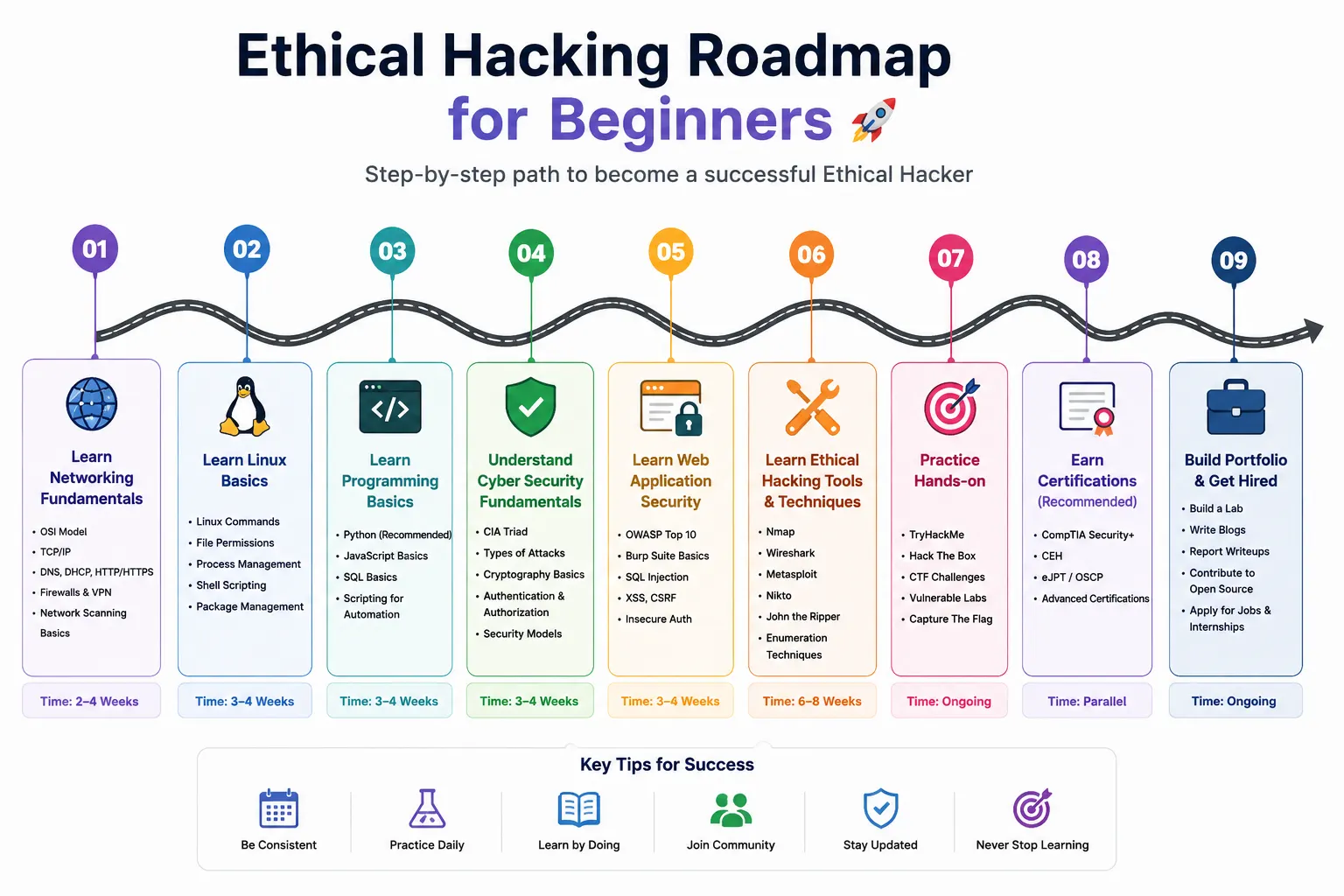
Now the questions that arise. From where to start and in what order you need to learn. In this section, you will get a step-by-step guide on how to become an ethical hacker. Let's begin:
A clear, advanced base is very important. In this step you should learn about the following things:
Programming skills are essential for automating tasks, developing custom exploitation tools, and understanding the logic behind an attack. Important languages are:
You can use platforms like Hack The Box (HTB) Academy or LeetCode for practicing.
Linux is the most important operating system for ethical hacking. The most accessible setup is Kali Linux in a Virtual Machine (VMware or VirtualBox). This offers a zero-cost, quick setup environment. You should learn the following things:
You can also try games like OverTheWire: Bandit. It is designed for Linux beginners and helps improve command-line skills.
Understanding system security is a prerequisite for identifying vulnerabilities. Focus on the nature of modern, enterprise-level attacks:
You cannot become an ethical hacker by learning theory alone. Practical, hands-on experience is mandatory. Focus on these accessible platforms and tools:
Certifications are crucial for validating your skills and opening doors in the corporate and government sectors. Focus on these high-value certifications:
These certifications are challenging, but the preparation process itself significantly boosts your knowledge. You can check this list of the best ethical hacking certifications.
Cybersecurity is evolving continuously. Every week, new tools, new threats and new exploits are available; therefore, you need to be updated.
Many individuals begin their careers in general entry-level cybersecurity positions (e.g., Security Operations Center - SOC Analyst). Starting out in these roles gives you a solid foundation in enterprise operations. Use your Bug Bounty or CTF experience to highlight practical skills on your resume. Once you gain hands-on experience, you'll also meet other professionals who can share insights, offer guidance, and support your career growth over time toward specialization (e.g., as a Red Teamer or Cloud Security Architect).
Related Article- Cyber Security Tutorial For Beginners
Ethical hackers use a wide range of tools to identify vulnerabilities, analyze networks, and test security controls. Learning these tools can significantly improve your practical skills and prepare you for real-world penetration testing projects.
| Tool | Primary Purpose |
| Nmap | Network Discovery and Port Scanning |
| Wireshark | Network Traffic Analysis |
| Burp Suite | Web Application Security Testing |
| Metasploit | Penetration Testing and Exploitation |
| Kali Linux | Security Testing Operating System |
| John the Ripper | Password Auditing and Recovery |
| Nikto | Web Server Vulnerability Scanning |
| OWASP ZAP | Web Application Vulnerability Assessment |
Beginners should focus on mastering a few tools at a time rather than learning dozens simultaneously. Understanding how and when to use these tools is more important than simply memorizing their commands.
The field of Ethical Hacking is vast. As your skills and experience increase, your roles also get upgraded. Some popular career options which you can pursue with the details like experience needed and expected salary are given below.
They test a company's systems, applications, and networks to find security loopholes, like the real-world hackers do. This role now heavily includes API and Cloud Pen Testing.
They focus on securing the Software Development Life Cycle (SDLC), working with developers to fix vulnerabilities in the code before deployment (DevSecOps). They champion secure coding practices.
This is an advanced role where professionals simulate a highly motivated, skilled adversary, testing the full effectiveness of the security team (Blue Team) and controls over a prolonged period.
They design and implement security controls and governance within cloud environments (AWS, Azure, GCP). This is a strategic role requiring deep knowledge of cloud services and networking.
They do the analysis for malware, understand its behavior, and give inputs to the antivirus team or perform threat hunting. Requires specialized knowledge of assembly language and operating system internals.
The salary depends on the company, location, certification, and your practical skills. With that, Freelancing and Remote work are easily available for ethical hackers.
Read Also- 10 Top Career Opportunities in Cyber Security
Ethical hacking offers excellent earning potential due to the growing demand for cybersecurity professionals. Salaries vary based on experience, certifications, technical expertise, location, and industry. Professionals with practical penetration testing experience and advanced certifications often command significantly higher salaries.
| Experience Level | Average Salary in India | Average Salary in the USA |
| Fresher (0-2 Years) | INR 4 LPA - INR 8 LPA | $70,000 - $90,000 per annum |
| Mid-Level (2-5 Years) | INR 8 LPA - INR 15 LPA | $90,000 - $130,000 per annum |
| Senior-Level (5-10 Years) | INR 15 LPA - INR 30 LPA | $130,000 - $180,000 per annum |
| Expert-Level (10+ Years) | INR 30 LPA+ | $180,000+ per annum |
Professionals who specialize in areas such as Red Teaming, Cloud Security, Application Security, and Security Architecture often earn higher salaries due to the advanced skills required in these roles.
In today's digital era, where the risk of a breach or a cyber attack evolves every second, ethical hackers have become the essential, proactive protectors of the enterprise. They identify system flaws—from simple API vulnerabilities to complex cloud misconfigurations—to make environments secure. Protecting from the attack is their main job, often achieved through adversarial emulation and deep technical auditing. This is not just a job, but a responsibility where they need to stop the hackers in a legal and ethical way.
If you like to work with new technological tools, to face challenges, solve them, and have a passion for constantly learning the latest attack vectors, then Ethical Hacking is definitely made for you. And just remember, "Real hackers break codes. Ethical Hackers master the code to protect it."
After 12th, you can start by pursuing a course like BCA, B.Sc. in Computer Science, or a Diploma in Cyber Security. Crucially, alongside your studies, immerse yourself in practical skills: learn networking, master Linux, and start practicing on free platforms like TryHackMe and PortSwigger Web Security Academy. Your practical portfolio and certifications will be your strongest assets.
You can become an ethical hacker without a degree by showcasing highly specialized skills. Start with networking and Linux, then move to hacking labs and Bug Bounty platforms. Earn practical certifications (like eJPT and OSCP) to prove your skills. Create a portfolio of your work (e.g., published CTF write-ups, custom tools) on GitHub or LinkedIn to demonstrate competence directly to employers.
For a beginner, the best starting certifications are the eJPT (eLearnSecurity Junior Penetration Tester) for a practical entry point, or the CompTIA Security+ for a strong foundational knowledge in enterprise security. The CEH (Certified Ethical Hacker) is also widely recognized and covers a broad range of basic to intermediate-level tools and techniques.
Yes, absolutely. Success in ethical hacking is driven by technical aptitude, curiosity, and persistence, not academic background. You just need to build strong computer fundamentals, learn networking and programming (start with Python), and dedicate time to practical hacking labs. Many successful ethical hackers come from non-technical backgrounds who committed to the technical learning path.
AI can automate some hacking tasks but human skills and thinking are still important, so hackers will not be fully replaced.