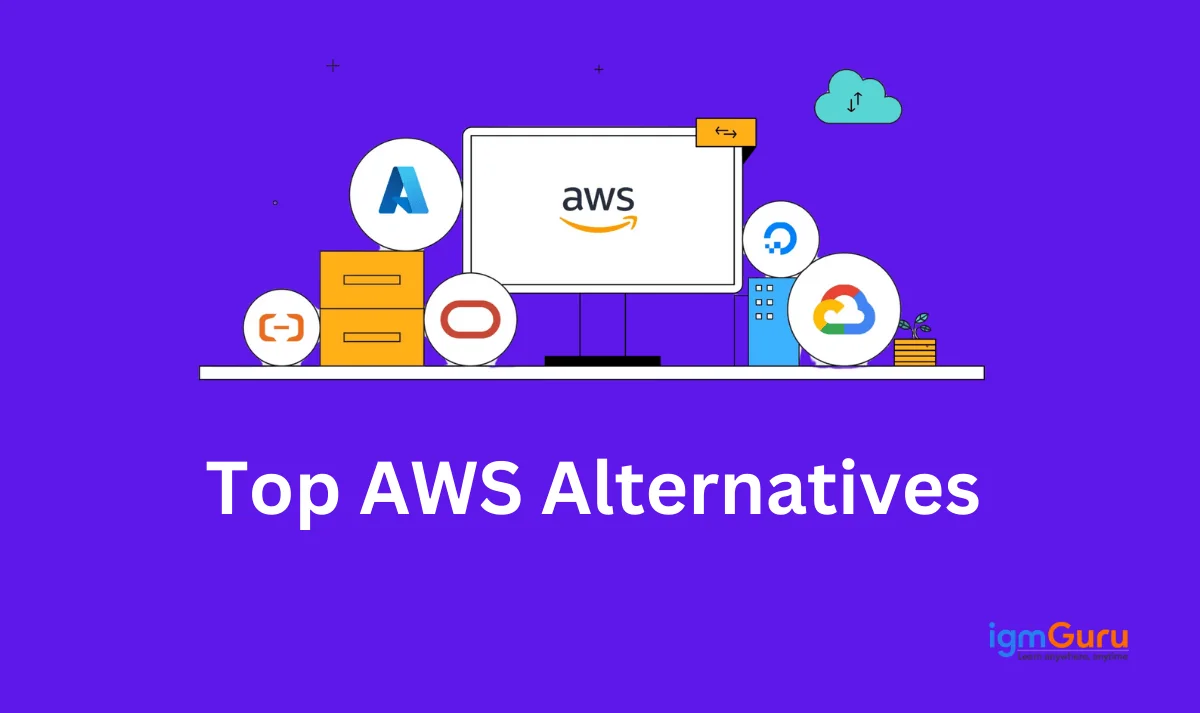
Amazon Web Services (or AWS) is a big name in cloud services with over 200 services and thousands of virtual machine configurations. It helps businesses of different types meet their needs with different AWS solutions. Many Small and Medium Enterprises, however, do not want to get into the complexity or the multi-tiered product ranges it provides. The reason may be the complexity or high pricing. Thus, the need to look for plausible AWS alternatives arises.
It ranks number one as a cloud service provider having the largest market share. Having said that, a lot of its users get frustrated because of certain overbearing characteristics. It is thus wise to check out some other options to find the best fit for a company and the comparative grounds between them.
AWS is a leading, in fact, the largest, cloud computing provider globally today, with thousands of solutions. Each of these solutions is designed to meet the distinct needs of different business types. It is at the top because it offers on-premises, cloud, edge, and serverless computing services. Computing power, storage, and databases are among its most chosen services.
Amazon Web Services started providing IT services through the cloud in 2006, which is now known as cloud computing. One big advantage of cloud computing is that businesses save money by paying for what they use instead of spending a lot upfront on hardware. Companies don't have to buy servers and equipment ahead of time with the cloud.
Explore igmGuru's AWS Solution Architect Training program to accelerate your career growth.
AWS is a known cloud provider, but not all its services can meet the needs of businesses or customers. It's very much similar to going out to shop and picking something that works best for what one is looking for. There are many options in the cloud market that may give more perks. It's always good to look out for more options.
The tech support from AWS is basic and difficult to get through. Businesses go for personal and responsive support when something goes wrong. It's not surprising why an organization would look for another name to get sufficient support.
AWS is costly and might even have hidden fees for complicated setups. Businesses prefer transparent and reasonable costs instead of surprises. Selecting a different option might cut IT costs.
Alternatives can be a better choice for a flexible and satisfactory performance. Many also have good billing options as many ask users to only pay for what they use. Users can cut down on wasting money on cloud services by going for an alternative. There are also many alternatives for many tasks, like web hosting and gaming.
AWS has countless services, but that does not make it a better option. Simple things are sometimes better than complicated ones. Other platforms aim to give simple services by focusing on the creation of easy designs and dashboards for users. This is the way to have a simple cloud setup so that teams can spend time on other tasks.
Related Article: How To Become An AWS Certified Developer Associate
AWS has a number of choices, giving different units and pricing plans for different needs. Way too many options can sometimes be a little too much to handle and understand. Some options giving different advantages over AWS features can prove to be much better picks. Here are the best AWS alternatives for addressing different business needs.
Microsoft Azure has similar services that AWS gives yet may be a better alternative. It gives reliable customer support, and its simple interface is actually great for users. Azure is more straightforward when it comes to pricing because of its pay-as-you-use mode. Users only pay for the resources they use, if and when they do.
Discounts are given to users who commit for a longer time. It also works well with other Microsoft products like Office 365. It has options of Platform as a Service (PaaS), Software as a Service (SaaS) and Infrastructure as a Service (IaaS). One can create or configure virtual machines, network security groups, database services, resource groups, file storage, and Active Directory easily and quickly.
Here are some impressive aspects of this platform-
Google Cloud Platform has a lot of features and services that stand out because of its fixed gaze on machine learning and artificial intelligence. Its pricing is clear-cut and users get great discounts for longer use plans. It boasts multiple high-performance computing capabilities with advanced analytics tools. It delivers results at a swift pace with near to none delay.
It is also known for easy connection with Firebase database, Google Analytics, and Google Authentication tools. This swift integration simplified handling of key platform management features. Their list of product offerings is quite wide. It encompasses databases, VMs, managed Kubernetes, data processing, App Engine (PaaS solution), cloud functions (FaaS solutions), object storage, etc.
Some features of GCP are -
IBM Cloud is a comparatively newer addition, with its launch in 2014. It has many services and takes security quite seriously. Users can also connect it with other IBM products like Watsonx. The pricing is competitive and one can save money with a long-term plan.
It might not be a great option for fancy analytics or machine learning tools though. It works best for companies that have security at their centre and need to link up with other IBM products. Its market share is much smaller than other hyperscalers. It is still a preferred one for organizations in specialized industries having strict compliance regulations.
It brings along many advantages and features, including:
Oracle Cloud has 100+ services across cloud infrastructure, software as a service and platforms as a service. It has good security, solid customer support, good performance and is easily scalable. Oracle is in line with AWS when it comes to its opaque pricing, leading to unclear billing.
If one needs advanced analytics or machine learning, this platform might not be the best fit. Businesses should go for it if they need different cloud services with strong security, are focused on database services or have specific applications in ERP and CRM. Its infrastructure is also not easily integratable with other cloud tools.
Here are some of their services
Related Article - AWS Interview Questions and Answers
DigitalOcean is one of the most popular AWS alternatives for startups, developers, and small businesses. Unlike AWS, it focuses on simplicity instead of offering hundreds of services, making it much easier for beginners to manage cloud infrastructure. Its transparent pricing, quick deployment, and user-friendly dashboard make it an excellent choice for hosting websites, applications, and development environments without the complexity often associated with enterprise cloud platforms.
DigitalOcean offers a growing portfolio of cloud products, including virtual machines, managed Kubernetes, databases, object storage, and application hosting. Businesses looking for predictable monthly costs and straightforward cloud management often prefer DigitalOcean over AWS for small to medium-sized projects.
Some notable features include:
Alibaba Cloud is the largest cloud service provider in China and one of the leading cloud platforms worldwide. It provides a comprehensive collection of cloud computing, networking, storage, security, and AI services similar to AWS. Businesses expanding into Asia often choose Alibaba Cloud because of its extensive regional presence and competitive pricing.
The platform supports organizations of every size, from startups to large enterprises. It also provides strong disaster recovery capabilities, high availability, and enterprise-grade security while maintaining compatibility with modern development frameworks and container technologies.
Some notable features include:
Linode, now part of Akamai Cloud, is a reliable cloud infrastructure platform known for its affordable pricing and straightforward cloud services. It is designed for developers and businesses that need powerful virtual servers without managing the complexity and pricing model of AWS.
The platform provides high-performance cloud computing with transparent billing, making budgeting much easier for growing businesses. Its global data centers and developer-focused ecosystem make it a practical option for hosting applications, websites, APIs, and databases.
Some notable features include:
Vultr is a cloud computing provider that focuses on high-performance infrastructure with easy deployment and competitive pricing. It offers cloud compute, dedicated servers, GPUs, Kubernetes, storage, and networking services from multiple locations around the world. Many developers choose Vultr because of its speed, flexibility, and simple management interface.
The platform supports a wide variety of workloads, including web applications, game servers, AI workloads, and enterprise applications. Businesses can deploy virtual machines within minutes while paying only for the resources they actually use.
Some notable features include:
Cloudflare has evolved from being a content delivery network into a complete cloud platform offering serverless computing, edge networking, Zero Trust security, storage, and developer services. Businesses building modern web applications often use Cloudflare to improve security, reduce latency, and deliver applications closer to users worldwide.
Although it does not replace every AWS service, Cloudflare serves as an excellent alternative for edge computing, networking, APIs, serverless applications, and website performance optimization. It is especially valuable for businesses looking to reduce infrastructure complexity while improving application performance.
Some notable features include:
Hetzner Cloud has become one of the fastest-growing cloud infrastructure providers because of its exceptional price-to-performance ratio. It is particularly popular among developers, startups, and European businesses looking for reliable cloud servers without paying premium enterprise pricing.
The platform delivers powerful cloud infrastructure with simple pricing, high-performance SSD storage, and excellent network connectivity. Businesses seeking affordable virtual servers and scalable infrastructure often consider Hetzner Cloud one of the strongest alternatives to AWS.
Some notable features include:
Microsoft Azure is a big player with a wide range of cloud tools and is well-known with businesses. Google Cloud Platform, backed by Google, is also getting popular for its advanced tech. IBM Cloud focuses on hybrid setups and strong security. There are dozens of other budding competitors in the market and a company might not always want to go with the top one.
Here are a few comparison bases of AWS with other cloud services. Every organization should thoroughly go through each of these aspects, and additional ones too, before finalizing the one.
The pricing form is important to understand the different models and their possible hidden costs while comparing these alternatives. Pay as you go and subscription based are two models for price structure. Users only pay for the services they use in pay as you go and the latter gives discounts to long-term users.
Trustworthy services are a big aspect when picking a name. Look for things like disaster recovery, data backups and data center locations. GCP has a handy feature called Live Migration, which lets VM instances keep running smoothly during planned maintenance, with no downtime.
AWS is fast and easy to scale. When choosing another platform, check how well it performs and how easily you can increase your resources. Here are some important things to consider:
i) Uptime guarantees - Make sure the platform promises good uptime for reduced downtime.
ii) Server response time - The speed with which servers respond to requests.
iii) Auto-scaling options - Automatic adjustment to resources when needed.
iv) Scaling options - Up or down scaling in both vertical and horizontal directions, according to the business needs
The alternative you pick should ensure a high level of security and boast impeccable compliance. There are three main factors here, data encryption, user access controls and compliance certifications.
Related Article - Cloud Computing Tutorial
| Provider | Key Services | Pricing Model | Strengths | Weaknesses | Best For |
| AWS | Compute, storage, databases, AI | Pay-as-you-go, reserved | Extensive services, global reach | Complex, costly | Large enterprises |
| Microsoft Azure | Compute, storage, PaaS, SaaS | Pay-as-you-go, reserved | Microsoft integration, hybrid support | Learning curve | Enterprises using Microsoft stack |
| Google Cloud | AI/ML, BigQuery, Kubernetes | Pay-as-you-go, discounts | AI leadership, cost-effective | Fewer regions than AWS/Azure | Startups, AI-driven projects |
| IBM Cloud | Virtual servers, Watsonx, databases | Pay-as-you-go, discounts | Strong security, compliance | Limited analytics capabilities | Regulated industries |
| Oracle Cloud | Compute, databases, ERP integration | Pay-as-you-go, reserved | Strong database services, security | Opaque pricing, limited integration | Oracle-centric businesses |
| DigitalOcean | Droplets, Kubernetes, Databases | Simple monthly pricing | Easy to use, affordable | Limited enterprise services | Startups and SMBs |
| Alibaba Cloud | Compute, Storage, AI, Databases | Pay-as-you-go | Strong Asia presence | Smaller global ecosystem | Businesses targeting Asia |
| Linode (Akamai) | VMs, Kubernetes, Storage | Predictable pricing | Simple infrastructure | Fewer managed services | Developers and SMEs |
| Vultr | Cloud Compute, GPU, Kubernetes | Hourly and monthly | Fast deployment | Smaller service catalog | Developers and gaming workloads |
| Cloudflare | Workers, R2, CDN, Security | Usage-based | Excellent edge network | Not a full hyperscale cloud | Web apps and APIs |
| Hetzner Cloud | Cloud Servers, Storage | Low-cost monthly pricing | Excellent price-performance | Limited global regions | European businesses and startups |
Choosing the right cloud service provider is a big deal for any business. It can really affect how things run and grow. AWS is a top choice because it offers a lot of services and has a strong setup. But it's not the only one with good services out there. Microsoft Azure, GCP, IBM Cloud and Oracle are a few others in the mix.
To pick the best one, companies should look at important things like features, pricing, performance, customer support, and success stories. This way, they can find what fits their needs and goals, which doesn't necessarily have to be the one at the top.
Microsoft Azure is a top competitor to AWS and has similar services like computing, storage, databases and networking.
Alibaba Cloud is similar to AWS in terms of services but as it's part of the Alibaba Group, it is more focused on customers in Asia.
Google Cloud provides a scalable and flexible infrastructure that allows users to access computing resources on demand, without the need for upfront investments in hardware.
Course Schedule
| Course Name | Batch Type | Details |
| Cloud Computing Certification Courses | Every Weekday | View Details |
| Cloud Computing Certification Courses | Every Weekend | View Details |