Writing simple if-else statements repeatedly can make Python code longer and harder to read. The ternary operator in Python is a one-line conditional expression used to return one value if a condition is true and another value if the condition is false. It is also called a conditional expression in Python. In this guide, you’ll learn its syntax, examples, use cases, advantages, and common mistakes with beginner-friendly explanations.
A ternary operator is a one-line conditional expression that evaluates a condition and returns one of two values. It depends on whether the condition is true or false. Python allows the same logic to be written in a single line rather than writing a full if-else statement across multiple lines.
|
This statement checks whether age is greater than or equal to 18. If the condition is true, then the value "Adult" will be assigned. Otherwise, "Minor" will be assigned. It is not like languages such as C, C++, or Java. Does Python not use the? : syntax. In place of that, it follows a more readable structure resembling natural language.

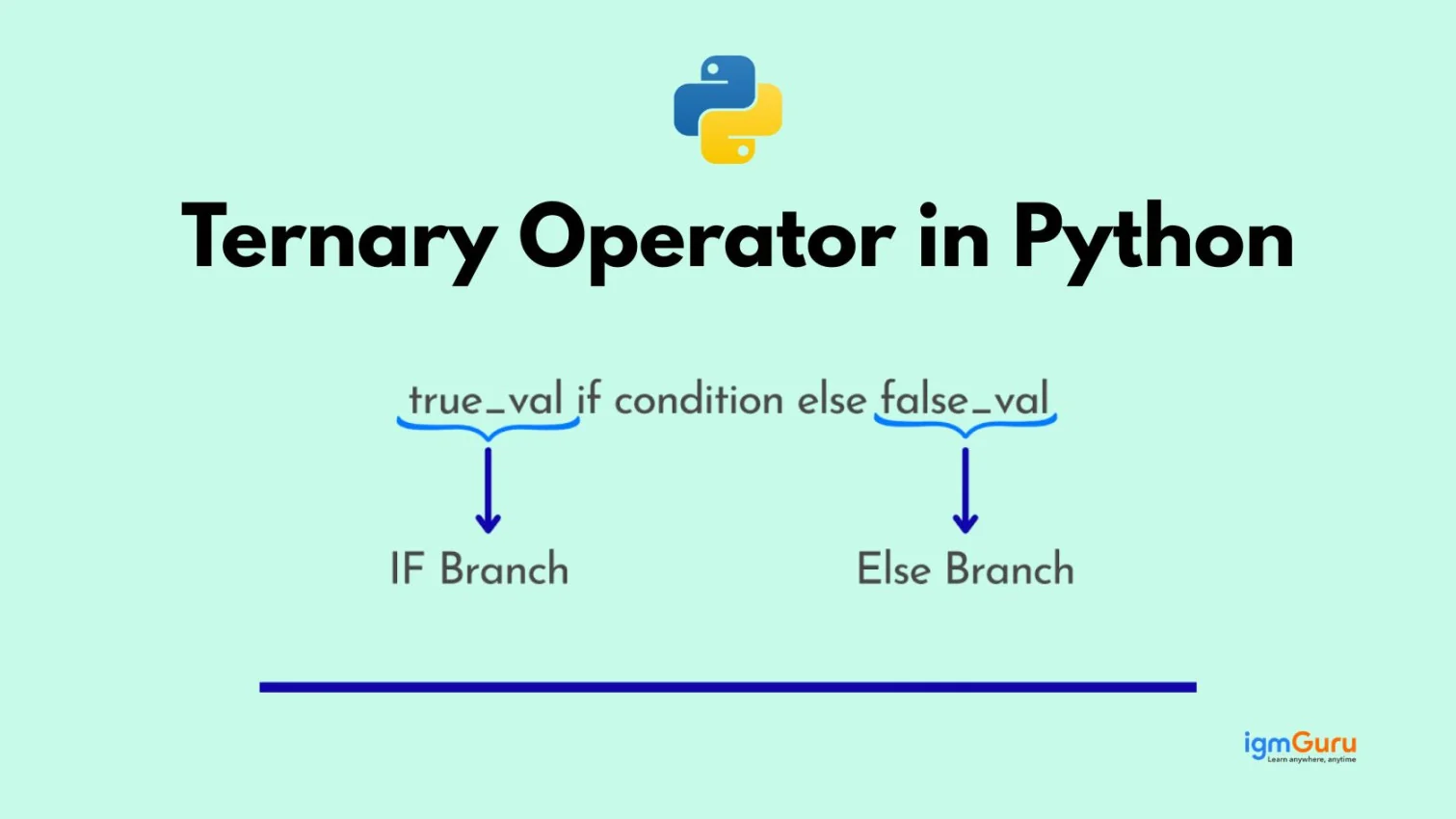
The term “ternary” means “composed of three parts.” The ternary operator in Python has exactly three components. Due to this, it is called a ternary operator.
1. A condition to evaluate
2. A value returned if the condition is true
3. A value returned if the condition is false
For example:
|
Let’s understand where are these three components:
The general syntax is:
|
This can also be read as:
“Return value_if_true if the condition is true, otherwise return value_if_false.”
The condition is placed in the middle by making the expression more readable and intuitive.
Read Also: Python Tutorial for Beginners
The best way to understand the ternary operator is with the help of clear examples.
|
If the age is 22, then the condition evaluates to true and "Adult" is assigned to status.
If age were 15, then the condition would evaluate to false and “Minor” would be assigned.
|
This expression checks whether the number is divisible by 2. If it gives you the remainder 0, then the number is even. Otherwise, it is odd. Here the number is 7, hence the output will be "Odd".
|
These examples demonstrate how ternary expressions simplify basic decision-making.
Here 35 is less than 40, then the condition evaluates to false and "Fail" is returned.
Let’s understand how ternary operators works step-by-step using this example:
|
The execution process follows some simple steps:
Step 1: Python evaluates the condition marks >= 40.
Step 2: If the condition is true, it selects "Pass".
Step 3: If the condition is false, it selects "Fail".
Step 4: The selected value is assigned to the variable result.
The condition is always evaluated first. Now, based on the result only one of the two values is returned. This evaluation mechanism ensures efficiency and clarity.
The ternary operator and the traditional if-else statement both perform conditional evaluation. The difference is structure and usage.
|
|
Many beginners often ask whether the ternary operator is better than a traditional if-else statement in Python. The answer depends on the situation. Ternary operators are better for simple one-line conditions because they make the code shorter and cleaner. However, for complex logic or multiple statements, traditional if-else blocks are easier to read and maintain.
The ternary operator reduces multiple lines into a single line. Today, sometimes traditional if-else is still preferred when:
Related Article: Python Variables
| Feature | Ternary Operator | Traditional If-Else |
| Syntax Length | Short and compact | Longer |
| Best For | Simple conditions | Complex logic |
| Readability | High for small conditions | Better for large logic |
| Multiple Statements | Not ideal | Recommended |
The ternary operator offers a lot of advantages. All you need is to use it appropriately.
1. Code Concise: It reduces the number of lines required for simple conditions.
2. Improved Readability for Simple Logic: The expression is easier to understand then the condition is straightforward.
3. Cleaner Variable Assignment: It is particularly useful when assigning values based on a single condition.
4. Common Usage in Functional Programming: It is frequently used in lambda functions and list comprehensions.
Related Article: Best Python Certification to Get
When you understand when to use the ternary operator, you will be able to write maintainable code. Understanding this is very important.
Read Also: What is Keras?
A nested ternary operator includes another ternary expression within the else part. Yes, Python allows multiple conditions in a ternary operator by using nested conditional expressions. This helps developers handle more than one condition in a single line. However, too many nested conditions can reduce readability and make debugging difficult. For instance:
|
It evaluates in a certain order:
Although nested ternary operators are supported in Python, they are not always recommended for complex conditions. Excessive nesting can make the code confusing and difficult to maintain. In most real-world applications, developers prefer traditional if-elif-else statements when the logic becomes too complicated.
Nested ternary expressions are valid but excessive nesting reduces readability. In such cases, a standard if-elif-else structure is recommended and that will be less confusing.
Read Also: Python Interview Questions And Answers
The ternary operator is widely used in practical coding scenarios. Some of the real-world use cases of ternary operators, which you can try for yourself, are:
|
|
|
|
The ternary operator is simple but beginners often make the following mistakes:
1. Forgetting the else Part: The ternary expression must always include an else clause.
2. Incorrect Syntax Order: The correct format is: value_if_true if condition else value_if_false
3. Overusing Nested Ternary: Complex nesting makes code difficult to maintain.
4. Reducing Readability: If the expression is hard to understand at first glance, it should be rewritten using standard if-else.
The ternary operator in Python is one of the most useful tools for writing concise and readable conditional logic. It simplifies simple if-else statements into a single line and is commonly used in modern Python development. By understanding when to use ternary expressions and when to avoid excessive nesting, you can write cleaner, more professional, and maintainable Python code.
Explore Our Trending Articles-
There is no significant performance difference between the ternary operator and a traditional if-else statement. These both are evaluated efficiently by Python. The main advantage of the ternary operator is cleaner and shorter syntax for simple conditions.
Yes, multiple conditions can be used by nesting ternary operators. Sometimes, excessive nesting reduces readability. Therefore, for complex decision-making, it is better to use a traditional if-elif-else structure instead of nested ternary expressions.
Unlike programming languages such as C, C++, and Java, Python does not support the traditional ?: operator syntax. Instead, Python uses a more readable conditional expression format:
value_if_true if condition else value_if_false |
This syntax improves readability and follows Python’s philosophy of writing clean and understandable code.
Yes, ternary operators in Python can return functions. Depending on the condition, Python can select and return one function from multiple options. This is useful when you want dynamic behavior in your program based on certain conditions.
Yes, ternary operators are commonly used inside list comprehensions in Python. They help apply conditional logic while creating a new list in a single line. This makes the code more compact and efficient for simple transformations.
Yes, ternary operators are beginner-friendly when used with simple conditions. They help new Python learners write shorter and cleaner conditional statements without using multiple lines of code. The syntax is also more readable compared to the traditional ?: operator used in some other programming languages.
However, beginners should avoid deeply nested ternary expressions because they can become difficult to understand and maintain. For complex logic, standard if-else statements are usually easier to read.
In Python, the terms conditional expression and ternary operator refer to the same concept. The official Python documentation uses the term conditional expression, while developers commonly call it a ternary operator.
It is called a ternary operator because it works with three parts:
Yes, nested ternary operators can negatively affect readability when overused. Although Python allows nesting ternary expressions, complex nested conditions often make the code harder to understand, debug, and maintain.




Top Advantages And Disadvantages of Artificial Intelligence (AI)
October 16th, 2026
File Handling in Python: Understand Step-by-Step With Examples
October 16th, 2026