Prompt engineering is a jargon that plays an important role in artificial intelligence. It is the skill of making the best use of any AI chatbot. The better your prompt is, the more accurate results you get.
You may have also noticed it in your daily or professional life. For example, two individuals use the same AI chatbot, but only one gets the best result from it. The person who knows better prompt engineering techniques gets the better answers.
Ask yourself, do you have this skill? If not, continue to read this article that covers everything you need to know. You will learn what prompt engineering techniques are, how they work, what the different types are, and how to apply them with real-world examples. You will also find information on tools, career opportunities, common mistakes, and what the future of this field looks like.
Let's Begin!
Read Also: What is ChatGPT Go?
The table below summarizes the key techniques covered in this guide, along with what each technique does and when it is most useful.
| Technique | What It Does | Best For |
| Zero-Shot Prompting | Asks the model to complete a task without providing examples. | Simple questions, summaries, and straightforward tasks. |
| One-Shot Prompting | Provides one example to show the expected pattern, format, or style. | Structured outputs and specific formatting. |
| Few-Shot Prompting | Provides multiple examples to demonstrate the desired output. | Classification, consistent formatting, and style-specific tasks. |
| Chain of Thought (CoT) | Guides the model through a problem step by step. | Math, logic, analysis, and complex reasoning. |
| Self-Consistency Prompting | Generates multiple reasoning paths and selects the most consistent answer. | Complex reasoning, mathematics, and fact verification. |
| Zero-Shot Chain of Thought | Uses a simple reasoning cue without providing examples. | Quick reasoning tasks requiring additional depth. |
| Tree of Thoughts (ToT) | Explores multiple reasoning paths before selecting the best approach. | Strategic planning and complex problem solving. |
| Role Prompting | Assigns the AI a specific role or expert persona. | Technical, professional, educational, and specialized tasks. |
| Prompt Chaining | Breaks a complex task into multiple connected prompts. | Long-form content, research, and multi-stage workflows. |
| Meta Prompting | Uses AI to create or improve the prompt before completing the task. | Complex tasks and improving prompt quality. |
| Generate Knowledge Prompting | Generates relevant background knowledge before answering the main task. | Research, education, and technical explanations. |
| Retrieval-Augmented Generation (RAG) | Retrieves relevant external information to ground the AI's response. | Knowledge bases, customer support, research, and enterprise AI. |
| ReAct Prompting | Combines reasoning with actions such as searches, tool use, or API calls. | AI agents, automation, and tool-using workflows. |
| Reflexion | Reviews previous output, identifies weaknesses, and improves the response. | Writing, coding, analysis, and iterative improvement. |
| Directional Stimulus Prompting | Uses specific cues to steer the model toward a desired perspective or tone. | Persuasive writing, marketing, and perspective-based analysis. |
| Active Prompting | Iteratively refines a prompt based on the output it produces. | New models, new tasks, and general AI use. |
| Multimodal Prompting | Combines inputs such as text and images to provide richer context. | Image analysis, document processing, and visual tasks. |
| Program-Aided Language Models (PALM) | Uses code as part of the model's reasoning process. | Mathematics, data analysis, and algorithmic problem solving. |
Prompt engineering is the process of designing and refining inputs (prompts) to guide AI models like LLMs, so they produce optimal, accurate, and contextually relevant outputs. It acts as the bridge between natural human language and the underlying logic of artificial intelligence.
Think of it like this. An AI model is extremely capable but also extremely literal. It responds exactly to what you give it. If you give it a vague question, it gives you a vague answer. If you give it a well-structured, context-rich prompt, it gives you something far more valuable.
Prompt engineering techniques are the specific strategies and frameworks you use to structure those inputs. They range from simple formatting choices to complex multi-step reasoning frameworks that guide an AI through difficult tasks.
A prompt itself is the text, instruction, or query you send to an AI. It can be a question, a command, a description, or a combination of all three. How you write it determines almost everything about the response you receive.
Here is the core idea. Large language models are trained on massive amounts of text data. They learn to predict the most likely and relevant continuation of any given input. When you write a prompt, you are essentially setting the context that the model uses to generate its response.
The better your context, the better the output. Prompt engineering gives you direct control over that context. You choose the format, role, examples, constraints and level of detail. The model uses all of that to produce a response that is more aligned with what you actually need.
Prompt engineering has become one of the most practical and high-demand skills in the AI space. Here is why it matters.
1. It closes the gap between AI capability and AI usefulness: Most AI models are far more capable than the average user realizes. Prompt engineering helps you access that capability.
2. It saves time: A well-engineered prompt gets you a usable result in one attempt. A poorly written prompt sends you through five rounds of back and forth.
3. It reduces errors and hallucinations: Structured prompts give the model the right context, which reduces the chances of the model generating inaccurate or fabricated information.
4. It is model-agnostic: The core principles of prompt engineering apply whether you are using ChatGPT, Claude, Gemini, Llama, Mistral, or any other LLM. Learning the techniques gives you a transferable skill.
5. It is relevant across industries: Marketing, software development, education, healthcare, legal, finance and customer service all use AI tools. Prompt engineering makes those tools work better in every context.
Before you learn the techniques, you need to understand what makes a prompt work. Every effective prompt contains some combination of these components.
1. Instruction is the core task you want the model to perform. Be specific. "Write a summary" is weaker than "Write a three-sentence summary in simple language for a general audience."
2. Context is the background information the model needs to understand your request. The more relevant context you provide, the better the output.
3. Input data is the specific content you want the model to work with. This could be a paragraph to summarize, a dataset to analyze, or a problem to solve.
4. Output format tells the model how you want the response structured. Do you want a list? A table? A paragraph? JSON? Specifying the format saves significant time.
5. Role or persona tells the model who it should behave as. "You are an experienced data scientist" sets a very different tone and depth of response than no role at all.
6. Tone and style guide the voice of the response. Professional, conversational, academic, persuasive, or simple are all valid instructions.
7. Constraints tell the model what to avoid. Word limits, restricted topics, required inclusions and formatting rules all belong here.
8. Not every prompt needs all seven components. But knowing which ones to include for a given task is the foundation of strong prompt engineering.
Also Read: Claude Code Cheat Sheet for Beginners and Developers
These are the most widely used and most effective prompt engineering techniques in practice today. Each one serves a different purpose and works best in specific situations.
Zero-shot prompting means you ask the model to complete a task without giving it any examples. You rely entirely on the model's pre-trained knowledge.
This technique works well for straightforward tasks where the model already has strong built-in capability. It is the fastest technique and requires the least setup.
Best for: Simple questions, basic summaries, straightforward translations and tasks where output quality is less critical.
One-shot prompting means you provide exactly one example of the kind of output you want before asking the model to complete the actual task. That single example sets the pattern.
This technique is more powerful than zero-shot for tasks where format or style matters. One example is often enough to get the model to mimic a specific structure or tone.
Best for: Structured outputs, specific formatting and tasks with a repeatable pattern.
Few-shot prompting gives the model several examples before the actual task. These examples demonstrate the exact pattern, tone, format, or reasoning you expect.
This is one of the most reliable techniques. More examples mean more context and more context means more consistent and accurate outputs.
Best for: Classification tasks, structured data generation, creative work with a specific style and tasks that need consistent formatting across many outputs.
Chain of thought prompting asks the model to reason through a problem step by step rather than jumping straight to an answer. You either explicitly spell out the steps or add a phrase like "think step by step" to trigger this behavior.
This technique dramatically improves performance on complex tasks that require multi-step reasoning, math, logic, or analysis.
Best for: Math problems, logical reasoning, complex analysis, decision-making support and any task where showing the reasoning is as important as the final answer.
Self-consistency builds on a chain of thought. Instead of generating one answer, you ask the model to generate multiple different reasoning paths to the same question. You then select the answer that appears most consistently across those paths.
This technique is particularly powerful when accuracy matters and you are working with problems that have a single correct answer.
Best for: Complex reasoning tasks, math, logic puzzles and fact verification.
Related Article: What is Grok AI?
This is a simple but powerful variation. You do not provide examples. You simply add "Let's think step by step" to your prompt. This single phrase activates the model's reasoning capability without requiring you to construct full few-shot examples.
Best for: Quick reasoning tasks where you need more depth but do not have time to build full few-shot examples.
Tree of Thoughts prompting takes the chain of thought one step further. Instead of following a single reasoning path, the model explores multiple branches of thought simultaneously. It considers different approaches, evaluates each and then chooses the best path to the final answer.
This technique mimics how a human expert might approach a difficult problem. It is computationally more intensive but produces higher quality results for complex decisions.
Best for: Strategic planning, complex problem solving, creative brainstorming and multi-step decisions with multiple valid paths.
Role prompting assigns the model a specific persona or expert identity before the task begins. "You are a senior financial analyst with 20 years of experience" changes the vocabulary, depth and framing of every response that follows.
This technique is simple but highly effective. It shifts the model's frame of reference and consistently produces more domain-specific and contextually appropriate outputs.
Best for: Technical writing, professional advice, specialized content, tone matching and educational content at specific levels.
Prompt chaining connects a series of prompts where the output of one becomes the input of the next. Instead of asking the model to do everything in one step, you break the task into a sequence of smaller, more manageable steps.
This technique reduces errors and gives you greater control over complex, multi-stage workflows. It also makes it easier to catch and correct mistakes at each individual step.
Best for: Long-form content creation, research workflows, multi-stage data processing and complex tasks that would overwhelm a single prompt.
Meta prompting asks the model to generate or improve a prompt before it completes the actual task. You ask the AI to help you write a better instruction and then you use that instruction to get your final output.
This technique is useful when you are not sure how to phrase your request. It leverages the model's own language understanding to optimize your inputs.
Best for: Beginners who are unsure how to structure a prompt, complex tasks where prompt design is unclear and situations where prompt quality is critical.
This technique asks the model to generate relevant background knowledge or context before attempting the main task. The model first lists what it knows about a topic and then uses that knowledge to produce a better, more informed response.
This approach reduces hallucinations and improves accuracy because the model builds a context window of relevant facts before answering.
Best for: Research questions, educational content, technical explanations and any task where accuracy and depth are priorities.
RAG combines an AI model with an external knowledge base or retrieval system. Instead of relying only on its training data, the model retrieves relevant documents or data in real time and uses that content to generate its response.
RAG is one of the most important techniques for enterprise AI applications. It keeps AI outputs current and grounded in verified, domain-specific information.
Best for: Customer support systems, knowledge bases, research tools, legal and medical applications and any use case requiring up-to-date or proprietary information.
ReAct stands for Reasoning and Acting. This technique structures the model to alternate between reasoning about a problem and taking an action, such as using a tool, running a search, or calling an API. The cycle of reason, act, observe, reason continues until the task is complete.
ReAct is the foundation of many AI agent systems. It is what allows AI to interact with external systems rather than just generating text.
Best for: Agentic AI tasks, tool-using workflows, research automation and multi-step tasks that require interacting with external data sources.
Reflexion allows the model to review its own previous output and improve it. After generating an initial response, you ask the model to evaluate what it just produced, identify weaknesses and generate a better version.
This self-evaluation loop is powerful because it applies the model's language understanding to its own work. The result is a more polished and accurate final output.
Best for: Writing, coding, analysis and any task where iterative improvement matters.
Directional stimulus prompting uses specific cues to steer the model toward a particular perspective, tone, or conclusion. Instead of leaving the framing open, you explicitly point the model in the direction you want it to go.
This technique gives you fine-grained control over how the model frames its response without fully dictating the content.
Best for: Persuasive writing, perspective-specific analysis, marketing content and any task where framing and tone are as important as the content itself.
Read Also: GPT-3.5 vs GPT-4 vs GPT-5: What's the Difference?
Active prompting is an iterative technique. You start with an initial prompt, review the output and then refine the prompt based on what you observe. This continues in a loop until the output meets your needs.
This is the technique most users already use without knowing it has a name. Formalizing it as a deliberate process makes it significantly more efficient.
Best for: All use cases, especially when working with a new model or a new type of task.
Multimodal prompting combines different types of inputs, such as text and images, to guide the model toward a richer, more context-aware response. You might upload an image and ask the model to describe, analyze, or reason about it alongside a text instruction.
This technique unlocks capabilities that text-only prompting cannot access.
Best for: Image analysis, document processing, visual question answering and tasks that combine visual and textual information.
This technique instructs the model to write and execute code as part of its reasoning process. Instead of computing a math problem in natural language, the model writes Python code to solve it, which is far more accurate for numerical and logical tasks.
Best for: Mathematical reasoning, data analysis, algorithmic problem solving and any task where precision matters more than fluency.
Techniques for prompt engineering are used every day in many industries. I am going to demonstrate some real-world examples that demonstrate this, using Gemini Flash. Of course, you may use any AI tool you choose — these examples are straightforward enough that they would work in any modern AI language generation tool.
Developers use few-shot and chain-of-thought prompting to generate code, debug errors, write tests and document functions. GitHub Copilot and similar tools are built on these principles.
Prompt: You are a senior software engineer. Create a Python function that validates email addresses, write 5 unit tests for it and explain the code step by step for a beginner developer.
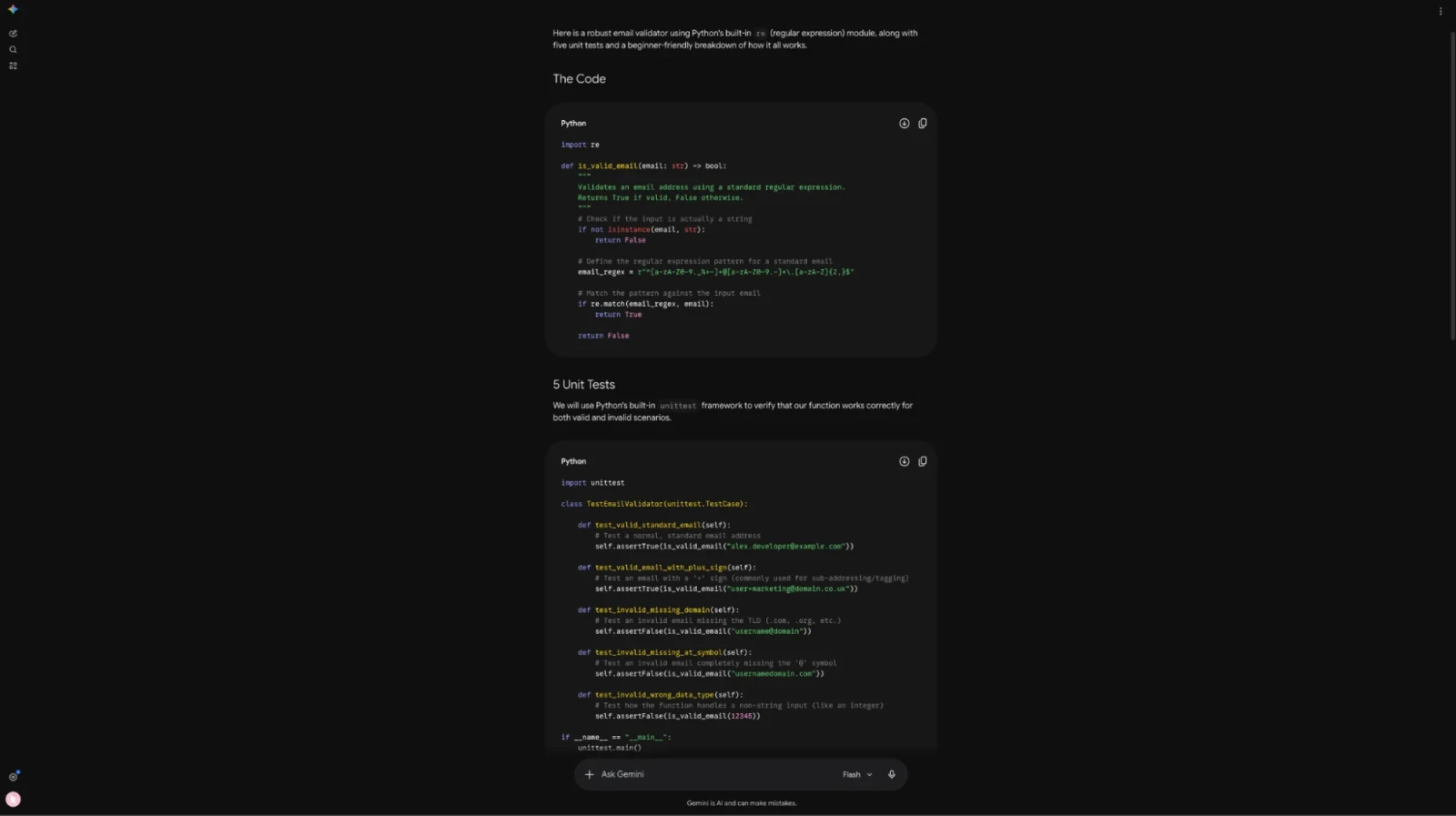
Marketers use role prompting and directional stimulus prompting to produce SEO-optimized blog posts, ad copy, email campaigns and social media content at scale.
Prompt: Act as an SEO content strategist. Write a 1,000-word blog post about "Benefits of Remote Work" optimized for the keyword "remote work benefits." Include a title, meta description, headings and FAQs.
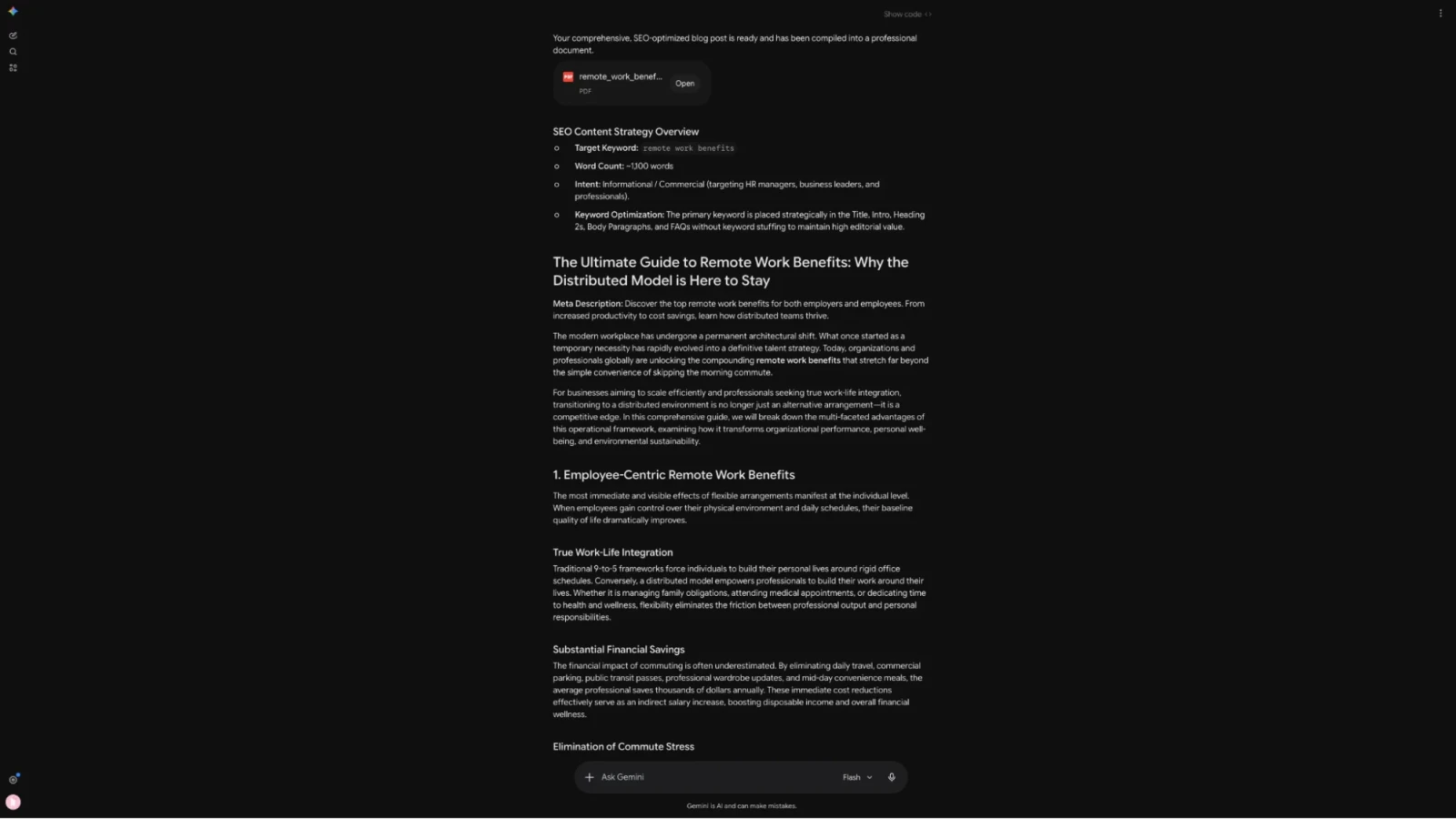
Companies use RAG-based systems to power chatbots that retrieve accurate, up-to-date product information and deliver it in a conversational tone without hallucinating.
Prompt: You are a customer support representative for an e-commerce company. A customer asks: "My order has not arrived and the tracking page hasn't updated in 5 days." Write a professional and empathetic response.
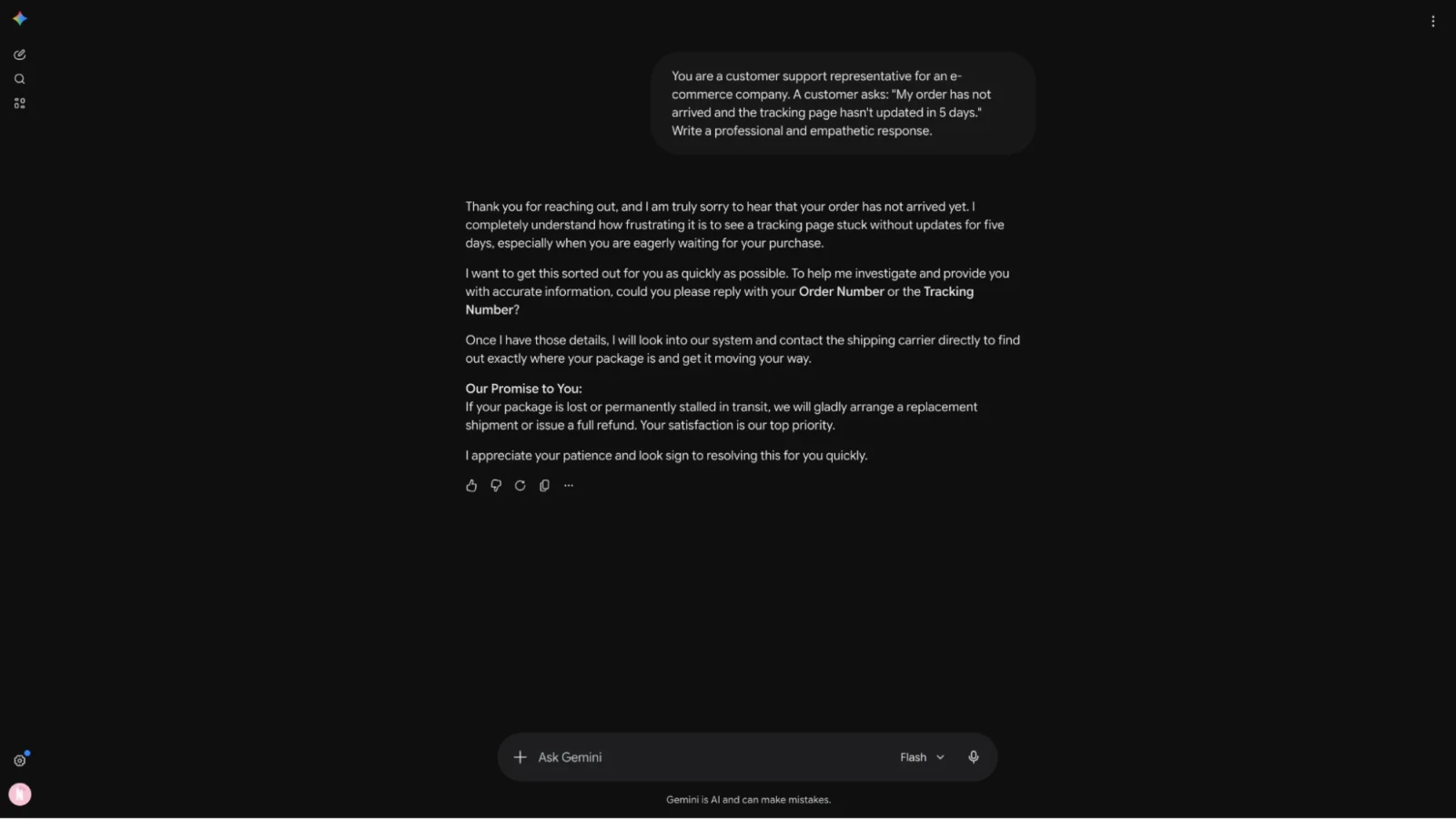
Medical teams use prompt chaining and generate-knowledge prompting to summarize patient records, research diagnoses and generate clinical documentation drafts that doctors then review.
Prompt: Act as a medical documentation assistant. Summarize the following patient notes into a concise clinical report: Patient reports headaches for two weeks, mild nausea, difficulty sleeping and increased work-related stress. No history of migraines. Blood pressure slightly elevated.
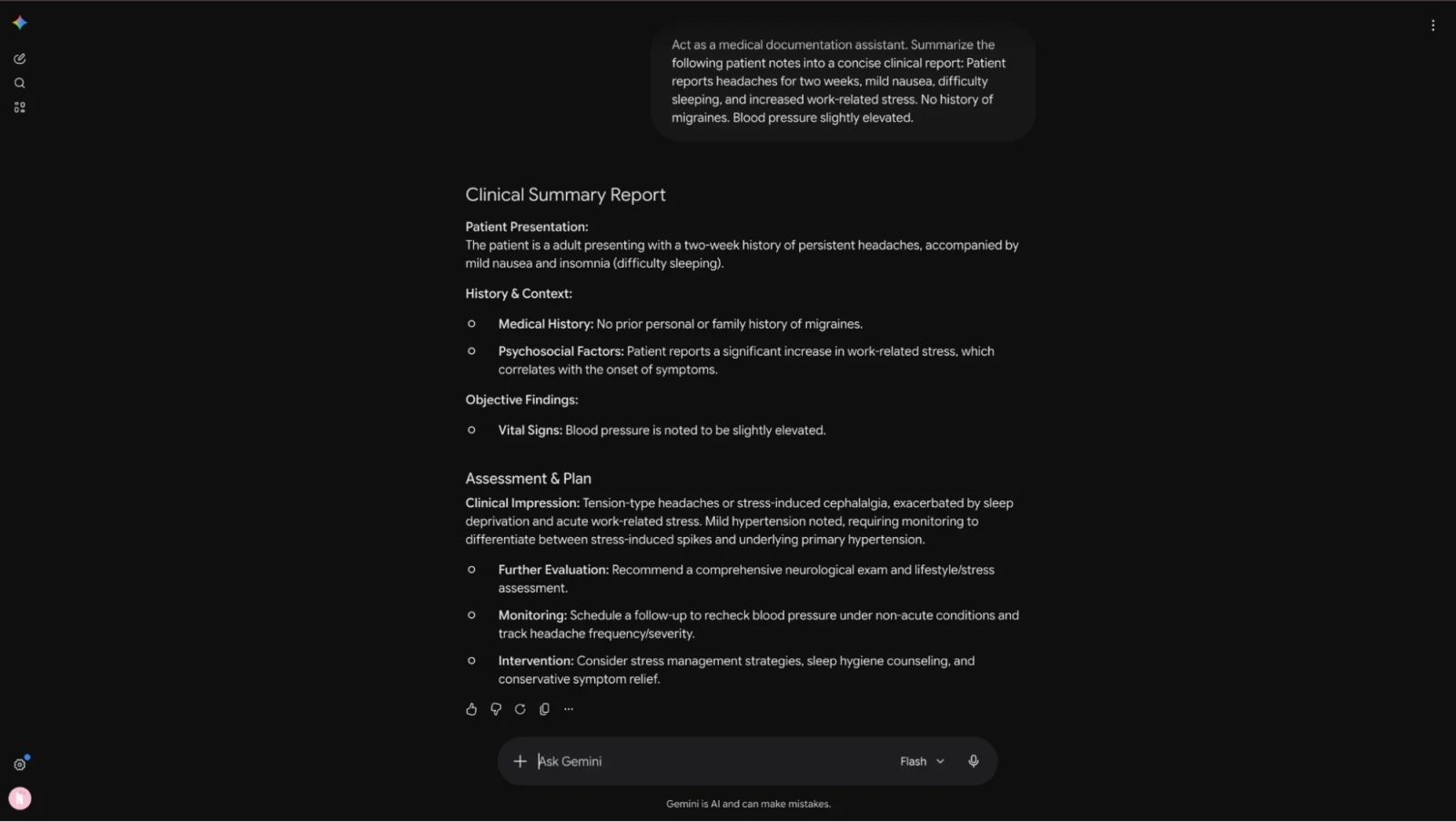
Drawbacks of AI in Healthcare: Artificial Intelligence is transforming healthcare, but it also comes with several challenges and limitations. Here are some of the major drawbacks of AI in healthcare:
Data Privacy and Security Risks
High Implementation Costs
Lack of Human Judgment
Reduced Patient-Doctor Interaction
Limited Accountability
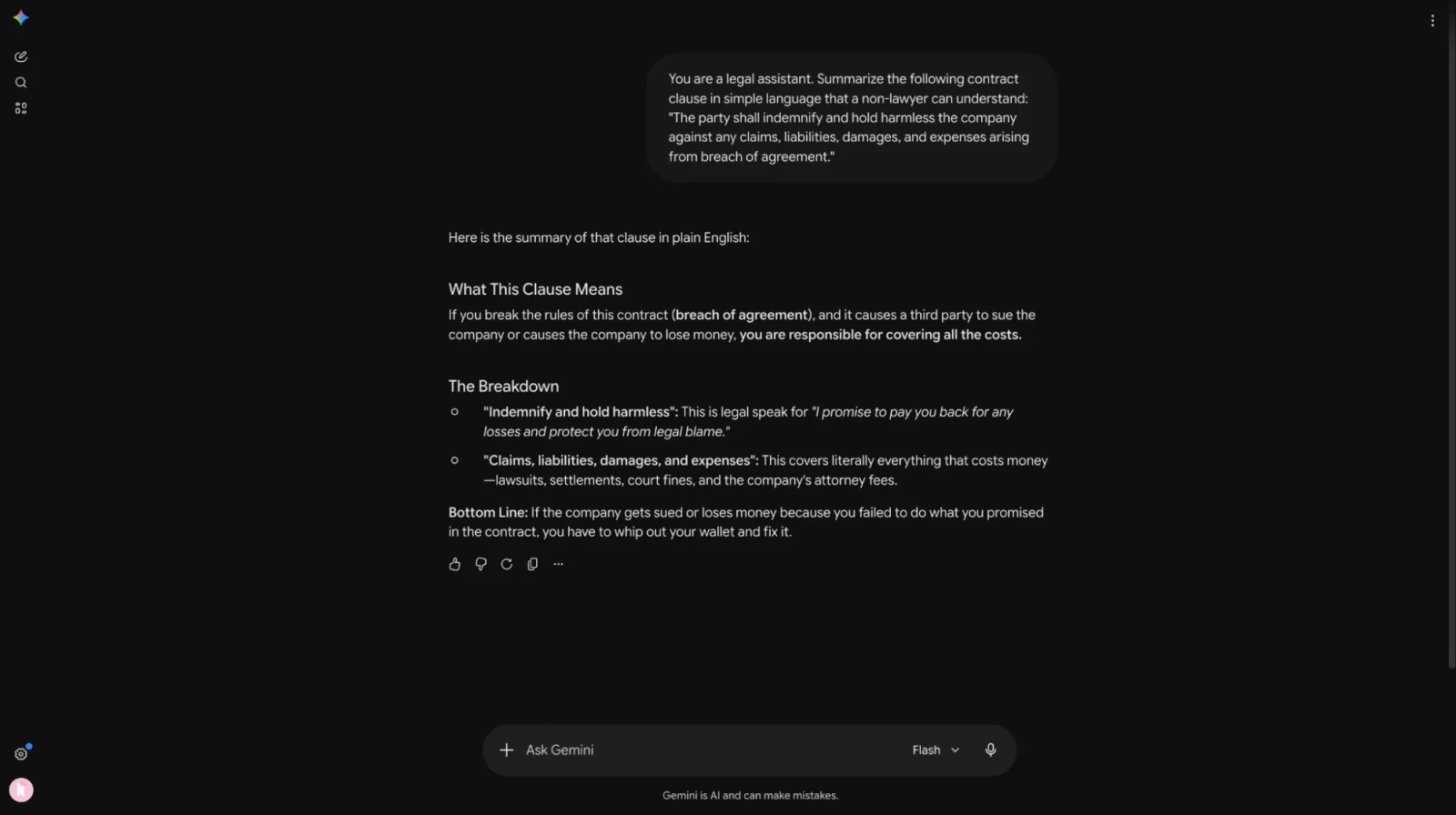
Law firms use zero-shot and few-shot prompting to review contracts, summarize case law and draft standard legal documents.
Prompt: You are a legal assistant. Summarize the following contract clause in simple language that a non-lawyer can understand:
"The party shall indemnify and hold harmless the company against any claims, liabilities, damages and expenses arising from breach of agreement."
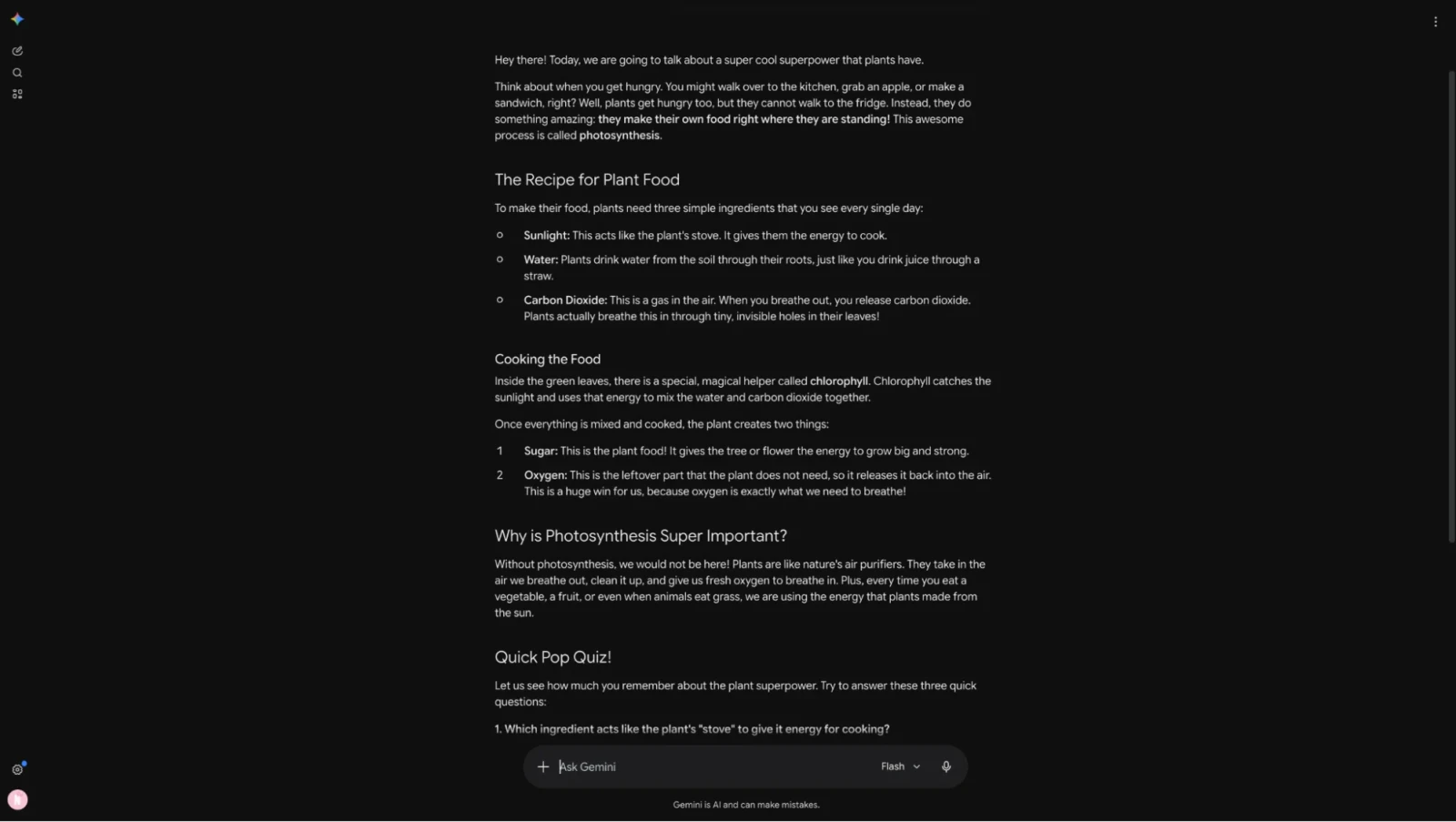
Teachers and e-learning platforms use role prompting and chain-of-thought prompting to create personalized explanations, generate quiz questions and build lesson plans at different difficulty levels.
Prompt: You are a high school science teacher. Explain photosynthesis to a 10-year-old student using simple language, real-world examples and a short quiz at the end.
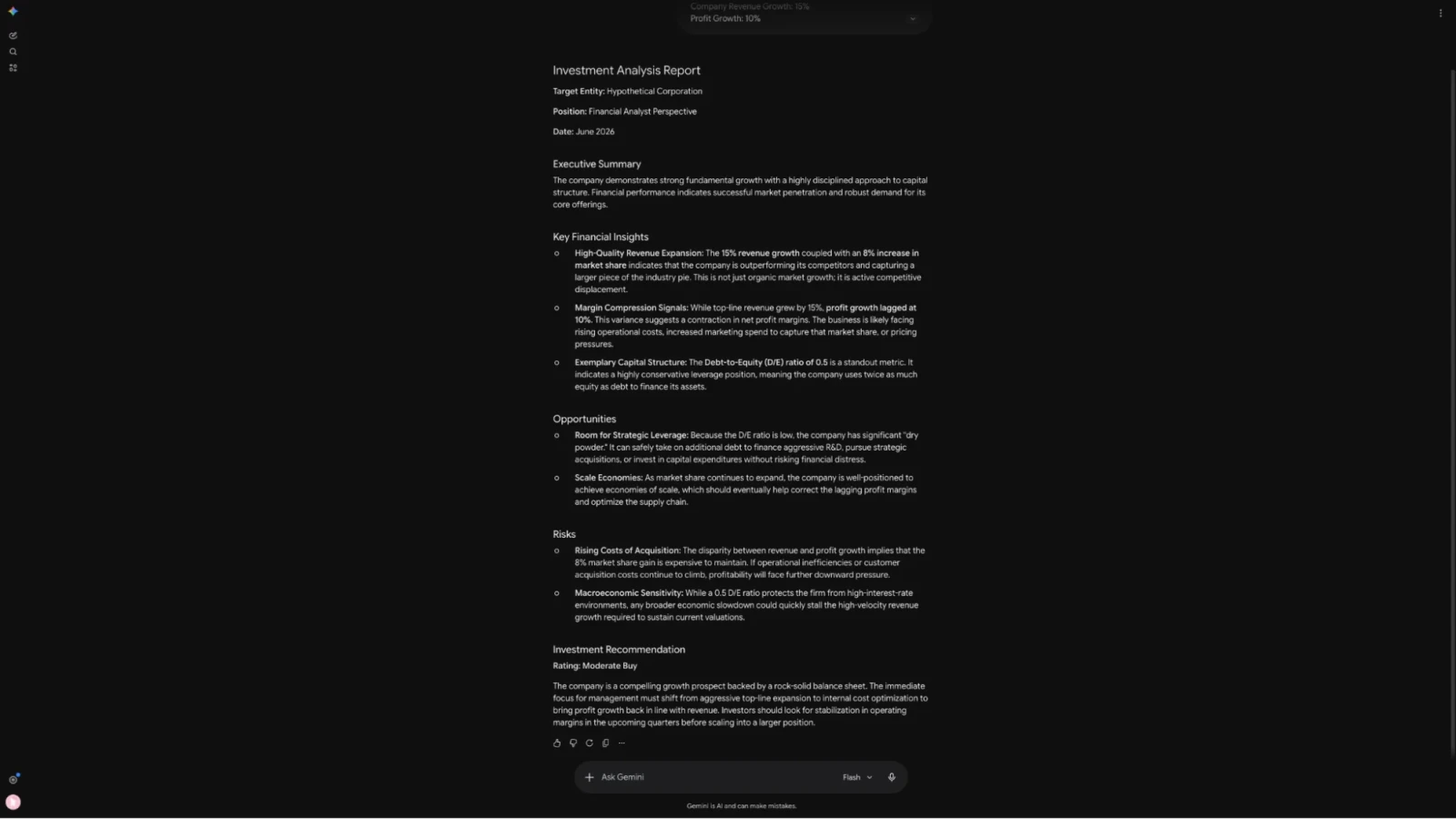
Analysts use ReAct-based systems to combine reasoning with live data retrieval, generating reports that synthesize market data with interpretive analysis.
Prompt: Act as a financial analyst. Analyze the following hypothetical stock performance data and create a short investment report with key insights, risks and opportunities.
Company Revenue Growth: 15%
Profit Growth: 10%
Debt-to-Equity Ratio: 0.5
Market Share Growth: 8%
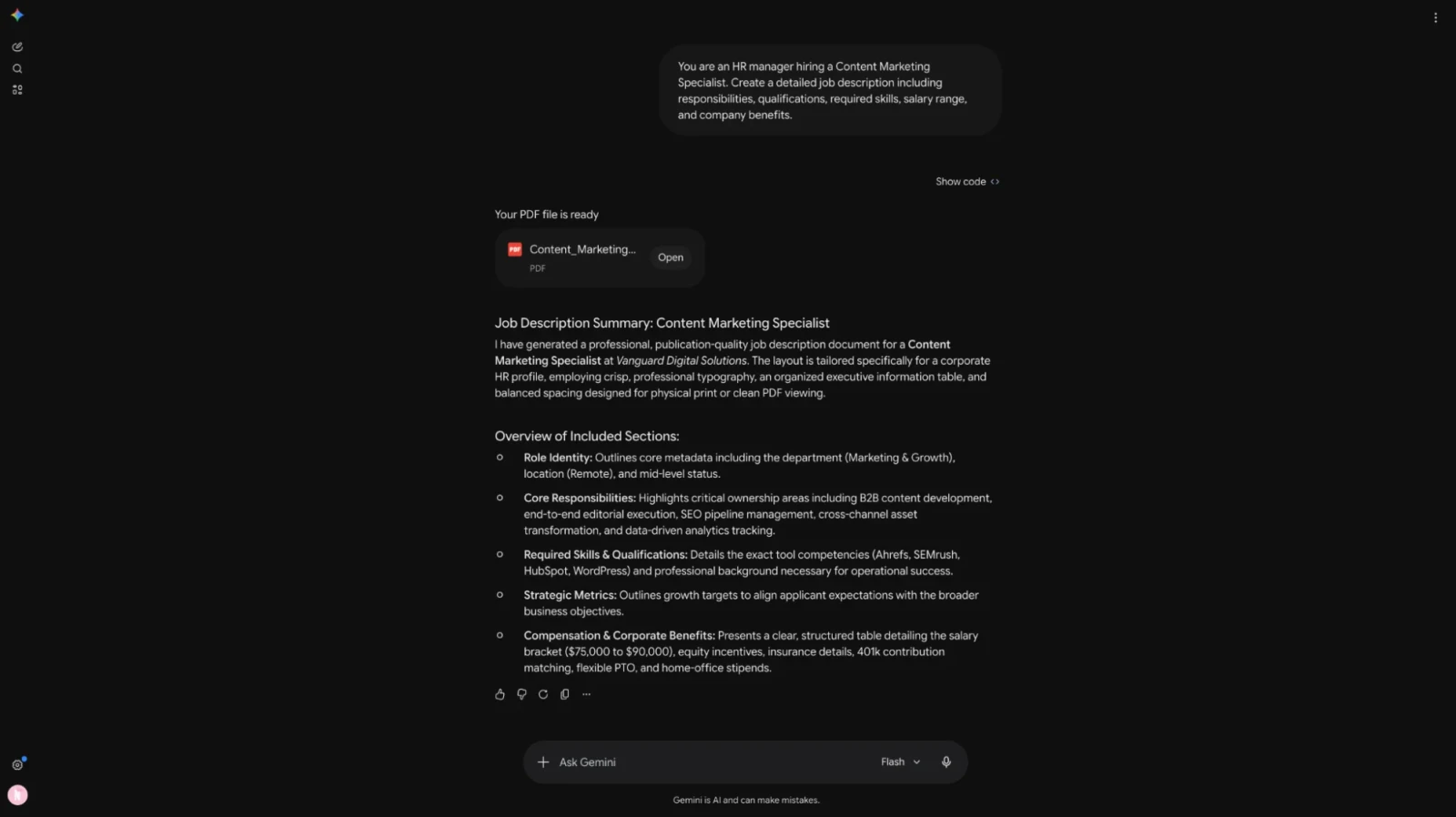
HR teams use prompt engineering to write job descriptions, screen resumes, draft offer letters and build onboarding documentation.
Prompt: You are an HR manager hiring a Content Marketing Specialist. Create a detailed job description including responsibilities, qualifications, required skills, salary range and company benefits.
The common thread across all of these is that prompt engineering makes AI outputs fit the specific context of a real business task. That specificity is what separates useful AI from generic AI.
Also Read: Artificial Neural Networks and its Applications
These practices consistently produce better results across all techniques and all models.
1. Be specific from the start: Vague prompts produce vague outputs. Include as much relevant context as you can in the initial prompt rather than hoping the model will infer what you need.
2. Define your output format explicitly: Tell the model whether you want a list, a paragraph, a table, JSON, bullet points, or any other structure. Do not make it guess.
3. Use positive instructions: Tell the model what to do, not just what to avoid. "Write in a formal, professional tone" is stronger than "Do not be casual."
4. Assign a role when the task is domain-specific: A persona gives the model a framework for the vocabulary, depth and perspective it should use.
5. Test and iterate: No prompt is perfect on the first attempt. Treat prompt writing as a drafting process, not a one-time action.
6. Keep prompts focused: Each prompt should have one primary task. If you need the model to do multiple things, use prompt chaining to break them into steps.
7. Use delimiters for clarity: Triple quotes, XML tags, or markdown headers can separate different parts of your prompt and reduce ambiguity, especially in complex instructions.
8. Include examples when consistency matters: If you need a specific format or style repeated across many outputs, few-shot examples will anchor the model's behavior.
9. Set constraints early: Tell the model about word limits, restricted topics, or required inclusions at the beginning of the prompt, not the end.
10. Document what works: Keep a personal prompt library of formulations that consistently deliver strong results. This library becomes one of your most valuable professional assets over time.
Even experienced users make these mistakes. Knowing them in advance saves you significant time and frustration.
1. Being too vague: "Tell me about marketing" tells the model almost nothing. The more specific you are, the more useful the response.
2. Overloading a single prompt: Asking the model to research, analyze, write, format and summarize all in one prompt leads to mediocre results across all tasks. Break it into steps.
3. Ignoring the role component: Skipping the persona instruction means the model defaults to a generic tone that may not fit your context.
4. Not specifying output format: If you do not tell the model what format you want, it will choose for you and it may choose wrong.
5. Accepting the first output without review: AI models produce a first draft. Prompt engineering includes reviewing, refining and improving the output through iteration.
6. Providing contradictory instructions: "Be brief but comprehensive" is a contradiction. Resolve conflicts in your instructions before you send the prompt.
7. Forgetting context in follow-up prompts: In a long conversation, the model may lose context from earlier messages. Restate critical information when you move to a new task.
8. Assuming the model knows your audience: If you are writing for a specific audience, say so explicitly. The model cannot know who will read the output unless you tell it.
9. Using keyword stuffing in prompts: Repeating the same instruction multiple times does not strengthen it. State it once, clearly.
10. Not testing across models: A prompt that works perfectly in ChatGPT may behave differently in Claude or Gemini. Test your most important prompts across the models you use regularly.
Several tools exist specifically to help you write, test, manage and optimize prompts.
| Tool / Platform | Purpose | Best For |
| PromptBase | Marketplace for buying and selling high-performing AI prompts across multiple models. | Finding proven prompts and monetizing prompt engineering skills. |
| LangChain | Open-source framework for building AI applications using prompt chains, agents, tools and memory. | Developers creating production-ready AI applications. |
| LlamaIndex | Connects LLMs with external data sources and knowledge bases. | Building Retrieval-Augmented Generation (RAG) applications. |
| OpenAI Playground | Interactive environment for testing prompts with controls for temperature, tokens, system messages and more. | Experimenting with and refining OpenAI prompts. |
| Anthropic Console | Prompt testing and evaluation platform for Claude models. | Developing and optimizing Claude-based AI workflows. |
| PromptLayer | Tracks prompt versions, logs outputs and monitors prompt performance. | Prompt management, version control and analytics. |
| DSPy | Stanford-developed framework that automatically programs and optimizes prompts. | Advanced prompt optimization and AI workflow automation. |
| Dust | No-code platform for creating and deploying AI workflows. | Teams that want to build AI solutions without extensive coding. |
| FlowGPT | Community platform for sharing, discovering and deploying prompts. | Learning from existing prompts and prompt collaboration. |
| Weights & Biases Prompts | Integrates prompt management into machine learning experiment tracking workflows. | ML teams are already using Weights & Biases for model development. |
Note: Most of these tools offer free plans, free tiers, or open-source versions, making it easy to start exploring prompt engineering without a significant budget
Related Article: What is Gemini Omni?
Prompt engineering principles are universal, but each model has its own behaviors, strengths and quirks that affect how you should write prompts.
| AI Model | Prompt Engineering Strengths | Best Use Cases | Prompting Tips |
| OpenAI GPT-4 / GPT-4o | Excellent at following detailed instructions and handling complex multi-step prompts. | Content creation, coding, research, analysis and general-purpose AI tasks. | Use structured prompts, system messages and clear task breakdowns for the best results. |
| Anthropic Claude | Strong at understanding conversational instructions and processing long documents. Consistently follows formatting requirements. | Long-form writing, document analysis, summarization and editing. | Write prompts in a natural, conversational style and provide clear formatting requirements. |
| Google Gemini | Excels at multimodal tasks involving both text and images. Integrates well with Google's ecosystem. | Image analysis, multimodal reasoning and productivity workflows. | Include both text and visual context when applicable to maximize performance. |
| Meta Llama | Flexible and customizable open-source model that can be fine-tuned for specific applications. | Custom AI applications, local deployments and research projects. | Use explicit instructions, structured formatting and detailed examples for better outputs. |
| Mistral AI Mistral | Delivers strong performance while maintaining fast inference speeds and efficiency. | Real-time applications, chatbots and resource-conscious deployments. | Keep prompts clear and concise while maintaining structure and context. |
| Cohere Cohere Command | Optimized for enterprise workflows, retrieval systems and structured business tasks. | Enterprise search, RAG applications and knowledge management systems. | Define roles, objectives and expected output formats explicitly. |
The general rule is this. Commercial models with strong instruction tuning handle natural language prompts well. Open-source and smaller models benefit from more explicit, structured formatting. Always test your prompts on the specific model you plan to use in production.
You do not need a technical background to start. You need curiosity, practice and a systematic approach.
You cannot improve at something you do not practice. Pick one tool, whether it is ChatGPT, Claude, or Gemini and use it for real tasks every day.
Understand the key components of a prompt, the basic techniques like zero-shot, few-shot and chain of thought and the vocabulary of the field. This guide is a solid starting point.
Take one task and try five different prompt formulations. Compare the outputs. Notice what changes when you add a role, provide examples, or ask the model to think step by step.
Save the prompts that work well. Organize them by task type. This library grows into a reusable asset over time.
Platforms like PromptBase, Reddit's r/ChatGPT and various GitHub repositories contain thousands of real prompts with real outputs. Study them to learn patterns faster.
Apply your prompt engineering skills to a real project. Build a writing assistant, a content workflow, or an analysis tool. Applied learning solidifies skills far faster than theoretical study.
You do not need to master every technique to benefit from prompt engineering. These are the skills that offer the most value for most professionals.
1. Writing clear, specific instructions is the most fundamental skill. It applies to every use case and every model.
2. Using role prompting to set context is simple, fast and consistently improves outputs across all types of tasks.
3. Applying a chain of thought for any complex reasoning task dramatically reduces errors and improves the depth of AI-generated analysis.
4. Structuring outputs through format instructions saves enormous amounts of editing time when you use AI for content or data work.
5. Iterating on prompts is a mindset as much as a technique. Treating the first output as a draft and refining from there is what separates great prompt engineers from average ones.
6. Understanding model limitations helps you set the right expectations and design prompts that work within those constraints.
7. Building prompt templates for recurring tasks is a productivity multiplier. Once you have a strong template, you can reuse it across dozens of similar tasks without starting from scratch.
Related Article: Top Skills Needed to Become Prompt Engineer
Prompt Engineer is now an established job title at AI companies, technology firms and large enterprises. Salaries range widely based on seniority and industry, but senior prompt engineers at AI-focused companies earn competitive packages.
1. AI Content Strategist is a role that combines prompt engineering with content production. These professionals build the AI workflows that content teams use to produce work at scale.
2. LLM Application Developer uses prompt engineering alongside software development to build AI-powered products. This role requires both coding skills and deep prompt engineering knowledge.
3. AI Trainer and Evaluator involves writing prompts to test AI models, evaluate their outputs and provide feedback that improves model quality. This role is central to the model improvement pipeline at AI companies.
4. Conversational AI Designer builds the prompt structures and dialogue flows behind chatbots, virtual assistants and customer support systems.
5. AI Consultant helps businesses implement AI tools effectively. Strong prompt engineering skills are a core part of this role because the consultant needs to demonstrate and deliver real AI value.
The most in-demand combination right now is prompt engineering plus one of the following: software development, content strategy, data analysis, or domain expertise in a specific industry like healthcare, legal, or finance.
Prompt engineering is powerful, but it has real constraints you should understand.
Even well-engineered prompts can produce responses that contain fabricated facts. You should always verify factual claims in AI outputs, especially for high-stakes applications.
A small change in phrasing can produce a dramatically different output. Prompts that work reliably are harder to create than they appear.
A prompt that works perfectly on GPT-4 may perform poorly on Llama or Mistral. Techniques do not transfer perfectly across all models.
Even with large context windows, extremely long or complex tasks can cause models to lose track of previous instructions or degrade in quality.
In applications where user input is included in prompts, malicious users can inject instructions that override your intended behavior. This is a critical concern for any production application.
Techniques that are cutting-edge today may be obsolete in six months as new models and methods emerge. Staying current requires ongoing learning.
For highly specialized tasks, fine-tuning a model on domain-specific data will outperform even the best prompt engineering approach.
Understanding these limitations helps you use prompt engineering more effectively and know when to reach for other tools.
Also Read: What Is Google Antigravity?
The field is evolving fast. Here is where it is heading.
1. Automated prompt optimization is already emerging through tools like DSPy. Rather than writing prompts by hand, you will describe your task and a system will search for the optimal prompt automatically.
2. Multimodal prompting will become standard as AI models continue to improve their ability to process images, audio, video and structured data alongside text.
3. Agentic AI will push prompt engineering toward system design. Instead of writing individual prompts, engineers will design the logic flows that guide AI agents through complex multi-step tasks.
4. Prompt engineering and fine-tuning will converge. The line between prompting a model and adapting its weights is already blurring. Techniques like prompt tuning, which optimizes soft prompts at the embedding level, sit directly between the two approaches.
5. Standardized prompt libraries and benchmarks will emerge as the field matures, similar to how software engineering has established design patterns and testing standards.
6. AI literacy will become a general professional skill. As AI tools embed in every major software product, the ability to communicate with AI effectively will become as expected as the ability to use a spreadsheet.
The engineers who build deep expertise in prompt engineering now will be the ones who shape how these systems evolve over the next decade.
Prompt engineering techniques are not a niche interest for AI researchers. They are a practical skill set that anyone who uses AI tools can and should develop.
You have learned what prompt engineering is, why it matters and how it works. You have seen all the major techniques, from zero-shot and few-shot prompting to chain of thought, ReAct and RAG. You have explored real-world applications, common mistakes, career paths and where the field is going.
The most important thing you can do with this information is act on it. Open your AI tool of choice, choose one technique you have not tried before and apply it to a real task. Notice the difference. Then try another.
Prompt engineering is ultimately a craft. You improve by doing. The techniques in this guide give you a strong foundation. What you build on it is up to you.
Start with zero-shot prompting to understand baseline model behavior. Then add role prompting to improve response quality. Once you are comfortable, try a few-shot prompting and chain of thought for more complex tasks.
Yes, Prompt Engineer is now a recognized job title at AI companies and large enterprises. The role is expanding into adjacent positions like AI content strategist, LLM application developer and conversational AI designer.
Chain-of-thought prompting asks the model to reason through a problem step by step before giving a final answer. It significantly improves accuracy on complex tasks like math, logic and multi-step analysis.
Popular tools include LangChain, LlamaIndex, PromptLayer, PromptBase, OpenAI Playground and Anthropic Console. For advanced automation, DSPy allows programmatic prompt optimization. Most tools offer free tiers to get started.