Every day, millions of people open Google, scroll through Instagram, check their inbox, or watch a YouTube video before they even think about walking into a store. And right in the middle of all of that, businesses are showing up and winning customers.
That is what digital marketing does.
Whether you are a student trying to understand the field, a business owner who wants more customers, or someone who wants to build a career in marketing, understanding digital marketing is no longer optional. It is a skill that the world is actively looking for right now. In this guide, I will walk you through everything you need to know about digital marketing. I will cover what it is, how it works, its types, channels, tools, and what you should know in 2026. Let’s begin!
Related Article: What is Google AI Studio?
Digital marketing is the promotion of products or services using digital channels such as search engines, social media, email and websites. It enables businesses to connect with specific audiences, drive traffic, build brand awareness and measure campaign performance in real-time.
In the past, businesses primarily relied on traditional advertising channels such as newspapers, television, radio, and billboards to promote their products and services. As internet usage became widespread and people increasingly turned to online platforms for information and entertainment, companies began shifting their marketing efforts to digital channels. This transition from conventional media to internet-based communication is what gave rise to digital marketing.
It does not consist of one single marketing strategy. It comprises several different types of marketing strategies which work in unison with one another. For example, a business may use Search Engine Optimization (SEO) to achieve high rankings in a search engine such as Google, use social media platforms to engage with potential customers, use email as a follow-up to prospects and customers and finally use paid ads to quickly drive website traffic to their site. When you put all these together to accomplish a specific objective, you have created a digital marketing strategy.
Read Also: Top 10 Social Media Management Tools in 2026
Digital marketing works by connecting businesses with the right audience at the right time with the right message. The whole process is about understanding who your audience is, where they spend time online and what they are searching for.
Here is how the process works step by step.
Before you do anything, you have to make sure that you know who you are targeting. What problems do they have? What do they search for? Where do they spend time online? This step is about building what marketers call a buyer persona.
Once you know your audience, you pick the platforms that make sense. If your audience is professionals, LinkedIn is a better fit. If you sell visually appealing products, Instagram works better.
You create content, ads, emails, or social posts that speak directly to what your audience needs. Good content solves a problem, answers a question, or adds real value.
You use SEO, paid ads, social media, or email to bring people to your website or landing page.
Once people land on your site, you guide them to take a specific action. That could be buying a product, filling a form, or signing up for a newsletter.
Digital marketing gives you real-time data. You can see what is working and what is not and you can improve your campaigns based on actual numbers.
This cycle of targeting, creating, driving, converting and improving is what makes digital marketing so effective compared to traditional approaches.
Related Article: Best AI Visibility Tools
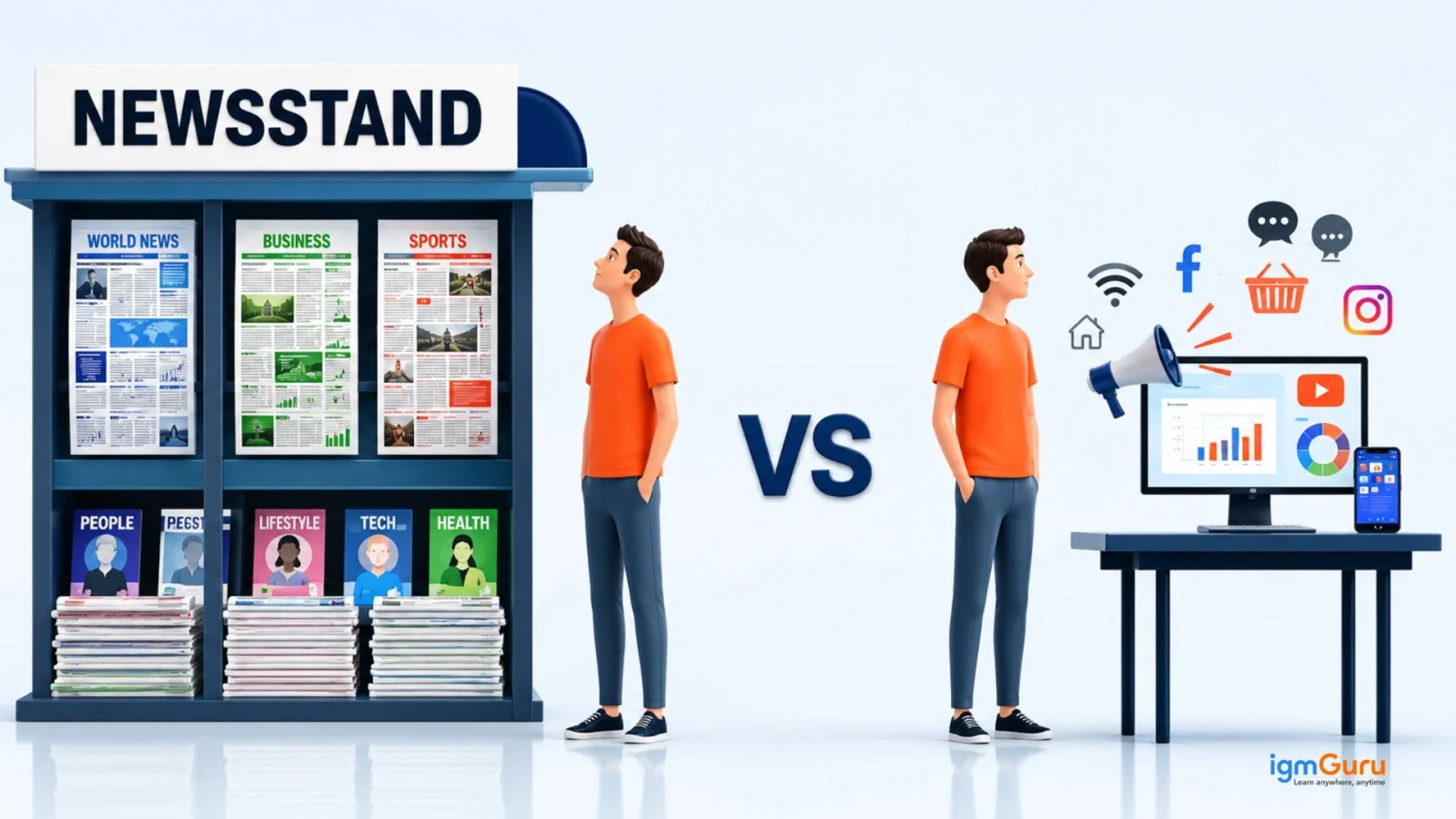
A lot of people ask about the real difference between digital marketing and traditional marketing. The answer is straightforward.
Traditional marketing uses offline channels like TV, radio, newspapers, magazines and billboards. Digital marketing uses online channels like Google, social media, websites and email. But the differences go much deeper than just the medium.
Here is a simple comparison to make it clearer.
| Aspect | Digital Marketing | Traditional Marketing |
|---|---|---|
| Definition | Marketing products or services through online channels such as websites, search engines, social media, email and mobile apps. | Marketing products or services through offline channels such as newspapers, television, radio, magazines, billboards and flyers. |
| Audience Reach | Can reach a global audience instantly through the internet. | Usually limited to a specific geographic area or region. |
| Cost | Generally more affordable and suitable for businesses of all sizes. | Often requires a larger budget for advertising and promotions. |
| Targeting | Allows businesses to target users based on demographics, interests, behavior, location and online activity. | Broad targeting with limited audience segmentation options. |
| Communication | Two-way communication where customers can comment, message, share and engage with brands. | Mostly one-way communication where customers receive information without direct interaction. |
| Performance Tracking | Results can be measured in real-time using analytics tools, including clicks, conversions and engagement. | Difficult to track exact results and customer responses accurately. |
| Speed of Implementation | Campaigns can be created, launched, modified, or paused instantly. | Campaign changes often take time and may involve additional costs. |
| Customer Engagement | High engagement through social media interactions, emails, polls, videos and live chats. | Limited engagement as customers mainly view or hear advertisements. |
| Return on Investment (ROI) | Easier to measure and optimize for better results and higher ROI. | ROI is harder to calculate because tracking customer actions is challenging. |
| Examples | SEO, content marketing, social media marketing, email marketing, PPC advertising, influencer marketing. | TV commercials, radio ads, newspaper advertisements, brochures, banners and billboards. |
Does this mean traditional marketing is dead? Not completely. Some businesses still benefit from TV or outdoor advertising. But for most businesses today, digital marketing gives better results at a lower cost with measurable, trackable data.
Also Read: Claude Fable 5: Anthropic's Most Powerful AI Model
Here is something worth thinking about. There are over 5 billion internet users in the world right now. Your potential customers are online every single day. If your business is not visible where your audience spends their time, you are losing ground to competitors who already are.
Digital marketing is important for several strong reasons.
A small business can run targeted ads or create content with a limited budget and still reach thousands of the right people. Traditional marketing simply cannot offer this level of efficiency.
A startup with a smart digital marketing strategy can compete with a large brand. SEO, content marketing and social media do not require a big budget to produce results.
You can track every click, every visit and every sale. You know exactly what is working and what is not. This is something traditional marketing has never been able to offer at this level.
Through email marketing, social media and content, businesses can stay connected with their audience over time. This builds trust and customer loyalty.
You can show your ads only to people who match your ideal customer profile based on age, location, interest, or past behavior. Every rupee you spend goes toward a qualified audience.
Your website, your blog and your social media are always available. Unlike a store that closes at night, your digital presence never stops working for you.
In simple words, digital marketing is important because it helps you reach the right people, at the right time, with the right message, at a cost you can afford.
Read Also: What is Meta AI?
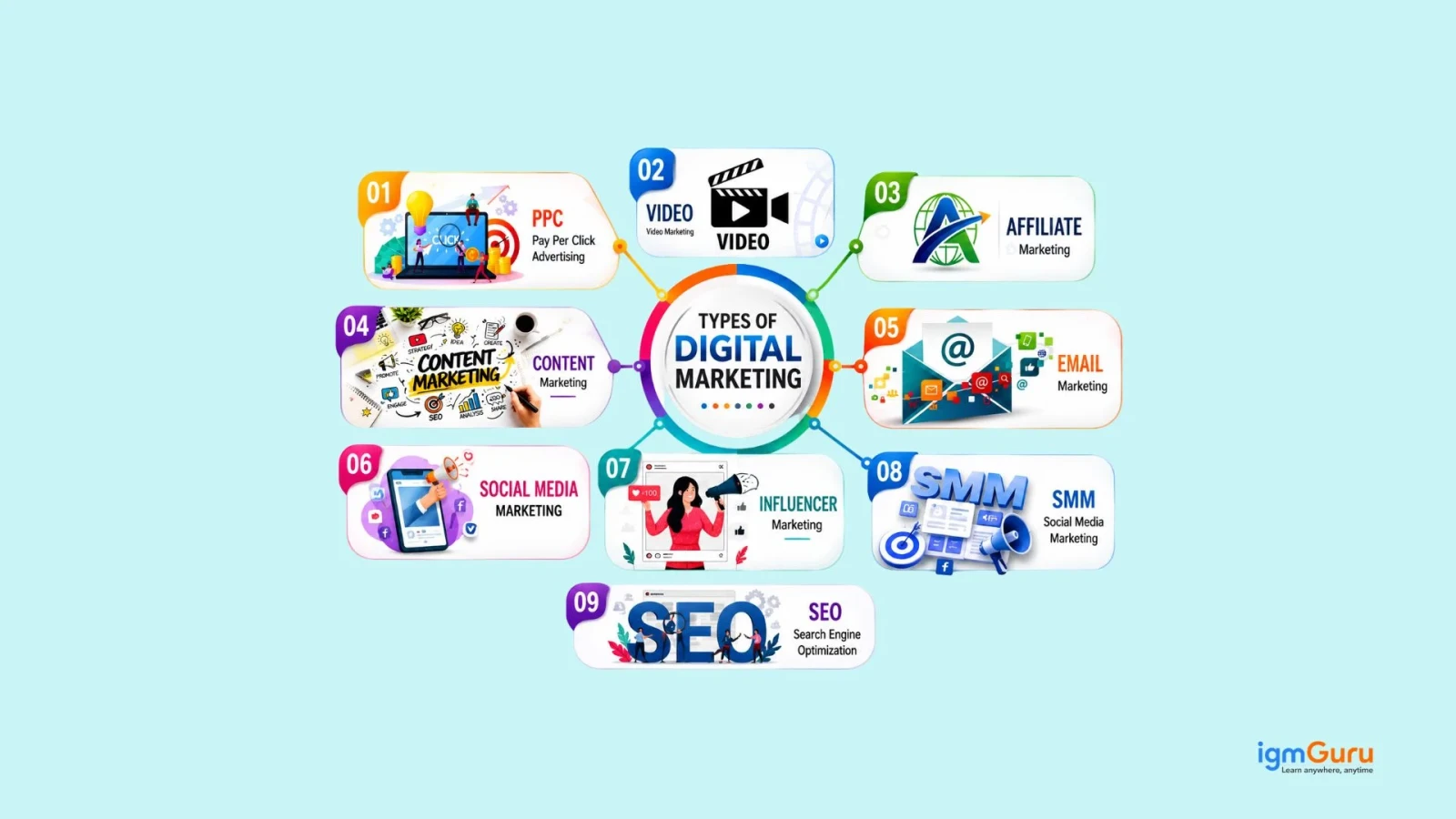
Digital marketing is not a single strategy. It includes several different types and each one has its own role. Understanding the types of digital marketing helps you decide which ones fit your business best. Let me walk you through the main ones.
SEO is the process of improving your website and content so it ranks higher on search engines like Google organically, without paying for clicks. When someone searches for a keyword related to your business, SEO helps your page appear in the results.
SEO includes on-page optimization, off-page link building, technical improvements and content creation. It is a long-term strategy, but once you rank, you can receive consistent traffic for months or even years without ongoing ad spend.
Real example: A digital marketing training institute that ranks on the first page of Google for "digital marketing course in India" receives hundreds of organic inquiries every month without paying for a single click on that traffic.
PPC is paid advertising where you pay every time someone clicks your ad. Google Ads is the most popular PPC platform. You can also run paid ads on Facebook, Instagram, LinkedIn and YouTube.
PPC gives you instant visibility. Unlike SEO, you do not have to wait months to see traffic. But you do need to keep spending to keep the traffic coming, which is why it works best alongside an organic SEO strategy.
Content marketing is about creating valuable and helpful content to attract and engage your target audience. This includes blog posts, articles, videos, infographics, podcasts and eBooks.
Good content answers questions your audience is already asking online. It builds trust over time and supports every other type of digital marketing, especially SEO. It is how you attract people before they are even ready to buy.
Companies with active blogs generate more leads than businesses that do not regularly publish content.
Related Article: How To Become A Content Writer?
Social media marketing involves using platforms like Facebook, Instagram, LinkedIn, X (formerly Twitter) and YouTube to promote your brand and connect with your audience.
It can include organic posts, stories, reels, live videos and paid social ads. Social media is great for building brand awareness, growing a community and maintaining direct relationships with your customers.
Email marketing is one of the most effective digital marketing types that continues to deliver strong ROI. It involves sending targeted emails to a list of subscribers to nurture leads, share updates, promote offers, or build ongoing relationships.
With email, you have full control over who sees your message and when. You are not dependent on any algorithm. That is what makes it one of the most reliable channels in digital marketing.
This type of marketing delivers an average ROI of $36 for every $1 spent, making it one of the highest-performing digital marketing channels.
Affiliate marketing is a performance-based model where you partner with individuals or websites to promote your products. Affiliates earn a commission for every sale or lead they bring in.
It is a low-risk way to expand your reach because you only pay when actual results are delivered. Many e-commerce brands rely heavily on affiliate programs for growth.
Influencer marketing involves partnering with people who have a large and engaged following on social media. Influencers promote your product or service to their audience, which builds trust and awareness quickly.
In 2026, micro-influencers with smaller but highly engaged audiences tend to deliver better results than large celebrity accounts because their audience trusts them more.
Video marketing uses video content to engage audiences on platforms like YouTube, Instagram Reels and Facebook. Video is one of the fastest-growing content formats because people prefer watching over reading in many situations.
Short-form videos, product demos, explainer videos and customer testimonials are all powerful forms of video marketing.
More than 90% of businesses now use video marketing, and short-form videos generate significantly higher engagement than static content.
Mobile marketing targets users on their smartphones through SMS, push notifications, in-app ads and mobile-optimized websites. With the majority of people browsing on mobile devices, this has become an essential part of any digital marketing plan.
Related Article: Julius AI: AI Data Analysis Tool for Beginners
Digital marketing channels are the platforms and tools you use to reach your audience. These are the places where your message gets delivered. Choosing the right channels depends entirely on where your target audience spends their time.
Search is the biggest channel for most businesses. Through SEO and PPC, you can reach people who are actively searching for what you offer. Search intent is very high here, which means people are already looking to buy or learn.
Facebook, Instagram, LinkedIn, X, Pinterest and YouTube are social channels where businesses can build an audience, run ads and engage directly with customers in a public setting.
Email is a direct channel that gives you full control over your message and timing. With proper segmentation and personalization, email campaigns can drive serious conversions at a very low cost.
Your website is your digital home base. Your blog is where you create content that attracts organic traffic, builds authority and answers the questions your audience is already searching for.
YouTube is the second-largest search engine in the world. Short-form platforms like Instagram Reels and YouTube Shorts are also powerful for reaching audiences quickly with engaging content.
Podcast marketing is growing steadily. Brands use podcasts to build thought leadership and reach a highly engaged audience during their commute, workout, or downtime.
WhatsApp, Telegram and Facebook Messenger are being used by businesses to communicate directly with customers through broadcast messages, chatbots and customer support.
These are visual banner ads that appear across websites on the internet. They are mostly used for brand awareness and retargeting people who have already visited your website before.
The best digital marketing strategy uses a combination of these channels based on where your specific target audience is most active.
Let me show you digital marketing working in practice, not just in theory.
A coaching institute in Pune started publishing blog posts targeting keywords like "best digital marketing course in Pune" and "how to learn digital marketing at home." Within 5 months, these posts ranked on the first page of Google. Organic inquiries increased by over 40%, with zero spend on ads for that traffic.
An online clothing store ran Google Shopping Ads targeting high-intent product keywords. They also set up a retargeting campaign on Facebook to re-engage visitors who had browsed products but did not purchase. The combination brought their cost per acquisition down by 28% while increasing monthly revenue.
A SaaS company segmented their email list into active users, inactive users, and trial users. They sent different email sequences to each segment. Inactive users received a win-back campaign with a special offer. This single campaign reactivated 18% of dormant users.
A financial education platform published one comprehensive guide targeting the keyword "how to invest in mutual funds in India." The article took 3 weeks to write and optimize. Six months later, it was receiving 4,000 organic visitors per month and was the top source of new sign-ups on the platform.
A startup selling sustainable products used Instagram Reels to showcase the story behind each product. No paid promotion in the first three months. Through consistent posting and community engagement, they grew from 800 to 22,000 followers and saw a direct correlation with website traffic growth.
These are not exceptional cases. They are the result of applying the right channel, the right content, and the right consistency.
Also Read: What is Social Media Optimization (SMO)?
A digital marketing strategy is your roadmap. Without one, your marketing becomes a series of disconnected activities that waste time and budget. With one, every action serves a clear purpose.
"Get more traffic" is not a goal. "Increase organic traffic by 30% in 6 months" is a goal. Define what success looks like in numbers.
Build a buyer persona. Name them. Describe their age, location, job, problems, online habits, and the questions they type into Google. The more specific this is, the better every decision you make will be.
Do you have a website? Social media accounts? An email list? An existing blog? What is working? What is not? Understanding your starting point prevents wasted effort.
Look at which keywords they rank for, what content they publish, which channels they use, and where they are weak. Gaps in their strategy are opportunities for yours.
You do not need to be everywhere. Being excellent on two channels is far better than being mediocre on seven.
Plan what you will create, for which platform, and on what schedule. Consistency matters more than volume.
Allocate budget by channel based on your goals. If you need immediate leads, invest more in PPC. If you want long-term authority, invest in SEO and content.
Put your campaigns live and review your analytics every week. Double down on what works. Cut what does not. Digital marketing rewards iteration.
Read Also: Top 15 Benefits of Digital Marketing in 2026
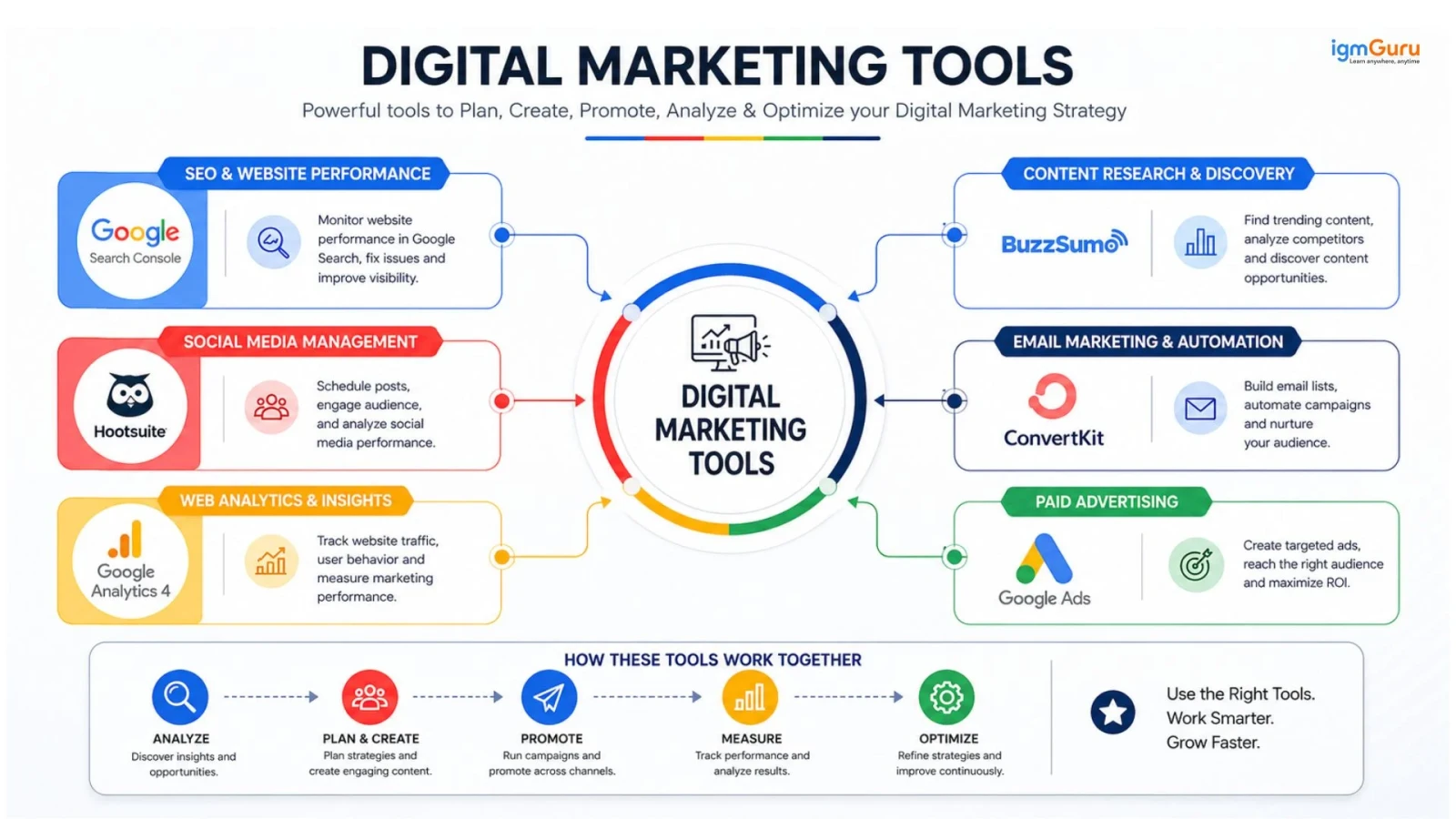
The right tools make digital marketing faster, smarter and more effective. You do not need all of these at once. Start with the free SEO tools and expand your toolkit as your skills and budget grow.
| Tool | What It Does |
|---|---|
| Google Search Console | Tracks your website's performance on Google search |
| Ahrefs | Keyword research, backlink analysis and competitor research |
| SEMrush | All-in-one SEO and marketing analytics platform |
| Ubersuggest | Beginner-friendly keyword research and site audit tool |
| Screaming Frog | Website crawl and technical SEO audit |
| Tool | What It Does |
|---|---|
| Grammarly | Grammar checks and readability improvement |
| BuzzSumo | Find trending content ideas in any niche |
| Surfer SEO | Optimize content for SEO while you write it |
| Hemingway App | Makes your writing clearer and easier to read |
| Tool | What It Does |
|---|---|
| Buffer | Schedule and publish posts across multiple platforms |
| Hootsuite | Social media management, scheduling and analytics |
| Canva | Create visual content for social media and ads |
| Tool | What It Does |
|---|---|
| Mailchimp | Email campaigns, automation and list management |
| ConvertKit | Email marketing built for creators and bloggers |
| ActiveCampaign | Advanced email automation with built-in CRM |
| Tool | What It Does |
|---|---|
| Google Analytics 4 | Track website traffic, user behavior and conversions |
| Hotjar | See how users interact with your website through heatmaps |
| Meta Business Suite | Analytics for Facebook and Instagram campaigns |
| Tool | What It Does |
|---|---|
| Google Ads | Run search and display ad campaigns |
| Meta Ads Manager | Run paid ads on Facebook and Instagram |
| LinkedIn Campaign Manager | B2B paid advertising and lead generation |
Read Also: How To Become A Social Media Specialist?
If you are completely new to digital marketing, the sheer amount of information can feel overwhelming. There are so many terms, so many tools and so many channels. But here is the truth. You do not need to learn everything at once. You just need to start from the basics and build steadily from there.
Here is what I recommend for beginners.
Before jumping into tools or platforms, make sure you understand the core concepts. What is SEO? What is PPC? What is content marketing? What is email marketing? This guide is a strong starting point.
Do not try to learn everything at the same time. Pick one area, whether it is SEO, social media marketing, or email marketing and go deep into it. Once you have a solid foundation in one area, picking up the others becomes much faster.
The best way to learn digital marketing is by doing it. Start a blog, create a social media page, or volunteer to help a local business with their online presence. Real experience teaches you more than any course alone can.
Blogs like HubSpot, Neil Patel, Search Engine Journal, Backlinko and Moz are great places to stay updated. They publish practical, current content on every aspect of digital marketing.
Google, HubSpot and Meta all offer free certifications that are recognized across the industry. These help you build credibility when you are just starting out and looking for jobs or clients.
Digital marketing, especially SEO and content marketing, takes time to show results. Do not give up if you do not see results in the first few weeks. Stay consistent, keep improving and the results will follow.
The key point for beginners is this: start, learn, apply and improve. That cycle is what builds great digital marketers.
Also Read: What is Google DeepMind and How Does it Work?
A lot of small business owners think digital marketing is only for companies with large budgets. That is one of the biggest misconceptions out there. In fact, digital marketing is one of the most powerful tools small businesses have precisely because it allows them to compete with much bigger brands at a fraction of the cost.
Studies show that a majority of small businesses now rely on digital marketing to attract customers and grow revenue.
Here is how small businesses can use digital marketing effectively.
If you run a local business, setting up a free Google Business Profile is the most important first step. It helps you appear in local search results and on Google Maps when people nearby are searching for what you offer.
Optimize your website and content for location-based keywords. If you run a bakery in Jaipur, you should target searches like "best bakery in Jaipur" or "cake shop near me." This brings in highly relevant local traffic without paying for ads.
Pick one or two platforms where your customers are active and stay consistent. You do not need to post every day, but you do need to post regularly and engage with your audience when they comment or message you.
Even with a small list of 200 subscribers, email can drive meaningful revenue. Offer something valuable in exchange for an email address, like a discount, a free guide, or an exclusive tip.
A small business blog that answers common customer questions can bring in consistent organic traffic without spending a single rupee on ads. It also builds your credibility as an expert in your field.
You can start with a small daily budget on Google Ads or Facebook Ads and target a very specific audience. Even a modest spend can generate solid leads if the targeting and the message are right.
Small businesses do not need to do everything. They need to do a few things consistently and do them well.
Digital marketing is one of the fastest-growing career fields in India right now. And unlike most high-paying careers, it does not require a specific degree. It rewards skills, portfolio, and measurable results.
| Role | Description |
|---|---|
| SEO Specialist | Optimizes websites to rank higher on search engines |
| Content Marketer | Creates and manages content strategies |
| Social Media Manager | Manages brand presence and campaigns on social platforms |
| PPC / Performance Marketer | Runs and optimizes paid ad campaigns |
| Email Marketing Specialist | Builds and manages email campaigns and automation |
| Digital Marketing Analyst | Tracks, measures, and interprets campaign data |
| Digital Marketing Manager | Leads the overall digital marketing strategy and team |
| AI Marketing Specialist | Uses AI tools to automate and personalize campaigns |
| Experience Level | Salary Range (LPA) |
|---|---|
| Fresher (0 to 1 year) | ₹2.5 to ₹5 LPA |
| Mid-Level (1 to 3 years) | ₹6 to ₹12 LPA |
| Senior (3 to 5 years) | ₹12 to ₹18 LPA |
| Manager or Leadership | ₹20 to ₹40 LPA |
| Freelance (Experienced) | ₹1,500 to ₹5,000 per hour |
Performance marketers and AI marketing specialists are the fastest-growing and highest-paying roles in 2026. Professionals who combine digital marketing skills with AI tools and data analytics are commanding significant premiums over generalists.
Location matters too. Bengaluru, Mumbai, and Delhi NCR offer 20 to 30% higher packages compared to Tier-2 cities. However, remote roles at Tier-1 companies are now standard, which gives professionals in Tier-2 cities access to metros salaries with lower living costs.
Read Also: Why Choose A Career In Digital Marketing?
Demand for digital marketing professionals in India is growing at a pace that supply has not caught up with. The integration of AI into marketing workflows is creating entirely new roles. Professionals who learn to use AI tools within their digital marketing practice are the ones moving into the highest-paying positions fastest.
One of the biggest advantages of digital marketing over traditional marketing is that everything is measurable. You do not have to guess whether your campaign is working. The data tells you. But you need to know which numbers actually matter for your specific goals.
Here are the key metrics you should track, organized by category.
Related Article: How to Become a Digital Marketing Specialist?
You do not need to track all of these at once. Focus on the metrics that align with your current goal and add more as your campaigns mature.
Digital marketing trends in 2026 looks different from what it did even two years ago. Here are the trends that are actively shaping how marketing works right now.
78 to 88% of marketers now use AI tools in their daily workflow. AI-driven campaigns deliver 22% higher ROI and 32% more conversions compared to manual campaigns. Marketers who resist AI tools are falling behind in both speed and personalization. The shift is not coming. It is already here.
AI tools like ChatGPT, Gemini, and Perplexity now answer user questions directly. Traffic referred from these AI platforms converts at 4.4x the rate of traditional organic search. Businesses that optimize their content to appear in AI-generated responses are capturing a high-converting audience that most competitors are not targeting yet.
Generic marketing does not convert in 2026. Consumers expect brands to understand their behavior and preferences. Businesses are using first-party data to deliver personalized emails, product recommendations, and website experiences that feel individually crafted for each visitor.
Short-form video delivers 2.5x higher engagement than static content. 91% of businesses now use video as a marketing tool. Instagram Reels, YouTube Shorts, and similar platforms remain the highest-engagement content format for reaching new audiences quickly.
With the phase-out of third-party cookies and stricter privacy regulations, brands are shifting to first-party data. Growing email lists, running loyalty programs, and offering value in exchange for customer information are now core parts of any long-term digital marketing strategy.
Micro-influencers with between 10,000 and 100,000 followers deliver better engagement and higher conversion rates than large celebrity accounts in almost every niche. Their audiences are more specific and more trusting, and they cost significantly less.
Brands are investing in communities, Facebook Groups, Discord servers, private forums, and membership programs. Community-led growth creates loyalty that paid advertising cannot buy. When people feel part of a community around a brand, they stay, they refer others, and they come back.
20.5% of the global population used voice search in 2024, and that number is rising. Voice queries are longer and more conversational. Optimizing content for natural, question-based language is becoming a meaningful part of any strong SEO strategy.
Also Read: What Is Midjourney and How to Use It?
Understanding what not to do is just as important as knowing what to do. Many businesses invest time and money into digital marketing and still do not see results because of these common mistakes. Let's go through the ones you should avoid from the start.
Random acts of marketing do not produce consistent results. If you are posting on social media without a goal, creating content without targeting any keywords, or running ads without defining your audience, you are wasting your budget and your time.
Beginners often make the mistake of setting up accounts on every platform and then failing to maintain any of them well. It is far better to focus on two or three channels and do them properly before expanding.
More than half of all internet traffic comes from mobile devices. If your website is not mobile-friendly or your emails do not look clean on a phone screen, you are losing a significant portion of your potential audience before they even read your message.
Adding keywords repeatedly in your content does not help you rank higher. Google is smart enough to detect it and will actually penalize your content for it. Use keywords naturally and focus on creating content that is genuinely helpful.
If someone searches "how to start digital marketing," they want a practical guide. If you give them a product page instead, your page will not rank and it will not convert. Always match your content to what the user is actually looking for.
If you are not measuring your campaigns, you have no way of knowing what is working and what is not. Set up Google Analytics and Google Search Console from day one and review your data regularly.
SEO and content marketing take time. Many people give up after a few weeks because they do not see results immediately. Consistency over months is what builds lasting traffic and real business results.
Many businesses focus all their energy on acquiring new customers and forget to nurture the ones they already have. Email marketing and loyalty programs can drive repeat business at a much lower cost than acquiring new leads.
Avoiding these mistakes from the beginning saves you a lot of time, money and frustration down the road.
Related Article: NotebookLM: An Ultimate Guide With Examples (2026)
You do not need a big team or a big budget to start with digital marketing. You just need a clear plan and the willingness to learn and take action. Here is a practical, step-by-step approach to get started today.
What do you want digital marketing to do for you? More website traffic, more leads, more sales, or a stronger brand presence? Pick one primary goal to focus on first before expanding to others.
Write down who your ideal customer is. What problems do they have? What do they search for online? What platforms do they use most? The clearer your picture of the audience, the better your marketing will perform.
If you do not have a website yet, create one. A clean, fast and mobile-friendly website is your digital foundation. Connect it to Google Search Console and Google Analytics as soon as it is live.
Create helpful, well-optimized content around topics your audience is already searching for. Focus on long-tail keywords that have clear search intent and lower competition. These are your best early wins.
Do not try to run five platforms at once. Pick one where your target audience is most active and build your presence there consistently before expanding to others.
Add an opt-in form to your website and start collecting subscriber emails from day one. Even a small list of engaged subscribers is valuable and gives you a direct channel to your audience.
Take free courses on Google Skillshop, HubSpot Academy, or Meta Blueprint. Apply what you learn to real campaigns. Test different approaches, see what works for your audience and double down on what performs.
Review your analytics regularly. Look at what is bringing in traffic and conversions. Cut what is not working and improve what is. This continuous improvement cycle is what separates businesses that grow from those that stay stuck.
The most important thing is to start. Imperfect action beats perfect planning every single time in digital marketing.
Digital marketing may feel complex at first. But once you break it down into its core parts, it starts to make a lot of sense. At its heart, digital marketing is about understanding people, showing up where they are and delivering value that earns their trust and their business.
Whether you are a beginner trying to understand the basics, a small business owner who wants more customers online, or a professional looking to grow your skills, digital marketing has something to offer you at every stage.
The things that matter most are these. Know your audience. Choose the right channels. Create content that genuinely helps people. Measure what matters. And never stop learning because this field changes fast and the people who stay curious always stay ahead.
You do not need to master everything at once. Start with one channel, go deep into it and build from there. Consistency and patience are what separate the businesses and marketers who see real results from those who give up too soon.
Yes, digital marketing is one of the best tools available for small businesses. It is cost-effective, highly targeted and measurable. Small businesses can compete with larger brands through local SEO, content marketing and social media without needing a large budget.
It depends on the channel. Paid ads can show results within days. SEO and content marketing usually take 3 to 6 months to show significant results. Email marketing can drive results quickly once you have an engaged list. Consistency and patience are the key factors in every case.
It depends on your business and audience. SEO is great for long-term organic traffic. PPC gives immediate results. Email marketing has the highest ROI for most businesses. Social media is best for brand awareness and community. A combination of channels almost always works best.
Yes, beginners can absolutely learn digital marketing on their own. There are many free resources, courses and certifications available from Google, HubSpot and Meta. The key is to start with the basics, practice on real projects and keep learning consistently every week.
For beginners, the best free tools are Google Analytics, Google Search Console, Google Keyword Planner, Canva for design, Mailchimp for email marketing and Buffer for social media scheduling. These tools cover all the major areas without requiring any upfront cost.