Do you know how to manage a bunch of related data in a Java program? Think of a high-volume log of microservice transactions, a thread-safe cache of unique user sessions, or a concurrent queue of tasks waiting to be processed by a cluster. Storing and organizing this kind of data in an efficient, thread-safe, and scalable way is the most critical challenge in Enterprise Java (JEE) development. This is where Collections in Java come into play.
They offer a powerful and flexible way to handle groups of objects, providing robust, pre-optimized data structures that eliminate the need for developers to manage raw arrays or concurrency from scratch. The right collection choice directly impacts an application's scalability and performance under heavy load.
Don't you want to master the art of choosing the right structure for enterprise applications? Every modern Java developer should, and this updated guide is the right source for them.
A Collection in Java is a single unit or an object representing a group of individual objects, referred to as its elements. It is designed to store, retrieve, manipulate, and communicate aggregate data. The crucial feature is that it allows developers to manage many separate variables in a cohesive, type-safe unit (via Generics), ensuring code is clean and reliable.
These groups of objects can be of various types and must be handled differently based on the application's needs. Whether you need a List that ensures fast random access ($O(1)$), a Set that guarantees uniqueness and optimizes search speed, or a BlockingQueue critical for inter-thread communication, the Java Collections Framework (JCF) provides the optimal solution.
Explore igmGuru's Java Course program to learn Java from Industry experts.
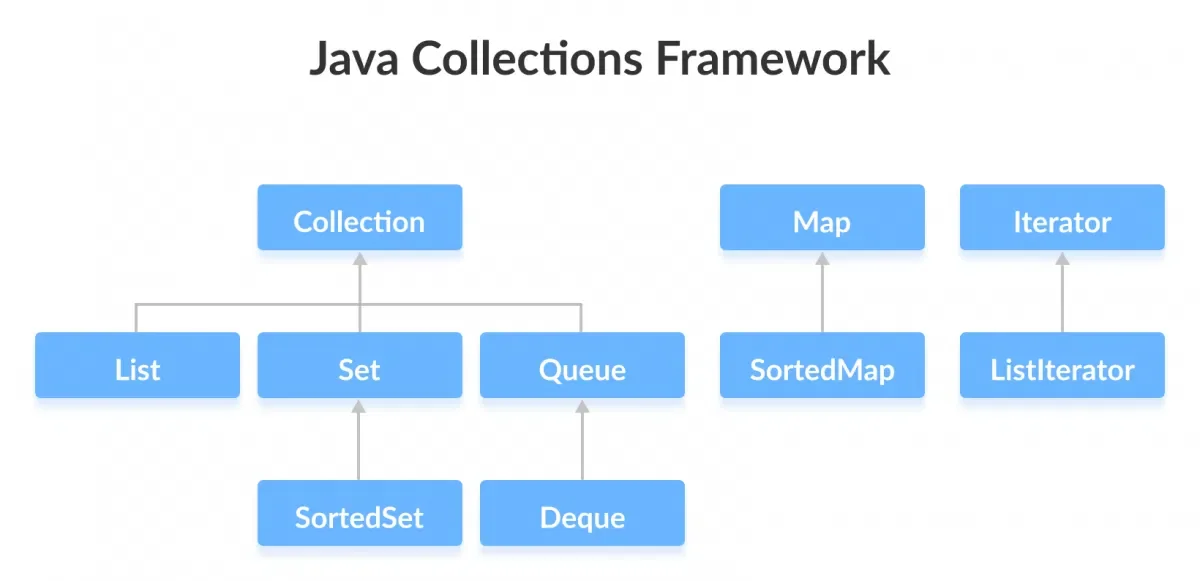
The Java Collection Framework (JCF) is the standardized architecture for representing and manipulating collections. It's a unified set of high-performance interfaces and their implementations, built into the core Java Development Kit (JDK).
Crucially, the JCF is an integral part of OpenJDK—the primary open-source implementation of the Java SE platform. This ensures it's available for free, has a low barrier to entry, and is accessible for every developer globally, providing a robust, quick setup for building enterprise-grade applications without proprietary dependencies. The JCF provides ready-to-use data structures and algorithms (like sorting and searching) in a consistent manner, greatly reducing development and testing overhead.
In modern enterprise systems, raw arrays are insufficient. The JCF offers benefits vital for scalable, production-ready code:
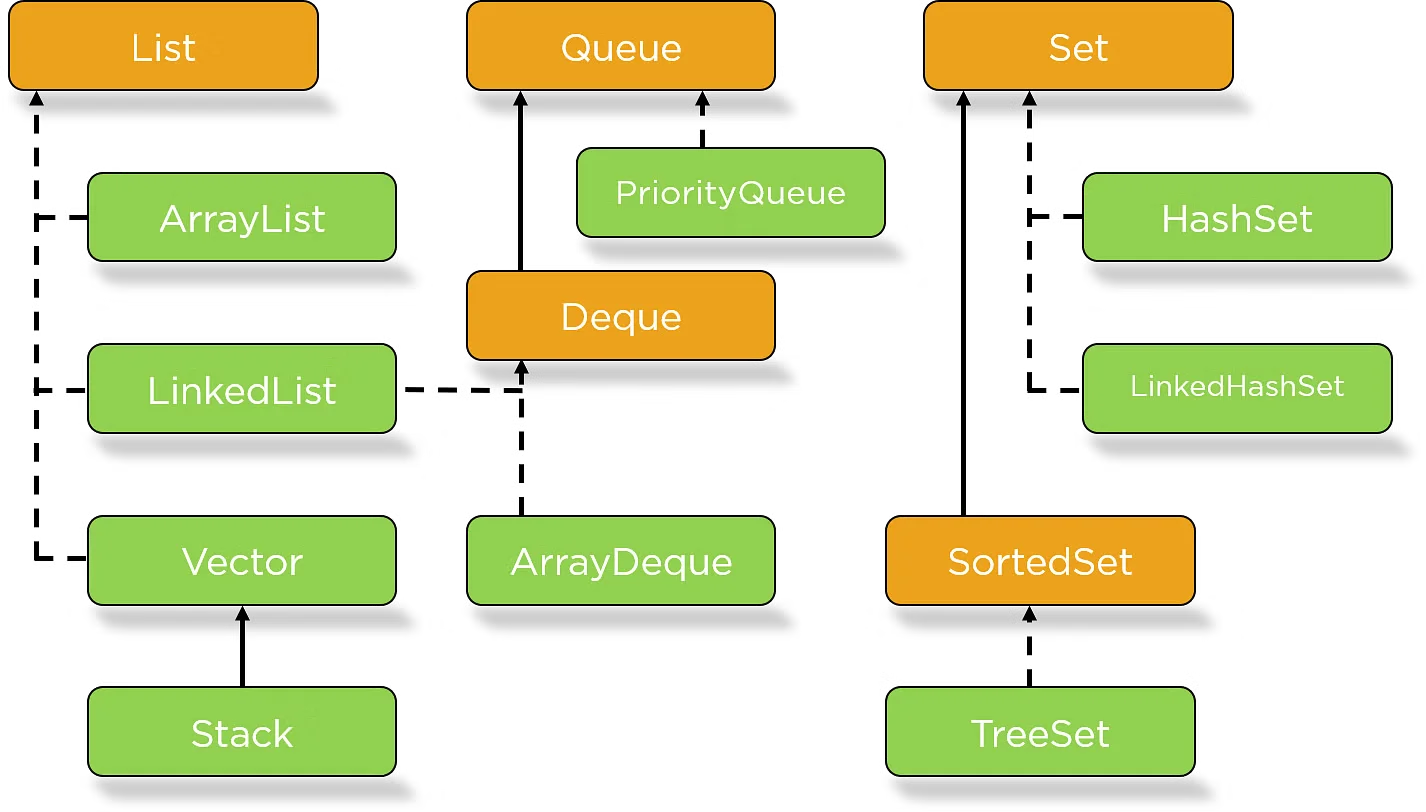
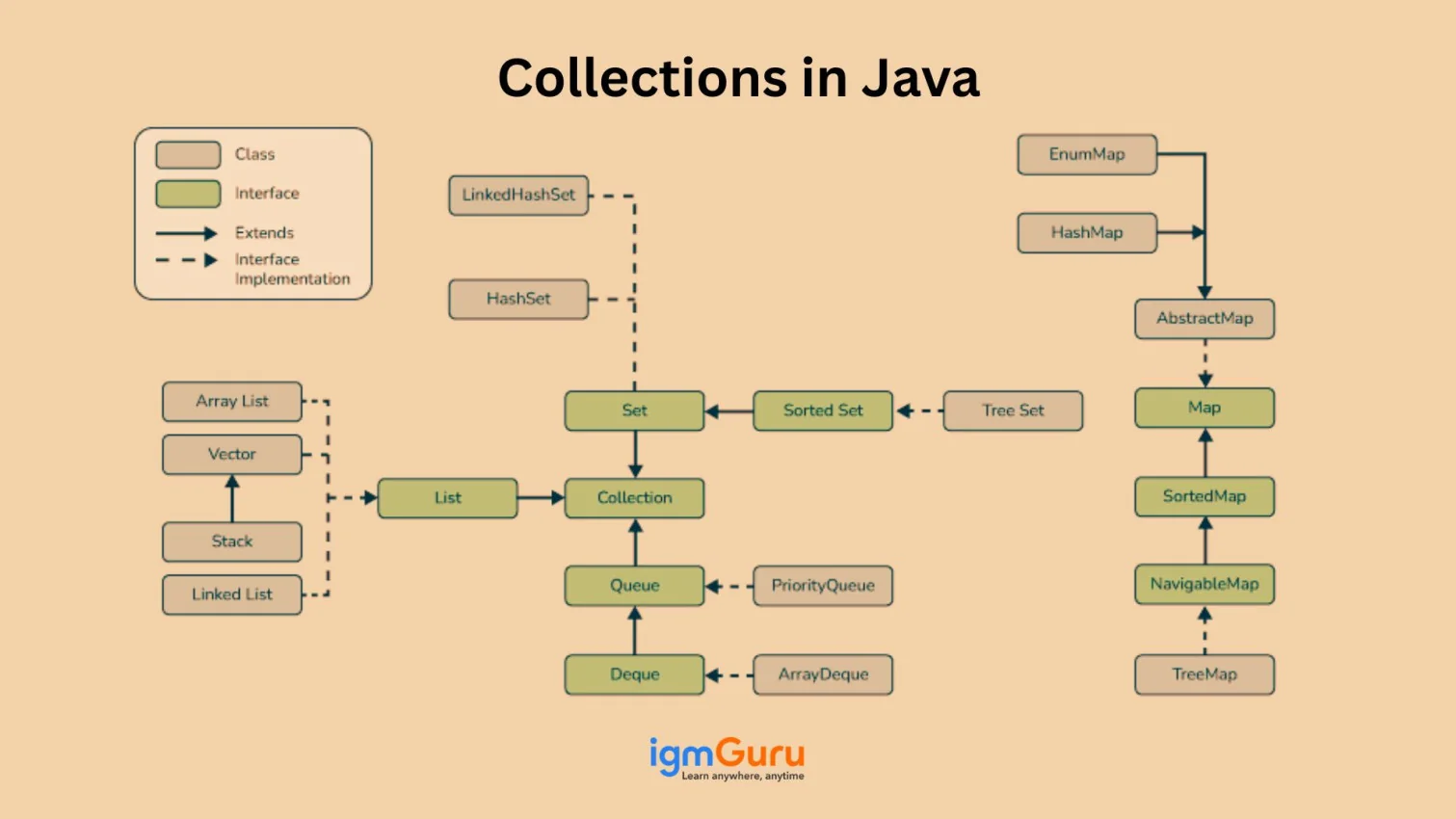
The JCF is built on a set of core interfaces, which define the contract, and concrete classes that provide the implementation. It begins with the Iterable interface, followed by the main Collection interface. The three main branches extending from Collection are:
The hierarchy also includes the Map interface, which is not technically a Collection (as it doesn't store a single list of elements) but is a foundational component of the framework, dealing with key-value pairs.
Related Article: What is an Interface in Java?
Choosing the right interface is the first step in optimizing performance for a specific high-value use case.
An ordered collection where elements are accessed by an integer index. Duplicates are allowed. The key decision here is implementation:
A collection that cannot contain duplicate elements, used to model the mathematical concept of a set.
Queues hold elements prior to processing, typically in a FIFO (First-In, First-Out) order. java.util.concurrent.BlockingQueue is the most critical implementation here, designed for:
An object that maps unique keys to values. While not a true Collection, it's indispensable for caching and data indexing. Key implementations:
Related Article- Java Tutorial | Learn Java Programming for Free
Here are the key implementation classes and their high-value use cases:
| Collection Class | Interface | Key Enterprise Use Case |
| ArrayList | List | Fast, read-heavy iteration over fixed database result sets. |
| LinkedList | List | Implementing small, frequently modified internal message lists. |
| HashSet | Set | Fast storage and deduplication of unique IDs (e.g., user sessions, product identifiers). |
| LinkedHashSet | Set | Maintaining unique items while preserving insertion order (e.g., user preferences). |
| ArrayDeque | Deque | High-performance, non-blocking stack or queue, preferred over Stack and LinkedList for most queue needs. |
| ConcurrentHashMap | Map | Thread-safe caching of configuration data or user tokens in a highly concurrent microservice. |
| LinkedHashMap | Map | Implementing a simple Least Recently Used (LRU) cache by overriding the removeEldestEntry method. |
| ArrayBlockingQueue | BlockingQueue | Fixed-size task queue for bounded thread pools (e.g., in ThreadPoolExecutor). |
As List, Set, and Queue all extend the Collection interface, they share a common set of fundamental methods. In modern Java, these methods are often used in conjunction with Java 8 Streams for efficient, declarative data manipulation.
| Method Signature | Behavior & Enterprise Relevance |
| boolean add(E e) | Adds an element. Return value is key for Sets: false if the element was a duplicate and not added. |
| boolean remove(Object o) | Removes a single instance of element. In concurrent collections, this operation is atomic. |
| int size() | Returns the count of elements. Note: In concurrent collections, this value can be quickly outdated. |
| boolean isEmpty() | Returns true if empty. For thread-safe checks, prefer specialized methods (e.g., ConcurrentHashMap.size() == 0). |
| boolean contains(Object o) | Returns true if the collection has a specific element. $O(1)$ in Hash-based structures. |
| Iterator<E> iterator() | Returns an iterator. In non-concurrent Lists/Sets, this can cause a ConcurrentModificationException if the collection is structurally modified by another thread. |
| void clear() | Removes all elements. |
| Stream<E> stream() | [Java 8+] Returns a sequential Stream for functional data processing (filter, map, reduce). |
| boolean removeIf(Predicate<? super E> filter) | [Java 8+] Removes all elements satisfying the given predicate, often more readable than an iterator loop. |
Also Explore: Java 21 Features
Here is an enterprise example simulating a thread-safe inventory system where multiple threads (sales, restock) modify item stock levels concurrently, and a Stream is used for reporting.
import java.util.concurrent.ConcurrentHashMap; // For thread-safe mapping import java.util.stream.Collectors; import java.util.Map; public class ConcurrentInventoryManager { // Using ConcurrentHashMap for thread-safe stock tracking private static final ConcurrentHashMap<String, Integer> INVENTORY = new ConcurrentHashMap<>(); public static void main(String[] args) { // Initialize inventory for demonstration INVENTORY.put("Laptop-X1", 15); INVENTORY.put("Monitor-P5", 40); INVENTORY.put("Keyboard-K9", 5); System.out.println("--- Initial Inventory Status ---"); System.out.println(INVENTORY); // 1. Enterprise Task: Atomically updating stock (high-value detail) // Safely decrement stock for a sale, ensuring no race conditions String item = "Laptop-X1"; int unitsSold = 2; INVENTORY.computeIfPresent(item, (key, value) -> value - unitsSold); System.out.println("\n--- Stock After Atomic Sale ---"); System.out.println(item + " stock remaining: " + INVENTORY.get(item)); // Output: 13 // 2. Enterprise Task: Using Java 8 Stream API for Reporting // Find all items with stock < 10 (low stock alert) System.out.println("\n--- Low Stock Alert (Stream API) ---"); Map<String, Integer> lowStockItems = INVENTORY.entrySet().stream() .filter(entry -> entry.getValue() < 10) .collect(Collectors.toMap(Map.Entry::getKey, Map.Entry::getValue)); System.out.println("Items for reorder: " + lowStockItems); // 3. Adding a new item INVENTORY.putIfAbsent("Mouse-M3", 50); System.out.println("\n--- Final Inventory Size: " + INVENTORY.size() + " ---"); } } |
Output:
--- Initial Inventory Status --- {Keyboard-K9=5, Monitor-P5=40, Laptop-X1=15} --- Stock After Atomic Sale --- Laptop-X1 stock remaining: 13 --- Low Stock Alert (Stream API) --- Items for reorder: {Keyboard-K9=5} --- Final Inventory Size: 4 --- |
This practical example demonstrates choosing the correct thread-safe collection (ConcurrentHashMap) and utilizing modern Java features (Stream API and computeIfPresent) to handle concurrent and complex data manipulations, which is typical of high-value enterprise applications.
The Java Collection Framework is the backbone of robust, scalable, and high-performance Java applications. By mastering the distinction between the core interfaces—particularly the concurrent variants like ConcurrentHashMap and BlockingQueue—you unlock the ability to design systems that handle massive concurrency and data volumes. Given its foundation in OpenJDK, the JCF offers a high-performance, open-source solution that remains a low-barrier-to-entry utility for developers worldwide. Keep experimenting with the java.util.Concurrent package to master true enterprise-grade data management!
A List is ordered and allows duplicates, making it ideal for sequential data access by index ($O(1)$ for get(index)). A Set is unordered and guarantees uniqueness, using hashing to achieve near-constant-time complexity ($O(1)$) for lookups, insertions, and deletions, which is better for real-time validation and deduplication.
A Collection represents a group of individual elements. A Map stores data as key-value pairs (entries), making it a different structural concept. It is managed by its own interface hierarchy because it operates on pairs, not single objects, but it is considered an integral part of the overall JCF architecture.
Choose ArrayList for most use cases, especially where fast random access by index or iteration over large datasets is needed (e.g., retrieving query results). Choose LinkedList only when you have a very specific need for frequent, rapid insertions and deletions in the middle of the list, a scenario less common than the ArrayList's superior performance for reads and cache locality.
The modern, high-performance, and thread-safe alternative to the legacy Hashtable (which uses a single lock for all operations) is ConcurrentHashMap. It achieves high concurrency and throughput by only locking the specific segment of the map being modified, making it the standard for concurrent caching and shared data structures.
Java provides several collection types such as List, Set, Queue and Map. These collections are used to store and manage groups of objects in different ways.