Cloud computing adoption continues to grow rapidly in 2026, with Microsoft Azure holding a significant share of the global cloud market. Organizations are actively hiring Azure-certified professionals to manage their cloud infrastructure, data, AI solutions, and DevOps environments. Anyone having a Microsoft Azure certification not only validates their cloud expertise but also increases their earning potential and career growth opportunities.
In this guide, I have conducted thorough research (Microsoft official) and consulted our Azure engineers to provide you with the most accurate and up-to-date list of top Azure certifications for 2026.
This table will give you a quick overview of the most popular and in-demand Azure certifications.
| Certification | Who It's For | Skills Covered | Prerequisites | Cost (USD) | Exam Validity |
|---|---|---|---|---|---|
| AZ-900 (Azure Fundamentals) | Beginners and non-technical professionals | Cloud concepts, Azure services, pricing, and security basics | No mandatory prerequisites | Varies by region | No expiry |
| AI-901 (Azure AI Fundamentals) | Beginners interested in AI and machine learning | AI fundamentals, generative AI, and Microsoft Foundry concepts | No mandatory prerequisites | Varies by region | No expiry |
| DP-900 (Azure Data Fundamentals) | Beginners interested in data roles | Core data concepts, relational and non-relational data, and analytics | No mandatory prerequisites | Varies by region | No expiry |
| AZ-104 (Azure Administrator Associate) | System administrators and cloud engineers | Identity, storage, virtual networks, compute, governance, and monitoring | Relevant IT knowledge and hands-on Azure experience recommended | Varies by region | 1 year |
| AI-200 (Azure AI Cloud Developer Associate) | Cloud developers building scalable AI-enabled applications | Azure SDKs, AI cloud solutions, data services, messaging, containers, and monitoring | Programming and Azure development experience recommended | Varies by region | 1 year |
| SC-500 (Cloud and AI Security Engineer Associate) | Cloud security engineers | Cloud security, identity, networking, compute, AI security, and compliance | Azure and hybrid security experience recommended | Varies by region | 1 year |
| AI-300 (Machine Learning Operations Engineer Associate) | Machine learning and AI operations professionals | Operationalizing machine learning and generative AI solutions | Relevant machine learning and cloud experience recommended | Varies by region | 1 year |
| DP-700 (Fabric Data Engineer Associate) | Data engineers | Data ingestion, transformation, analytics, and data engineering with Microsoft Fabric | Data engineering and SQL knowledge recommended | Varies by region | 1 year |
| PL-300 (Power BI Data Analyst Associate) | Data analysts | Data modeling, visualization, analysis, and Power BI reporting | Power Query and DAX knowledge recommended | Varies by region | 1 year |
| DP-300 (Azure Database Administrator Associate) | Database administrators | Azure SQL, database security, performance, availability, and optimization | Database and Azure SQL knowledge recommended | Varies by region | 1 year |
| AI-103 (Azure AI Apps and Agents Developer Associate) | AI engineers and application developers | Generative AI, AI agents, computer vision, text analysis, and information extraction | Python and Azure AI development knowledge recommended | Varies by region | 1 year |
| AZ-305 (Azure Solutions Architect Expert) | Experienced cloud architects | Cloud architecture, identity, governance, storage, networking, and business continuity | Azure Administrator Associate certification required to earn the Expert credential | Varies by region | 1 year |
| AZ-400 (DevOps Engineer Expert) | DevOps engineers | CI/CD, automation, source control, monitoring, and infrastructure delivery | Verify current certification eligibility and prerequisite requirements with Microsoft | Varies by region | 1 year |
Note: Exam prices vary by country or region. Certification requirements, exam objectives, and availability may change. Check Microsoft's official certification pages before registering.
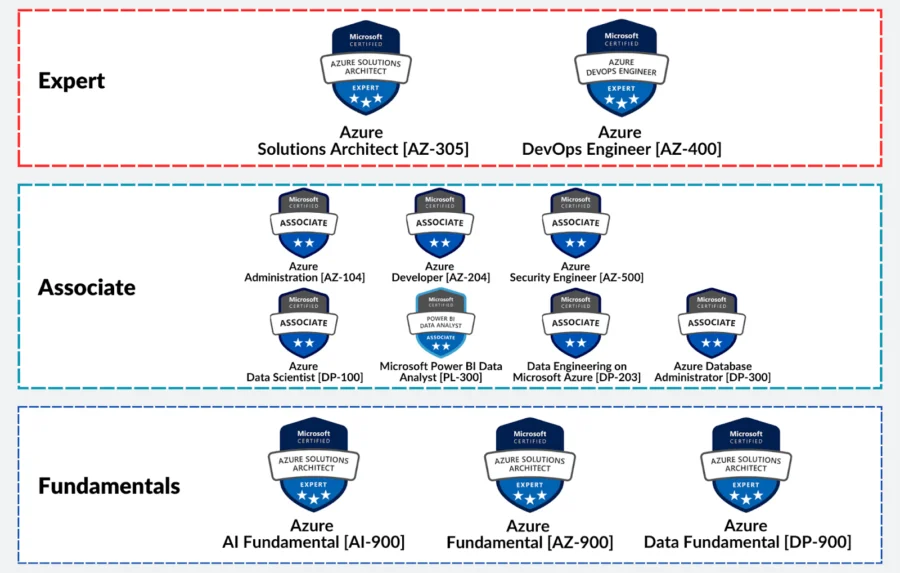
There are plenty of Azure certifications that you can choose from. However, what you should really go for depends highly on what your background is, your existing skill set, and your future goals. Here are the top certifications (based on category) for this year. Here is a list of certifications provided by Microsoft Azure-
These certifications are the first step in the Azure certification journey. These are made for freshers, as they cover basic cloud concepts and Azure services. This level is suitable for the ones who are new to cloud computing or looking to understand the basics.
The AZ-900 Azure Fundamentals certification covers the foundational knowledge of cloud services. Basics of cloud services, such as storage, security, computing, networking, etc., are covered.
Microsoft Azure AI Fundamentals is designed for beginners who want to understand artificial intelligence and its applications. The AI-901 exam replaces the retired AI-900 exam and updates the learning focus toward modern AI solutions, including generative AI and Microsoft Foundry.
This DP-900 certification is for the freshers working with data in the cloud, covering both technical and non-technical roles. Skills needed for this role are core data concepts, relational and non-relational data on Azure and analytics workloads.
These certifications are for those who have some experience in cloud services. They dig deeper into particular roles like Azure Administrator, Developer or Security Engineer. The Associate Azure Certifications need foundational knowledge of Azure and basically include more complicated concepts than the base level.
An Azure Administrator has the knowledge and skills to implement and manage the identity, compute, virtual networks, governance, and storage in the cloud. They also monitor and provision the resources in the cloud. To earn the Microsoft Azure Administrator Associate AZ-104 certification, you must have experience in using PowerShell, ARM Templates, Azure CLI, and Azure Portal.
The Microsoft Azure AI Cloud Developer Associate certification focuses on developing and implementing AI-enabled cloud solutions on Azure. It covers backend services, scalable application architectures, Azure SDKs, data management, messaging, monitoring, and the development lifecycle.
The Microsoft Cloud and AI Security Engineer Associate certification focuses on implementing security controls across cloud, hybrid, and AI-enabled environments. It covers identity protection, infrastructure security, networking, data protection, regulatory compliance, and security monitoring.
Microsoft's AI-300 certification pathway focuses on operationalizing machine learning and generative AI solutions. It is relevant to professionals working on deploying, managing, evaluating, and operating AI solutions in modern Microsoft cloud environments.
This certification is for Database administrators and data professionals. Skills needed to attain this certification are handling relational databases on Azure involving security, performance and availability.
The Microsoft Fabric Data Engineer Associate certification focuses on building and managing data engineering solutions using Microsoft Fabric. It covers data ingestion, transformation, orchestration, and the development of analytical data solutions.
This Power BI Data Analyst Associate certification is for data analysts who have a strong grip on Power BI for data analysis and visualization. The skills needed here are preparing data, modeling data, visualizing data, and analyzing data through Power BI.
This certification is for Azure AI engineers for creating and managing innovative tools in Azure for automating and letting machines do all the heavy work. Skills needed to attain this certificate are recognizing cloud automation needs, designing pipelines for AI apps and integrating bots with Azure extensions.
Related Article: DevOps Tutorial For Beginners
These certifications are the peak Azure credentials. Microsoft Expert Azure Certifications are for professionals, demanding an in-depth understanding of Azure services and architecture. These are suitable for the ones who have extended experience and focus in areas like Azure Solutions Architect or DevOps Engineer.
The Azure Solutions Architect Expert provides solutions for Microsoft Azure in storage, design, compute, security, and network. These professionals have the skills to implement authentication, configure infrastructure, and implement workloads.
A Microsoft DevOps Engineer Expert has prowess in designing and implementing strategies for code, source control, continuous integration, delivery, feedback, collaboration, infrastructure, compliance, monitoring, security, and testing. These professionals ensure a complete development and deployment cycle in the cloud by creating software automation pipelines.
Related Article - Microsoft Azure Tutorial
Before we move to the best Azure Certifications, let us take a closer look at the top reasons why you should go for Azure certifications for the coming year.
If you are reading this article, then the first question may arise in your mind: Which Azure certification should I choose? Well, choosing the right Azure certification can feel confusing, especially when there are multiple options across different roles and experience levels. The best certification for you depends on your background, current skills, and long-term career goals. Here's a simple decision-based guide to help you choose wisely.
If you are completely new to cloud computing or transitioning from a non-technical background, AZ-900 is the safest and smartest starting point for you. It introduces you to cloud concepts, Azure services, pricing models, security basics, and compliance principles without going too deep into technical implementation.
This certification builds your foundation. It helps you understand how Azure works before you move into specialized roles like administrator, developer, or architect. Even experienced professionals from other domains take AZ-900 to validate their cloud basics.
If you want to develop scalable cloud applications with AI capabilities, AI-200 is a relevant certification pathway to explore. It focuses on backend services, Azure SDKs, data services, messaging, and the development lifecycle for AI-enabled cloud solutions.
Before choosing this certification, review the current exam objectives to ensure they match your development goals and the types of Azure applications you want to build.
If your primary goal is to move to leadership roles, AZ-305 is one of the most rewarding Azure certifications in 2026. This certification is designed for professionals who architect end-to-end cloud solutions, including networking, storage, security, governance, and cost optimization.
Solutions Architects are responsible for designing scalable and secure systems for organizations. Because this role involves decision-making and strategic planning, it commands higher salaries compared to associate-level certifications.
If you aim to become a Cloud Architect but don’t yet have deep Azure experience, start with AZ-104 (Azure Administrator Associate). It gives you hands-on knowledge of managing virtual machines, storage, identity, networking, and governance.
Once you gain practical experience, move to AZ-305. This two-step path builds both implementation and design expertise, which is essential for architecture-level roles.
If you are interested in CI/CD pipelines, automation, infrastructure as code, monitoring, and deployment strategies, the AZ-400 (DevOps Engineer Expert) is the right certification. It suits professionals who enjoy improving development workflows and ensuring smooth cloud deployments.
This certification is ideal for developers and administrators who want to bridge the gap between development and operations.
AI-103 is designed for professionals who want to develop AI applications and agents using Python and Microsoft Foundry. It covers generative AI, agentic solutions, computer vision, text analysis, and information extraction.
Review the official exam objectives to determine whether this certification aligns with your current experience and career goals.
Read Also- Experts' Tips On How To Become An Azure Developer
Microsoft role-based and specialty certifications generally remain valid for one year after all requirements for earning the certification have been completed. Eligible certifications can be renewed through a free online renewal assessment on Microsoft Learn.
The renewal assessment allows certified professionals to demonstrate that their skills remain current with changes to Microsoft technologies. Check your Microsoft Learn certification profile for the renewal window and eligibility requirements.
Note: Microsoft Fundamentals certifications, such as Azure Fundamentals and Azure AI Fundamentals, do not expire. Renewal rules differ for other credentials, so check the official certification page for the latest requirements.
If you're still unsure which Microsoft Azure certification to pursue, compare them side by side based on career role, difficulty level, recommended experience, and typical career path.
| Certification | Level | Best For | Difficulty | Recommended Experience | Typical Job Roles |
|---|---|---|---|---|---|
| AZ-900 | Fundamental | Cloud beginners | Easy | No prior Azure experience | Cloud Support, IT Support, Beginner Cloud Roles |
| AI-901 | Fundamental | Beginners interested in AI | Easy | Basic cloud and AI knowledge is beneficial | AI Fundamentals Learner, Aspiring AI Professional |
| DP-900 | Fundamental | Beginners interested in data | Easy | Basic data concepts are beneficial | Aspiring Data Analyst, Junior Data Professional |
| AZ-104 | Associate | Azure administrators | Intermediate | Azure infrastructure, networking, and administration knowledge | Azure Administrator, Cloud Engineer |
| AI-200 | Associate | AI cloud developers | Intermediate | Programming, Python, and cloud development knowledge | Cloud Developer, AI Application Developer |
| AI-300 | Associate | Machine learning operations professionals | Intermediate to Advanced | Machine learning, Python, and AI operations knowledge | Machine Learning Operations Engineer, AI Operations Engineer |
| DP-700 | Associate | Data engineers working with Microsoft Fabric | Intermediate | SQL, data transformation, and data engineering knowledge | Fabric Data Engineer, Data Engineer |
| DP-300 | Associate | Database administrators | Intermediate | SQL Server, relational databases, and database administration knowledge | Azure Database Administrator, Database Administrator |
| PL-300 | Associate | Business intelligence professionals | Intermediate | Power BI, Power Query, and DAX knowledge | Power BI Data Analyst, Business Intelligence Analyst |
| AI-103 | Associate | AI application and agent developers | Intermediate to Advanced | Python, generative AI, and Azure AI development knowledge | AI Application Developer, AI Agent Developer |
| AZ-305 | Expert | Cloud solutions architects | Advanced | Strong Azure architecture and infrastructure knowledge | Azure Solutions Architect, Cloud Solutions Architect |
| AZ-400 | Expert | DevOps professionals | Advanced | Experience with Azure development or administration, CI/CD, and automation | Azure DevOps Engineer, DevOps Engineer |
Microsoft Azure offers certification pathways for cloud administrators, developers, security professionals, data engineers, AI specialists, and solutions architects. The right certification depends on your existing skills, career goals, and the technologies you want to work with. Before registering for an exam, verify its current availability and requirements on Microsoft Learn, particularly when a certification pathway has recently changed.
Azure Solutions Architect Expert is the Azure certification in high demand.
Both AZ-104 and AZ-204 serve different purposes and target different areas of Azure technology. Your aspirations for your career and future are the true deciding factors in which one is better for you.
Yes, you can take AZ-305 directly. However, it is not recommended to do so since a good amount of hands-on experience in Azure services is required. Thus, you must gain complete knowledge and skills beforehand to pass the exam.