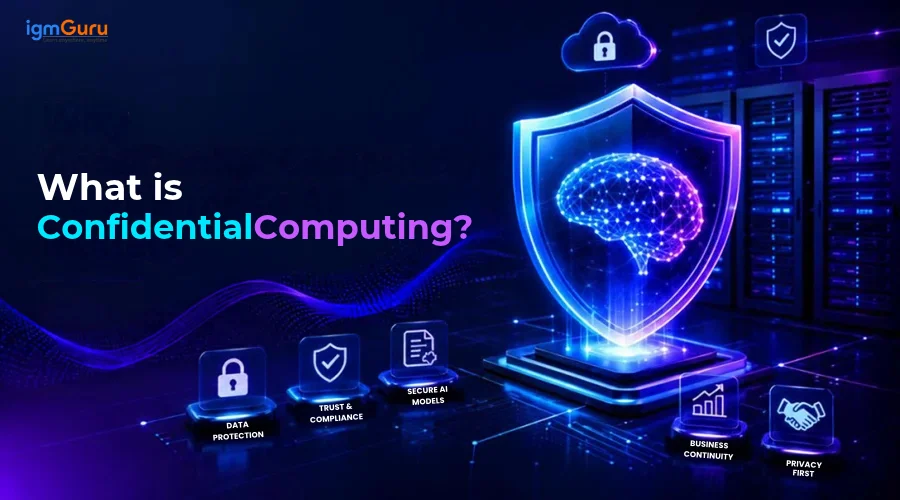
When considering data security, we usually think about two realms. We safeguard our information when it sits on hard disks (idle), as well as when it is on networks (in motion). But what happens when the data is being processed in computer memory? That’s where confidential computing comes in and fills a security gap that has existed for years.
The concept of confidential computing refers to a cloud and hardware security system used for the protection of data while it undergoes processing. In other words, all data remains encrypted even when it is processed in various applications or in the cloud.
In this article, I will explain what confidential computing is, its principles of operation and why it is important in modern data security. Let's start!
Read Also: What is the CIA Triad? Definition, Importance and Examples 2026
Confidential computing refers to a type of cloud and hardware security technology that protects the privacy of data being processed by computers. In the usual scenario, data is encrypted while at rest as well as during transmission. However, when being processed, data has to be decrypted, hence posing a risk to the data in memory and making it vulnerable to unauthorized access.
The importance of confidential computing has grown significantly as cloud computing and AI adoption have accelerated. Organizations now handle more sensitive data than ever before and they face stricter regulatory requirements around data privacy.
Your cloud provider can be honest, but that does not guarantee complete security. Malicious insiders or compromised administrators can still access unencrypted data in memory. Confidential computing protects you from this threat by keeping data encrypted throughout processing.
Regulations like GDPR, HIPAA, and other privacy laws require that organizations safeguard sensitive data. Confidential computing helps organizations meet these requirements by demonstrating that data remains protected during its entire lifecycle.
Many organizations hesitate to move sensitive workloads to the cloud due to security concerns. Confidential computing builds confidence by providing hardware-enforced protection that software controls alone cannot achieve.
According to recent reports, the global average cost of a data breach has reached over 4.88 million dollars. Confidential computing significantly reduces the attack surface, making data breaches far less likely.
The market reflects this growing importance. The confidential computing market reached 5.3 billion dollars in 2023 and is projected to grow to 59.4 billion dollars by 2028, with a compound annual growth rate of 62.1 percent. Industry leaders like Gartner have ranked confidential computing among the top three technologies to watch in 2026.
Also Read: What Is Endpoint Security?
Understanding how confidential computing works requires learning about its core components and how they interact. When you deploy a workload to run inside a Trusted Execution Environment, several things happen at the hardware level.
First, the processor creates an isolated execution context before the main operating system even loads. This isolated area, called a protected enclave, is separate from the rest of your system at the hardware level.
Memory assigned to this enclave is encrypted with encryption keys that are generated and managed by the processor itself. These keys are unique and never exposed to anyone, not even to the operating system. This means the contents of the enclave remain unreadable to anything outside the enclave boundary.
When code runs inside the TEE, it processes data in the clear, but the moment anything outside tries to access this data, it appears encrypted. A platform security processor embedded inside the CPU die manages this protection automatically. You do not need to do anything manually. The processor handles encryption and decryption transparently.
The processor isolates the TEE from other processes on the same machine, including other virtual machines, the host operating system and even users with root access. This isolation is enforced at the hardware level, making it far more resistant to attacks than software-based security alone.
All data within the TEE gets encrypted automatically. The processor generates unique encryption keys during system startup and manages them securely. These keys never leave the processor.
The TEE can prove to remote parties that specific code is running securely inside the protected environment. This process, called attestation, establishes trust between the enclave and external systems through secure communication channels.
When the TEE needs to send or receive data, it uses controlled pathways. The TEE and main system can share memory space to exchange information, but this shared memory is carefully managed to prevent unauthorized access.
Confidential computing relies on several core components working together. Understanding each component helps you grasp how the entire system achieves its security goals.
At the heart of confidential computing is the Trusted Execution Environment. A TEE is a secure area of your main processor. It guarantees that code and data loaded inside it are protected with respect to confidentiality and integrity. Confidentiality prevents unauthorized entities from reading data, while integrity prevents code in the TEE from being replaced or modified.
TEEs work through hardware-based memory encryption that isolates specific application code and data in memory. This isolation is not dependent on the operating system or software running on your machine. It is enforced directly at the hardware level.
Different processor manufacturers have developed their own TEE implementations:
A. Intel Software Guard Extensions (SGX): Intel's SGX creates a private region of encrypted memory called a secure enclave. The contents get decrypted only when accessed by the process running within the enclave.
B. AMD Secure Encrypted Virtualization (SEV): AMD's SEV encrypts each virtual machine's memory state using encryption keys that other virtual machines cannot access. This approach protects entire virtual machines, not individual processes.
C. Intel Trust Domain Extensions (TDX): Intel's newer TDX provides VM-based isolation with significantly improved memory capacity compared to earlier approaches.
D. ARM TrustZone: ARM processors include TrustZone, which provides application-level isolation for trusted code and data.
Attestation is the process by which a TEE proves to a remote party that authorized code is actually running inside the secure environment. This verification happens through cryptographic proofs that remote systems can verify without trusting the infrastructure operator.
When you deploy confidential AI models or process sensitive data in the cloud, attestation lets you confirm that the cloud provider is not running different code than what you authorized. This removes the need to trust the provider.
A platform security processor embedded inside the CPU die handles the critical security functions. This specialized processor manages encryption key generation, manages memory encryption, handles attestation processes and enforces isolation boundaries. It operates independently, ensuring security even if the main CPU is compromised.
Also Read: What Is Multi-Factor Authentication?
You might wonder how confidential computing differs from traditional encryption methods. Understanding these differences helps you choose the right security approach for your needs.
| Feature | Confidential Computing | Traditional Encryption |
| Purpose | Protects data while it is being processed in memory. | Protects data when it is stored or transmitted. |
| Data Protection State | Secures data at rest, in transit and in use. | Primarily secures data at rest and in transit. |
| Processing Security | Data remains encrypted even during computation inside a trusted execution environment (TEE). | Data must be decrypted before processing, exposing it in memory. |
| Security Risk | Reduces risks from insiders, malware and compromised operating systems. | Vulnerable when decrypted for processing. |
| Technology Used | Trusted Execution Environments (TEEs), secure enclaves, hardware-based isolation. | Cryptographic algorithms such as AES, RSA and TLS/SSL. |
| Cloud Security | Enables secure processing of sensitive workloads in public and hybrid clouds. | Protects stored and transmitted cloud data but not data during processing. |
| Compliance Support | Helps meet strict regulatory and privacy requirements for sensitive data. | Supports compliance by encrypting stored and transmitted information. |
| Performance Impact | May introduce some overhead due to secure enclave operations. | Generally lower overhead for standard encryption tasks. |
| Typical Use Cases | Healthcare analytics, financial services, AI/ML workloads, confidential cloud computing. | Secure file storage, database encryption, VPNs, HTTPS communication. |
| Level of Protection | Provides end-to-end protection throughout the data lifecycle. | Provides partial protection, leaving data exposed during processing. |
Machine learning models, especially large language models and deep learning systems, require access to massive amounts of data during training. In regulated industries like healthcare and finance, this data is extremely sensitive. Organizations cannot afford to share raw customer data with cloud providers, model developers, or AI vendors.
Confidential computing solves this dilemma. Organizations can now train and deploy AI models on sensitive data while keeping the data encrypted throughout the entire process.
Organizations can train machine learning models on confidential data without exposing this data:
Federated Learning: Multiple organizations can collaborate to train shared models without sharing raw data. Each organization trains the model on its local data inside a TEE and only model updates (not raw data) are shared with other participants.
Multi-Party Model Training: Two or more companies can train a joint model on combined data without exposing their individual data to each other or to the infrastructure provider.
Fine-tuning on Proprietary Data: Businesses can customize foundation models (like large language models) on their proprietary data without exposing this data to model providers.
After models are deployed, confidential computing protects data during inference:
Privacy-Preserving Prediction: When you submit data to an AI model for prediction, the data is processed inside a TEE. The model provider sees neither your input nor the prediction result.
Healthcare AI Diagnosis: A patient can submit their medical data to an AI diagnostic system without the healthcare AI company ever seeing the patient's medical records.
Financial Risk Assessment: Investors can get AI-powered risk assessments of their portfolios without exposing portfolio holdings to the model provider.
Confidential computing also protects the AI model itself:
Proprietary Model Protection: Model developers can run inference on customer data without exposing their proprietary model parameters to customers or infrastructure providers.
Model IP Security: When competitors or attackers try to extract model parameters (model stealing attacks), confidential computing makes this far more difficult.
License Compliance: Model providers can ensure that customers use models according to licensing terms without modifying the model or using it outside authorized contexts.
Read Also: What is a Supply Chain Attack?
Confidential computing provides numerous benefits that extend across different industries and use cases.
The primary benefit is ironclad data protection. Confidential computing guarantees that sensitive information remains encrypted throughout processing. Even if an attacker gains access to your system or cloud infrastructure, your data remains protected because it stays encrypted.
Your organization can now process sensitive data on shared infrastructure without worrying about insider threats from cloud provider employees or compromised administrators. The hardware-enforced encryption ensures that even these high-privilege users cannot access unencrypted data.
Confidential computing helps organizations meet stringent compliance requirements. By demonstrating that data remains encrypted during processing, organizations can satisfy GDPR, HIPAA, PCI-DSS, and other privacy regulations more easily.
Many organizations hesitate to move sensitive workloads to public clouds. Confidential computing removes this barrier by providing hardware-enforced protection that works in multi-tenant cloud environments. You can process your most sensitive data on shared cloud infrastructure with confidence.
Organizations can now collaborate on data analysis and insights without sharing raw data. Two or more organizations can process a combined dataset using confidential computing without exposing their individual datasets to each other. This enables secure research partnerships, joint analytics projects and collaborative AI model training.
As organizations deploy AI models for sensitive applications (healthcare diagnostics, financial fraud detection, personal data analysis), confidential computing protects both the training data and the model itself. This enables confident use of AI in regulated industries.
While confidential computing requires specialized hardware, it enables organizations to run sensitive workloads on cost-effective public cloud infrastructure rather than building expensive private data centers. This shifts capital expenditure to operational expenditure while maintaining or improving security.
While confidential computing is powerful, it does have real limitations that you should understand before deploying it.
1. High Implementation Cost: Specialized hardware and infrastructure can increase deployment expenses.
2. Complex Deployment: Setting up and managing confidential computing environments requires technical expertise.
3. Limited Hardware Support: Only certain processors, devices and cloud platforms currently support confidential computing.
4. Performance Overhead: Additional security measures can slightly impact system speed and processing efficiency.
5. Application Compatibility Issues: Some existing applications may require updates or modifications to work effectively.
6. Trust and Verification Challenges: Organizations need to verify that hardware and software providers implement security features correctly.
Confidential computing adoption is accelerating across multiple sectors, each with unique requirements and use cases.
Banks and financial institutions are among the earliest adopters. They are using confidential computing to secure payment systems, detect fraud and ensure compliance with financial regulations.
Payment Processing: Payment processors can run confidential computing to secure transaction data from system administrators and infrastructure providers.
Fraud Detection: Banks deploy machine learning models in TEEs to detect fraudulent transactions without exposing transaction history to anyone.
Compliance Auditing: Financial firms run audit systems in confidential environments to satisfy regulatory requirements while protecting sensitive financial data.
Healthcare organizations are rapidly adopting confidential computing to comply with HIPAA and enable collaborative medical research.
Patient Data Analysis: Healthcare providers analyze patient data in TEEs to develop treatment plans while maintaining HIPAA compliance.
Medical Research: Research institutions collaborate on studies without exposing individual patient data to researchers from other institutions.
Pharmaceutical Companies: Drug makers use confidential computing to analyze clinical trial data and accelerate drug discovery.
Governments around the world are adopting confidential computing to protect citizen data and enable inter-agency collaboration.
Census and Statistics: Statistical agencies process citizen data to produce aggregate statistics while protecting individual privacy.
National Security: Defense and intelligence agencies use confidential computing to collaborate with contractors without exposing classified information.
Public Health: Government health agencies analyze epidemiological data to track disease spread and guide public health policy.
Major cloud providers and technology companies are building confidential computing capabilities directly into their platforms.
Microsoft Azure: Offers confidential computing for Windows and Linux workloads using AMD SEV-SNP and Intel TDX.
Google Cloud: Provides confidential computing for containerized workloads and virtual machines.
AWS: Is developing confidential computing offerings based on Nitro Enclaves and other technologies.
Ad networks and media companies are using confidential computing to enable privacy-preserving analytics.
Audience Analytics: Publishers analyze user behavior without exposing individual user data to advertisers or platforms.
Privacy-Preserving Targeting: Ad networks optimize ad delivery while protecting user privacy.
Telecom operators are adopting confidential computing to process customer data for network optimization and fraud prevention.
Network Optimization: Telecom operators can analyze network traffic patterns to improve service quality without exposing customer data.
Fraud Prevention: Carriers can detect fraudulent usage patterns without exposing customer call details.
Related Article: What is Phishing?
The future of Confidential Computing is optimistic because its increasing adoption in various fields, including AI, cloud computing, healthcare, finance, and edge computing, ensures its inevitable future popularity. It will help organizations securely run joint projects related to sensitive data, allow them to comply with changing privacy regulations, and facilitate building Zero Trust architectures.
Advancements in hardware, cloud services and industry standards will facilitate deployment efforts, and soon, Confidential Computing will become an integral part of cybersecurity and data protection approaches.
Confidential computing represents a fundamental shift in how we approach data security. By protecting data while it is being used, not just at rest or in transit, confidential computing addresses a critical security gap that has existed since the beginning of modern computing.
For organizations handling sensitive data in healthcare, finance, government, or other regulated industries, confidential computing is no longer a theoretical future technology. It is practical and available today. Major cloud providers offer confidential computing services. Hardware manufacturers continue to improve TEE capabilities. The industry is investing heavily in this space.
However, confidential computing is not a magic solution. It does have real limitations, particularly around side-channel attacks and implementation complexity. Organizations should evaluate their specific security needs and threat models before deciding whether confidential computing is right for them.
For organizations that need to protect data during processing and that handle sensitive information in cloud environments, confidential computing is worth serious consideration. It provides security guarantees that traditional encryption cannot match. As the technology matures and adoption increases, confidential computing will likely become a standard part of any comprehensive data security strategy.