An AI that chats just like a close friend, decodes images, writes code and explains live sports in real time. It is all possible with GPT-4. OpenAI's chatbot is powered by the GPT-4 and GPT-4o models. It was launched in March 2023. This technology blends text, vision and voice to create seamless and human-like interactions. ChatGPT provides everything- even if you are a student nailing homework, a coder squashing bugs or a business boosting efficiency.
This guide will help you in understanding what is GPT-4, its visionary goals and many more like its features, use cases, limitations and pricing. Let's begin.
TL;DR
- GPT-4 is OpenAI’s multimodal AI model built for more capable reasoning, instruction-following, and image understanding. Compared with GPT-3.5, it delivers stronger performance across reasoning, academic, and coding tasks.
- GPT-4 can work with text and images, while GPT-4o expands these capabilities with real-time voice, audio, and video. It can also analyze data, interpret charts and screenshots, assist with coding, and adapt its responses through steerable instructions.
- The model can be used for education, coding, healthcare, business, content creation, language learning, accessibility, research, and automation, making it useful for both professional workflows and everyday tasks.
- GPT-4 is most valuable when a task requires more than simple text generation—such as complex reasoning, contextual understanding, analysis, problem-solving, or working with visual information.
GPT-4 is essentially ChatGPT enhanced with GPT-4. It is OpenAI's fourth-generation Generative Pre-trained Transformer model. GPT-4 is a multimodal AI that processes both text and images to give intelligent text responses as output. It was trained on massive datasets from the internet and licensed sources by using techniques like reinforcement learning from human feedback (RLHF). It is to align with user needs and safety guidelines.
It is not like earlier models. It excels in complex reasoning, creativity and handling nuanced instructions. For instance- it can analyze an image of a menu in another language, translate it and suggest dishes based on dietary preferences. As per OpenAI's official research, GPT-4 achieves human-level performance on benchmarks like the Uniform Bar Exam and it scores in the top 10%. It is a huge jump from GPT-3.5's bottom 10%.
In 2024, OpenAI introduced GPT-4o ('o' for omni), which builds on GPT-4 by adding real-time voice, audio and video capabilities. By April 2025, OpenAI announced GPT-4 would be replaced in ChatGPT by GPT-4o by month's end to make advanced features more accessible. Now, free users get GPT-4o with limits and paid users get expanded access. This evolution keeps this model relevant for tasks from casual chats to professional analysis.
Explore igmGuru's Generative AI training program for a complete career transformation.
OpenAI's vision for ChatGPT-4 centers on scaling AI safely and accessible to benefit humanity. They rebuilt their deep learning infrastructure with Azure to create a supercomputer for stable training. This helps with the prediction feature. OpenAI can accurately forecast GPT-4's performance before full training.
The core vision also includes safety and alignment. After six months of iterative improvements that include adversarial testing and RLHF, GPT-4 reduces harmful outputs by 82% and boosts factuality. One of their main goals was to create an AI that's steerable, refuses unsafe requests and evolves with user feedback. OpenAI also uses open-sourced tools like Evals for community-driven benchmarks.
In the long run, the vision also includes multimodal expansion. GPT-4o's real-time voice and vision aim to make AI feel natural like explaining rules during a live sports stream.
This model packs innovative features that set it apart. These features make GPT-4 versatile for beginners and experts alike. Here is a breakdown in bullet points for easy scanning:
It accepts text and images. It can describe a photo, solve diagram-based questions or summarize screenshots.
It can handle up to 8,192 tokens (about 6,000 words). GPT-4 Turbo extends to 128K for longer conversations.
It uses system messages to customize tone. It responds as a Socratic tutor who asks guiding questions instead of giving answers.
It outperforms in 24 of 26 languages tested to include low-resource ones like Latvian or Swahili.
It can do real-time audio processing and converse naturally. It can explain videos or translate spoken languages across 50+ options.
Upload charts or datasets to get insights, create visualizations or run code interpretations.
It connects to external tools for browsing, image generation (via DALL-E) or code execution.
Read Also- GPT-5 Explained: New Features, Pricing, and more
Getting started with this model is straightforward. Follow these steps:
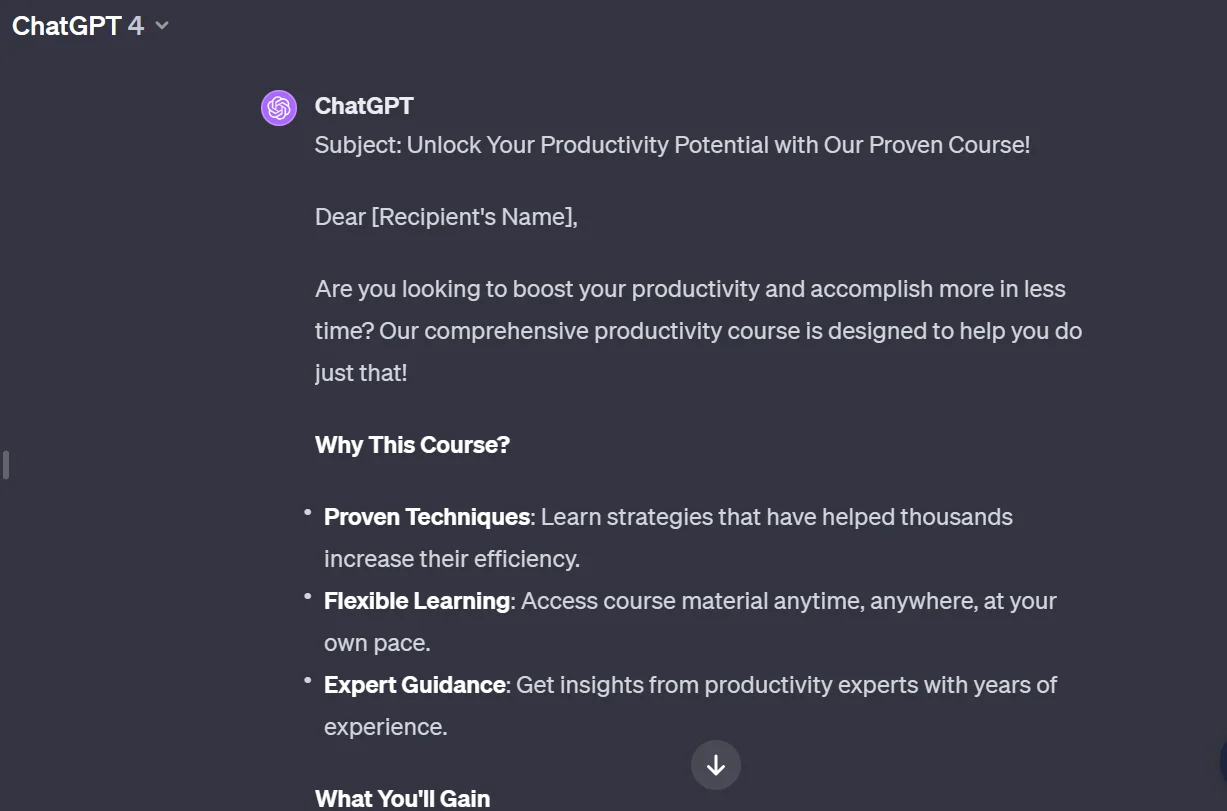
GPT-4 has a lot of strengths. It brings powerful capabilities to life across diverse scenarios. To understand it in a better way let us look at some real-world examples. These examples highlight how this model tackles data reasoning, productivity guidance and creative content creation with ease.
1. The prompt that is given: Give me 5 practical tips to boost my workday productivity.
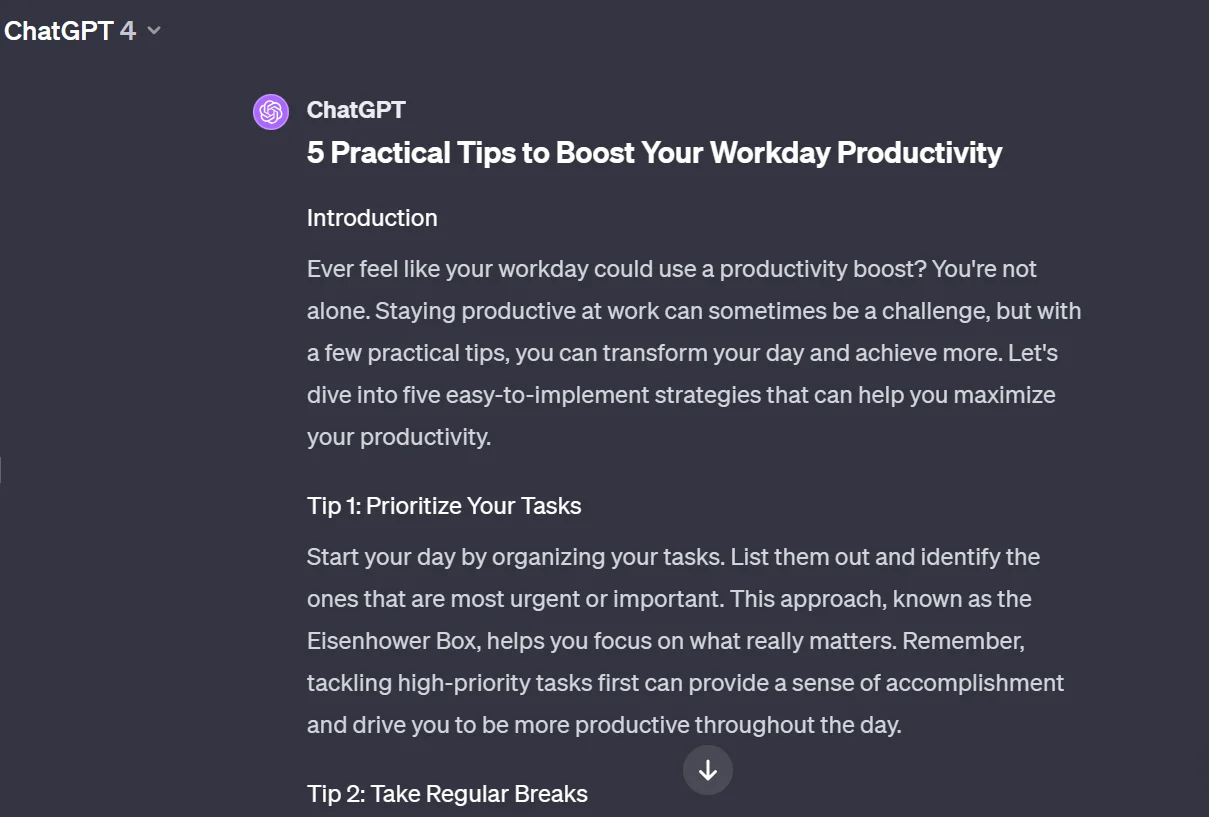
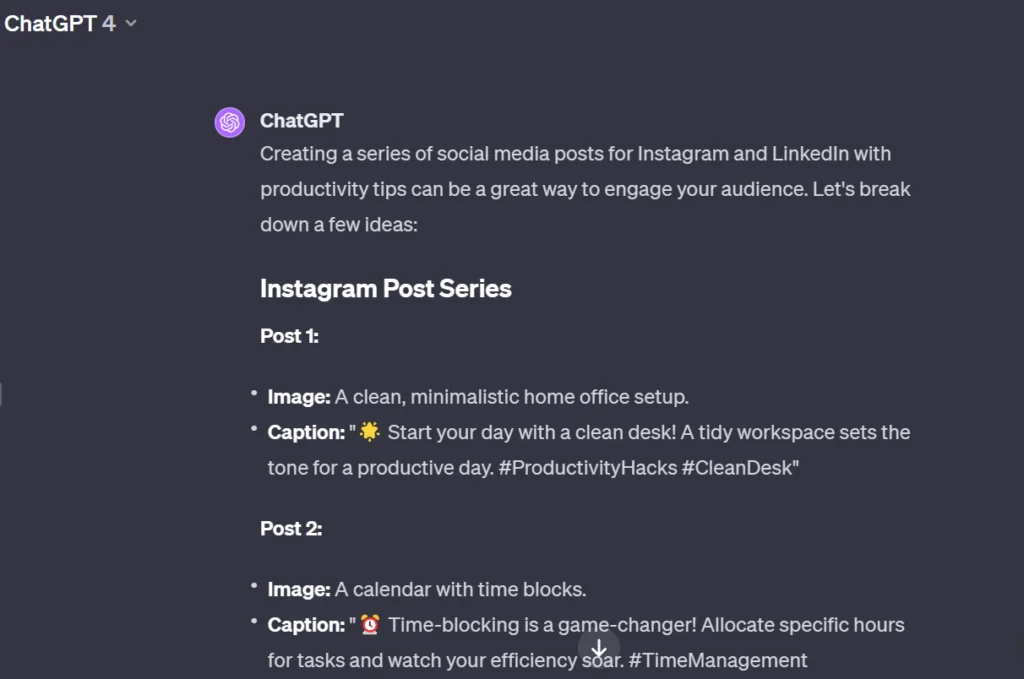
2. The prompt which is given- Create a series of social media posts for Instagram and LinkedIn with productivity tips.
3. The prompt that is given- Write a marketing email promoting an online productivity course. Keep the tone professional but encouraging.
Read Also- ChatGPT Agent: Ultimate Guide to OpenAI's AI Assistants
This model shines in various scenarios. In education, it acts as a personalized tutor. Students can upload math problems with diagrams and it guides solutions step-by-step without spoiling answers. Teachers can use it to generate lesson plans or grade essays.
Here are some use cases and applications of GPT-4 for professionals.
Here are some use cases and applications of GPT-4 for end-users.
Read Also- How To Build AI Agents- An Ultimate Guide For Beginners
This model comes with flexible pricing plans. It includes from free plan to teams and enterprise.
| Plan | Cost | Features |
| Free | $0 | GPT-4o with limits; switches to GPT-3.5; basic voice/image. |
| Plus | $20/month | Unlimited GPT-4/GPT-4o; 5x message limits; plugins, DALL-E. |
| Team | Custom | Collaboration tools; higher limits. |
| Enterprise | Custom | Scalable API; advanced security. |
| API (GPT-4) | $0.03/1K prompt tokens; $0.06/1K completion | 8K context; double for 32K. |
OpenAI tested GPT-4 on a variety of benchmarks. It includes challenging exams designed for humans. They used the most recent publicly available tests for Olympiad and AP free-response questions. For other cases, they relied on 2022-2023 practice exam editions. The model was not specifically trained for these exams. Although small questions had been part of its training data, the results are still considered a fair representation of its capabilities. For more representative data you can see the official technical report.
| Simulated Exams | GPT-4 estimated percentile | GPT-4 (no vision) estimated percentile | GPT-3.5 estimated percentile |
| Uniform Bar Exam (MBE+MEE+MPT) | 298/400 ~90th | 298/400 ~90th | 213/400 ~10th |
| LSAT | 163 ~88th | 161 ~83rd | 149 ~40th |
| SAT Evidence-Based Reading & Writing | 710/800 ~93rd | 710/800 ~93rd | 670/800 ~87th |
| SAT Math | 700/800 ~89th | 690/800 ~89th | 590/800 ~70th |
| Graduate Record Examination (GRE) Quantitative | 163/170 ~80th | 157/170 ~62nd | 147/170 ~25th |
| Graduate Record Examination (GRE) Verbal | 169/170 ~99th | 165/170 ~96th | 154/170 ~63rd |
| Graduate Record Examination (GRE) Writing | 4/6 ~54th | 4/6 ~~54th | 4/6 ~54th |
| USABO Semifinal Exam 2020 | 87/150 99th-100th | 87/150 99th-100th | 43/150 31st-33rd |
| USNCO Local Section Exam 2022 | 36/60 | 38/60 | 24/60 |
| Medical Knowledge Self-Assessment Program | 75% | 75% | 53% |
| Codeforces Rating | 392 below 5th | 392 below 5th | 260 below 5th |
| AP Art History | 5 86th-100th | 5 86th-100th | 5 86th-100th |
| AP Biology | 5 85th-100th | 5 85th-100th | 4 62nd-85th |
| AP Calculus BC | 4 43rd-59th | 4 43rd-59th | 1 0th-7th |
| AP Chemistry | 4 71st-88th | 4 71st-88th | 2 22nd-46th |
| AP English Language and Composition | 2 14th-44th | 2 14th-44th | 2 14th-44th |
| AP English Literature and Composition | 2 8th-22nd | 2 8th-22nd | 2 8th-22nd |
| AP Environmental Science | 5 91st-100th | 5 91st-100th | 5 91st-100th |
| AP Macroeconomics | 5 84th-100th | 5 84th-100th | 2 33rd-48th |
| AP Microeconomics | 5 82nd-100th | 4 60th-82nd | 4 60th-82nd |
| AP Physics 2 | 4 66th-84th | 4 66th-84th | 3 30th-66th |
| AP Psychology | 5 83rd-100th | 5 83rd-100th | 5 83rd-100th |
| AP Statistics | 5 85th-100th | 5 85th-100th | 3 40th-63rd |
| AP US Government | 5 88th-100th | 5 88th-100th | 4 77th-88th |
| AP US History | 5 89th-100th | 4 74th-89th | 4 74th-89th |
| AP World History | 4 65th-87th | 4 65th-87th | 4 65th-87th |
| AMC 10 | 30/150 6th-12th | 36/150 10th-19th | 36/150 10th-19th |
| AMC 12 | 60/150 45th-66th | 48/150 19th-40th | 30/150 4th-8th |
| Intro Sommelier (theory knowledge) | 92% | 92% | 80% |
| Certified Sommelier (theory knowledge) | 86% | 86% | 58% |
| Advanced Sommelier (theory knowledge) | 77% | 77% | 46% |
| Leetcode (easy) | 31/41 | 31/41 | 12/41 |
| Leetcode (medium) | 21/80 | 21/80 | 8/80 |
| Leetcode (hard) | 3/45 | 3/45 | 0/45 |
OpenAI also evaluated GPT-4 on traditional benchmarks commonly used for testing machine learning models. In these evaluations, this model performed far better than existing large language models and even surpassed most state-of-the-art models that include those that may have been fine-tuned or optimized specifically for certain benchmarks.
| Benchmark | GPT-4 Evaluated few-shot | GPT-3.5 Evaluated few-shot | LM SOTA Best external LM evaluated few-shot | SOTA Best external model (includes benchmark-specific training) |
| MMLU Multiple-choice questions in 57 subjects (professional & academic) | 86.4% 5-shot | 70.0% 5-shot | 70.7% 5-shot U-PaLM | 75.2% 5-shot Flan-PaLM |
| HellaSwag Commonsense reasoning around everyday events | 95.3% 10-shot | 85.5% 10-shot | 84.2% LLAMA (validation set) | 85.6% ALUM |
| AI2 Reasoning Challenge (ARC) Grade-school multiple-choice science questions. Challenge-set. | 96.3% 25-shot | 85.2% 25-shot | 84.2% 8-shot PaLM | 85.6% ST-MOE |
| WinoGrande Commonsense reasoning around pronoun resolution | 87.5% 5-shot | 81.6% 5-shot | 84.2% 5-shot PALM | 85.6% 5-shot PALM |
| HumanEval Python coding tasks | 67.0% 0-shot | 48.1% 0-shot | 26.2% 0-shot PaLM | 65.8% CodeT+GPT 3-5 |
| DROP (f1 score) Reading comprehension & arithmetic. | 80.9 3-shot | 64.1 3-shot | 70.8 1-shot PaLM | 88.4 QDGAT |
This guide has provided everything you need to know about GPT-4 from its origins and vision to its standout features, real-world applications and benchmark results. You now have a clear picture of how GPT-4 can fit into your workflow, whether you are a student, professional or just curious about AI. The capabilities are even broader now with the integration of GPT-4o's added voice, vision and real-time abilities. Just try it out for yourself and see how this AI can make your work and learning easier.
No, GPT-4 is not free to use. It can be accessed after the subscription(20$ per month)
GPT-4 is more accurate, better at reasoning and supports multimodal input. It can work with both text and images. It also performs much better in benchmark tests.
Yes, it can process images, describe them, answer questions about them and even interpret diagrams or charts.
GPT-4 is best for handling complex reasoning, generating high-quality content, and understanding nuanced context in conversations.
GPT-4 is used for tasks like writing, coding, research assistance, data analysis, and creating personalized learning or business solutions.
Course Schedule
| Course Name | Batch Type | Details |
| Generative AI Course | Every Weekday | View Details |
| Generative AI Course | Every Weekend | View Details |