Digital marketing has become one of the most important growth tools for businesses today. It does not matter whether you run a small shop or a big company; digital marketing is necessary for every business today.
The digital advertising industry is growing at a massive speed. According to a Research and Markets report, the global digital advertising market was valued at $563.4 billion in 2021 and is expected to reach around $1.3 trillion by 2027. This clearly shows how fast businesses are shifting from traditional marketing to digital marketing.
Today, people search on Google before buying anything, scroll Instagram for product discovery and trust online reviews more than advertisements. That is why digital marketing is no longer optional. If a business is not using SEO, GEO, social media, Google Ads and online branding, it will lose customers to competitors.
In this article, we will discuss the top benefits of digital marketing, how it helps businesses grow and why it is essential in 2026.
Digital marketing is the process of promoting a business, product or service. It is done by using online platforms and digital channels such as search engines, social media, websites, email and mobile apps. It is also known as online marketing or internet marketing.
The main goal of digital marketing is to reach the right audience, increase brand awareness, generate leads and drive more sales using the internet.
It is not like traditional marketing (TV, newspaper, banners). Digital marketing allows businesses to connect with customers in a faster, cheaper and more targeted way. It also helps businesses in tracking results like website traffic, clicks, conversions and customer engagement in real time.
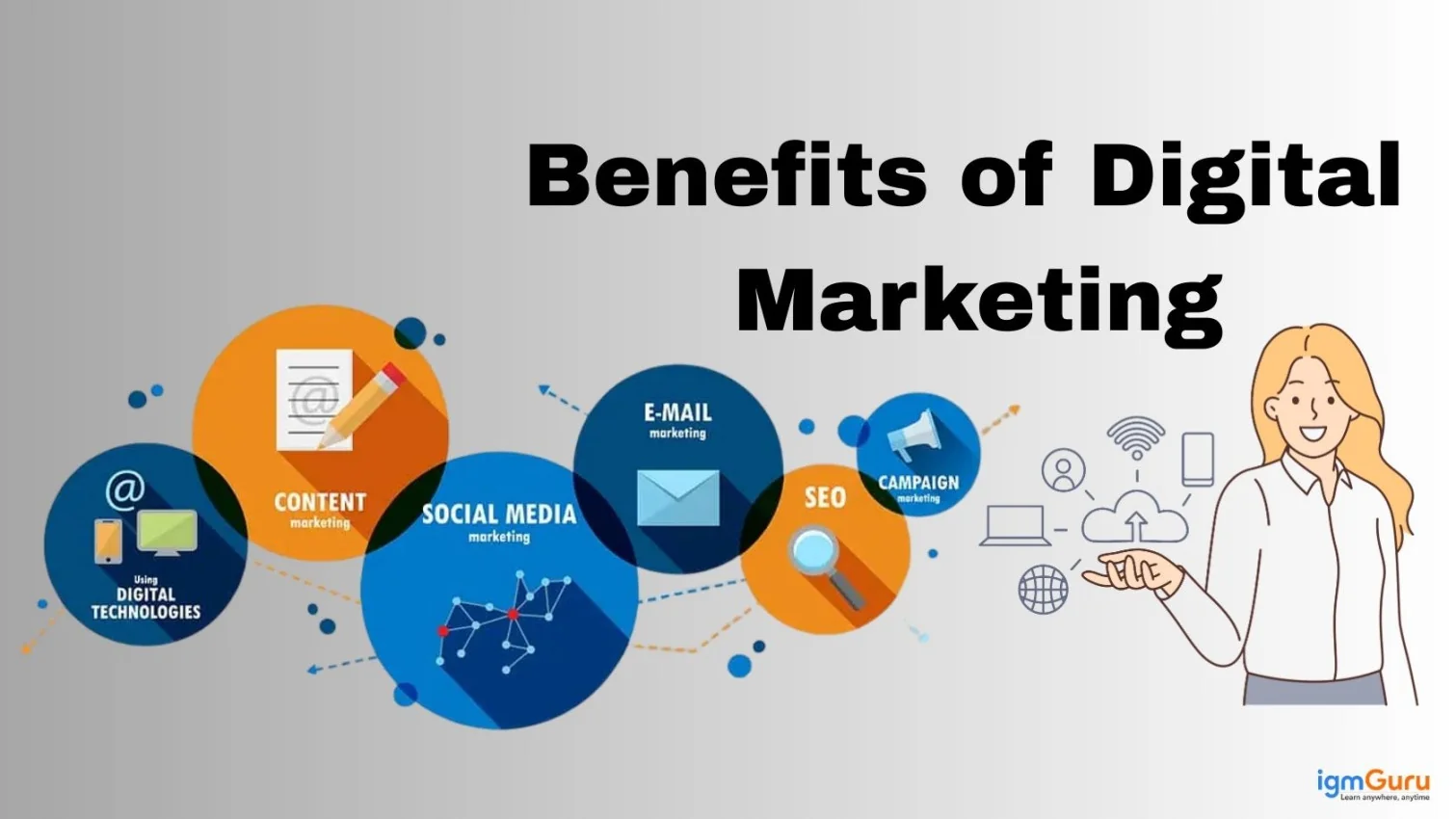
Digital marketing includes different online marketing methods like SEO (Search Engine Optimization), PPC (Google Ads), social media marketing, content marketing, email marketing, affiliate marketing, social media optimization and mobile marketing. By these channels businesses promote their products online, increase website traffic, generate leads and boost sales.
In 2026, digital marketing is important because customer behavior is now fully digital-first. Now, people spend more time on smartphones, social media and search engines. It means businesses must reach customers where they are most active.
Online visibility has also become a major factor for business survival. If your website does not rank on Google or your brand is not visible on platforms like Instagram, YouTube and LinkedIn, customers will choose competitors who appear first. A strong digital presence builds brand trust and keeps your business relevant.
Now-a-days, digital platforms also influence buying decisions more than ever. Ads, content, online reviews, ratings and brand presence shape customer trust and purchasing choices. That is why digital marketing is no longer optional in 2026. It is essential for growth, lead generation and staying ahead in the market.
Digital marketing offers multiple advantages. It helps businesses grow faster, reach the right audience, and increase sales. Below are the top benefits of digital marketing in 2026 that make it essential for every business.
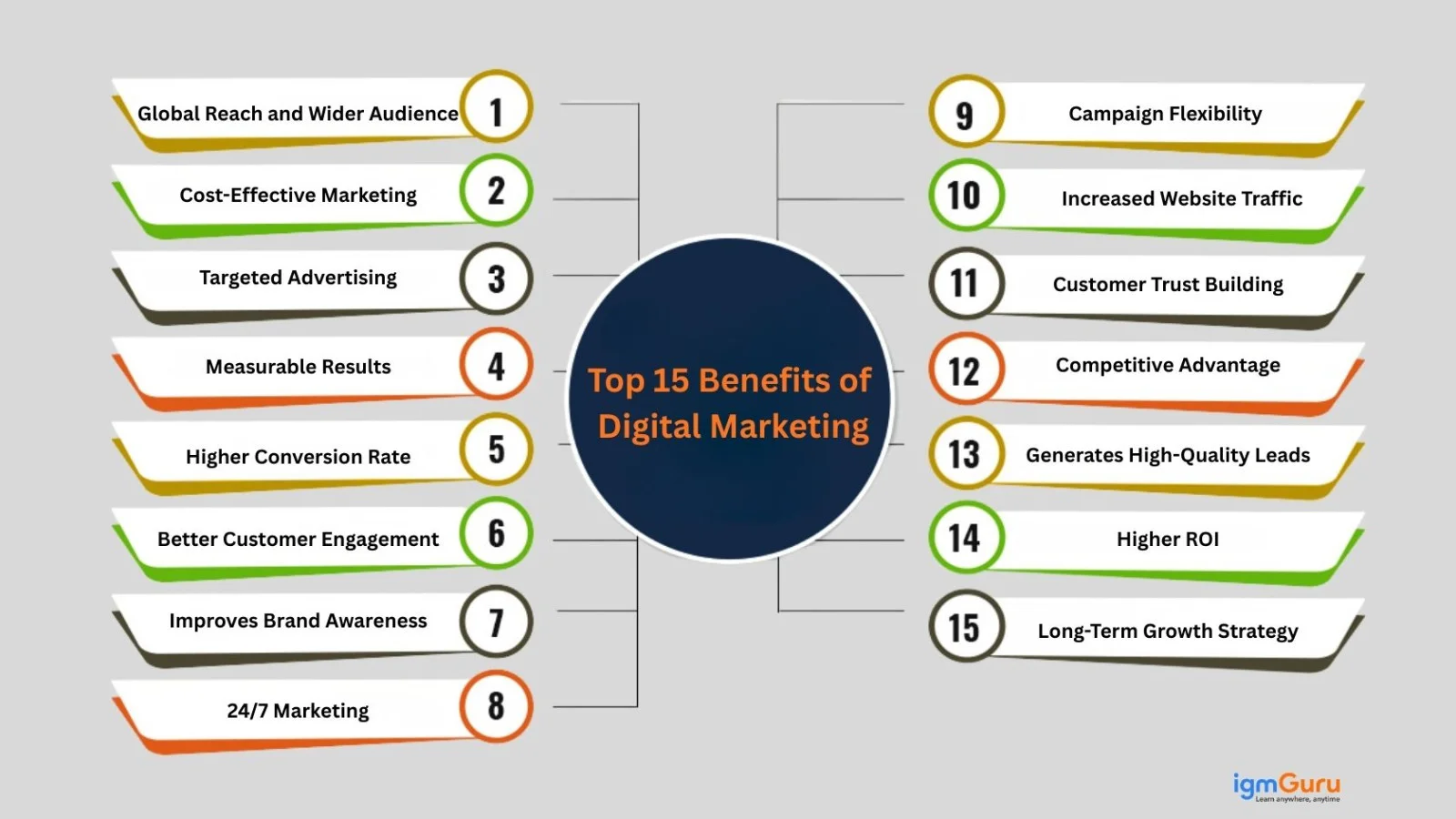
This is one of the biggest benefits of digital marketing is that it allows businesses to reach customers globally. Unlike traditional marketing, which is limited to a city or region, online marketing helps brands promote products worldwide through Google, social media and online ads. Even a small business can attract international customers through a website and digital campaigns. This makes digital marketing a powerful tool for expanding business reach.
Example: A small handmade jewellery brand in India can sell products to customers in the USA or UAE through Instagram and Google Shopping.
Digital marketing is much more affordable compared to TV ads, newspapers, radio, or billboards. Businesses can start with a low budget and still generate strong results using SEO, social media marketing and paid advertising. This is especially useful for startups and small businesses that cannot spend huge amounts on traditional marketing. It helps them grow faster without heavy investment.
Example: A local cafe can run Instagram ads for ₹200–₹500 per day and still attract nearby customers.
Digital marketing allows businesses to target the right audience based on age, gender, location, interests, online behavior and buying intent. Platforms like Google Ads and Meta Ads help businesses show ads only to people who are most likely to buy. This reduces wasted spending and increases the chances of conversions. Targeted marketing is one of the main reasons digital advertising performs better than traditional advertising.
Example: A gym can show ads only to people aged 18–35 living within 5 km of the location.
It is not like traditional marketing, digital marketing provides measurable results. Businesses can track website traffic, ad clicks, impressions, lead generation, conversion rate and customer behavior using tools like Google Analytics and Meta Business Suite. This data helps companies understand what is working and what is not. With proper tracking, businesses can improve marketing performance and make better decisions.
Example: A brand can track exactly how many people clicked the ad and how many actually purchased the product.
Digital marketing improves conversion rate because it reaches customers who are already interested in a product or service. For example, when someone searches “best digital marketing agency near me” and clicks on an ad, they already have buying intent. This increases the chances of lead generation and sales. Digital marketing also supports retargeting ads, which brings back customers who visited your website but did not purchase.
Example: Amazon uses remarketing ads to remind users about products they added to the cart but didn’t buy.
Digital marketing helps businesses connect directly with customers through social media comments, DMs, polls, email responses and website chat support. This improves customer engagement and builds stronger relationships. When customers feel connected to a brand, they trust it more and are more likely to purchase. High engagement also improves brand loyalty and customer retention.
Example: Brands like Zomato engage customers through memes and replies, increasing loyalty and repeat usage.
Brand awareness is one of the most important factors for long-term business growth. Digital marketing increases brand visibility through social media posts, Google search rankings, YouTube videos, paid ads and content marketing. When customers see your brand repeatedly online, it creates familiarity and trust. Over time, this helps businesses build a strong brand identity and attract more customers.
Example: Nike strengthens its brand image through consistent Instagram campaigns and YouTube storytelling ads.
Digital marketing works 24/7. Your website, Google Business Profile, online ads and social media pages remain active even when your business is closed. Customers can search your business, read reviews, check products and contact you anytime. This increases customer convenience and helps businesses generate leads continuously without time limits.
Example: A customer can find a salon on Google at midnight, check reviews and book an appointment instantly.
One major advantage of digital marketing is flexibility. Businesses can quickly change ad budget, audience targeting, keywords, content strategy, or marketing message anytime. If a campaign is not performing well, it can be optimized instantly. This is not possible in traditional marketing, where once an ad is printed or broadcast, it cannot be changed. Flexibility helps businesses save money and improve campaign results faster.
Example: If an ad is not getting clicks, a company can change the headline or image within minutes.
Digital marketing helps businesses increase website traffic through SEO, paid ads, content marketing and social media promotion. More traffic means more potential customers, more leads and more sales opportunities. Ranking on Google for high-search keywords can bring consistent organic traffic without paying for ads every day. This makes digital marketing one of the best strategies for long-term online growth.
Example: A blog ranking on Google for “best skincare products” can bring thousands of visitors every month without paid ads.
Digital marketing helps build trust through customer reviews, testimonials, social proof, informative content and consistent communication. When customers see positive reviews and helpful content, they feel more confident in buying from a brand. Email updates, remarketing and social media interaction also strengthen customer relationships. This improves customer satisfaction and increases repeat purchases.
Example: Flipkart and Amazon build trust through verified reviews, ratings and customer support systems.
Digital marketing gives businesses a competitive advantage, especially in highly competitive industries. Even small businesses can compete with large companies by using smart SEO strategies, targeted ads and strong content marketing. Brands that invest in online marketing stay ahead because they appear more visible and trustworthy. In 2026, digital presence is often the deciding factor between success and failure.
Example: A small bakery can rank on Google Maps and compete with bigger food chains in the same area.
Digital marketing is one of the best ways to generate leads. Businesses can collect leads through landing pages, lead forms, email subscriptions, WhatsApp marketing and paid campaigns. The best part is that these leads are often high-quality because they come from people who are already interested in your product or service. This improves sales efficiency and reduces customer acquisition cost.
Example: An online coaching institute can generate leads through Google Ads using keywords like “best MBA coaching near me”.
Digital marketing offers a higher return on investment compared to traditional marketing because every campaign can be tracked and optimized. Businesses can identify which platform is generating the most leads and invest more in that channel. With proper targeting and analytics, companies can reduce marketing waste and increase profits. That is why digital marketing is considered one of the most ROI-driven marketing strategies.
Example: A brand can stop a low-performing ad and shift budget to a high-performing ad instantly, increasing profit.
Digital marketing supports long-term business growth because it helps brands build strong online visibility, consistent lead generation and customer loyalty. It is also scalable, meaning businesses can increase budget, expand campaigns and target new markets as they grow. Over time, digital marketing creates a stable online presence that keeps generating traffic, leads and sales.
Example: Brands like Nykaa started online and scaled into a multi-crore business using strong digital marketing strategies.
Digital marketing is one of the best growth strategies for small businesses and startups because it helps them compete with bigger brands without spending a huge budget. Unlike traditional marketing, digital marketing allows small businesses to reach the right customers, promote products online and generate leads quickly. It also helps startups build brand awareness and trust in a shorter time.
Today, customers search online before purchasing, which makes digital marketing essential for small businesses that want to increase visibility and attract new buyers. Whether it is through Google search, social media platforms, or paid ads, digital marketing gives small businesses the opportunity to grow faster and scale smoothly.
One major advantage of digital marketing is that it can be started with a low budget. Small businesses can run ads on Google and social media platforms with flexible spending. They can also use free methods like SEO and content marketing to get organic traffic without paying daily.
Example: A local boutique can run Instagram ads for a small budget and still get direct inquiries and orders.
Digital marketing helps small businesses target customers in a specific location. Using Google My Business, local SEO and location-based ads, businesses can attract nearby customers easily. This is extremely useful for salons, cafes, gyms and retail stores.
Example: A restaurant can target only people living within a 3–5 km radius and increase walk-in customers.
For startups, building trust and brand identity is important. Digital marketing helps businesses build a strong online presence through social media, reviews, blogs and online advertising. Regular online visibility increases brand recognition and helps businesses grow faster than traditional methods.
Example: Many D2C brands like boAt grew rapidly by using social media marketing and online campaigns to build their brand image.
Read Also: Digital Marketing Interview Questions and Answers
Today, many businesses still get confused between digital marketing and traditional marketing. To understand which one is more effective in 2026, let’s compare both marketing methods based on cost, targeting, reach, ROI, and performance tracking.
| Factor | Digital Marketing | Traditional Marketing |
| Cost | More affordable and budget-friendly. Businesses can start with low investment. | Expensive, especially TV ads, newspapers, radio and hoardings. |
| Target Audience | Highly targeted (age, location, interests, behavior, keywords). | Mostly general audience, less specific targeting. |
| Reach | Global reach with online platforms like Google, social media and websites. | Mostly limited to local or regional reach. |
| ROI (Return on Investment) | Higher ROI because campaigns can be optimized for better results. | ROI is uncertain because results are not easily measurable. |
| Tracking & Analytics | Easy to track clicks, leads, conversions, traffic and engagement using analytics tools. | Hard to measure exact results and customer response. |
| Customer Engagement | Two-way communication through comments, chats and social media interaction. | One-way communication like TV, radio, newspaper ads. |
| Speed of Results | Faster results through ads and instant promotions. | Slower results, takes more time to reach the audience. |
| Flexibility | Ads can be edited anytime (budget, targeting, design, content). | Once published or printed, changes are not possible. |
| Best For | Businesses looking for growth, leads, sales and online visibility. | Businesses focusing on local brand awareness and offline audience. |
Related Article: Best AI Visibility Tools
Lead generation means attracting potential customers and collecting their contact details like phone number, email, or enquiry request. One of the biggest benefits of digital marketing is that it helps businesses generate leads faster and more efficiently than traditional marketing.
Digital marketing allows businesses to reach people who are already searching for a product or service online. It also helps in targeting the right audience, running ads and converting visitors into leads through landing pages, forms and call-to-action buttons. This makes online lead generation one of the most powerful growth strategies for businesses in 2026.
Google Ads is one of the fastest ways to generate high-quality leads. Businesses can show ads to people who are actively searching for related services or products. This increases the chances of conversion because the audience already has buying intent.
Example: If someone searches “dentist near me” and clicks an ad, they are most likely ready to take an appointment.
Social media platforms like Instagram and Meta help businesses generate leads through paid ads, story promotions, and lead forms. Businesses can target users based on location, interests and online activity. Social media also helps brands build trust before customers take action.
Example: A skincare brand can run Instagram lead ads to collect customer details for free samples or offers.
Content marketing is a long-term lead generation strategy where businesses publish blogs, videos and informative content to attract organic traffic. When users find helpful content, they trust the brand and are more likely to enquire or purchase. SEO plays an important role in bringing traffic through Google search results.
Example: A coaching institute can write blogs like “What is GrokAI?” and collect leads through enquiry forms.
Customer engagement means how actively customers interact with your business through likes, comments, messages, reviews, website visits and purchases. One of the biggest benefits of digital marketing is that it helps businesses build direct communication with customers, which increases trust and brand loyalty.
Unlike traditional marketing, digital marketing creates two-way interaction where customers can ask questions, share feedback and connect with brands instantly. This improves customer satisfaction and increases the chances of repeat purchases.
Digital marketing allows businesses to communicate directly with customers through social media comments, DMs, WhatsApp chats and website live chat. This makes customer support faster and improves customer experience.
Example: A customer can message a clothing brand on Instagram and instantly get size and pricing details.
Digital marketing helps businesses personalize offers and content based on customer behavior. Brands can show product recommendations, customized ads and special discounts depending on customer interests. Personalized marketing increases customer engagement and improves conversion rate.
Example: E-commerce platforms like Amazon recommend products based on browsing and purchase history.
Many customers visit a website but do not purchase immediately. Digital marketing allows businesses to retarget these users through ads on Google, Meta and Instagram. This keeps the brand in the customer’s mind and increases the chances of conversion.
Example: If you search for shoes online, you often see the same shoe ads again on Instagram or YouTube.
Website traffic means the number of people who visit your website. One of the biggest benefits of digital marketing is that it helps businesses bring more visitors to their website through multiple online channels. Higher website traffic increases brand visibility, improves lead generation and creates more sales opportunities.
Digital marketing drives traffic by improving Google rankings, running paid advertising campaigns and promoting content on social media. This makes it easier for businesses to attract both new and returning customers.
Organic traffic comes from Google search results without paying for ads. Businesses can increase organic traffic by using SEO techniques like keyword optimization, quality content and backlinks. When a website ranks higher on Google, it receives consistent visitors every day.
Example: A travel website ranking for “best places to visit in Rajasthan” can get thousands of free visitors monthly.
Paid traffic comes from running ads on Google, YouTube, Instagram, and Meta. This method brings instant website traffic and is useful for businesses that want fast results. Paid ads also help in promoting products, offers and services to the right audience.
Example: An online store can run Google Shopping Ads to drive instant traffic to product pages.
Social media platforms are also strong sources of website traffic. Businesses can share blog posts, product links and offers through Instagram, Facebook, LinkedIn and YouTube. When content is engaging, users click and visit the website, increasing traffic and brand awareness.
Example: A fashion brand posting product links on Instagram stories can drive customers directly to its website.
Also Explore: Best SEO Tools
ROI (Return on Investment) means how much profit a business earns compared to the money it spends on marketing. One of the biggest benefits of digital marketing is that it helps businesses achieve a higher ROI because campaigns are measurable, flexible and highly targeted. Unlike traditional marketing, digital marketing allows businesses to track every click, lead and conversion, which helps in improving results and reducing unnecessary spending.
Digital marketing gives businesses complete control over their budget. You can decide daily spending, pause ads anytime, or increase budget for high-performing campaigns. This makes online marketing cost-effective and reduces marketing waste.
Example: A business can run ads with a ₹500 daily budget and increase it only when leads start coming.
Digital marketing campaigns can be optimized instantly based on performance data. If an ad is not working, businesses can change the audience, keywords, ad design, or message in real time. This improves conversion rate and increases ROI.
Example: If a Google ad is getting clicks but no leads, the business can change the landing page or call-to-action immediately.
Digital marketing allows precise targeting, meaning ads reach people who are more likely to purchase. This improves lead quality, increases sales and reduces customer acquisition cost. Better targeting directly results in higher profit and stronger marketing performance.
Example: A coaching institute can target students searching for “online courses” instead of advertising to random users.
Digital marketing is no longer just an option, it is a necessity for every business in 2026. Digital marketing offers a lot of benefits that traditional marketing cannot match. Benefits like global reach, cost-effective advertising, better targeting, lead generation and higher ROI. It also helps businesses attract the right customers, build brand awareness, increase website traffic and convert leads into sales.
The best part is that digital marketing is that it is measurable. Businesses can track every click, lead and conversion and improve campaigns in real time. Even if you are a startup, small business, or established brand, investing in digital marketing will definitely help you grow faster, stay competitive and achieve long-term success.
In short, digital marketing is one of the smartest ways to increase business visibility, sales and profitability in today’s digital-first world.
Explore Our Trending Articles:
Digital marketing is better because it is cost-effective, measurable, and allows accurate audience targeting. Traditional marketing is expensive and results are difficult to track.
Digital marketing helps businesses grow by increasing online visibility, attracting more customers, generating leads, and improving conversions. It also supports long-term brand building.
Digital marketing increases sales by reaching high-intent customers through SEO and paid ads. It also helps in retargeting users who visited your website but didn’t purchase.
Yes, digital marketing is highly cost-effective because businesses can start with a small budget and still get results. It also reduces unnecessary spending through targeted ads.
Analytics helps track clicks, traffic, leads, and conversions in real time. This makes it easier to measure performance and improve marketing results.