A few months ago, I was auditing a blog that had dropped out of the top ten overnight. The content was well written. The keywords were placed correctly. But there was no author name, no sources and no way to verify who wrote it. That is when it hit me. Google was not judging the words on the page. It was judging whether it could trust the person behind them.
That judgment has a name. It is called E-E-A-T.
If you write content, run a website, or manage SEO for a business, you have probably seen this term everywhere. But most explanations make it sound complicated. It really is not. In this guide, I will break down what E-E-A-T means, why Google cares about it and how you can build it into your own content step by step.
Let’s start!
Related Article: How To Become A Content Writer?
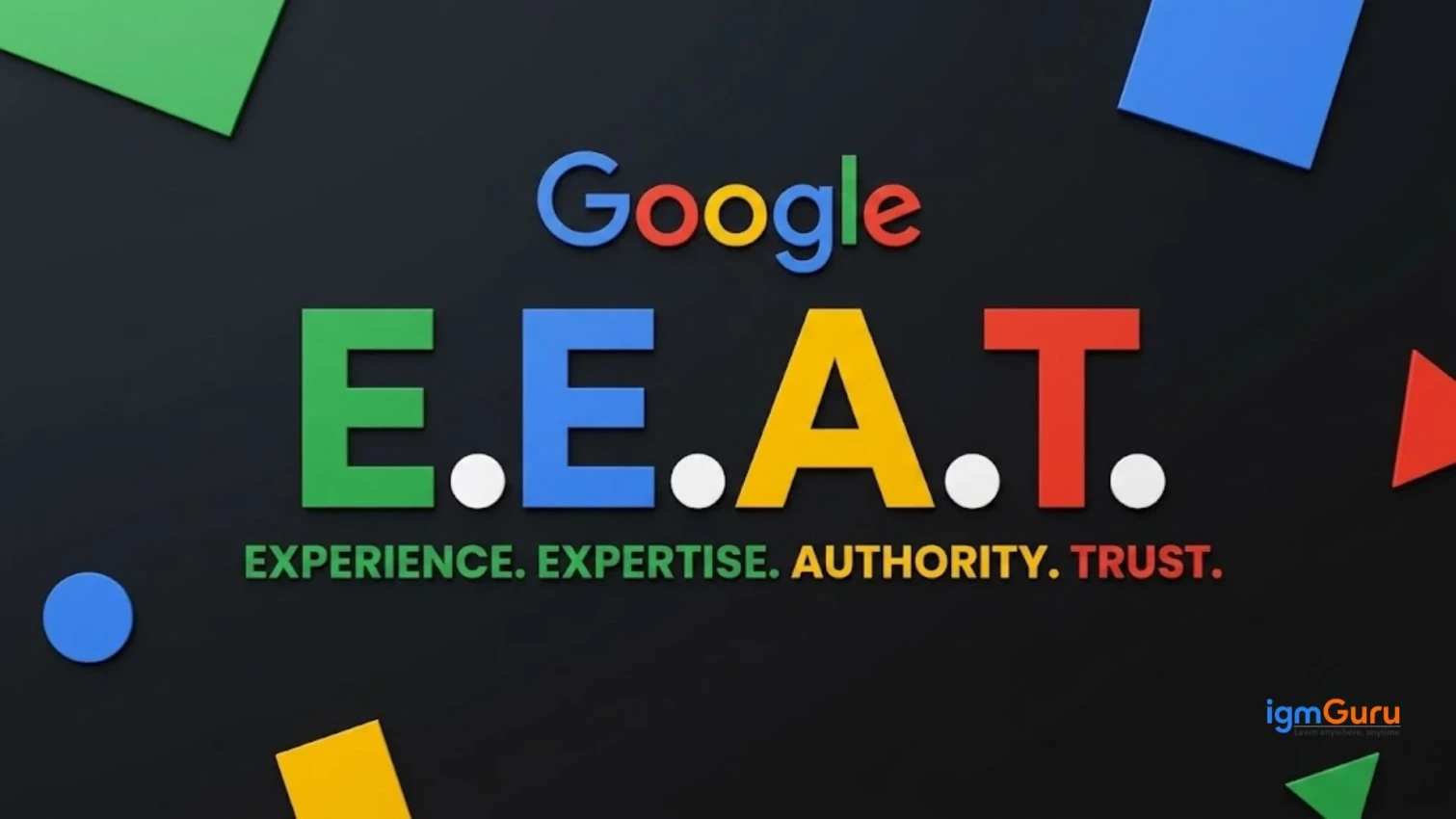
E-E-A-T is a framework Google uses to evaluate the quality and credibility of web content. Its full form is Experience, Expertise, Authoritativeness and Trustworthiness.
While it is not a direct algorithmic ranking factor, it is a core concept in Google's Search Quality Rater Guidelines. These guidelines help human reviewers score search results, which Google uses to train its search algorithms to surface the most helpful and accurate information.
So in short, E-E-A-T is Google's way of asking one simple question about every piece of content: can this be trusted and does it come from someone who actually knows this subject?
You might be wondering, is E-E-A-T actually a ranking factor? The answer is no, not directly. Google does not calculate an E-E-A-T score and rank pages by it. Instead, E-E-A-T works as a quality framework. It shapes how Google's automated systems and human quality raters judge content and that judgment feeds into the signals that do affect rankings.
Here is how it connects to your actual rankings.
Google's Helpful Content System is built around the idea of people-first content. It rewards pages that are created to genuinely help readers, not pages built only to attract clicks from search engines. E-E-A-T is the lens Google uses to measure whether content meets that bar. A page with strong Experience, Expertise, Authority and Trust signals is far more likely to be seen as helpful.
E-E-A-T matters even more now because of AI-powered search. With Google's AI Overviews and AI Mode pulling answers directly from web pages, the sources that get cited are almost always the ones that show clear credibility. If your content cannot prove who wrote it and why they should be trusted, it becomes very hard to get picked up in these AI-generated answers.
In simple terms, E-E-A-T will not guarantee a top ranking by itself. But weak E-E-A-T can absolutely hold your content back, even if everything else on the page is technically perfect.
Read Also: What is GEO? Generative Engine Optimization Guide
Let's go through each pillar one by one, because each plays a different role.
Experience is about whether the content creator has real, firsthand, lived knowledge of the topic. This is the newest pillar and it is quickly becoming one of the most important.
Google wants to see signs that a real person has actually used the product, visited the place, tried the method, or lived through the situation they are writing about.
Examples of firsthand experience include:
A review of a laptop that includes real photos taken by the reviewer
A recipe post written by someone who has actually cooked the dish multiple times
A travel guide based on an actual trip, not scraped facts from other websites
How to demonstrate experience:
Add personal photos instead of stock images. Share specific details that only come from doing the task yourself, like exact timings, small mistakes you made, or unexpected results. Write phrases like "when I tested this" or "in my experience" only when they are true and back them up with proof.
Expertise is about whether the person creating the content has the knowledge and skill needed to speak on that topic. This can come from formal education, professional experience, or years of hands-on practice.
There is an important difference here. Google recognizes two kinds of expertise.
Formal expertise applies to topics like medical, legal, or financial advice, where a proper qualification usually matters. A cardiologist writing about heart health carries more expertise than a random blogger.
Everyday expertise applies to topics like hobbies, personal experiences, or day to day advice, where lived knowledge counts just as much as formal training. A parent who has managed a picky eater for years has real expertise on that topic, even without a certificate.
Authoritativeness is about reputation. It asks a simple question: is this person or website known and respected as a go-to source on this topic, according to other people and other trusted sites?
This is not something you can claim about yourself. This has to be earned through recognition from others.
Signals that build authoritativeness include:
Being mentioned or quoted by other reputable websites
Getting backlinks from trusted industry sources
Having your content shared and referenced by experts in your field
Building a recognizable name in a specific subject area over time
Read Also: What is Content Marketing?
Out of all four pillars, Google treats trustworthiness as the most important one. Even if a page shows strong experience and expertise, it will not perform well if readers or Google cannot trust it.
Trust is built through several factors:
Website security, meaning your site runs on HTTPS
Transparency about who runs the website and who wrote the content
Accurate, fact-checked information that stays updated over time
A visible way for users to contact you
A healthy reputation shown through reviews and online mentions
Think of trust as the foundation. Experience, expertise and authority all sit on top of it. Without trust, the other three pillars do not hold much weight.
Google does not have a single algorithm that scans a page and spits out an E-E-A-T number. Instead, it uses a mix of methods.
Google employs thousands of human quality raters around the world. These raters follow a detailed public document to manually assess search results and judge how well pages demonstrate E-E-A-T. Their ratings do not directly change rankings, but they help Google measure whether its algorithms are working as intended.
The raters give feedback and Google's engineers use that feedback to train and refine automated ranking systems. So while a human never manually approves your specific page, the standards those humans use eventually shape the algorithm that does rank your page.
These include author information, links from credible sources, brand mentions across the web, website security, content accuracy and consistency in publishing on a specific topic over time.
Also Read: Best SEO Tools
YMYL stands for Your Money or Your Life. It refers to topics that could seriously impact a person's health, financial stability, safety, or well-being if the information is wrong.
Industries commonly affected by YMYL include:
Health, such as medical advice, symptoms and treatments
Finance, such as investing, loans and tax guidance
Legal, such as rights, contracts and legal procedures
Safety, such as emergency information or product safety
News, especially topics involving major public events
Google applies a simple test here. Would a careless mistake on this topic cause real harm to someone? If the answer is yes, the topic is YMYL and Google expects a much higher level of E-E-A-T before it trusts that content enough to rank it well.
This is exactly why a random blog post about wallpaper colors does not need the same level of scrutiny as an article about managing diabetes. The stakes are simply different.
Now let's get practical. Here is how you can actually strengthen each pillar.
1. Create experience-based content: Add real photos, screen recordings, personal results and firsthand observations wherever possible. Avoid writing only from research. Show that you have actually done the thing.
2. Demonstrate expertise: Write detailed, accurate content that goes beyond surface-level information. Where relevant, mention your background, training, or years of hands on work in the subject.
3. Build author authority: Create a proper author bio for every piece of content. Link the author to their credentials, social profiles, or other published work. Avoid generic bylines like "Admin" or "Team."
4. Strengthen website trust signals: Enable HTTPS across your site. Add a clear privacy policy, terms page and contact information. Keep your design and navigation clean and professional.
5. Keep content accurate and updated: Review your published content regularly. Update outdated statistics, broken links and old information. Add a visible "last updated" date so readers know the content is current.
6. Cite reliable sources: Whenever you reference data, studies, or claims, link to credible, well known sources. This shows readers and Google that your content is grounded in facts, not assumptions.
7. Earn high-quality backlinks: Focus on getting mentioned by other respected websites in your industry. This happens naturally when your content is genuinely useful, original, or well-researched.
8. Encourage positive reviews and brand mentions: Ask satisfied customers or readers to leave honest reviews. A steady stream of positive mentions across the web builds long term trust.
9. Showcase credentials and certifications: If your writers or business hold relevant certifications, display them clearly on author pages or the website footer.
10. Add transparent contact and about pages: Make sure visitors can easily learn who is behind the website and how to reach you. Hidden or missing contact details are a major red flag for trust.
Read Also: What is SMM (Social Media Marketing)?
Even experienced website owners fall into these traps.
1. Publishing AI content without human review: Using AI to draft content is fine, but publishing it without expert editing removes the human judgment and firsthand experience that E-E-A-T depends on.
2. Thin or generic content: Short, surface level articles that repeat what is already ranking do not add any real value.
3. Fake author profiles: Using stock photos and made up names for authors damages trust the moment readers or Google notice it.
4. Outdated information: Old statistics, expired offers, or outdated advice signal that a page is not maintained.
5. Clickbait headlines: Headlines that promise something the content does not deliver hurt user trust and increase bounce rates.
6. Poor website security: Running an unsecured site without HTTPS is one of the fastest ways to lose trust signals.
7. No citations or references: Making claims without backing them up with credible sources weakens your authority instantly.
Beyond fixing individual pillars, a few habits help you build strong E-E-A-T across your entire website over time
Write for people first, then optimize for search engines
Publish original research or original data when possible
Share real case studies from your own work or business
Add quotes from genuine subject matter experts
Update your content regularly instead of publishing and forgetting it
Build topical authority by covering a subject in depth, not just once
Improve overall user experience, including page speed and mobile usability
I have personally used this checklist while publishing SEO content and it has helped me create more trustworthy, user-focused articles that performed well and earned higher content quality scores. Before you publish your next article, use this quick checklist to ensure it meets Google's E-E-A-T expectations and follows SEO best practices.
The author bio is present and includes real credentials
The About page is available and up to date
The contact page is easy to find
HTTPS is enabled sitewide
Sources are cited for facts and statistics
Content is reviewed and updated regularly
Original images or examples are included
A clear editorial policy exists
The website maintains a positive online reputation
Related Article: Best AI Visibility Tools
Can AI-written content actually rank? Yes, but with an important condition. Google has stated clearly that it does not penalize content simply because it was created with AI assistance. What it does penalize is content that lacks originality, accuracy, or genuine value, regardless of who or what wrote it.
The safest approach is to treat AI as a drafting tool, not a publishing tool. Let it help you organize ideas or speed up your first draft. Then have a real, knowledgeable person review, fact check and add firsthand experience before it goes live. Content that mixes AI efficiency with human expertise and honest editing tends to perform far better than content published straight from a prompt.
Related Article: 12 Best AI Chatbots For 2026
1. High E-E-A-T example: A financial article written by a certified financial advisor, published on a well known finance website, complete with a detailed author bio, cited government and institutional sources and content that is reviewed every few months.
2. Low E-E-A-T example: A financial article published under a generic "Editorial Team" byline, with no sources cited, no update history and information that has not changed in years despite changing tax rules.
Key differences: The strong example proves who wrote it, supports claims with credible sources and stays current. The weak example gives readers no way to judge whether the information can be trusted at all.
E-E-A-T is not a checkbox you tick once and forget. It is an ongoing habit of writing honestly, backing up your claims, showing your real experience and staying transparent about who you are.
Here is the simple version. Experience shows you have actually done the thing. Expertise shows you understand it. Authoritativeness shows others recognize you for it. Trustworthiness ties everything together and makes readers and Google, believe what you say.
You do not need to fix everything overnight. Start small. Fix your author bios, cite your sources, enable HTTPS and keep your content updated. Do this consistently across your website and over time, you build the kind of credibility that survives algorithm updates and earns lasting trust from both readers and search engines.
No, E-E-A-T is not a direct ranking factor like page speed or keywords. It is a quality framework that shapes the broader signals Google's systems use to rank content.
Yes, but the level required changes depending on the topic. YMYL topics like health and finance need much stronger E-E-A-T than casual topics like hobbies or entertainment.
E-A-T was the original three part framework covering Expertise, Authoritativeness and Trustworthiness. Google added the second E, Experience, in December 2022 to reward firsthand, lived knowledge.
Because without trust, the other three pillars lose their value. Readers and Google will not rely on content, no matter how experienced or expert the source seems, if it feels inaccurate or unsafe.
Small websites can start with the basics. Add a real author bio, enable HTTPS, cite trustworthy sources and keep content updated. Authority builds gradually through consistency.
No, using AI to assist with writing does not automatically violate E-E-A-T. The issue is publishing AI content without human review, fact checking, or added expertise.