A super keyword in Java is a powerful tool that connects a subclass to its parent class. It allows developers to access parent class methods, constructors, and fields directly. Understanding super is important for mastering inheritance, constructor chaining and resolving vagueness in object-oriented programming. I have created this blog to walk you through the meaning, characteristics, use cases, advantages, and disadvantages of the Java Super keyword.
In Java, the super keyword is a reference variable used within a subclass to access members (methods, fields, and constructors) of its immediate parent class. It has an important role in inheritance by allowing subclasses to interact with and extend the functionality of their parent classes.
Also Read: What is Java Abstraction?
Understanding how super works internally gives you deeper clarity beyond syntax. When a subclass calls super, it does not create a new object. Instead, it refers to the already constructed parent portion of the current object. Java objects are created in a top-down hierarchy. This means the parent class constructor executes first and then followed by the child constructor.
When you use super.method() or super.variable, the compiler resolves the reference at compile time. It determines that the call must target the immediate parent class, bypassing method overriding rules used in normal polymorphism. super also forces access to the parent’s implementation directly. This makes a super compile-time binding mechanism for accessing superclass members.
At the JVM level, when super() or super.method() is used, the compiler generates the invokespecial bytecode instruction. invokespecial is used for:
This instruction ensures that the parent class implementation is executed directly, which skips runtime polymorphic method lookup. This shows that super has special handling at JVM level and is not just syntactic sugar.
In Java object creation:
If you do not explicitly write super(), the compiler automatically inserts it. It only happens when the parent has a no-argument constructor. In this case, you must explicitly call the parameterized constructor using super(arguments). This ensures proper object initialization order and prevents partially constructed objects.
After the Java 8 update, all interfaces can contain default methods. When a class implements multiple interfaces that define the same default method, ambiguity arises. In such cases, Java allows the use of InterfaceName.super.methodName() to resolve conflicts. This is less commonly discussed but highly relevant in modern Java development.
|
|
This feature helps resolve the diamond problem in multiple inheritance scenarios using interfaces.
The super keyword also works with abstract classes. Even though abstract classes may contain abstract methods, they can also include concrete methods and constructors. A subclass can use super to access those implemented members. This is common in enterprise applications where base classes provide partial functionality.
|
|
Here are some examples of using the Java super keyword-
Use super () (or super params) at the start of a subclass constructor to initialize inherited parts first.
|
super.methodName() invokes the parent class’s version of a method. This allows you to extend or augment behaviour in subclasses.
|
When subclass and superclass both have identically named fields, super.fieldName lets you reference the parent’s field.
|
Read Also: Java Tutorial For Beginners
The super keyword is also used in the given contexts-
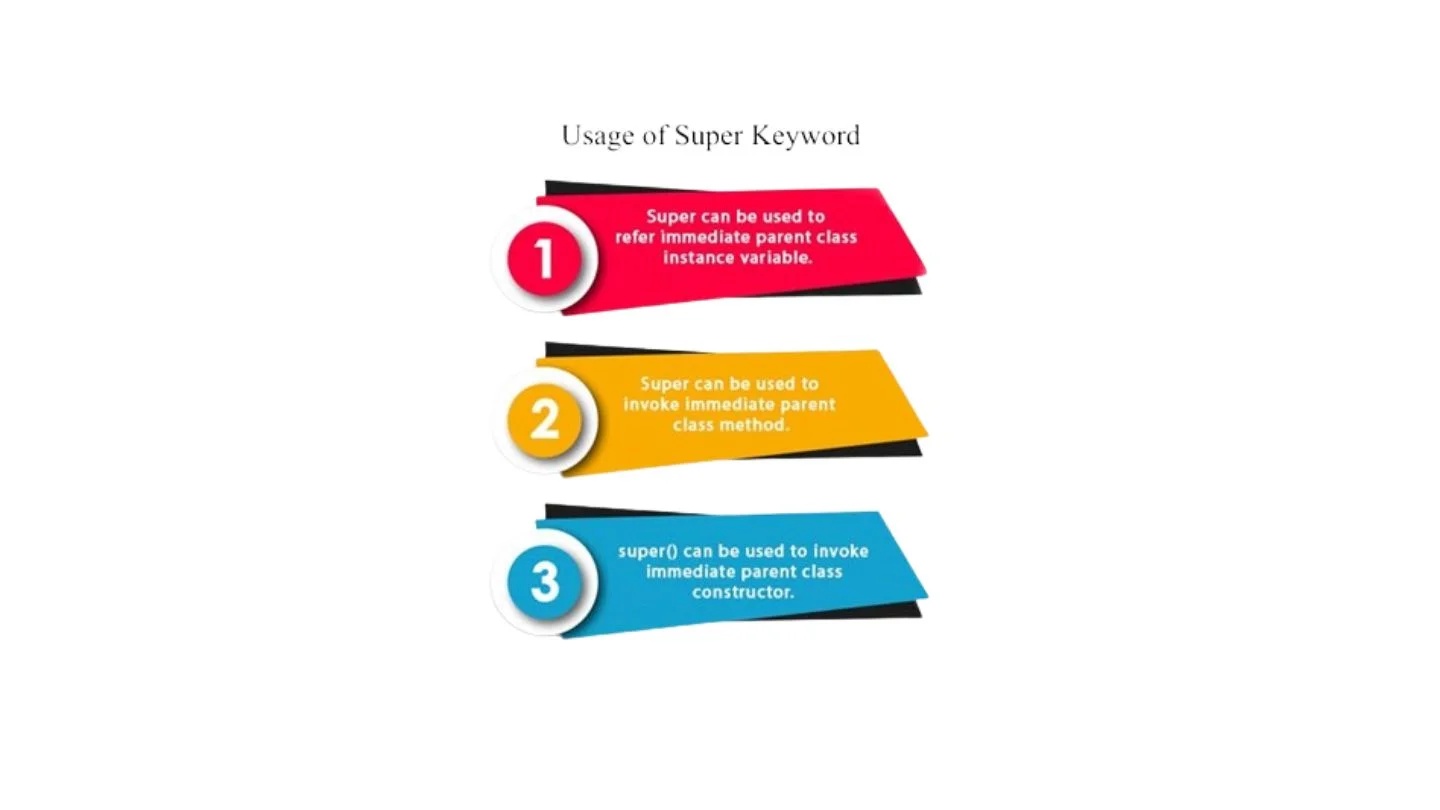
The super keyword is used when you need to invoke a parent class’s method from a child class. This becomes important when both the parent and child define a method with the same name. Super allows you to eliminate vagueness and directly call the parent version.
Let’s say it is very much like when you would want to listen to your parent’s advice rather than your own. super.methodName() helps you follow the parent’s behaviour in code -
|
|
This is a student class This is a person class |
The super keyword in Java allows a subclass to invoke its immediate parent class’s constructor. super can call both parameterless (default) and parameterized constructors.
The parent exists before a child is born. Just like that the parent class constructor must be there before the child’s constructor gets done with its work.
|
|
Person class Constructor Student class Constructor |
This situation occurs when both the base and derived classes have identical data members which is causing vagueness for JVM.
Imagine there is a child named ‘Ravi’ and the parent also has the same name. We would normally say ‘Parent Ravi’ to call the parent. It is as same as using super.maxSpeed.
|
Here are a few advantages of the Java super keyword-
Here are a few disadvantages of the Java super keyword-
Java super is not the only keyword you can use. There are so many of them. Let's explore a comparison between some of the best ones you can use:
| Feature / Aspect | this | super | this() | super() |
| Refers to | Current object | Parent (superclass) object | Current class constructor | Parent class constructor |
| Used For | Accessing current class variables & methods | Accessing parent class variables & methods | Calling another constructor in the same class | Calling a constructor from the parent class |
| Where Used? | Inside any non-static method | Inside any non-static method | Inside the constructor only | Inside the constructor only |
| Must be the first statement? | No | No | Yes | Yes |
| Constructor Chaining | No | No | Chains constructors within the same class | Chains constructors to the parent class |
| Access Modifiers Affected? | No | Can access protected parent members | No impact | Parent constructor must be accessible |
| Implicit call? | Not called automatically | Not called automatically | No (used explicitly) | Yes, the compiler adds super() if not written |
| Can both appear in the same constructor? | Yes | Yes | ❌ Cannot be used with super() | ❌ Cannot be used with this() |
| Static Context? | ❌ Not allowed | ❌ Not allowed | ❌ Not allowed | ❌ Not allowed |
| Common Use Cases | Resolve local variable conflicts | Call overridden parent method; access parent variable | Reduce code duplication in constructors | Ensure parent object setup before child |
Even though the super keyword looks simple, developers often misuse it in real projects. Understanding these mistakes helps avoid compilation errors and logical bugs.
If the parent class defines only parameterized constructors, the compiler does NOT add super() automatically.
|
|
If not handled properly, your code will fail to compile.
You cannot use super inside static methods or static blocks.
|
Reason: super refers to instance-level parent members. Static methods belong to the class, not the object.
Many beginners think super.method() follows runtime polymorphism. It does NOT.
|
|
super bypasses dynamic dispatch and directly calls the parent implementation. This distinction is extremely important in interviews and enterprise debugging.
It is safe to conclude that the super keyword is an important tool to bridge the gap between subclasses and their parent classes. It allows efficient code reuse, constructor chaining, method overriding and making inheritance more manageable. Developers must understand this concept effectively so that they can write clearer object-oriented code.
Read Related Articles:
Java Project Ideas For Beginners and Advanced
Java JDK 21: New Features of Java 21
Super only provides access to the parent class, as it cannot directly reach the grandparent class members.
It is not mandatory as Java automatically calls the parent’s no-argument constructor if not used directly.
The code will fail to compile because super () must be the first line in a subclass constructor.
Freshers should learn super because it is important for understanding inheritance and how parent and child classes work together.