Spring Boot is one of the hot topics asked in Java-based interviews due to its robust functionality. It can help build production-ready applications with minimal configuration, with its embedded servers, fast startup, and auto-configuration features. Therefore, preparing with the best Spring Boot interview questions and answers has become the first priority to become a Java Developer.
To help you do that, I have collected the best Spring Boot interview questions and answers for beginners, intermediates, and experienced professionals. The article also explores the scenario-based questions often asked to check candidates' problem-solving skills. Let's begin!
Let’s begin with the most asked Spring Boot interview questions and answers for freshers. These include the most fundamental topics every candidate should know before going for an interview.
Spring Boot is a framework of Java programming language that helps to simplify application development by providing auto-configuration, embedded servers and convention over configuration. It allows developers to create production-ready Spring applications quickly with minimal setup and configuration.
It provides various features including:
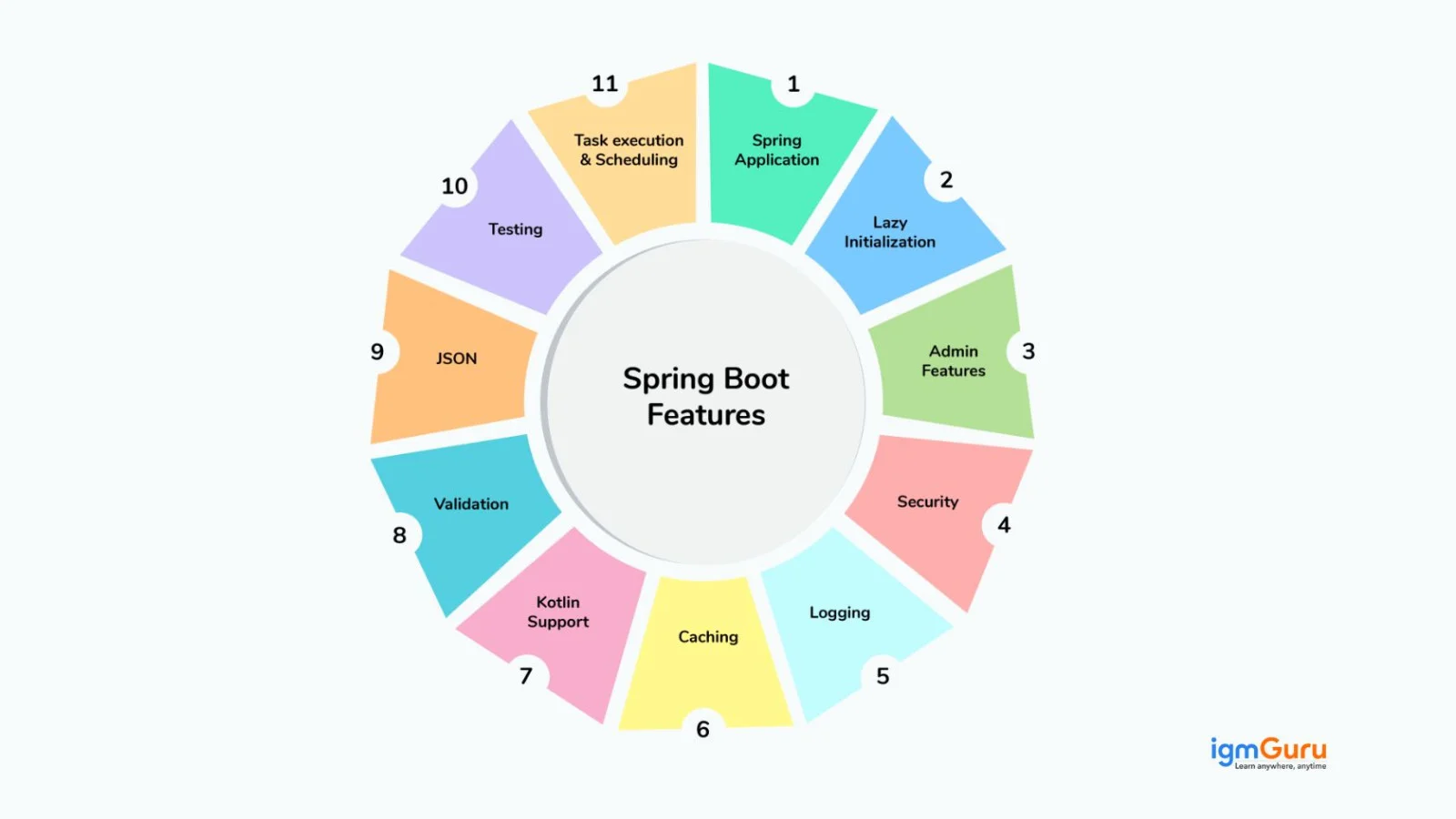
Spring Boot provides various advantages including:
The following are the key components of this framework:
Spring Boot and Spring serve the same ecosystem but differ in configuration effort, setup time and development speed. Spring Boot simplifies Spring development by adding automation and sensible defaults.
| Feature | Spring Framework | Spring Boot |
| Configuration | Mostly manual (XML / Java config) | Auto-configuration |
| Setup Time | High | Very low |
| Boilerplate Code | More | Minimal |
| Server | External server required | Embedded server |
| Dependency Management | Manual | Starter-based |
| Development Speed | Slower | Faster |
| Best Use Case | Legacy or highly customized apps | Microservices, REST APIs, new projects |
This means you should choose Spring Boot for fast development and modern applications and Spring Framework when you need full control or are working on legacy systems.
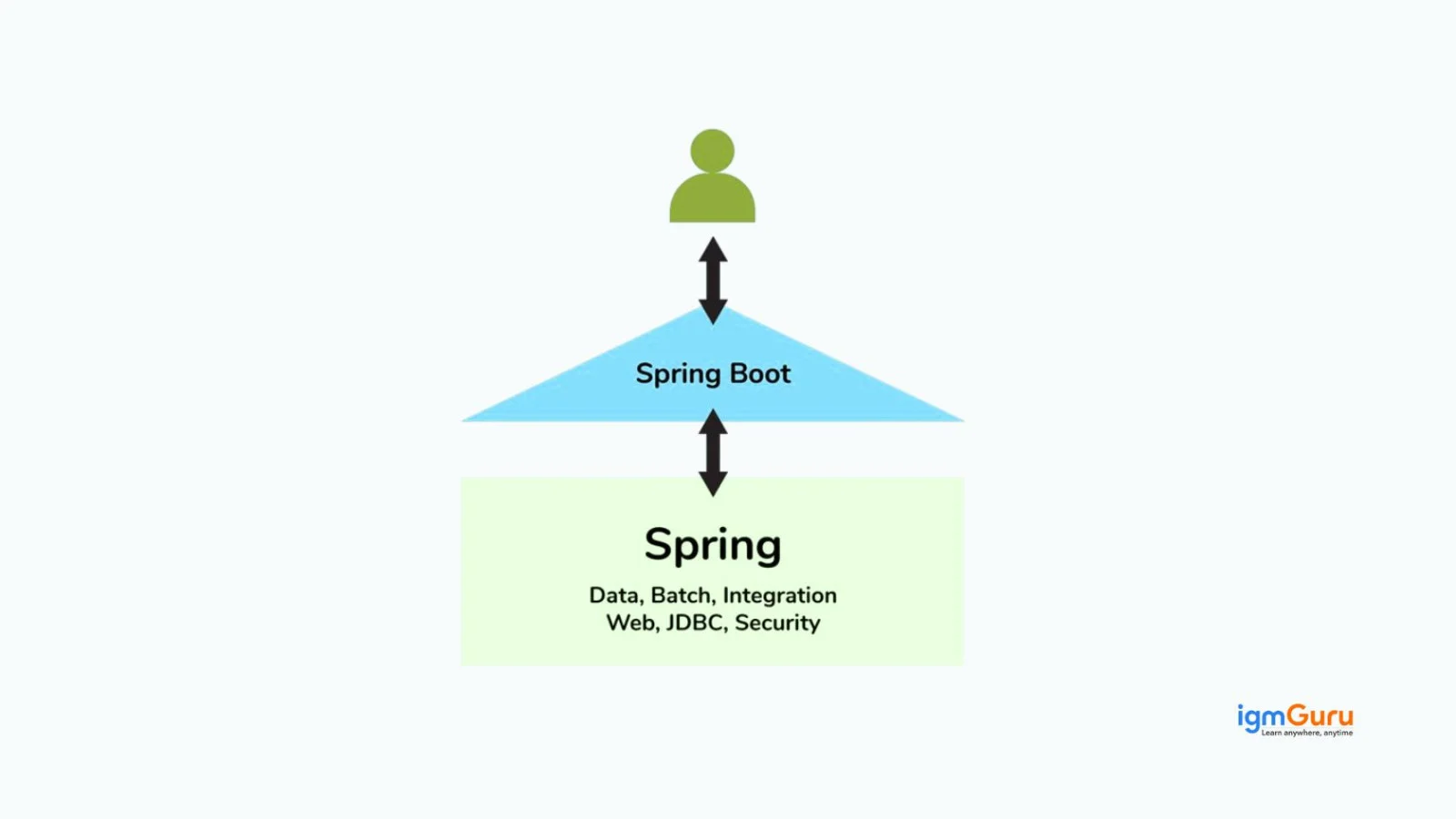
It works by automatically configuring the application based on the dependencies present in the classpath. When the application starts, it scans the project, applies default configurations, creates required beans and starts an embedded server so the application can run immediately. It uses starter dependencies, auto-configuration and the @SpringBootApplication annotation to reduce manual setup and let developers focus on business logic.
Spring Initializr is a web-based tool that helps developers quickly create a Spring Boot project with the required configuration and dependencies. It generates a ready-to-run project structure based on the selected project type, language, build tool and dependencies. It removes the need for manual project setup and ensures best-practice defaults. This makes it especially useful for beginners and for starting new Spring Boot applications quickly.
Spring Boot CLI is a command-line tool. It allows developers to quickly develop, run and test the applications built on this framework without writing extensive configuration or build files. It is mainly used for rapid prototyping and running the applications using simple commands. Spring Boot CLI supports Groovy scripts and automatically manages dependencies. This makes it useful for fast development and learning.
| CLI Command | Use |
| spring init | Creates a new Spring Boot project from the command line |
| spring run | Runs a Spring Boot application or Groovy script |
| spring test | Executes tests in a Spring Boot project |
| spring jar | Packages the application as an executable JAR |
| spring help | Displays help information for CLI commands |
Starter dependencies are predefined dependency bundles that group commonly used libraries for a specific functionality. They simplify dependency management by automatically including all required dependencies instead of adding them one by one.
For example: Adding spring-boot-starter-web provides everything needed to build a web or REST application such as Spring MVC, Tomcat and Jackson. The starter dependencies help here to reduce configuration effort, ensure compatibility and speed up application development.
I follow the given steps to start these types of applications:
I. Create the main class: This class acts as the entry point of the application.
II. Annotate it with @SpringBootApplication: This annotation enables auto-configuration, component scanning and Spring Boot features.
III. Call SpringApplication.run(): This method boots the application, creates the Spring context and starts the embedded server.
IV. Run the application: The application can be run from an IDE, using build tools or as an executable JAR.
This process allows Spring Boot applications to start quickly with minimal configuration.
Read Also: Java Tutorial for Beginners
Now we will discuss some of the most asked Spring Boot interview questions and answers for intermediates. These are based on core topics and knowledge a Spring Boot should have in their skills set.
@Controller and @RestController are used to handle web requests, but they differ in how they return responses. The main difference is whether the response is a view or raw data (JSON/XML). Let’s understand the other ones:
| Feature | @Controller | @RestController |
| Purpose | Used for MVC web applications | Used for REST APIs |
| Response Type | Returns a view name (HTML, JSP, Thymeleaf) | Returns data (JSON/XML) |
| @ResponseBody | Required to return data | Not required |
| Typical Use Case | Web applications with UI | RESTful web services |
| Combination | Standalone annotation | @Controller + @ResponseBody |
The IoC (Inversion of Control) container is the core Spring runtime that manages bean instantiation, dependency injection, lifecycle callbacks, scopes and proxy creation. It decouples object creation from usage, resolves dependencies at startup or runtime and underpins advanced features such as AOP, declarative transactions and security integration.
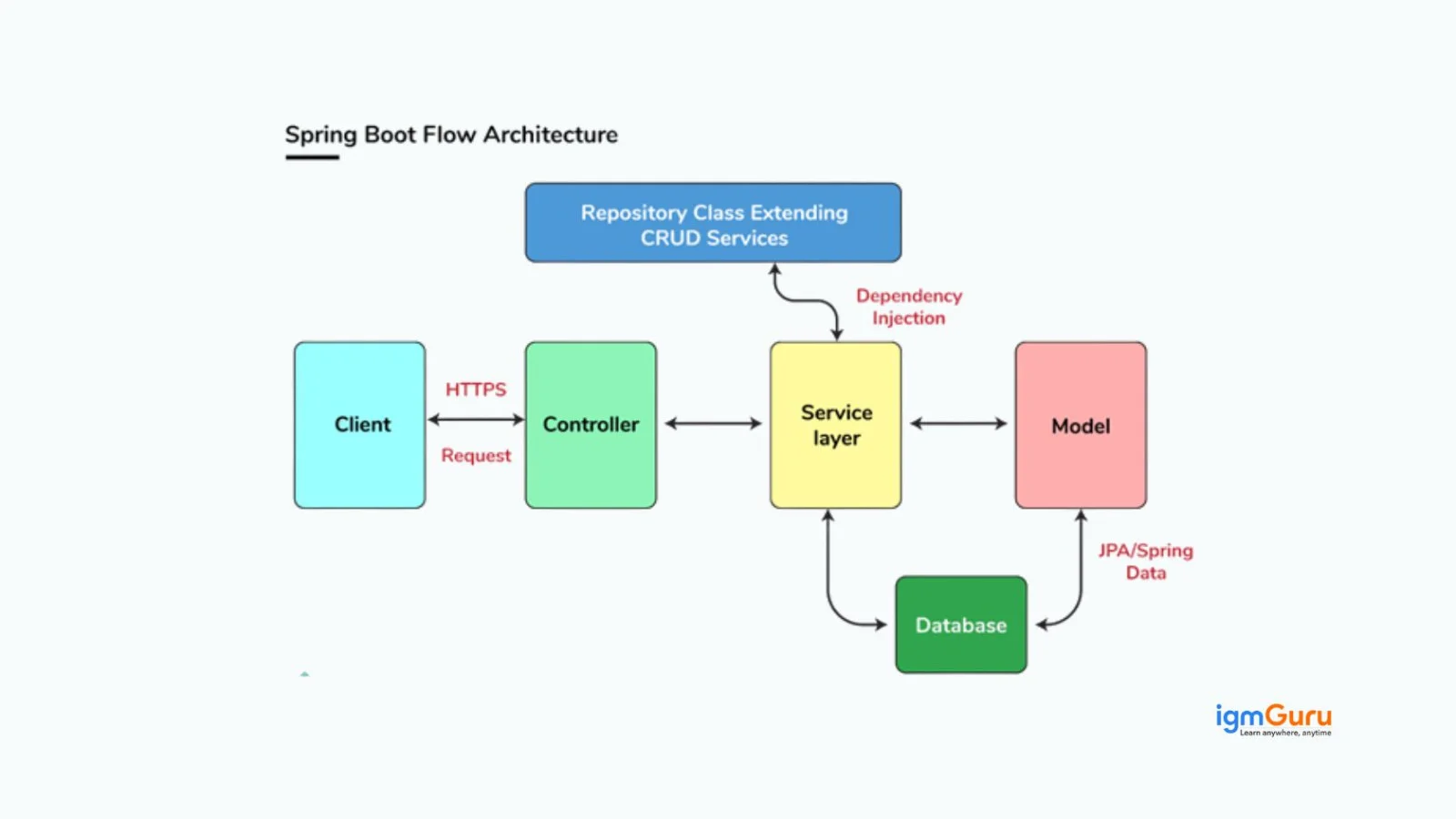
An HTTPS request in a Spring Boot application flows through well-defined layers to ensure separation of concerns and clean architecture. The layers are:
Once data is fetched or persisted, the response flows back in reverse order: Database → Repository → Service → Controller and finally the controller returns the response (usually JSON) to the client over HTTPS. This flow ensures loose coupling, testability, scalability and clear responsibility across layers, which is a core design principle in Spring Boot applications.
Both annotations are used to map HTTP requests to controller methods, but they differ in usage clarity and specificity. Here is a detailed differentiation between them:
| Feature | @RequestMapping | @GetMapping |
| Type | Generic request mapping annotation | Specialized request mapping annotation |
| HTTP Methods | Supports all HTTP methods | Supports only GET |
| Method Declaration | Requires method = RequestMethod.GET | No method attribute needed |
| Readability | Less explicit | More expressive and clear |
| Introduced In | Earlier versions of Spring | Spring 4.3+ |
| Best Use Case | When multiple HTTP methods are required | When handling only GET requests |
Spring Boot Actuator is a sub-module of Spring Boot that provides production-ready features to help monitor and manage applications. It exposes built-in endpoints that give insight into the application’s health, metrics, environment and runtime behavior. It also provides the best advantages including:
Spring Boot Actuator provides several built-in endpoints that are commonly used to monitor and manage the applications in production. These endpoints expose application health, metrics and runtime details. Here are some of the commonly used endpoints:
| Endpoint | Purpose |
| /actuator/health | Checks application health and availability |
| /actuator/metrics | Exposes performance and system metrics |
| /actuator/info | Displays custom application information |
| /actuator/env | Shows environment properties and active profiles |
| /actuator/beans | Lists all Spring-managed beans |
| /actuator/mappings | Displays all request mappings |
| /actuator/loggers | View and change logging levels at runtime |
| /actuator/threaddump | Provides thread state information |
| /actuator/heapdump | Generates heap dump for memory analysis |
Application properties are defined to externalize configuration so that behavior can be changed without modifying code. These properties are typically declared in application.properties or application.yml files and are automatically loaded by Spring Boot at startup.
Properties are used to configure server settings, database connections, logging levels, profiles and custom application values. Spring Boot binds these properties to beans using @Value or @ConfigurationProperties. This allows type-safe and environment-specific configuration across different deployments.
It is possible to create a non-web application in Spring Boot as it is not limited to web applications. By excluding web dependencies or configuring the application type as non-web, it can be used to build command-line applications, batch jobs, schedulers and background services.
Spring Boot supports this through features like CommandLineRunner, ApplicationRunner and by disabling the embedded web server. This allows the application to start, execute logic and terminate without handling HTTP requests.
Basic Spring Boot annotations are used to define application structure, enable features and manage dependency injection. Understanding these annotations shows clear knowledge of how the applications are wired internally.
| Annotation | Purpose |
| @SpringBootApplication | Entry point of the application; enables auto-configuration and component scanning |
| @Component | Marks a class as a Spring-managed bean |
| @Service | Defines business logic layer components |
| @Repository | Handles database operations and enables exception translation |
| @Controller | Handles HTTP requests and returns views |
| @RestController | Handles REST requests and returns JSON/XML responses |
| @Autowired | Injects dependent beans automatically |
| @RequestMapping | Maps HTTP requests to controller methods |
| @GetMapping | Handles HTTP GET requests |
| @PostMapping | Handles HTTP POST requests |
| @PutMapping | Handles HTTP PUT requests |
| @DeleteMapping | Handles HTTP DELETE requests |
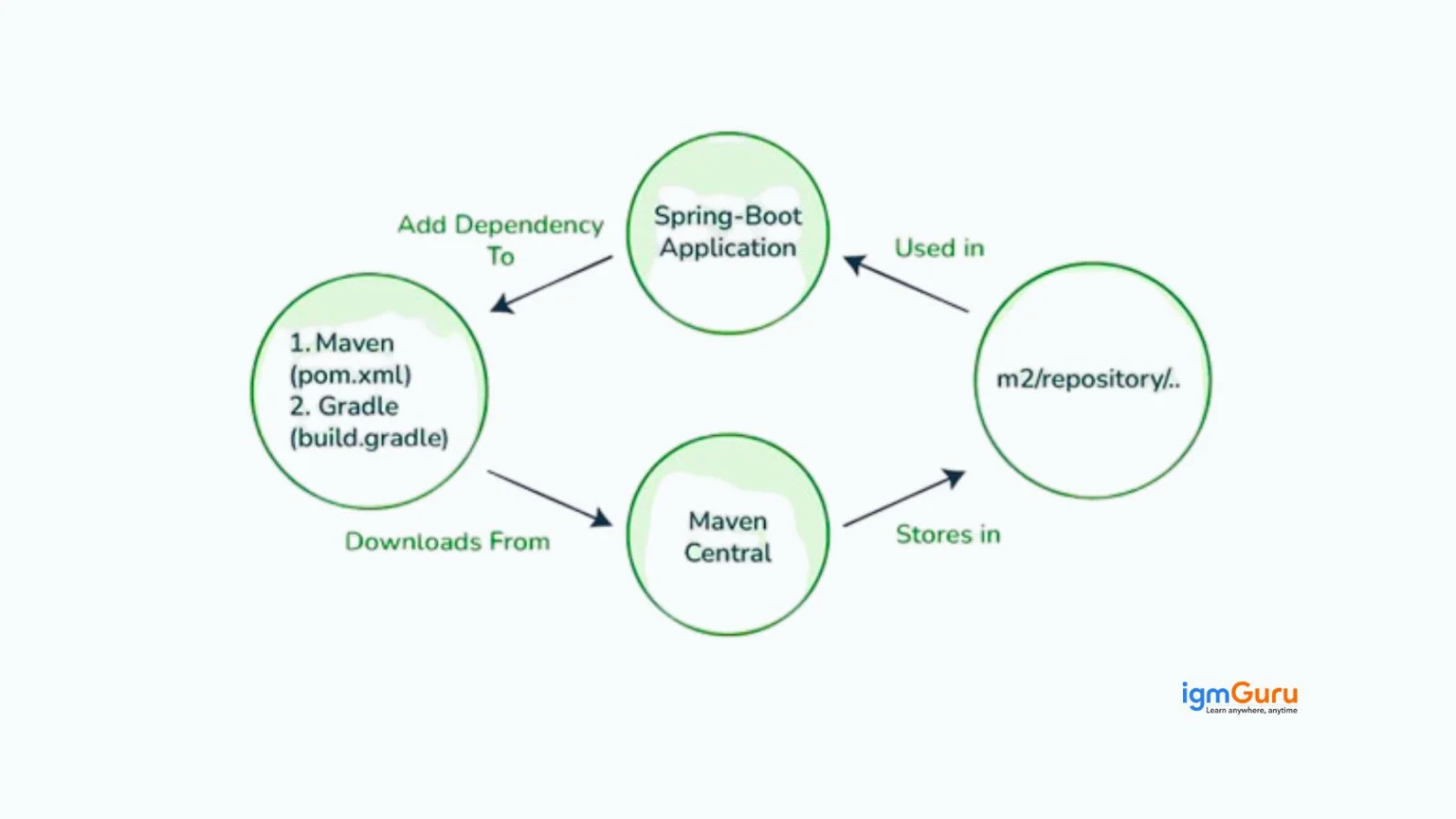
Spring Boot dependency management is the mechanism that controls library versions automatically to ensure compatibility across the application. It is primarily achieved through Spring Boot starters and the Spring Boot parent POM, which define and manage dependency versions internally.
By using starter dependencies, developers avoid specifying individual library versions, reducing version conflicts and dependency mismatches. This approach simplifies build configuration, improves stability and ensures that all Spring and third-party libraries work seamlessly together in a Spring Boot application.
Related Article: CMD Commands

This section includes the most asked Spring Boost interview questions and answers for experienced professionals. These are mostly asked to test your knowledge and skills on working with real-world projects.
I would create a non-web application by disabling the web environment and running application logic without starting an embedded server. It typically includes the following steps:
Spring Boot then starts the application context, executes the required business logic (such as batch processing, scheduling or background tasks) and exits without handling HTTP requests.
A starter dependency is a predefined set of compatible libraries grouped together to provide a specific functionality. It simplifies dependency management by eliminating the need to add and manage individual dependencies manually.
Each starter follows a naming convention like spring-boot-starter-* and automatically brings in required transitive dependencies with compatible versions. This approach reduces configuration effort, avoids version conflicts and accelerates application development while maintaining consistency across Spring Boot modules.
The default port is the network port on which the embedded server listens for incoming HTTP requests. By default, the applications run on port 8080 when using the embedded Tomcat server. This default can be changed through application configuration, but 8080 is used out of the box to allow applications to start immediately without additional setup.
Both annotations are related to auto-configuration, but they differ in scope and responsibility. @SpringBootApplication is a higher-level convenience annotation, while @EnableAutoConfiguration focuses only on auto-configuration. Let’s understand the complete difference between them:
| Feature | @SpringBootApplication | @EnableAutoConfiguration |
| Type | Composite annotation | Core auto-configuration annotation |
| Purpose | Bootstraps the entire Spring Boot application | Enables Spring Boot auto-configuration |
| Includes | @Configuration, @EnableAutoConfiguration, @ComponentScan | Only auto-configuration logic |
| Component Scanning | Enabled by default | Not included |
| Usage | Used on the main application class | Used internally or in advanced custom setups |
| Common Practice | Preferred entry-point annotation | Rarely used alone |
@ComponentScan is a Spring annotation used to define how Spring discovers and registers beans in an application. It tells the IoC container which packages to scan for components such as @Component, @Service, @Repository and @Controller.
This framework by default scans the package of the main application class and all its sub-packages. Using @ComponentScan, developers can explicitly include or exclude packages, control bean discovery and avoid unnecessary class loading, which is important in modular or large-scale applications.
It is possible to check and access environment properties in Spring Boot applications. This framework provides the Environment abstraction, which allows applications to read configuration properties from multiple sources such as application.properties, application.yml, system properties, environment variables and command-line arguments.
Developers can access these properties programmatically using the Environment interface or bind them directly to beans using @Value or @ConfigurationProperties. This makes configuration flexible, environment-aware and easy to manage across different deployment environments.
Debugging logs in a Spring Boot application can be enabled by configuring the logging level so that detailed internal logs are printed during application startup and runtime. This is commonly done by:
Enabling debug logs helps developers analyze application behavior, troubleshoot configuration issues and understand auto-configuration decisions during development and debugging sessions.
Dependency Injection (DI) is a core Spring principle where objects receive their dependencies from the IoC container instead of creating them manually. This promotes loose coupling, easier testing and better maintainability. Spring have various types of Dependency Injection including:
| Type | Description |
| Constructor Injection | Dependencies are injected through the class constructor; recommended for mandatory dependencies |
| Setter Injection | Dependencies are injected using setter methods; useful for optional dependencies |
| Field Injection | Dependencies are injected directly into fields using annotations; concise but less test-friendly |
Constructor Injection and Setter Injection are two ways of injecting dependencies in Spring, but they differ in design intent, safety and usage.
| Feature | Constructor Injection | Setter Injection |
| Injection Time | At object creation | After object creation |
| Dependency Requirement | Mandatory dependencies | Optional dependencies |
| Immutability | Supports immutable objects | Does not support immutability |
| Testability | Easier to test | Slightly harder to test |
| Null Safety | Prevents null dependencies | Risk of null values |
| Recommended By Spring | Yes | Less preferred |
Thymeleaf is a server-side Java template engine used in Spring Boot to build dynamic web pages. It processes HTML templates on the server and injects data from the backend before sending the final HTML to the client.
It integrates seamlessly with Spring MVC, supports natural templating (valid HTML files) and allows dynamic rendering using expressions, conditionals, loops and template fragments. Thymeleaf is commonly used for UI-based Spring Boot applications where server-side rendering is required.
Now we will discuss some of the most asked Advanced Spring Boot interview questions and answers. These are based on the most robust and trending topics that will help you impress the panel in your next interview.
Spring Boot auto-configuration works by conditionally configuring beans based on the classpath, existing beans and application properties. During startup, it scans spring.factories (or auto-configuration imports in newer versions) to load auto-configuration classes and applies them only when specific @Conditional conditions are satisfied.
Auto-configuration classes are executed after user-defined configurations, ensuring that custom beans always take precedence. This mechanism is driven by conditions such as @ConditionalOnClass, @ConditionalOnMissingBean and @ConditionalOnProperty.
Customization and disabling are done by:
All three annotations control conditional bean creation, but they differ in what condition they evaluate and when they are best used. Understanding the distinction reflects real-world Spring Boot experience.
| Annotation | Condition Type | What It Checks | Typical Use Case | How to choose between them? |
| @ConditionalOnProperty | Configuration-based | Presence or value of a property | Feature toggles, enabling/disabling functionality via config | Choose @ConditionalOnProperty when behavior should change based on configuration values (for example, enabling a cache or security feature). |
| @ConditionalOnClass | Classpath-based | Whether a class exists on the classpath | Auto-configuration, optional library integration | Choose @ConditionalOnClass when bean creation depends on the presence of a dependency or library on the classpath. |
| @Profile | Environment-based | Active Spring profile | Environment-specific beans (dev, test, prod) | Choose @Profile when defining environment-specific behavior such as different beans for development, testing and production. |
Spring Boot supports microservices architecture by enabling teams to build small, independent, production-ready services with minimal configuration. It provides embedded servers, externalized configuration, health checks and rapid startup, which are essential characteristics of microservices.
Spring Boot focuses on building individual microservices, while Spring Cloud provides the distributed system capabilities required to operate those services at scale.
Role of Spring Boot vs Spring Cloud in Microservices:
| Aspect | Spring Boot | Spring Cloud |
| Core Purpose | Build standalone microservices | Manage and operate microservices |
| Service Creation | REST APIs, business logic, data access | Service discovery, config, resilience |
| Configuration | application.properties / yml | Centralized configuration management |
| Scalability Support | Basic | Advanced (load balancing, circuit breakers) |
| Production Readiness | Actuator, metrics, health checks | Distributed tracing, gateways, config servers |
Externalized configuration allows application behavior to change without modifying or rebuilding the code. It is very important for managing multiple environments like dev, test and prod.
Spring Boot loads configuration from multiple sources with a well-defined priority order including application.properties/yml, profile-specific files, environment variables, system properties and command-line arguments. Environment-specific configurations are typically managed using Spring Profiles such as dev, test and prod.
For example:
Spring Boot automatically picks up files like application-dev.yml, application-test.yml and application-prod.yml based on the active profile. These files can define different database URLs, logging levels or feature flags. Profiles can be activated through configuration files, environment variables or startup parameters.
This approach ensures clean separation of configuration from code, supports safe deployments and allows the same artifact to run consistently across environments with environment-appropriate behavior.
This framework handles application startup performance by using auto-configuration, classpath scanning, lazy initialization and optimized bean creation. It initializes the application context, evaluates conditional configurations, creates beans and prepares the embedded server. Startup time mainly depends on the number of beans, classpath size, auto-configurations and initialization logic. The following are some tips to optimize slow startup times:
Spring Boot Actuator’s security model is based on restricting access to management endpoints and exposing only what is necessary, especially in production environments. Many sensitive endpoints are disabled or secured by default to prevent unauthorized access.
Actuator endpoints are protected using Spring Security, where access can be controlled through authentication, authorization and role-based access. Only non-sensitive endpoints like health are typically exposed publicly, while others such as env, metrics, beans or heapdump are restricted.
To expose sensitive endpoints safely:
It integrates naturally with containers and Kubernetes as it produces self-contained, executable applications that are easy to package, deploy and scale in cloud-native environments.
Its applications are typically packaged as executable JARs and containerized using Docker. The embedded server (Tomcat/Jetty/Undertow) removes the need for external app servers. This makes containers lightweight and portable. If we get into Kubernetes:
Its Actuator plays a key role by providing readiness and liveness probes, which Kubernetes uses to manage pod lifecycle and traffic routing.
Transaction management in Spring Boot is built on Spring’s declarative transaction model, where transactions are started, committed or rolled back automatically based on method boundaries and runtime behavior. It is typically enabled via @Transactional, which is implemented using AOP proxies around beans. When a @Transactional method is invoked through a Spring-managed proxy, Spring:
It handles global exception handling using a centralized mechanism that separates error handling logic from business code, resulting in consistent and maintainable APIs.
At the framework level, it provides a default error handling flow through BasicErrorController, which returns structured error responses. For application-level control, global handling is typically implemented using @ControllerAdvice combined with @ExceptionHandler. Designing a clean error response strategy includes:
Common memory leaks and performance issues in its applications usually arise from improper bean management, resource handling and JVM misconfiguration. These occur mostly in long-running production systems. Here are some of the common memory leaks and performance issues:
Diagnosing them includes:
Read Also: Java Interview Questions and Answers
This section covers some of the most relevant Java Spring Boot interview questions that connect Java core concepts with Spring Boot development. These questions are often asked to test how well you understand the JVM, modern Java features and how they work inside Spring Boot applications.
Modern Spring Boot versions are designed to work efficiently with Java 17 and above. Features like records help create immutable DTOs with less boilerplate code. Pattern matching improves readability in complex logic. Virtual threads (introduced in Java 21) enhance concurrency by allowing lightweight threads, which can improve scalability in high-throughput applications. Using modern Java versions improves performance, maintainability and long-term support.
Virtual threads are lightweight threads introduced in Project Loom (Java 21). Unlike traditional platform threads, they are managed by the JVM and consume fewer system resources. In Spring Boot applications that handle many concurrent requests, virtual threads can improve scalability by reducing thread exhaustion. However, they must be used carefully with blocking operations and database drivers to ensure compatibility.
When running inside Docker or Kubernetes, JVM memory settings must be tuned carefully. The JVM allocates heap memory based on container limits. If not configured properly, it may cause OutOfMemory errors or excessive GC pauses. Developers should configure container-aware JVM flags and monitor memory using Actuator metrics. Proper memory tuning ensures stable production performance.
CompletableFuture is a Java concurrency API used to execute asynchronous tasks programmatically. @Async is a Spring annotation that allows asynchronous execution managed by Spring’s task executor. CompletableFuture provides more fine-grained control, while @Async simplifies asynchronous method execution. The choice depends on whether you need advanced chaining and error handling or simple background execution.
Java records are immutable data carriers introduced in Java 16. In Spring Boot, they are useful for creating request and response DTOs because they reduce boilerplate code and enforce immutability. This improves thread safety and code clarity. Records also integrate well with JSON serialization libraries like Jackson, making them suitable for REST APIs.
This section includes some of the most asked Spring Boot coding interview questions. These questions are commonly asked in technical rounds where candidates are expected to write practical and production-ready code rather than only explain concepts.
To create a paginated API, I use Spring Data JPA’s Pageable interface. The controller method accepts page and size parameters, and the repository extends JpaRepository. This automatically enables pagination support. The response includes content, total pages and total elements. Pagination improves performance and handles large datasets efficiently.
Global exception handling is implemented using @ControllerAdvice and @ExceptionHandler. This centralizes error handling logic and ensures consistent error responses across the application. Instead of handling exceptions in every controller, a dedicated handler class processes them and returns a standardized response structure.
To secure APIs with JWT, I configure Spring Security and create a filter that validates the token from incoming requests. The token is generated after successful authentication and contains user roles and claims. The filter verifies the token before allowing access to protected endpoints. This approach ensures stateless authentication suitable for microservices.
Validation is implemented using annotations like @NotNull, @Size and @Email on request DTOs. The @Valid annotation is used in controller methods to trigger validation. If validation fails, MethodArgumentNotValidException is thrown and handled globally. This ensures data integrity and prevents invalid input from reaching business logic.
To optimize slow queries, I enable SQL logging and analyze execution plans. I ensure proper indexing at the database level and avoid N+1 query problems by using fetch joins or EntityGraph. I also configure connection pooling using HikariCP and monitor database metrics through Actuator. Performance tuning requires both application-level and database-level improvements.
You can create a REST endpoint using @RestController and @GetMapping. The @PathVariable annotation captures the user ID from the URL, while the service layer handles the business logic and retrieves the required user.
| Code Example |
|
A POST API can be created using the @PostMapping annotation. The @RequestBody annotation converts the incoming JSON request into a Java object, which can then be passed to the service layer for processing and persistence.
| Code Example |
|
A custom exception handler can be implemented using @RestControllerAdvice and @ExceptionHandler. This approach centralizes exception handling and allows the application to return consistent HTTP status codes and error messages to API clients.
| Code Example |
|
Spring Data JPA supports derived query methods, allowing developers to create database queries by following predefined method-naming conventions. For example, the following repository method automatically generates a query to retrieve a user based on the email field.
| Code Example |
|
The Optional return type also provides a clean way to handle situations where no matching user exists.
Spring Boot supports scheduled tasks using the @Scheduled annotation. First, scheduling must be enabled with @EnableScheduling. You can then define a method that runs automatically according to a fixed interval or cron expression.
| Code Example |
|
In this example, the executeTask() method runs every 60 seconds. In real-world applications, scheduled tasks can be used for report generation, database cleanup, notifications and other recurring background operations.
Now let us discuss some important Spring Framework interview questions. These questions focus on core Spring concepts that form the foundation of Spring Boot. Interviewers often ask these to evaluate deeper framework knowledge.
BeanFactory is the basic IoC container responsible for bean creation and dependency injection. ApplicationContext extends BeanFactory and provides advanced features like event propagation, internationalization and AOP integration. In modern applications, ApplicationContext is preferred because it offers more enterprise-ready capabilities.
The bean lifecycle includes instantiation, dependency injection, initialization and destruction. Initialization callbacks can be defined using @PostConstruct, and destruction logic using @PreDestroy. Spring also allows custom lifecycle management using BeanPostProcessor. Understanding the lifecycle is important for writing optimized and controlled components.
Aspect-Oriented Programming (AOP) separates cross-cutting concerns like logging, security and transactions from business logic. Spring implements AOP using proxies. When a method is annotated with @Transactional, Spring creates a proxy that wraps the original bean and manages transaction boundaries automatically.
Spring resolves circular dependencies through setter injection or field injection by creating early bean references. However, circular dependencies in constructor injection cause errors because dependencies are required at object creation time. It is recommended to refactor code to avoid circular dependencies for better design.
The servlet stack (Spring MVC) follows a blocking request-response model, where each request occupies a thread. The reactive stack (Spring WebFlux) uses a non-blocking, event-driven model suitable for high-concurrency systems. Reactive programming improves scalability but requires careful design and compatible libraries.
This section includes the most asked scenario based Spring Boot interview questions and answers. These type of questions are asked to check the proficiency and knowledge of candidate on real world projects
If an application performs well locally but slows down in production, I approach it systematically, starting with observability, not assumptions. Here are the steps I would use:
I treat it as a configuration management problem, not a code issue and focus on making configuration predictable, validated and environment aware. I manage it via the following steps:
If sensitive Actuator endpoints are exposed in production, I treat it as a security misconfiguration and lock it down immediately with a layered approach.
This approach ensures we retain operational visibility for teams while completely avoiding information leakage or attack surfaces in production.
I design for failure as a first-class concern, as in a microservices system, dependent services will fail. The steps includes:
This design prevents cascading failures, keeps the service responsive under stress and makes the system resilient and production-ready.
When multiple users update the same data concurrently, I treat it as a concurrency and consistency problem and address it at both the application and database levels.
This approach ensures strong data consistency, predictable behavior under concurrent access and avoids race conditions without unnecessarily sacrificing performance.
When traffic suddenly increases, I first verify whether the issue is caused by CPU exhaustion, thread pool saturation, database bottlenecks or external service latency. I immediately monitor Actuator metrics, JVM health and request latency to identify the primary bottleneck.
This approach improves system stability, prevents cascading failures and keeps the application responsive under heavy load.
I first reproduce the issue using logs, API tracing and request correlation IDs to understand whether the inconsistency comes from business logic, caching, database reads or concurrent updates.
I also implement automated integration tests to ensure API responses remain consistent across deployments and environments.
I handle duplicate message processing by designing the consumer to be idempotent so repeated events do not create inconsistent data.
This ensures reliable event processing and prevents duplicate updates in distributed systems.
I compare the local and container environments to identify differences in configuration, networking, JVM memory limits or missing dependencies.
I also test the application using production-like environments before release to reduce deployment-related failures.
I first analyze whether connections are leaking, queries are slow or the connection pool size is incorrectly configured. I monitor HikariCP metrics, database activity and request throughput to identify the root cause.
This improves database stability, prevents request failures and ensures the application can handle higher concurrency efficiently.
Preparing for a Spring Boot interview requires more than remembering annotations and framework features. Interviewers often assess your understanding of Spring Core, dependency injection, REST API development, microservices, security, database integration and your ability to solve real-world backend problems. Following these practical tips will help you perform confidently in both technical and system design interview rounds.
@SpringBootApplication.@RestController, request mappings, validation, exception handling, pagination, filtering and proper HTTP status codes.The best way to crack a Spring Boot interview is to combine strong theoretical knowledge with hands-on project experience. Regular coding practice, building production-ready applications and understanding real-world scenarios will prepare you for fresher, intermediate and senior-level Spring Boot interviews.
We have explored the most asked Spring Boot interview questions and answers curated by top experienced professionals. It will work as the perfect resource for your next Spring Boot interview preparation whether you are a beginner, intermediate or experienced professional. Further, you can also refer to our additional guide for a deeper understanding of this framework.
You should understand core concepts like dependency injection, auto-configuration, REST APIs, Actuator, transaction management, profiles and basic microservices concepts.
Spring Boot is preferred for microservices as it supports lightweight services, fast startup, embedded servers, externalized configuration and seamless integration with Spring Cloud for service discovery and resilience.
The most important annotations include @SpringBootApplication, @RestController, @Service, @Repository, @Autowired, @RequestMapping and @Transactional. These are frequently asked in both fresher and experienced interviews.
A Spring Boot professional’s salary is influenced by experience, company and skill level. They can earn up to ₹45 to 70+ LPA in India and $105,000 in the USA.
To ace a Spring Boot interview, you need to master both its architectural automation and how it integrates with databases, security protocols, and microservices. Interviewers look for developers who understand the underlying mechanics rather than those who just memorize annotations.
Explore Our Trending Articles-