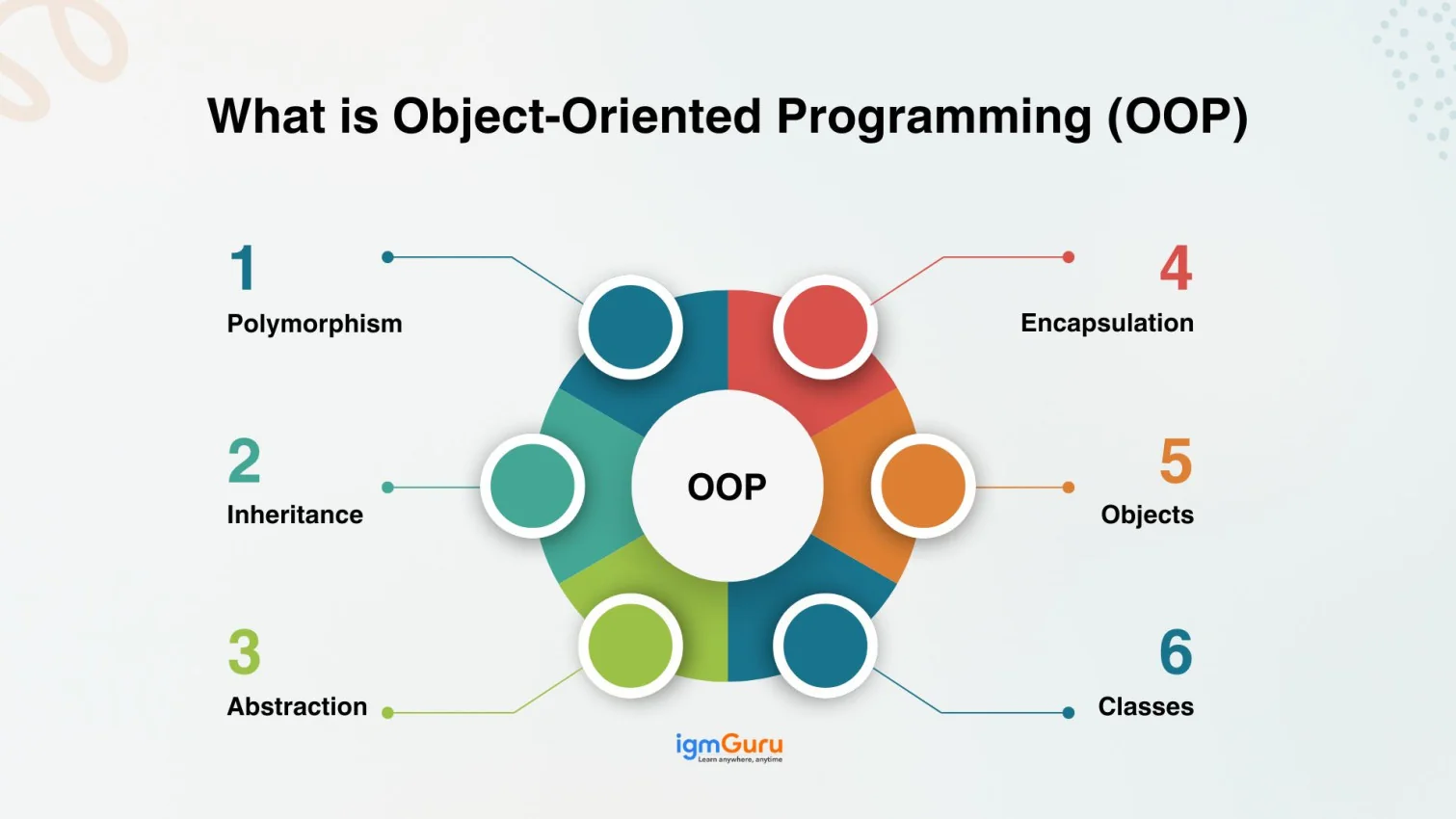
Object-Oriented Programming (OOP) is a software design model that includes organizing code around "objects" rather than logic. Instead of just writing a sequence of steps to perform a task, you create self-contained objects that bundle together both data (attributes) and the actions (methods) that can be performed on that data.
It simplifies the complexity of advanced applications like software like video games, banking apps or social media platforms. It has been a popular programming paradigm among developers and engineers because of its capability to make software development more organized and efficient. If you are also one of them or want to become one of them, understanding OOP is a must thing to do.
In this blog, I will explain everything from the very basics to the core concepts, key terminologies, popular programming languages, benefits, and many other things. Let's get into it!
Object-Oriented Programming structures programs as collections of interacting objects, where each object encapsulates both data (attributes or state) and behavior (methods or functions). This approach mirrors the way we interact with the real-world. It is is the most important and powerful programming approach of modern software development.
OOP was first introduced through the Simula programming language in the 1960s, which was essentially built for the simulation process. However, OOP gained popularity in software development after the launch of C++ in the 1980s; from then it gained widespread recognition and changed the way developers design, build, and maintain software by enabling modularity, reusability, and scalability.
In today's era, OOP is one of the core components of the world's top programming languages like Java, Python, Ruby, C++, and C#. This approach is used in web development, mobile apps, enterprise software, games, and even machine learning tools like TensorFlow. There is a reason behind the widespread use of OOP i.e. its emphasis on code organization and abstraction makes it crucial for building large, complex, and maintainable applications that can evolve with changing business and user needs.
Explore igmGuru's Java Course program to learn core and advanced Java.
Only understanding Object-Oriented Programming is not enough. To gain more knowledge on this, it is necessary to learn about its 4 core concepts (principles). These concepts ensure that the software is scalable, maintainable, and modular. Let's break them down to understand them individually.
Encapsulation refers to wrapping data (variables) and behavior (methods) into a single unit, typically a class. Encapsulation prevents direct access to data. Hence, modifications are only possible through specific methods. This is crucial for data integrity and security.
Abstraction means hiding unnecessary details and showing only essential features of an object. This helps in writing and using code becomes easy, and it also reduces programming complexities.
Inheritance allows new classes to derive properties and methods from existing classes. Additionally, it promotes code reuse and establishes a natural hierarchy.
Polymorphism means "many forms," which allows a single interface to represent different underlying data types. This can be achieved through:
Understanding Object-Oriented Programming begins with familiarizing yourself with its vocabulary. These terminologies create the foundation for writing, reading, and designing OOP-based programs effectively.
i) Private: Accessible only within the class.
ii) Public: Accessible from anywhere.
iii) Protected: Accessible within the class and its subclasses.
Related Article- Java Tutorial For Beginners
Beyond the four core principles, modern software development also uses advanced OOP concepts. Understanding them is equally important for you to master this programming paradigm.
Composition is a design principle that suggests building complex functionality by combining smaller and independent objects. This means it will not be inherited from a base class. While inheritance establishes an "is-a" relationship, composition creates a "has-a" relationship.
Inheritance can sometimes lead to tightly coupled systems where changes in a parent class affect all child classes. Deep inheritance hierarchies also become difficult to maintain and refactor. Composition here promotes flexibility because behaviors can be changed at runtime by replacing components rather than modifying the entire class structure.
This approach improves reusability, reduces dependency issues and makes systems easier to extend without breaking existing functionality. Modern frameworks and clean architecture principles strongly favor composition over inheritance.
SOLID is a collection of five object-oriented design principles that help developers write clean, maintainable and scalable code. These principles guide software architecture decisions and reduce long-term technical debt.
A class should have only one reason to change. In simple words, it should be focused on only one responsibility. This makes debugging and maintenance easier because each class handles one clearly defined task.
Software entities should only open for extension not modification. This means you have to add new functionality without customizing existing code. This reduces the risk of introducing bugs.
Subclasses should be able to replace their parent classes without breaking the program’s behavior. If a subclass changes expected behavior, it violates this principle.
Clients should not be forced to depend on interfaces they do not use. Smaller and more specific interfaces are always better in comparison to large or general-purpose ones.
High-level modules should not depend on low-level modules. Both should depend on abstractions. This improves flexibility and allows systems to change implementations without affecting core logic.
Design patterns are reusable solutions to common software design problems. They are not ready-made code but structured templates that guide developers in solving recurring architectural challenges. Below are some widely used design patterns in OOP:
The Singleton ensures that a class has only one instance throughout the application and provides a global access point to it. It is commonly used for configuration settings, logging systems, and database connections where multiple instances could cause conflicts.
The Factory pattern provides a way to create objects without specifying the exact class of the object being created. It centralizes object creation logic and promotes loose coupling. This pattern is commonly used in frameworks where object creation depends on dynamic conditions.
The Observer pattern is used to define a one-to-many relationship among objects. This relationship means if any of the objects is changed then all the others should be notified. This pattern is widely used in event-driven systems, notification services, and user interface frameworks.
Design patterns are essential in professional software development because they provide standardized solutions that improve code readability, maintainability, and collaboration among teams.
Understanding theory is only the first step, you need to actually apply it into practical code to know how Object-oriented Programming works. Below are simple Java examples that demonstrate how OOP concepts are applied in real development.
This example shows how a class acts as a blueprint and how an object is created from it.
|
This demonstrates how real-world entities are represented as objects in OOP.
Encapsulation protects data by making variables private and providing controlled access through methods.
|
Polymorphism allows different classes to provide their own implementation of a method.
|
OOps and procedural are the core types of programming, and beginners often get confused about choosing between them in real projects. Understanding how both are different can help them choose the right approach for different projects.
| Feature | OOP | Procedural Programming |
|---|---|---|
| Structure | Organized around objects | Organized around functions |
| Reusability | High (via inheritance) | Limited |
| Data Security | Strong (encapsulation) | Weak |
| Scalability | Suitable for large systems | Best for small programs |
| Real-World Mapping | High | Low |
OOP principles are implemented in various modern programming languages. Each of them has their own advantages, ecosystems, and use cases.
It is among the most used object-oriented languages. Java is platform-independent and strictly follows OOP concepts. It is highly used for Android apps, enterprise-level applications, and cloud-based services.
Python is a flexible and easy-to-read language. It supports OOP, procedural, and functional programming. Python's object-oriented features make it a favorite for AI, data science, and rapid prototyping.
C++ is a language that supports both procedural and OOP. It offers deep control over system resources that make it ideal for system software, operating systems, and gaming engines.
C# is developed by Microsoft. It is designed for building a wide range of enterprise applications, including desktop apps, mobile apps (with Xamarin), and games (with Unity engine). It supports strong OOP features, including interface implementation and inheritance.
Ruby is also known for being a "pure object-oriented" language. It comprises everything, even primitive data types as objects. Ruby on Rails, is a powerful web framework that exemplifies the practical application of OOP.
OOP is not just a programming style, it offers structured advantages that help developers build complex, scalable, and maintainable software systems.
Related Article- Python Tutorial for Beginners
OOP offers so many benefits, yet it also has limitations and challenges, especially for beginners or specific use cases.
Let’s build a real project “banking application” using OOP to understand its practical use. We are building:
This class represents a generic bank account. It includes basic attributes and behaviors common to all accounts.
|
|
|
In real systems, a bank manages multiple accounts.
|
The bank does not need to know if the account is savings or current. That’s polymorphism in action.
|
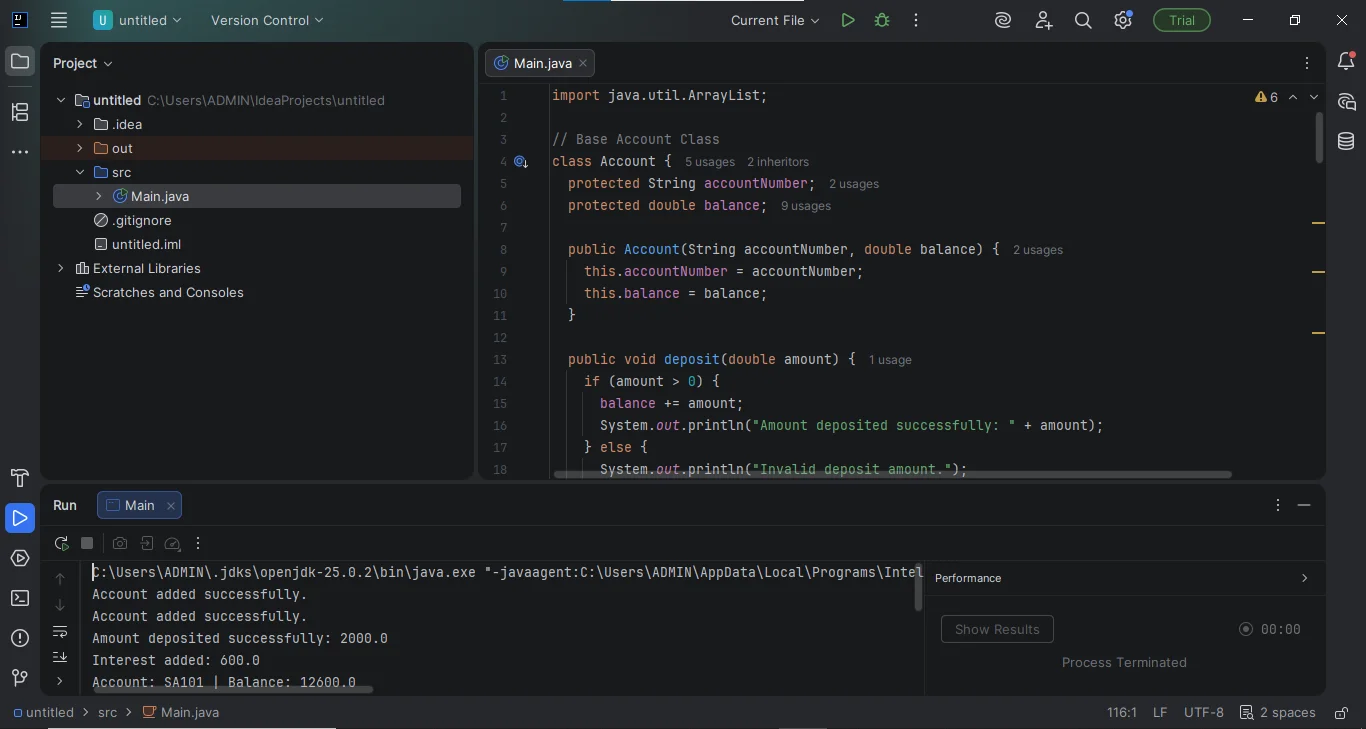
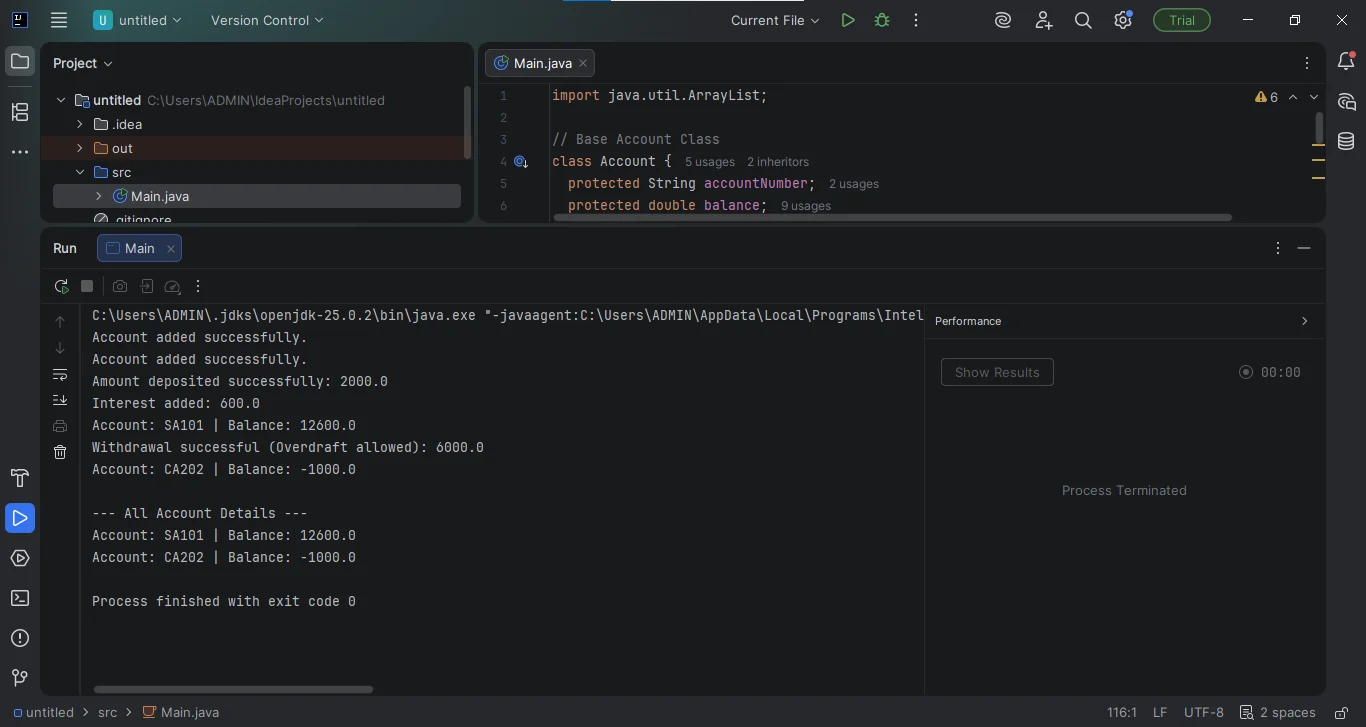
You can run this project on IntelliJ, Eclipse or VS Code. Just combine all the code and run it in one of them. I have used IntelliJ as shown below:
Even with the rise of functional programming and microservices architecture, OOP remains dominant in enterprise systems, Android development, backend APIs, and cloud-based platforms. Major frameworks and tools continue to rely heavily on object-oriented principles for scalability and maintainability. This ensures that learning OOP is not just academic knowledge but a long-term career investment.
Object-oriented programming not only acts as a technique, but it is the foundation of modern software development. It is being used from small applications to massive enterprise systems. Additionally, OOP helps in structure, scalability, and reusability into code.
By understanding its core concepts and key terminologies, developers can write better, maintainable, and efficient programs. Whether you're a beginner or someone who is learning (brushing up) on fundamentals or mastering OOP, this will open your doors to real-world software development opportunities.
OOP is a way of coding where real-world things are represented as objects that have data and actions. It makes programs easy to manage, reuse, and scale.
In real life, OOP is like how objects work around us. For example, a car (object) has properties like color and model (attributes) and actions like drive or brake (methods). In programming, we create similar objects to organize code better and make it work like real-world systems.
OOP is useful because it makes code more organized, reusable, and easier to maintain. It helps break down complex problems into smaller, manageable parts (objects), supports code reuse through inheritance, protects data using encapsulation, and allows flexibility with polymorphism. This makes building and updating software faster and more efficient.
Popular OOP languages include Java, Python, C++, C#, Ruby and PHP. These languages support key OOP concepts like classes, objects and inheritance.
OOP helps developers create modular, reusable and easy-to-maintain software. It also makes large applications easier to manage and scale.