Want to become a Java Developer? It will be a great career choice as they are in huge demand in various industries across different countries. This demand also comes with a huge competition that can be a speed breaker to your journey. Don’t worry, I am here with a comprehensive, step-by-step guide on how to become a Java developer.
It will dive into what a Java developer is, the skills they need, a complete step-by-step roadmap, along with their roles and responsibilities. In short, you will be interview-ready by following this guide with dedication.
A Java developer is a software professional who uses the Java programming language to build, maintain, and optimize applications. These applications can be from simple console-based tools to enterprise-level web platforms or mobile apps.
Most Java developers work on backend development, handling the complete system logic (server-side). This work also extends to Android apps, APIs, big data tools (like Hadoop), and cloud-based microservices. Yet, the question arises, what specific work is done by Java developers? Let's have a look.
A Java developer plays a key role in designing, developing, and maintaining Java-based applications. They ensure smooth performance and scalability, from writing clean and efficient code to integrating databases and working on backend services. They also collaborate with cross-functional teams across the entire software development life cycle. Further, they are responsible for the following tasks:
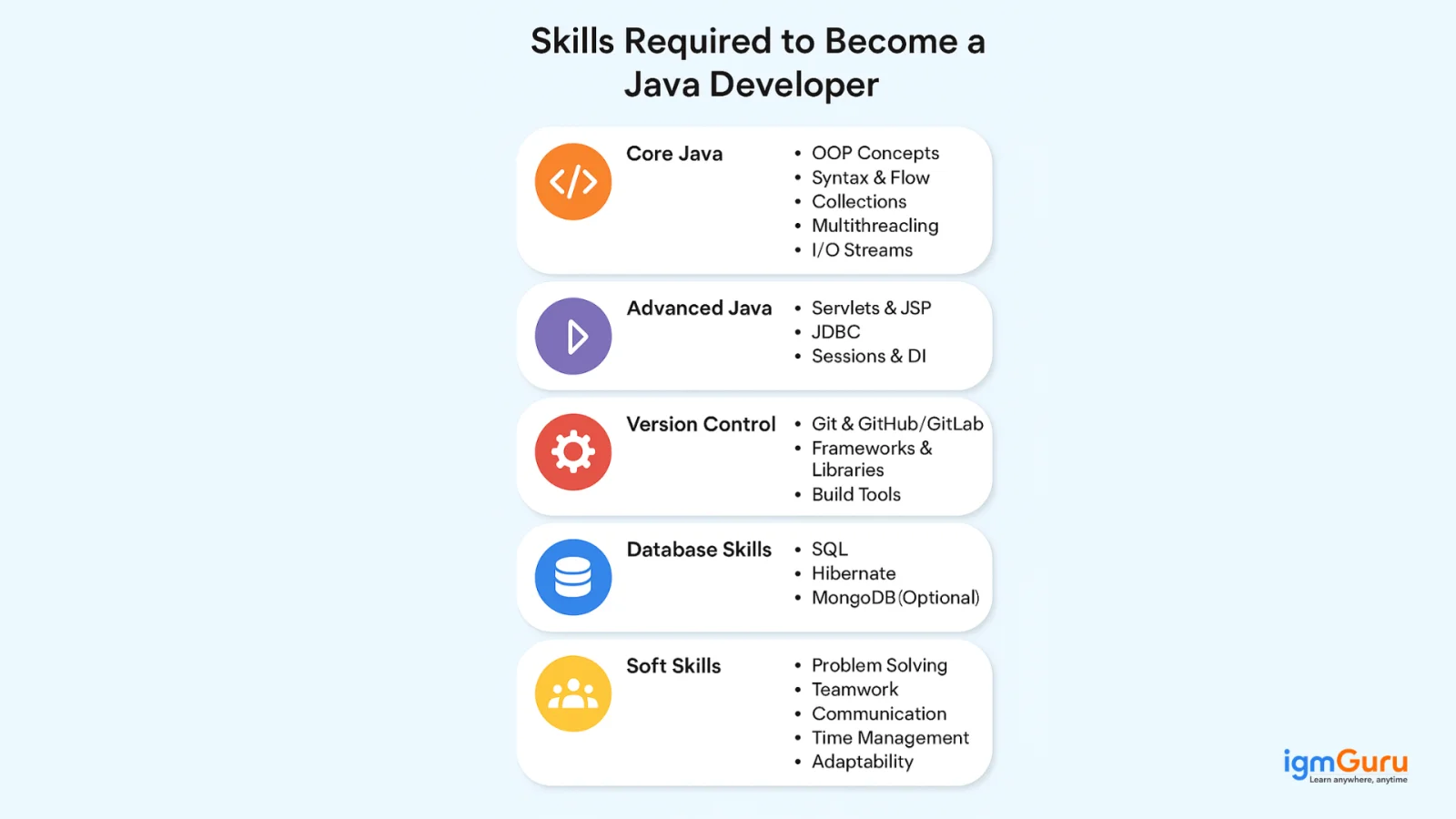
To become a proficient Java developer, it’s essential to master a full stack of tools, technologies, and professional traits. From solid Core Java knowledge to advanced frameworks like Spring Boot, and from databases to version control, every skill counts. The image below shows all the must-have technical and soft skills that make a proficient developer truly job-ready in today's tech world.
Becoming a Java developer requires building your skills in the right sequence, step by step. Here is a roadmap that will guide you from fundamental concepts to becoming a job-ready developer, providing clear direction at every stage. If you want to know how to become a Java developer with no experience, following these steps meticulously is key.
The first and most important step is mastering the core concepts. A weak foundation will make understanding frameworks and complex projects difficult later.
Core Java involves more than just syntax; it establishes your object-oriented thinking and logical problem-solving skills. In this stage, focus heavily on the following Core Java topics for interview preparation:
With a strong base, the next step is grasping the frameworks, tools, and architecture used for scalable enterprise development. This step is crucial for anyone seeking to learn the best Java frameworks to learn in 2026.
Tools like Spring Boot, Hibernate (JPA), and Maven/Gradle are crucial for building scalable applications, microservices, and backend APIs. Frameworks ensure your code is modular, secure, and efficient. By mastering these, you get ready for enterprise-level development. Specifically, learn how to learn Spring Boot for Java developer roles by focusing on RESTful services and Microservices architecture.
Java developers mostly work on the backend, yet having basic knowledge of frontend technologies (HTML, CSS, JavaScript) is beneficial. This is necessary if you aim for a full-stack role or are working in a startup. Understanding the integration of API gives you a better perspective on creating robust backends.
Theoretical knowledge is only valuable when applied. Projects boost your confidence and introduce you to real challenges like coding errors, debugging, and version control. A beginner Java developer seeking a job should complete 2–3 real-world projects to build a strong resume.
Here are some project ideas for practice:
Since you are now done working on Projects, the next logical step is open-source contributions. This means contributing to someone else's codebase—fixing bugs, adding new features, or improving documentation. This will help you gain experience in teamwork, production-level code, and issue-tracking tools. Additionally, this will increase your GitHub contributions visibly, which is often noticed by recruiters. For those asking how to get a first Java developer job in India, a strong GitHub profile is indispensable. You can begin by:
Now, when you have Java skills, projects, and a GitHub profile, it is time to enter the real world. Applying for a job and appearing for interviews is not only about sending a resume, but proving your job readiness through projects, problem-solving, and communication. You can also enter this industry through freelancing and internships. When searching for Java developer jobs for beginners no experience, use popular Indian job portals like Naukri, LinkedIn Jobs India, and Indeed India.
In the Indian IT sector, having a technical degree is generally preferred. The most common educational paths include B.Tech/B.E. (Computer Science or IT), MCA, or BCA. However, talent outweighs tradition; those with a relevant certification or bootcamp experience can certainly succeed, especially if they have a strong project portfolio.
Java is one of the most versatile programming languages; therefore, it is widely used across various industries and platforms. Its reliability, platform independence, and security make it a top choice for building everything from enterprise systems to mobile apps. Here are some key areas where it is commonly used:
In short, the role of these developers is dynamic and depends on the company's project, whether your role will be technical or architectural.
Are you wondering whether learning Java is worth it? The answer is an emphatic yes. Java developers are some of the most well-paid professionals in the software industry, both in India and globally. Its widespread use in enterprise applications, banking systems, backend development, and cloud platforms helped Java remain a highly in-demand and rewarding skill. The question of Java developer salary for freshers in India is often the starting point for a promising career.
According to recent salary data (2024–2025), here's what developers typically earn:
| Region | Experience Level | Average Annual Salary |
| India | Entry-Level (0-2 years) | INR 4.5 - INR 6.5 LPA (Starting salary for freshers) |
| Mid-Level (2-5 years) | INR 7.5 - INR 13.0 LPA | |
| Senior-Level (5+ years) | INR 14.0 - INR 25.0 LPA+ (Higher for roles like Architect/Lead, which are the highest paying Java developer roles in India) | |
| United States | All Levels (Avg.) | $105,000 - $115,000 per year |
| Senior Developers | $130K - $150K+ |
In a rapidly evolving tech world, Java continues to stand strong. It has been proving its worth in backend systems, cloud applications, and enterprise-grade platforms. Becoming a Java developer is a smart career move that offers stability and high demand. You can achieve this with a solid learning roadmap and hands-on project experience, which will help you to confidently step into this high-demand role of continuous growth through communities like GitHub. Together with attractive salaries both in India and globally, Java is not just a skill; it is like a career game-changer. Therefore, whether you are a student, fresher, or someone looking to switch into tech, you can start learning Java today. Master these Java developer skills to get a job fast.
On average, it takes 6 to 12 months to become proficient and start applying for a Junior Java Developer role if you constantly learn and practice. However, mastering advanced skills and becoming fully job-ready may take 1 to 1.5 years, depending on your pace and dedication.
Yes, you can learn the basics of Core Java and OOPs in 3 months with regular practice. In this time, you can cover fundamental concepts and some simple projects. Yet, for advanced topics, frameworks, and true job-readiness, you will need more time and hands-on experience.
It is described as moderately challenging for beginners. Its syntax is clean and similar to English, and it follows a logical, object-oriented structure. Therefore, learning it step by step will make it easier.
The 4 types of Java are Java SE for core programming, Java EE (Jakarta EE) for enterprise apps, Java ME for mobile and embedded systems and JavaFX for desktop applications.
First, learn basic Java concepts. Practice small programs every day. Then learn object-oriented concepts, work on simple projects and use version control to slowly build confidence.
Course Schedule
| Course Name | Batch Type | Details |
| Java Training | Every Weekday | View Details |
| Java Training | Every Weekend | View Details |