Are you trying to figure out what is Java used for in the real world? You are not alone; many beginners and even experienced developers ask this question before diving deeper into the language. They are trying to figure out whether learning Java is actually worth the time.
Java is one of the most powerful and widely used programming languages even in 2026. It runs some of the biggest systems we depend on daily: Android apps on millions of phones, secure banking platforms, large enterprise applications, cloud services and high-performance backend systems.
In this guide, I’ll walk you through the major real-world uses of Java in simple, practical terms. You’ll discover exactly where Java is being used today across mobile development, web and backend technologies, finance, cloud computing, and modern applications. Whether you’re just starting your coding journey or looking to understand Java’s current relevance, you’ll gain clear insights to help you make better decisions about learning or using this language.
Java is a widely used object-oriented programming language (OOP) designed to minimize platform dependency through its core philosophy: Write Once, Run Anywhere (WORA). Java programs compile into bytecode that can run on any machine with a Java Virtual Machine (JVM).
Its strong type system, large ecosystem of libraries, and mature tooling make it suitable for building modular, scalable, and secure applications across different industries. Java's syntax resembles C/C++, making it approachable for developers familiar with traditional programming structures.
Here is why Java still matters:
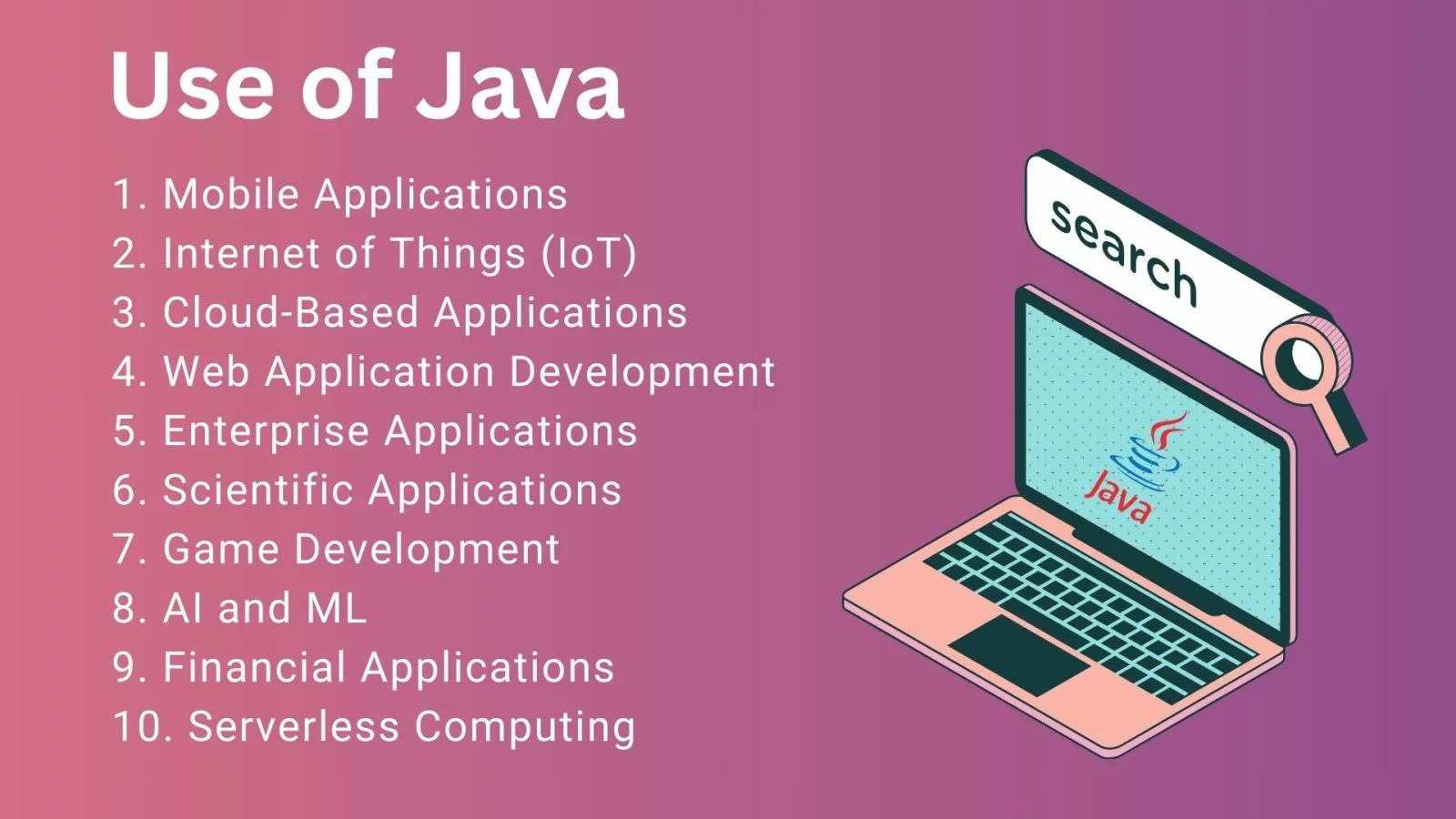
Java powers a broad range of applications- from enterprise systems and Android apps to cloud services and data processing platforms. Below are the major real-world applications where Java continues to play a critical role.
When it comes to mobile phones, Java-based Android is the most famous. Many famous software companies are using its technologies for mobile app development. It is compatible with platforms like Kotlin and Android Studio while being supported by Android Studio. Cross-platform mobile applications are developed using tools like PhoneGap and Xamarin.
More and more IoT applications are being developed with Java because they mostly need scalable and lightweight software solutions. The most popular picks for developing IoT apps are frameworks like Kura, ThingWorx and Eclipse. This language adds portability and flexibility to such devices.
Java is an excellent language for designing and creating cloud apps. This is because of its factors like excellent performance, scalability and reliability. Its platform-independent nature makes these cloud-based apps functional and accessible from any device. Companies across the spectrum depend on cloud apps like Dropbox, Amazon Web Services, Slack and Salesforce.
Development of web apps, dynamic content and web services is among the main uses of this language. Its components like security, performance, and adaptability, make it an amazing option for complicated web apps. Play Framework is a tool with which developers support their work. Frameworks like Servlets, JSPs and Struts offer safe and scalable solutions.
Plenty of large-scale enterprise applications have been developed with this language to date. Supply chain management systems, healthcare systems, and finance and banking systems are a few ones on the list. Top frameworks for the same are Java Persistence API (JPA), Java Message Service (JMS) and JavaServer Faces (JSF). It develops highly efficient, scalable and secure enterprise-level apps.
Key advantages:
Read Also- Top 50+ Java Interview Questions and Answers
With vast community support, a wealth of development tools, and the ever-reliable Java runtime environment (JRE), this language is often the go-to choice for developing scientific apps. It is also a great pick for simulations, mathematical operations, and other scientific calculations. It has strong math libraries and is also extremely portable.
It is the perfect programming language for game development, especially for those running on Android devices. Its high performance makes these kinds of apps run very well on these systems. Open source tools like jMonkeyEngine add 3D to games. It is also useful for 2D games. It's quite an easy one to use and is also compatible with graphics libraries. This makes it a developer favorite for developing immersive experiences.
Different artificial intelligence and machine learning apps use their tools and libraries like Java-ML, DL4J and Weka. This language is great for this usage because of its versatility, scalability and plethora of libraries. Data analysis and data processing tools are also developed with it. Top frameworks for the same are H2O.ai, Apache Spark and Deeplearning4j.
It is a big help when creating different financial software of importance in financial services. It authorizes the development of server-side financial systems for handling transactions, risk analysis and data processing in banks. Performance, threading capabilities, and security are a few of its winning features for financial transactions.
Many serverless applications on platforms like AWS Lambda are written in this language. This is a natural one that brings along many robust tools and libraries. Each of these renders it a great pick for the changing serverless architectures.

Here is the quick comparison among Java, Python, C#, and Kotlin.
| Feature/Aspect | Java | Python | C# | Kotlin |
| Type System | Statically typed | Dynamically typed | Statically typed | Statically typed |
| Primary Use Cases | Enterprise apps, Android, cloud, backend | AI/ML, automation, data science, scripting | Windows apps, Unity games, enterprise | Android apps, modern mobile & backend |
| Performance | High (JVM) | Moderate (interpreted) | Very high (.NET CLR) | High (JVM) |
| Learning Curve | Moderate | Easy | Moderate | Moderate |
| Ecosystem | Massive, mature | Massive for AI/ML | Strong for Windows & gaming | Growing fast (Android-first) |
| Mobile App Development | Android (primary) | Minimal | Xamarin/.NET MAUI | Android (official preference) |
| Enterprise Usage | Very high | Moderate | High | Growing |
| Syntax Style | Verbose | Simple, readable | Cleaner than Java | Concise, modern |
| Cross-Platform Support | Excellent with JVM | Great with libraries | Strong with .NET Core | JVM-based mobility |
| Best Known For | Scalability, reliability | Data science, ML, prototypes | Windows ecosystem, gaming | Modern Android development |
| Community Support | Huge, global | Huge, global | Strong (Microsoft-backed) | Strong (JetBrains & Google) |
Below are some real-world examples that show how deeply Java is embedded in modern technology, especially across the United States and India.
Large e-commerce platforms handle millions of orders, searches, and recommendations every day. Java is widely used in these systems because it manages heavy traffic without slowing down.
Money moves through secure systems that must work flawlessly, and Java has proven reliable for creating financial engines that handle risk analysis, transactions, and trading.
Because of its strong security model, U.S. financial institutions depend on Java for mission-critical operations.
Major cloud platforms and streaming giants rely on Java to run intensive backend services that need to be reliable at all times.
Transport and delivery companies require accurate real-time tracking, route planning, and package scanning. Java supports these complex workflows.
Java's ability to process data quickly helps these companies operate smoothly at a nationwide scale.
Here is the quick overview of Java developer salaries in the USA and India.
| Experience Level | USA Salary (2025) | India Salary (2025) |
| Entry-Level | USD $70,000 - $90,000/year | ₹4,00,000 - ₹7,00,000/year |
| Mid-Level | USD $95,000 - $125,000/year | ₹7,00,000 - ₹15,00,000/year |
| Senior-Level | USD $130,000 - $160,000+/year | ₹15,00,000 - ₹25,00,000+/year |
Java's long-term popularity is driven by its reliability, scalability, security, and a massive ecosystem that continues to evolve. From powering enterprise systems and Android applications to supporting newer domains like cloud-native development and serverless computing, Java remains a key language in 2026.
Its continued relevance shows that learning Java is still a strong investment for anyone aiming for a career in modern software development.
Explore These Trending Articles:
Java Oracle is for creating a wide range of applications like web applications, mobile apps, enterprise software and more.
Java Spring gives infrastructure support for creating Java-based applications on any deployment platform.
Java and Python are majorly used for general-purpose programming languages. It is often favored for huge-scale enterprise applications and Android development because of its strong performance. Whereas Python is famous for data science, machine learning and extensive libraries in those fields.
Course Schedule
| Course Name | Batch Type | Details |
| Java Training | Every Weekday | View Details |
| Java Training | Every Weekend | View Details |