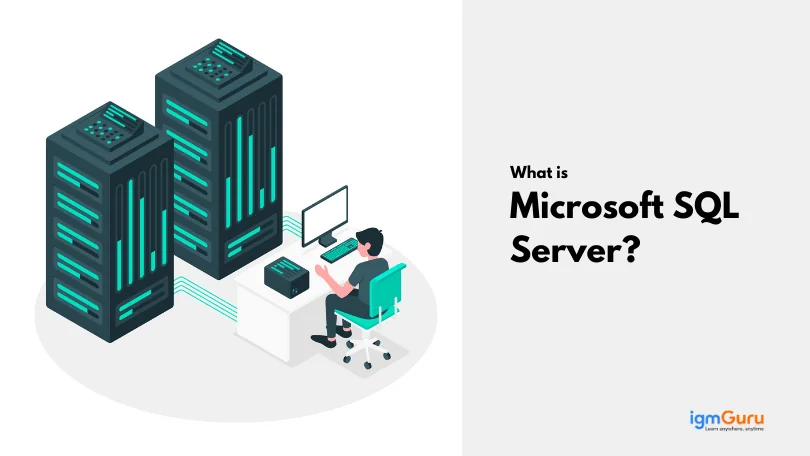
Microsoft SQL Server is a relational database management system (RDBMS) developed by Microsoft. It is a database server designed to store and retrieve data as requested by other software applications, which can reside on the same computer or on a remote computer across a network. It is done using a client-server model. It is now amongst the top 3 DB-Engines as of June 2025.
This popularity is the result of the features and application it provides in different sectors. Do you want to learn about it? This article here deep dives into what is Microsoft SQL server, how it works, what its features and use cases are and more. It will be the perfect guide for you to get started with this robust RDBMS.
Microsoft SQL Server is an RDBMS or relational database management system for storing, managing and retrieving data from many different applications. These could be large enterprise systems or small scale apps. It uses a proprietary query language of SQL called Transact-SQL (T-SQL) for interacting with this server and database.
MMSQL supports different data types. Its robust features are a big help in performance optimization, scalability, data storage and security. Applications that need efficiency and reliable data management find this RDBMS the best. Data warehousing, online transaction processing (OLTP) and business intelligence are at its centre.
Microsoft came together with Sybase Solutions in 1987 to develop a database management system. The purpose was simply to get into a competition with Oracle and IBM, giants of that time. All the selling rights and profits earned by product versions for non-Microsoft went only to Sybase. Microsoft however got exclusive rights to the DB products designed for its platform.
Microsoft later bought all the rights from Sybase and then changed its name to the current one. Plenty of versions have come out for this product till date and only a few are still in use.
Explore all Microsoft Certification Courses by igmGuru to become an all-rounder.
Microsoft SQL Server stores all the important information in relational databases while managing data without any hitches. This is possible because of its different options, tools and visual interface. All these hold very high importance for websites with the option stating user registration for logging in.
Companies find this tool very useful because of the multiple facilities and utilities it brings to the table. It manages a lot of things, especially when there is a product catalog, array of multimedia content or a list of customers. Any application or website that has either of these or different aspects will find MSSQL super useful.
Explore the top Data Warehousing Interview Questions today.
The MSSQL Server architecture is in multiple layers to make it an effective and strong database platform. Understanding its architecture will make it easier to tackle different issues. The general architecture has the design and structure of this DBMS as well as its three other architectures.
This is the complete SQLS architecture in a broad snapshot with the other three. It has many layers and is also the most generic term because of these. It contains different layers like
The log file architecture describes the archive and/or disposing of transaction logs. It is very important for info compliance with recoverability and integrity. This one includes
This is the physical layout of the information on the disk along with the way it is stored there. It also defines different data processing and storage aspects like control, speed and density. This architecture includes
It explains a clear way of memory allocation in Server for data caching. Memory architecture has a direct insinuation for resource management, capacity and query efficiency. The three things it includes are
A complete understanding of its architecture entails getting ahead with its components and technologies. The next section covers everything about it.
Here is a peek into some of the main technologies in MSSQL Server.
Database engine is a core service that stores, processes and secures data. It gives highly controlled access and transaction processing to stay updated with the requirements of demanding data consuming apps within the enterprise. It supports sustaining business continuity via business continuity and database recovery.
SQL Server Integration Services is a platform wherein high performance data integration solutions are built. These include packages providing ETL processing for data warehousing.
SQL Server Reporting Services has enterprise level, web-enabled reporting functionality. It is possible to create reports drawing content from multiple sources, publish these reports in different formats and even centrally manage security and subscriptions.
SQL Server Analysis Services is one analytical platform for team, corporate and personal business intelligence. Power Pivot, SharePoint and Excel Server environments enable servers and client designers to support traditional OLAP solutions, self-service analytics and collaboration, and new tabular modeling solutions. Data mining is also a part of it for uncovering the hidden patterns and relationships inside humongous volumes of data.
SQL Machine Learning Services integrate machine learning into enterprise workflows through popular R and Python languages. ML Services integrates R and Python with the Server to easily build, retrain and score models through stored procedures.
Data Quality Services gives knowledge-driven cleansing solutions for building a strong knowledge base. This knowledge base then performs correction and deduplication on data through computer-assisted and interactive means.
There are quite a few reasons behind the success of this tool. There are many unique and distinguishing features of Microsoft SQL Server. The list tags along different tools for business intelligence, data management, security and analysis.
MSSQL is a RDBMS at its heart and follows all the principles of relational database management religiously. It defines relationships between different tables while keeping up the integrity of the data. This tool also performs complicated queries through SQL.
Data warehousing is another one of its features wherein it builds and maintains warehouses. It also supports many different techniques like columnstore indexes, compression and partitioning for better query performance on gigantic sets. These built-in capabilities for warehousing make it a very good pick for data analytics and business intelligence.
Companies can pick the platform and language of their choice and that makes it highly flexible. It supports many options like operating in Linux, Windows or Kubernetes deployment. All these options and choices increase the compatibility level and ease of use according to the needs of the company.
Businesses can make the most of mobile business intelligence features for uninterrupted integration between DBMS and different devices. This also leads to anywhere access to analytical and data tools in real time. The scalability choices give surety of accommodation of the growing user demands and data volumes without any issues.
Big data clusters do intelligent analysis and handling. It queries and explores complete data estates without any data replication. This includes Oracle and Server databases. They handle gigantic data volumes or big data because of their performance benefits and scalability. A unified view of the entire analysis comes forward by integrating different sources. It taps into the complete potential of a company's data for more success with intelligent decisions.
Query store gives the business great knowledge about query optimization and performance. Runtime statistics and store query execution plans are captured and stored for analyzing and comparing performance over a period of time. It is also easy to go back to prior query plans if needed.
Temporal tables automatically track and store the changes in data (through deletions, updates or inserts) over a course of time. This means complete analysis, compliance and auditing through built-in mechanisms. It becomes easy to reconstruct past data states or perform historical analysis. These tables also integrate with the current SQL Server functionality for managing and manipulating data.
There are many different intelligent database capabilities for improving the overall efficiency and performance. In memory technology makes data accessing and processing faster. This in turn improves the speed of transactions. Temporary DB operations are optimized through in-memory technology.
It has a blend of some amazing compliance and data encryption features. It is a highly secure platform because of its classification, protection and monitoring system. Data’s integrity and confidentiality are its main focus points by meeting all regulatory compliance requirements.
Explore other popular RDBMS with this article on PostgreSQL.
Microsoft SQL Server has different applications across various industries and scales. Its primary application is in storing, managing and retrieving data for software applications. Let’s explore some of the common Key applications of Microsoft SQL Server:
SQL Server is commonly used as the database for large-scale enterprise applications like Microsoft Dynamics 365, SAP and other ERP/CRM solutions. It helps in managing humongous amounts of data related to customers, sales, inventory and operations.
It provides the data storage and management foundation for dynamic websites and web applications. These data storages are usually built with technologies like PHP, ASP.NET or Java. They are good at handling user data, content and transactional information.
SQL Server is also used in business intelligence and data warehousing due to the services it provides. The services are:
These are extensively used for building data warehouses, performing complex data analysis and generating reports for business intelligence.
It can serve as the backend database for desktop applications developed using frameworks like .NET. It is also used in mobile applications requiring local data storage and synchronization.
Online stores and e-commerce platforms rely on SQL Server to manage product catalogs, customer orders, payment transactions and user accounts. It also has robust transaction processing capabilities and security features, which makes it suitable for financial institutions. They can use it for managing accounts, transactions and other critical financial data.
Microsoft has released multiple versions between 1995 and 2026. The initial ones had their focus on workgroup and departmental applications but its capabilities expanded with time. It is not an enterprise-class relational database management system for competing with rival platforms like Oracle Database and IBM Db2.
Many analytics and management tools are also a part of it now. These support new platforms and technologies including mobile devices, cloud computing and the web. This list has all the versions till now with their latest GDR and latest cumulative update.
Learn about competitor Relational Database Management Solution - Snowflake.
There are five main MSSQL Server editions that one should learn about when exploring this tool. Each of these editions come with different uses and carry along certain differences. These also vary according to the versions that are currently running
1. Standard Edition - It encompasses the core functionality for most applications like management, database administration and common development tools. All these makes the database more manageable through the use of minimal resources.
2. Enterprise Edition - This edition supports many different warehouse features while adding supports for more databases, transactions and users. Some of its advanced features are better security, support for gigantic database sizes and data compressions. Companies with performance and scalability as focal points prefer this one.
3. Web Edition - This is also a low cost option but is different from the Standard edition. The point that makes it different is that it gives maximum compute capacity and maximum memory for buffer pool.
4. Developer Edition - The developer edition is for developing app products that will run atop the Server. One can create stored views, functions and procedures with it. Its functionalities are very similar to the Enterprise edition. It has a license for use as a test and development system rather than a production one.
5. Express Edition - This limited edition is only for small organizations and individuals. There are no advanced functionalities that the other four carry with the least amount of functionalities.
Here is a comparative guide on MongoDB vs MySQL - two very popular databases.
Microsoft SQL Server has stemmed as one of the finest database solutions in the market today. It is a high performance, low maintenance and secure DB management system. It does a lot of things and carries out many different functions like predicting customer behavior, analyzing data and forecasting sales. Business intelligence analytics is the driving force behind it all.
It stores, retrieves and manages data from a relational DB for effectively accessing and manipulating information.
MSSQL supports different BI, analytics applications and transaction processing in corporate IT environments.
Explore These Trending Articles:
What is PL/SQL- Everything You Need To Know
What is Full Stack Development? Everything You Need To Know
What Is Power Apps? Everything You Need To Know
What is Kubernetes Architecture? Components Explained
Course Schedule
| Course Name | Batch Type | Details |
| Microsoft SQL Server Training | Every Weekday | View Details |
| Microsoft SQL Server Training | Every Weekday | View Details |