The way people discover and choose products online is changing rapidly. With the rise of AI tools like ChatGPT, Gemini, Claude, and others, AI is becoming an increasingly important part of the search journey. Instead of visiting multiple websites, customers can now ask an AI browser for product recommendations and make decisions based on the answers they receive.
This creates a new challenge for businesses: Is your brand showing up when potential customers ask AI for recommendations? If your competitors are consistently being mentioned while your brand is missing from those answers, you could be losing valuable visibility and potential customers without even realizing it.
This is where AI visibility tools come in. They help you understand how often your brand appears in AI-generated responses, which competitors are being mentioned, and which websites or sources influence those recommendations.
In this guide, we explore the best AI visibility tools and compare them based on their features, pricing, pros, cons, and ideal use cases. It will help you find the right one for your business goals.
Read Also: Best Claude Code Alternatives
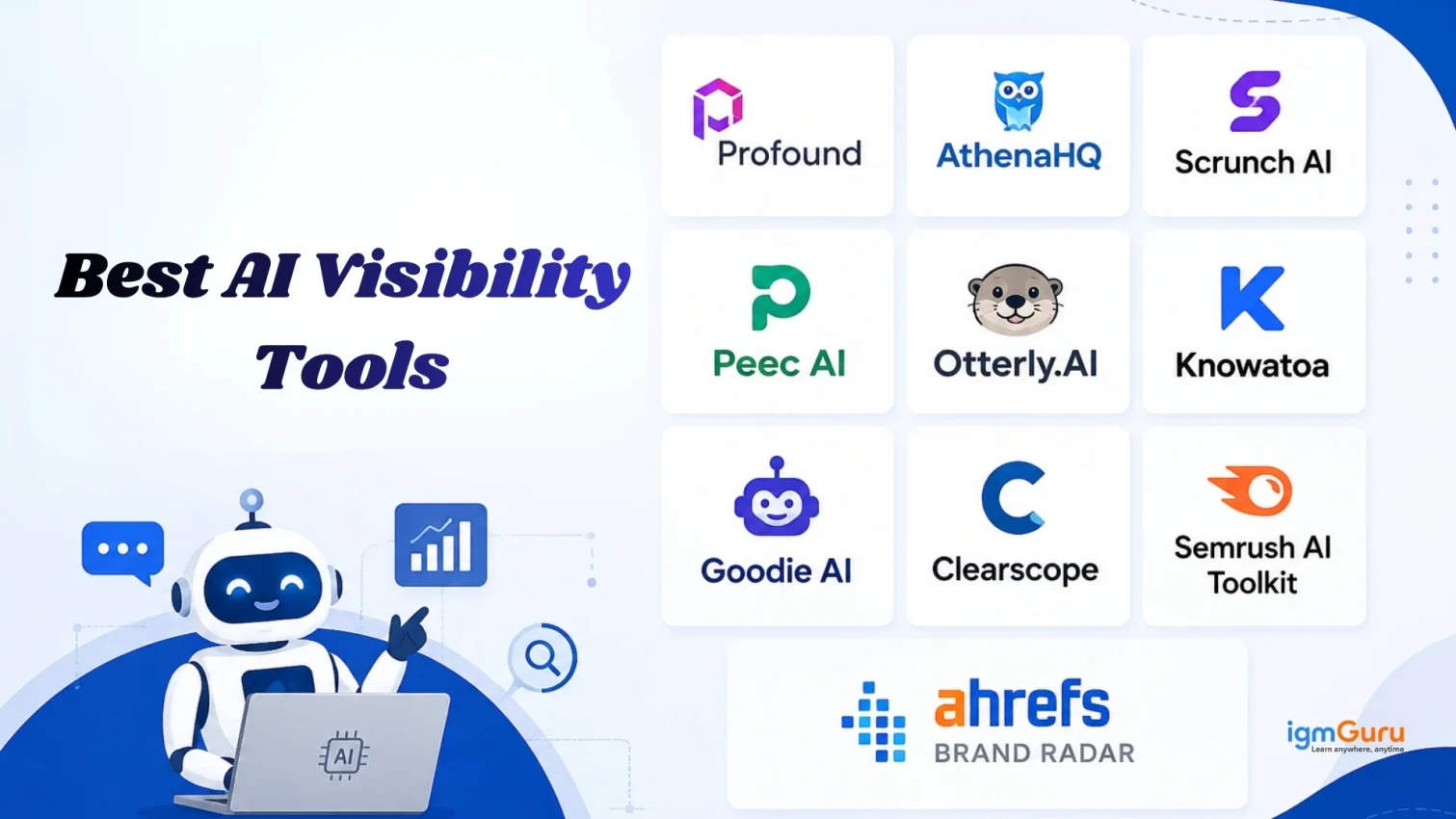
| Tool | Best For | Pricing |
| Profound | Broad enterprise engine coverage | $99/mo Starter; $399/mo Growth; Enterprise custom |
| AthenaHQ | Ecommerce revenue attribution | Free Essential; $295/mo Starter; Enterprise custom |
| Scrunch AI | Security- and compliance-led teams | $250/mo Core; Enterprise custom |
| Peec AI | Agencies pitching new business | From $95/mo |
| Otterly.AI | Freelancers and small teams | From $29/mo |
| Knowatoa | Free/low-commitment visibility diagnosis | From $59/mo |
| Goodie AI | Monitoring plus AI content optimization | Custom/plan dependent |
| Clearscope | Content teams optimizing existing pages | From $129/mo |
| Semrush AI Toolkit | SEO + GEO in one dashboard | From $99/mo per domain |
| Ahrefs Brand Radar | Existing Ahrefs users | From £159/mo for Brand Radar AI |
An AI visibility tool is software that tracks how often, how accurately, and in what context your brand appears inside AI-generated search results and AI chatbot recommendations.
Most of the tools do the same task, but when it comes to the best, there are many parameters, like cost, pros, cons, and best use case. One more important factor is how many KPIs the tool includes in their reports. This means choosing the best completely depends on your requirements, like budgets, tasks, accuracy, etc.
Note: According to a report, Google AI Overviews appeared in 43% of U.S. searches in mid-2026, compared with 15% a year earlier.
| Evaluation Criteria | What to Look For |
| Multi-engine tracking coverage | Support for multiple AI surfaces, including ChatGPT, Google AI Overviews, Perplexity, Gemini, Claude, Copilot, and AI Mode. |
| Actionable insights vs. passive monitoring | Insights that explain visibility gaps and recommend practical next steps instead of only tracking brand mentions. |
| Trend and pattern tracking | Historical data that helps identify meaningful visibility changes and distinguish them from one-off AI responses. |
| Conversation-level data | Access to tracked prompts and actual AI responses to understand how a brand is represented. |
| Citation source detection | Information about the domains and URLs cited by AI systems to identify sources influencing brand visibility. |
| Brand visibility scoring and share of voice | Metrics that help compare brand presence against competitors and monitor visibility changes. |
| Sentiment analysis | Analysis of how AI systems describe a brand, including whether mentions are positive, negative, or inaccurate. |
| Competitor benchmarking | Features that show which competing brands appear alongside yours in AI-generated answers. |
| AI crawler and technical visibility | Insights into whether AI crawlers can access, interpret, and retrieve website content. |
| Integration and workflow features | API access, analytics integrations, data exports, dashboards, and content workflow support. |
| Pricing | Plans and pricing that fit your project's budget, team size, tracking requirements, and expected usage. |
Read Also: RAG Tutorial For Beginners
Profound is one of the strongest options for organizations that need AI visibility measurement across a broad range of answer engines. Its higher-tier offering can track up to nine answer engines.
It also combines visibility monitoring with prompt research, competitor analysis, citation insights, AI bot tracking, and AEO-oriented content workflows. Here you can investigate prompts, examine competitors, monitor citations, and connect visibility data with content optimization.
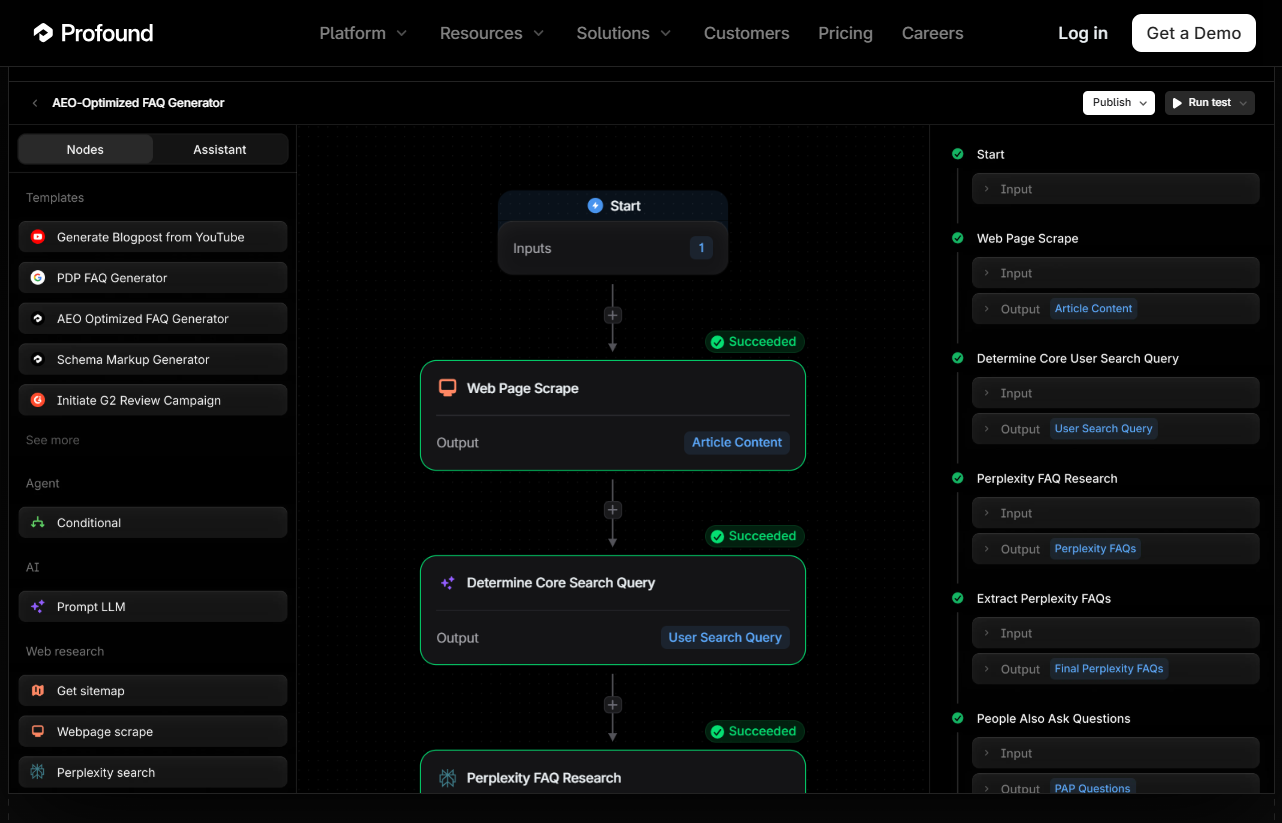
Profound is best for enterprise-grade Answer Engine Optimization (AEO) and tracking how brands appear across major AI search surfaces and LLMs. It helps large companies accurately measure their share of voice, analyze complex conversational prompt trends, and closely monitor AI agent web crawlers. It can be called a powerful analytics tool built specifically for modern Answer Engine Optimization software.
Broadest engine coverage is available on Enterprise.
Strong enterprise-oriented visibility and competitor reporting.
Conversation Explorer helps teams discover and investigate relevant prompts.
Combines AI visibility tracking with citation and content workflows.
AI bot tracking adds a technical visibility layer.
The most comprehensive engine coverage requires Enterprise.
Starter is limited to ChatGPT.
Growth covers three answer engines.
Enterprise pricing requires a sales conversation.
Visibility measurement is still tied to the prompts being tracked rather than representing every possible AI conversation.
Its starter costs $99/month when billed annually and tracks ChatGPT across 50 prompts.
Growth costs $399/month when billed annually and adds three answer engines and 100 tracked prompts.
Enterprise pricing is custom and can cover up to nine answer engines and multiple companies.
Related Article: Gemini vs. ChatGPT: Which AI is Better? [2026]
AthenaHQ takes a more action-oriented approach to AI visibility, with particular appeal for e-commerce teams. Its Shopify integration is designed to connect AI search discovery with e-commerce outcomes, including revenue attribution from AI-driven discovery.
The platform tracks AI responses, sources, competitors, and visibility across a broad collection of models. Its current Starter plan lists nine model surfaces, including ChatGPT, Perplexity, Google AI Overviews, Google AI Mode, Gemini, Claude, Copilot, and Grok.
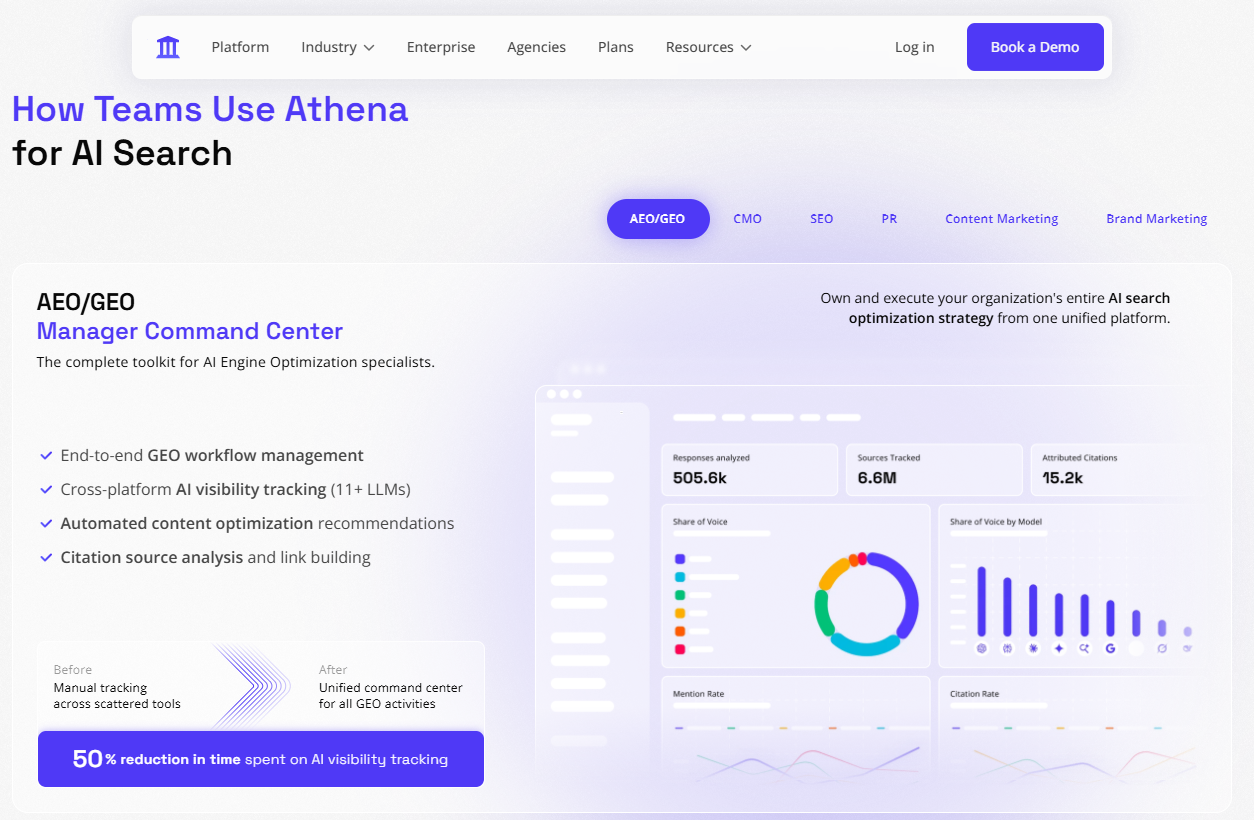
AthenaHQ is particularly known for e-commerce because it does not track visibility as the final metric. It has a Shopify integration designed to connect AI search visibility with commercial outcomes. Its content workflows help to identify gaps and recommend changes. It has a trade-off credit model. In this model, each credit represents an AI response, so monitoring many prompts across many engines can quickly consume the allowance.
Strong multi-engine coverage.
Useful prompt and response analysis.
Citation and competitor intelligence.
Shopify integration for e-commerce workflows.
Content recommendations and optimization actions.
Free Essential tier for initial testing.
Credit-based usage makes scaling harder to predict.
The paid plan is considerably more expensive than entry-level trackers.
Some advanced capabilities are reserved for Enterprise.
API access can involve additional cost.
Multi-region and multilingual requirements can push teams toward Enterprise.
It offers a free tier with 300 credits.
The Starter plan is $295/month with 3,600 credits and nine model surfaces.
Enterprise pricing is custom
Scrunch AI is a strong choice for organizations that care about the technical side of AI visibility as much as the marketing side. It views GEO not merely as a matter of being mentioned, but focuses more on how AI systems interact with websites. Its enterprise platform includes the Agent Experience Platform (AXP), site audits, API access, expanded model coverage, SSO, and enterprise infrastructure.
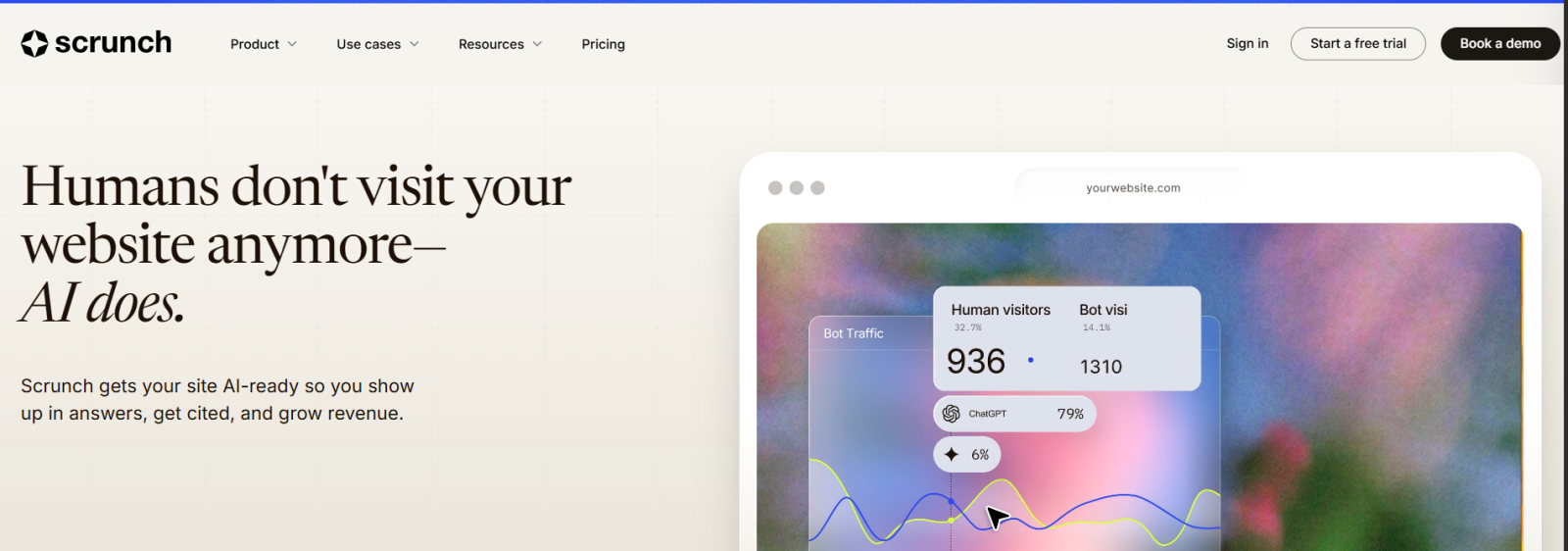
Scrunch is a particularly good fit when the question is not just "Does AI mention us?" but also "Can AI agents actually access and understand our website?"
Its technical emphasis makes it useful for large websites where crawlability, access control, site architecture, and AI-agent behavior can become part of the visibility problem.
Enterprise-oriented infrastructure.
SOC 2-focused security posture.
AI crawler and site visibility analysis.
Agentic-web optimization capabilities.
Enterprise API and integration support.
Expanded model coverage at the Enterprise level.
Pricing becomes sales-led at Enterprise.
Core only covers four LLMs.
Advanced engine coverage requires Enterprise.
Less focused on producing content than content-first platforms.
Smaller teams may not need the technical depth.
Scrunch Core costs $250/month and includes 125 unique prompts, five site audits per month, one brand workspace, five user licenses, and four LLMs.
Enterprise pricing is custom and expands coverage to nine LLMs, adds AXP, API access, integrations, SSO, and dedicated support.
Read Also: Gemini for Developers
Peec AI is particularly useful for agencies that need to turn AI visibility data into client-facing reports and sales material.
Its agency-oriented capabilities include Pitch Workspaces, while its broader platform supports prompt tracking, competitor analysis, and reporting. Higher plans include Looker Studio integration, which is useful when AI visibility needs to become part of an existing reporting stack.
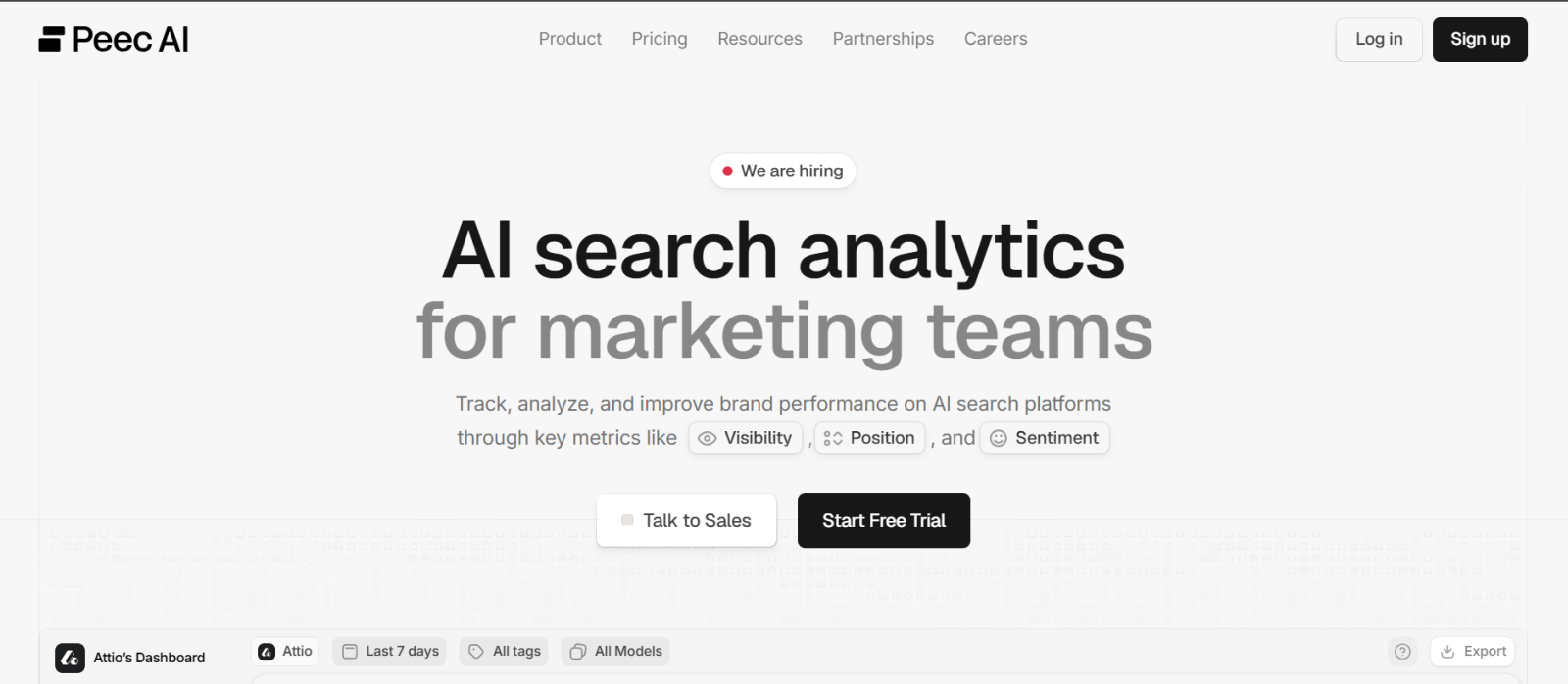
Peec AI wins at usability. It helps agencies to take AI visibility information and package it into something a prospect or client can understand without forcing them through a complex enterprise dashboard.
This makes it especially useful during sales conversations. Instead of explaining why GEO matters theoretically, an agency can show where a prospect appears, where competitors appear, and which questions create the biggest visibility gaps.
Agency-friendly reporting workflows.
Pitch Workspaces for sharing visibility findings.
Looker Studio integration on higher plans.
Daily tracking.
Multi-country support.
Straightforward presentation of AI visibility data.
Baseline plans focus on a smaller set of engines.
Additional models can cost extra.
Less emphasis on proactive recommendations than some competitors.
Trend and action data are not as deep as the strongest enterprise platforms.
Peec AI's brand plans start at $95/month for Starter with 50 prompts and three selected models.
Pro costs $245/month for 150 prompts.
Advanced costs $495/month for 350 prompts and adds features such as multi-country support and Looker Studio integration.
Otterly.AI is one of the easiest entry points into AI visibility tracking. Its positioning is straightforward. It helps you monitor where your brand appears, identify citations, and turn existing SEO keyword research into prompts for AI search.
One of its most useful features is the ability to transform existing SEO keywords into AI-search prompts, which reduces the amount of prompt research required before monitoring begins.
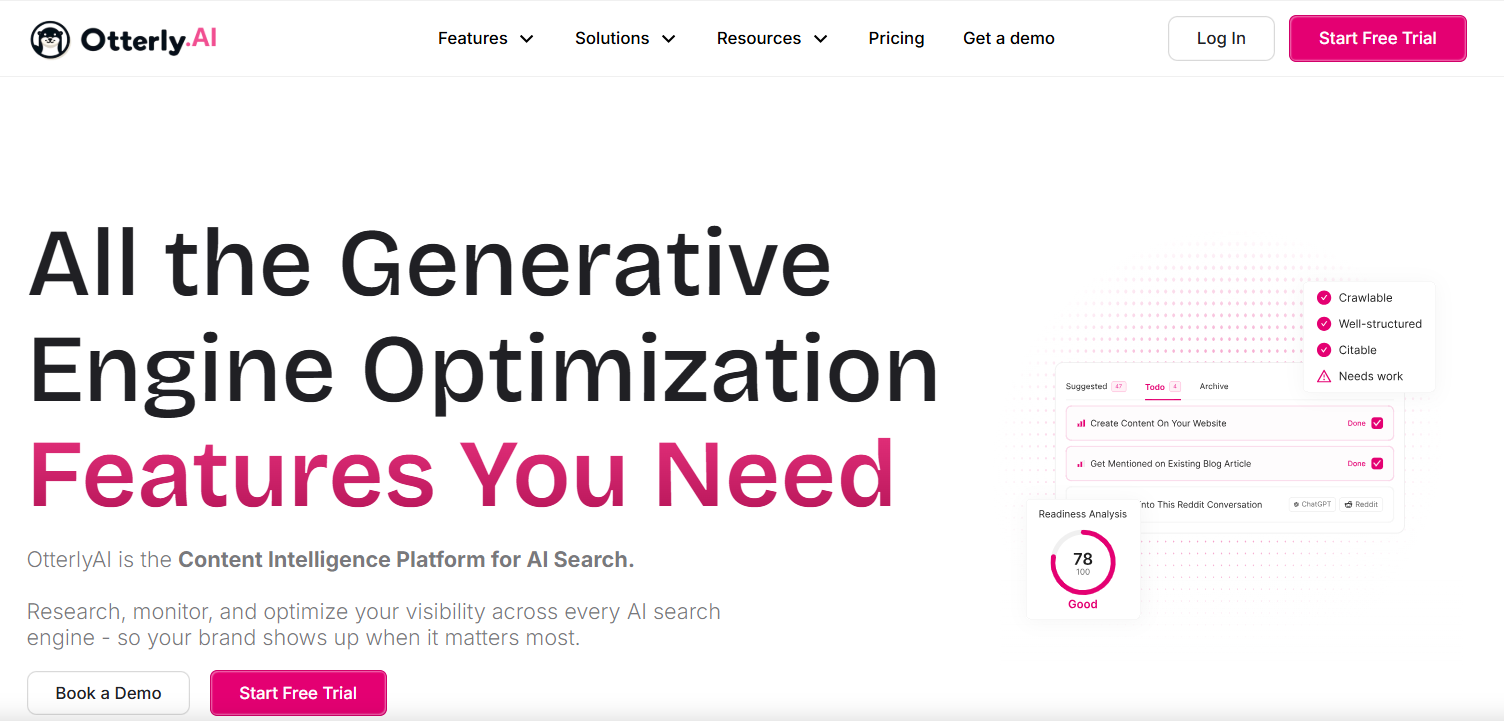
Otterly.AI works well when the goal is to get an AI visibility program running without buying a large enterprise platform. It can be especially practical for freelancers, consultants, content teams, and smaller agencies that already have an SEO keyword set they can convert into AI prompts.
Low entry price.
Easy setup.
Daily tracking.
Multi-country support.
GEO audit functionality.
Brand visibility and citation analysis.
Useful for teams moving from SEO into GEO.
Proactive insight and trend capabilities are less extensive than enterprise platforms.
AI crawler visibility is not its strongest area.
Several engines are paid add-ons.
Prompt limits increase significantly with higher plans.
Lite plan starts at $29/month, Standard at $189/month, and Premium at $489/month.
The baseline plans cover Google AI Overviews, ChatGPT, Perplexity, and Copilot, while Google AI Mode, Gemini, and Claude are available as add-ons.
Read Also: What is a Prompt Engineer?
Knowatoa is useful when you want to answer a simple question first: How visible is my brand in AI search right now?
Instead of requiring a team to build an elaborate monitoring program immediately, Knowatoa functions as a visibility and diagnostic platform. It can identify missing AI answers, competitor visibility gaps, citation sources, and brand sentiment changes.
Knowatoa makes sense when you are still validating the need for AI visibility software. It can help establish a baseline before you decide whether you need a much larger platform.
Low barrier to entry.
Clear visibility diagnostics.
Competitor gap analysis.
Citation insights.
Sentiment monitoring.
Weekly change reporting.
Useful for initial GEO benchmarking.
Less comprehensive as an optimization platform than some enterprise competitors.
Advanced workflows require higher tiers.
Ongoing monitoring becomes a paid commitment.
Teams looking for deep technical or content execution capabilities may need another tool.
Knowatoa offers a Starter plan at $59/month
Growth cost around $199/month,
Enterprise pricing is done by quotation.
Goodie AI tries to close the gap between measuring AI visibility and acting on what the measurement reveals. Its platform combines visibility reporting with competitor and sentiment analysis, agent analytics, content optimization, prompt discovery, and an AEO Content Writer. It also includes optimization actions designed to turn AI-search findings into specific tasks.
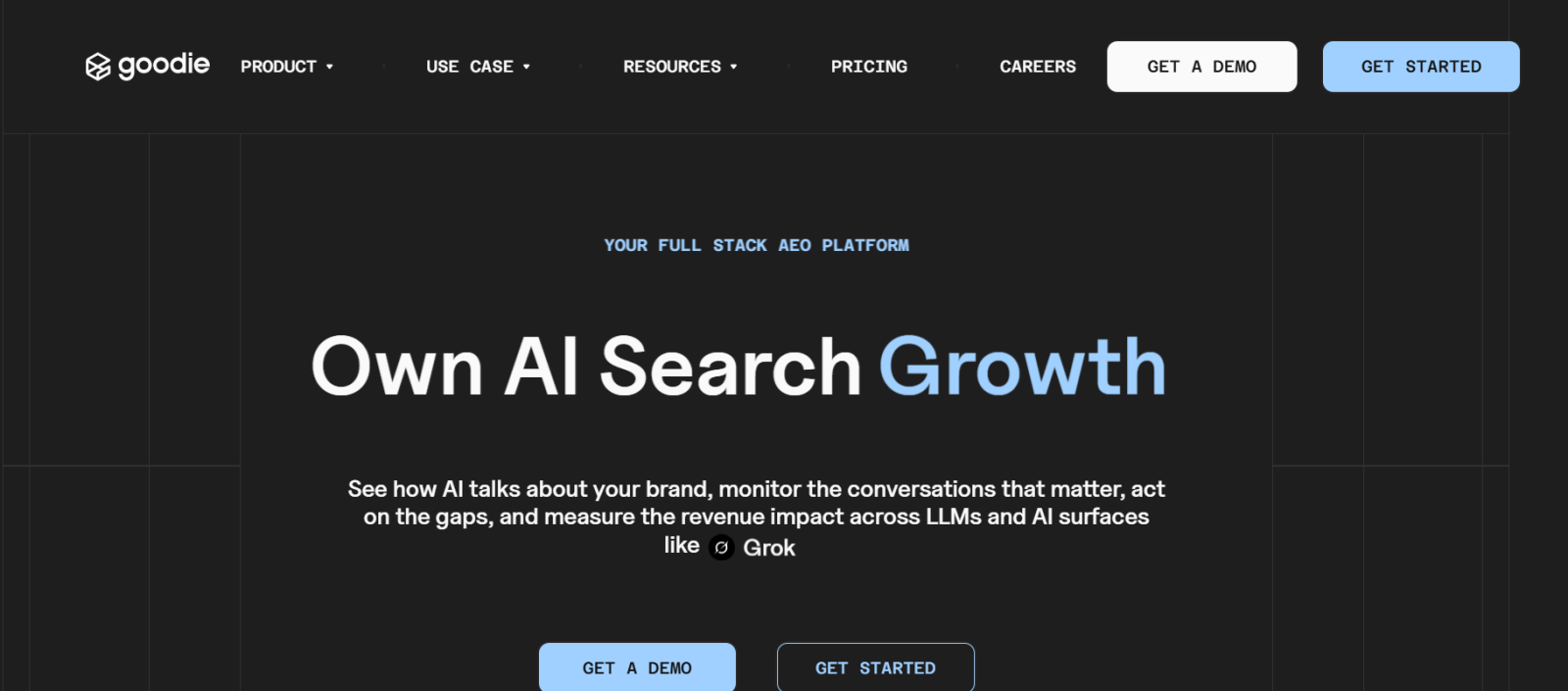
Goodie proves to be best when your team does not want a visibility dashboard sitting separately from content production. Its model is closer to a continuous GEO workflow that discovers prompts, measures visibility, identifies problems, and executes optimization actions.
Combines monitoring and optimization.
Agentic Actions can generate optimization recommendations.
AEO Content Writer is designed around AI-search ingestion.
Prompt discovery helps identify opportunities.
Technical optimization capabilities.
Broad integration ecosystem.
Data export is restricted on lower plans.
API access is reserved for Enterprise.
Historical data is limited on lower tiers.
Action credits can constrain optimization volume.
Teams may need higher plans to unlock the full workflow.
Goodie uses tiered plans with limits around tracked pages, action credits, prompt research, seats, exports, and integrations.
Its vendor's pricing structure and feature allocation can change quickly, so you should confirm the live plan details before purchasing.
Clearscope approaches AI visibility from a content optimization perspective. This makes it particularly relevant for teams that already produce large volumes of SEO content and want to understand whether those pages are actually becoming sources for AI answers.
Its AI search features complement its existing content workflow. The platform can connect content inventory with AI citation visibility. This helps teams move from "we published this page" to "is this page actually being cited?"
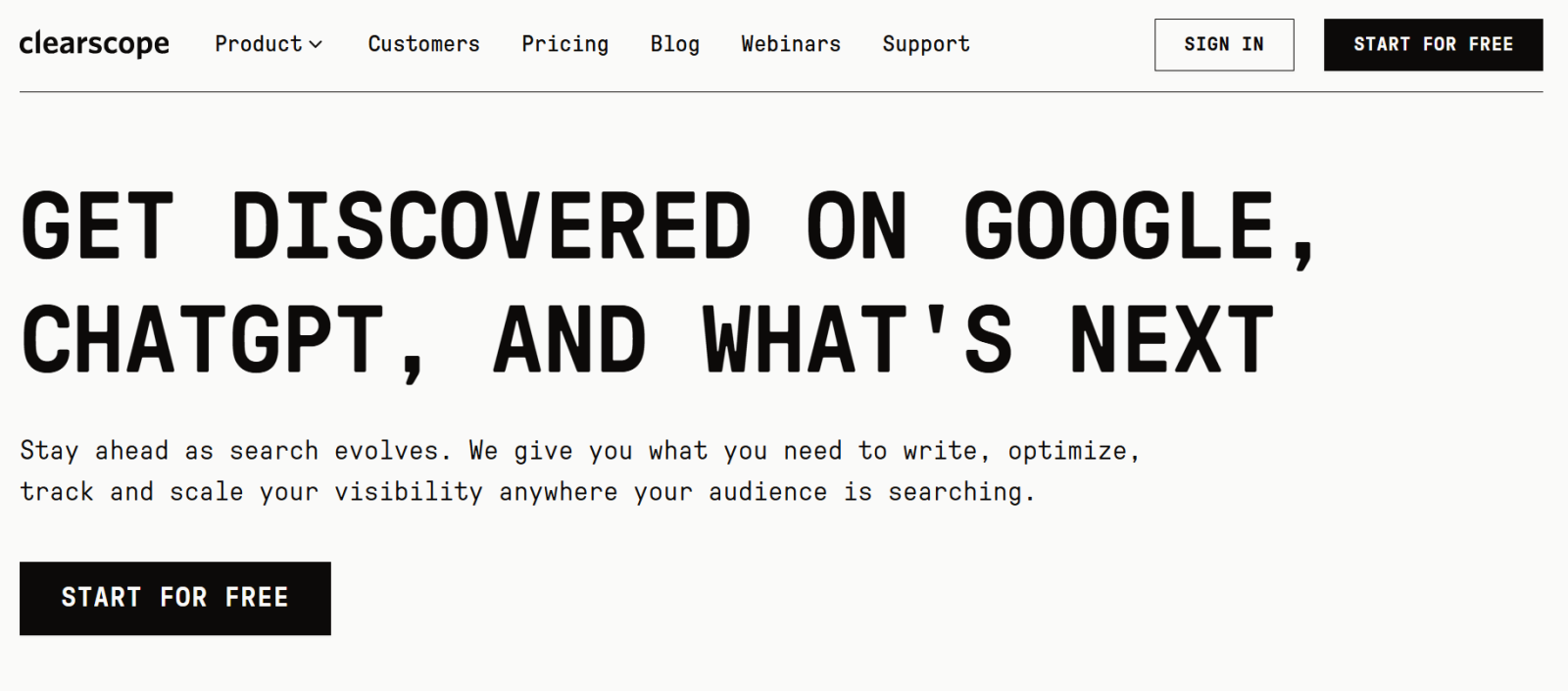
The important distinction is that Clearscope is not trying to replace every GEO platform. Its strength is closing the loop between content creation and AI citation performance. That can be valuable for content teams with hundreds or thousands of existing pages. Rather than creating an entirely new GEO workflow, they can use AI visibility signals to decide which existing content deserves improvement.
Strong content optimization workflow.
Connects content inventory with AI citation visibility.
Useful topic-clustering approach.
Established platform for content teams.
Easy transition for teams already using Clearscope.
Custom prompt tracking is less flexible than dedicated visibility platforms.
LLM coverage is narrower than enterprise AI visibility specialists.
Less focused on technical AI crawler analysis.
Best value comes when content optimization is already a core workflow.
Clearscope Essentials costs $129/month and includes 50 tracked prompts and 50 pages.
Business costs $399/month with 300 tracked prompts and 300 pages.
Enterprise pricing is custom.
Also Read: NotebookLM: An Ultimate Guide With Examples (2026)
Semrush is one of the more obvious choices for teams that already use its traditional SEO platform. Its AI visibility product tracks mentions across ChatGPT, Google AI, Gemini, and Perplexity, while its broader Semrush ecosystem covers keyword research, content optimization, backlinks, technical SEO, competitor analysis, and site auditing.
That matters because GEO does not exist separately from SEO. The same content, authority, technical accessibility, and competitive landscape can influence both traditional and AI visibility.
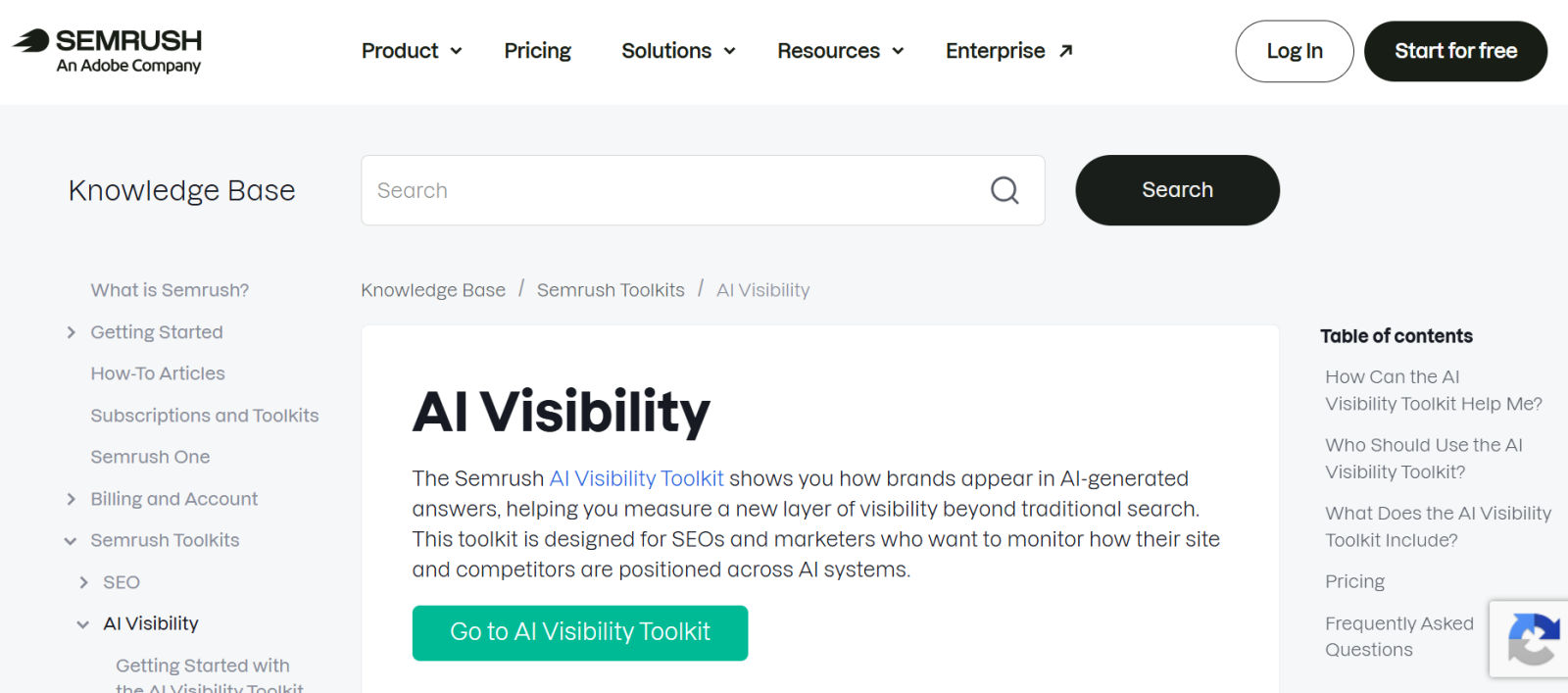
Semrush proves to be one of the best when your team already has an SEO operation inside the platform. Instead of buying another dashboard purely for GEO, you can bring AI visibility into the same environment where your team already manages keywords, backlinks, content, and technical SEO.
Combines SEO and AI visibility.
Large existing research ecosystem.
Prompt research and competitor analysis.
AI readiness auditing.
Familiar workflows for existing Semrush users.
Easy to connect AI visibility gaps with broader SEO work.
Pricing is charged per domain for the AI visibility product.
Additional users can increase overall platform cost.
More platform than some teams need for simple AI tracking.
Engine coverage is narrower than the broadest specialist platforms.
Semrush's AI Visibility Base plan costs $99/month per domain when billed annually. It includes 25 custom prompts, AI visibility reporting, competitor analysis, prompt research, AI readiness auditing, and mentions from ChatGPT, Google AI, Gemini, and Perplexity.
Ahrefs Brand Radar is the easiest recommendation for teams already invested in the Ahrefs ecosystem. It uses a large database of search-backed prompts and lets teams analyze AI visibility, mentions, citations, competitors, and related sources. Ahrefs says its database now contains hundreds of millions of monthly prompts across AI Overviews, AI Mode, ChatGPT, Copilot, Gemini, and Perplexity.
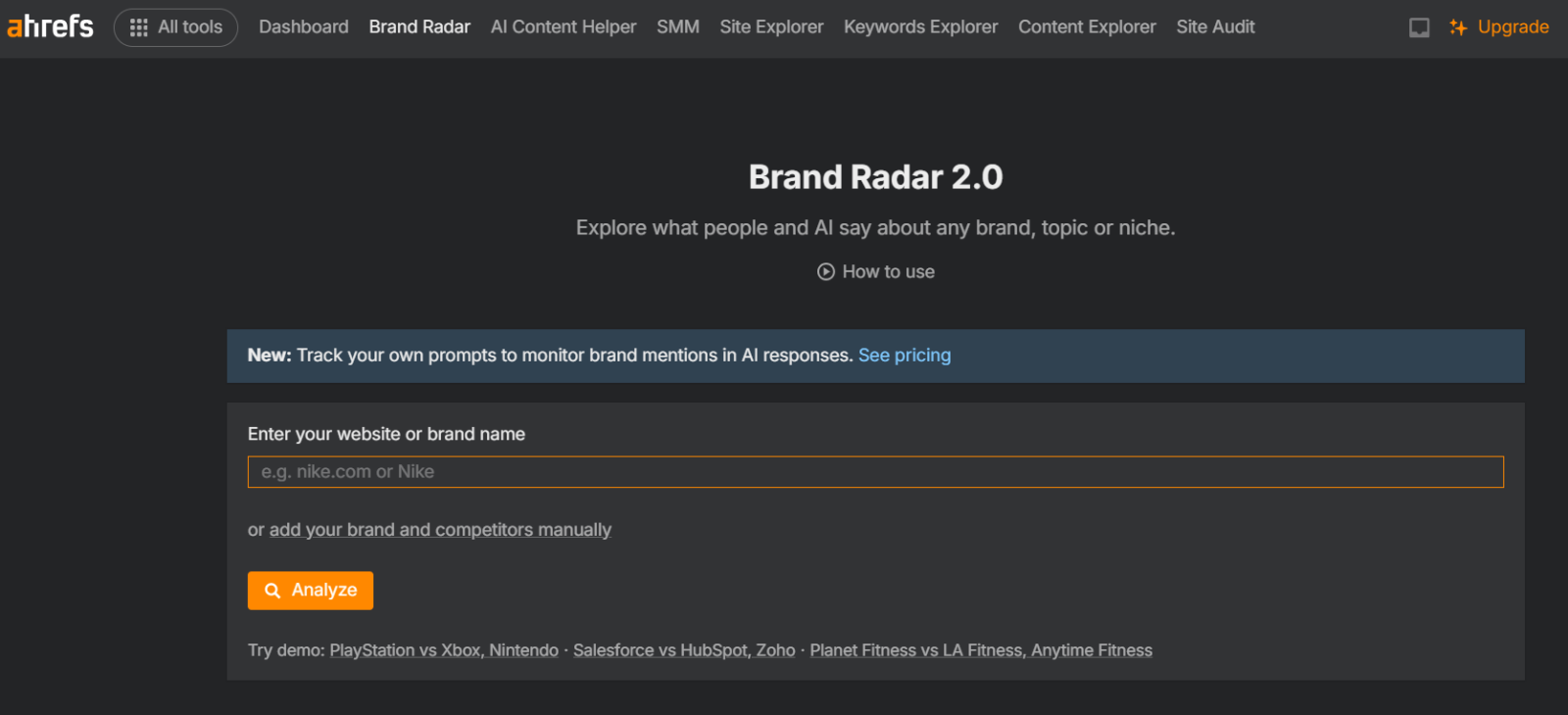
Brand Radar's biggest advantage is scale. Rather than starting with a manually created list of prompts, Ahrefs can use its enormous search-backed dataset to identify where brands appear across a much broader set of questions. It also makes the connection between SEO and AI visibility particularly clear. It is the same competitive research that informs traditional search strategy can be used to understand AI discovery.
Huge search-backed prompt database.
Strong competitor benchmarking.
Citation source analysis.
Familiar Ahrefs interface.
Combines AI visibility with SEO data.
Useful for researching demand beyond custom prompts.
Custom prompt tracking can add usage costs.
Does not provide the same conversation-level depth as some specialist tools.
Limited technical AI crawler analysis compared with technically focused platforms.
More expensive if purchased purely for AI visibility.
Ahrefs Brand Radar AI starts from £159/month for single-platform access, while all-platform access is listed at £560/month and includes 2,500 custom prompt checks per month. Custom prompt packages start at $50/month for 2,500 checks, with larger Growth and Scale packages available.
Read Also: Types of Artificial Intelligence (AI)
There is no perfect AI visibility platform without knowing the requirements. You need to understand what you want to do and in what budget. Those factors determine the best tool for you. On the other hand, AI visibility in new to the market and is developing to be perfect, which takes time. Each tool we have explored emphasizes a different part of the problem.
| AI Visibility Tool | Best For | Key Strength | Starting Price | Best Choice If You Need |
| Profound | Enterprise teams | Broad AI engine coverage and enterprise visibility | $99/month | Advanced AEO, competitor, citation, and AI crawler analysis |
| AthenaHQ | E-commerce brands | AI visibility tied to revenue attribution | Free / $295/month | Shopify integration and AI-driven revenue insights |
| Scrunch AI | Security-focused enterprises | Technical AI crawler and agent visibility | $250/month | AI accessibility, site audits, security, and enterprise workflows |
| Peec AI | Agencies | Client reporting and Pitch Workspaces | From $95/month | Presenting AI visibility insights to prospects and clients |
| Otterly.AI | Freelancers and small teams | Simple and affordable AI visibility tracking | From $29/month | Starting GEO tracking without an enterprise platform |
| Knowatoa | Teams testing AI visibility | Visibility diagnostics and competitor gap analysis | From $59/month | Establishing a baseline before investing in a larger platform |
| Goodie AI | Content and marketing teams | Visibility monitoring plus content optimization | Custom/plan dependent | Connecting AI visibility data directly with optimization workflows |
| Clearscope | Content teams | Content optimization and AI citation visibility | From $129/month | Improving existing content based on AI citation performance |
| Semrush AI Toolkit | SEO and GEO teams | SEO and AI visibility in one platform | From $99/month | Managing traditional SEO and AI visibility from one dashboard |
| Ahrefs Brand Radar | Existing Ahrefs users | Large search-backed prompt database | From £159/month | AI visibility research alongside existing SEO data |
AI search is moving beyond simple chatbot answers toward richer search, commerce, agents, and eventually advertising. This continuous change also affects the way the best AI visibility tools work. In the future, data access will be improved, and measurement will become more standardized.
AI visibility platforms are likely to develop in a way that resembles the evolution of traditional SEO software. Their earlier visibility metrics will eventually give way to more sophisticated attribution, competitive intelligence, optimization and workflow automation. This means you should be aware of all the trend shifts and feature changes to use the best one.
Read Also: Julius AI: AI Data Analysis Tool for Beginners
Here are some of the best AI visibility tools that have almost taken their position in my list.
Brandlight can be a strong enterprise option when brand sentiment, reputation, competitive intelligence, and technical AI visibility all matter. Its platform combines visibility, citation analysis, sentiment, content, commerce, and AI crawler analytics.
Similarweb can be a compelling choice for teams that want SEO and GEO intelligence in the same broader market intelligence environment, although it is lighter on some conversation-level and sentiment workflows.
ZipTie is worth watching for teams that want URL-level visibility and a strong focus on response-level evidence. Its system archives repeated AI responses to make trend analysis more stable.
SISTRIX is an early-stage option to watch, especially for teams already using SISTRIX. Its AI Search product measures visibility across AI Overviews, AI Mode, and ChatGPT and is currently included in SISTRIX subscriptions during its beta phase.
The important thing is not to wait for AI visibility measurement to become perfect. The data is imperfect because the underlying systems are changing. But imperfect visibility data is still more useful than making strategic decisions without knowing what AI systems are saying about your brand.
Also Explore: Best ChatGPT Alternatives
Using an AI visibility tool has become essential for every online business as searches are shifting to AI-powered tools. The only question here is which is the best AI visibility tool in 2026.
Well, the choice depends on different factors, including pricing, features, best uses, pros, cons, etc. That is what the article has explained. You just need to understand the specifications and relate them to your requirements. This will make your choice clearer than ever.
The top 5 AI visibility and tracking tools right now are Semrush AI Toolkit, Ahrefs Brand Radar, Profound, Peec AI, and Otterly.AI.
Running open-source AI tools locally on your own hardware provides the absolute best privacy because no data ever leaves your device.
The best AI visibility tools help brands track and optimize their presence across different generative engines.
You can check your AI visibility for free by using dedicated online AEO tools or running manual audits on major AI platforms.