Type a question into Google today and you may not click a single link. You get an answer on the spot, written by AI. That one shift has quietly rewritten the rules of online visibility, and it has given rise to a new discipline called AI Optimization (AIO).
Here is the real question. If AI tools are answering for you, will they mention your brand at all?
I ran into this myself recently. I asked ChatGPT to recommend project management tools for a small team, and it gave me three names without a single link to click. None of them were brands I had worked with, even though I knew similar products in that space. That moment made it clear how much visibility can shift when AI, not a ranked list, decides who gets mentioned.
This guide gives you a clear, practical answer. It will help you learn what AI Optimization actually means, how it works behind the scenes, why it matters right now, and how to start using it before your competitors do.
Read Also: What is Digital Marketing?
AI optimization refers to the process of enhancing how artificial intelligence and machine learning models perform. It also refers to how businesses optimize their digital presence to be discovered, understood, and cited by AI systems.
This makes AI optimization a broad term with two main directions. The first direction focuses on the AI models themselves. Engineers tune these models so they run faster, cost less, and produce more accurate results. The second direction focuses on your business. It involves shaping your website, content, and brand information so AI tools like ChatGPT, Gemini, Perplexity, and Google AI Overviews can find you, trust you, and mention you in their answers.
Both directions share the same core idea. You are making something work better for AI, whether that something is a model or a brand.
For most business owners, marketers, and content writers, the second meaning is the one that matters most. It is the practice of making sure your content shows up when someone asks an AI assistant a question related to your industry.
AI Optimization works by aligning your content and data with the way AI models read, interpret, and retrieve information. Here is a simple breakdown of the process.
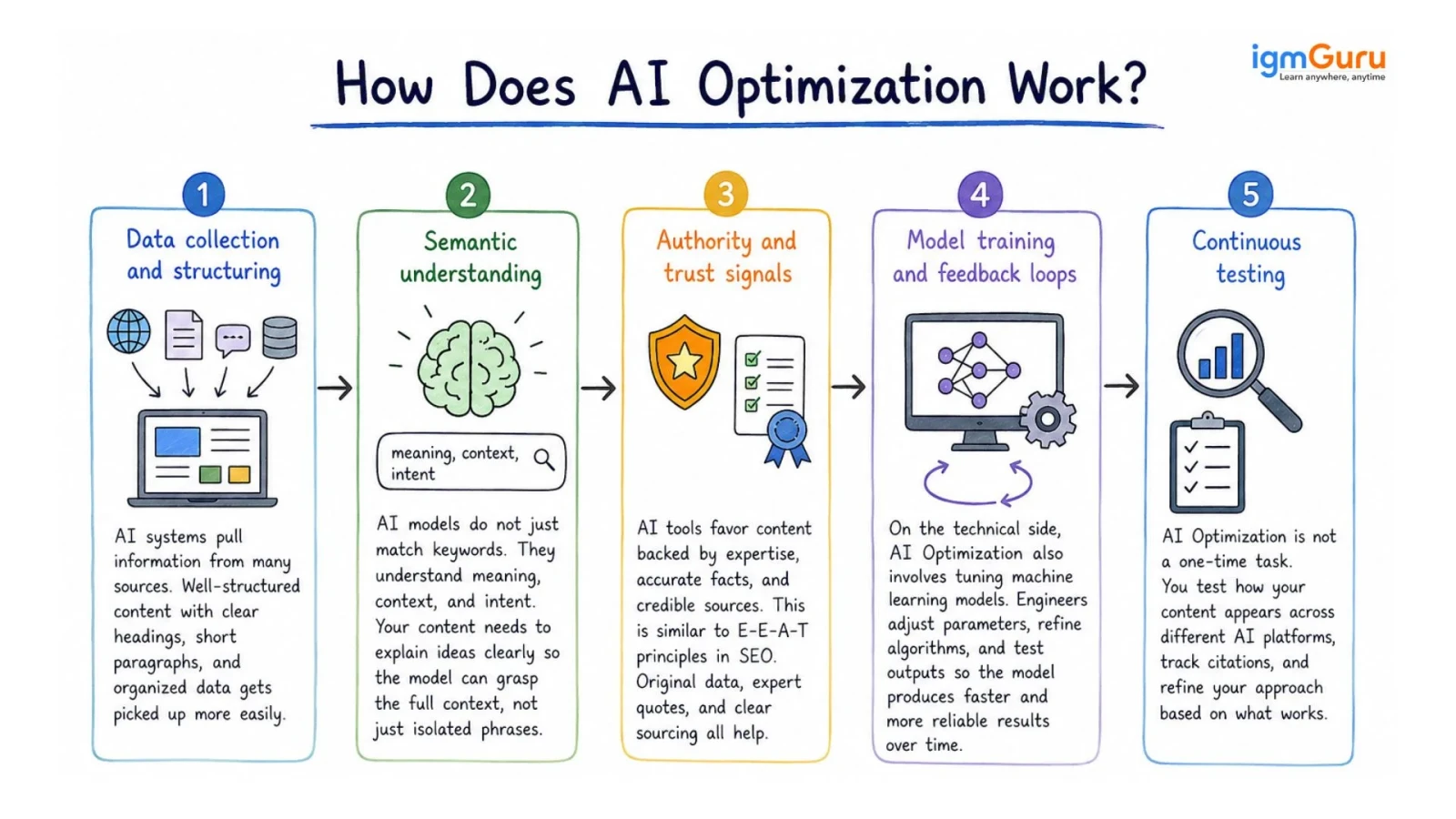
AI systems pull information from many sources, including websites, articles, forums, and databases. Well-structured content with clear headings, short paragraphs, and organized data gets picked up more easily.
AI models do not just match keywords. They understand meaning, context, and intent. Your content needs to explain ideas clearly so the model can grasp the full context, not just isolated phrases.
AI tools favor content backed by expertise, accurate facts, and credible sources. This is similar to E-E-A-T principles in SEO. Original data, expert quotes, and clear sourcing all help.
On the technical side, AI Optimization also involves tuning machine learning models. Engineers adjust parameters, refine algorithms, and test outputs so the model produces faster and more reliable results over time.
AI Optimization is not a one-time task. You test how your content appears across different AI platforms, track citations, and refine your approach based on what works.
When these steps come together, your content becomes easier for AI systems to find, understand, and use, which increases your visibility across search engines and AI answer tools alike.
Also Read: How to Become a Digital Marketing Specialist?
AI Optimization is not a single strategy. It includes several types that work toward different goals.
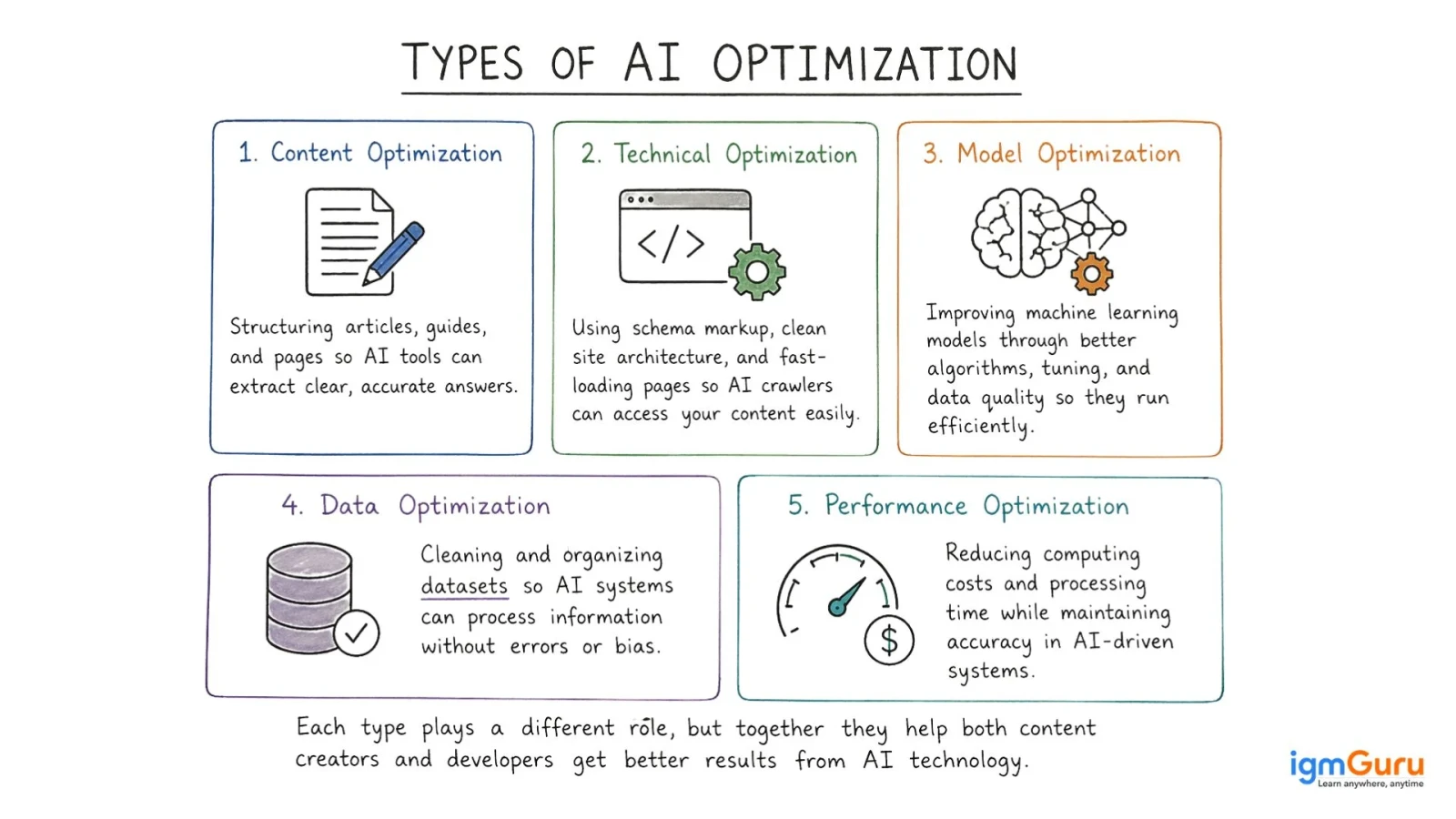
Content Optimization: Structuring articles, guides, and pages so AI tools can extract clear, accurate answers.
Technical Optimization: Using schema markup, clean site architecture, and fast-loading pages so AI crawlers can access your content easily.
Model Optimization: Improving machine learning models through better algorithms, tuning, and data quality so they run efficiently.
Data Optimization: Cleaning and organizing datasets so AI systems can process information without errors or bias.
Performance Optimization: Reducing computing costs and processing time while maintaining accuracy in AI-driven systems.
Each type plays a different role, but together they help both content creators and developers get better results from AI technology.
Related Article: Best AI Visibility Tools
AI Optimization matters because the way people search and find information has fundamentally shifted. A growing share of searches now end without a click, as AI tools answer questions directly. If your content is not optimized for these systems, you risk becoming invisible, even if you rank well on traditional search engines.
Here is why it deserves your attention.
AI-powered answers now appear at the top of search results, often before any organic links.
More users are turning directly to AI chatbots for research, recommendations, and decisions.
Businesses that get cited by AI tools gain credibility and trust, even without a click.
Poorly optimized content risks getting skipped entirely by AI crawlers and language models.
Early adopters of AI Optimization have a real advantage before the space becomes crowded.
Ignoring AI Optimization today is similar to ignoring mobile optimization a decade ago. It is no longer optional for anyone serious about online visibility.
Effective AI Optimization relies on a mix of content strategy and technical execution. These techniques consistently deliver strong results.
1. Write clear and direct answers: Structure your content so it answers questions in the first few sentences. AI tools favor content that gets to the point quickly.
2. Use structured formatting: Bullet points, tables, numbered steps, and FAQs help AI systems extract and present your information accurately.
3. Add schema markup: Structured data helps search engines and AI crawlers understand what your content is about and how it is organized.
4. Focus on original insights: Data, research, case studies, and expert opinions make your content more valuable and more likely to get cited.
5. Build topical authority: Cover a subject in depth across multiple related pages instead of writing one shallow article.
6. Keep language simple and precise: Avoid jargon and overly complex sentences. AI models process clear language more accurately than vague or clever phrasing.
7. Monitor AI citations: Track how often your brand appears in AI-generated answers and adjust your content based on the results.
Read Also: Top 15 Benefits of Digital Marketing in 2026
On the technical side, optimization plays a central role in how machine learning models function. Every model learns by minimizing errors between its predictions and actual outcomes. Optimization algorithms, such as gradient descent, adjust the model's internal parameters step by step until it produces accurate results.
This process affects several outcomes.
Accuracy: Well-optimized models make fewer mistakes and produce more reliable predictions.
Speed: Optimization reduces the time and computing power needed to train and run a model.
Scalability: Efficient models handle larger datasets and more users without breaking down.
Cost efficiency: Better optimization lowers the resources needed to operate AI systems at scale.
Without proper optimization, even a well-designed model can perform poorly, waste computing resources, or produce inconsistent results. This is why optimization sits at the core of every successful AI system, not just as an afterthought but as an ongoing requirement.
These four terms often get used interchangeably, but each one serves a distinct purpose. Understanding the difference helps you build a complete visibility strategy.
| Aspect | SEO | AEO | GEO | AIO |
| Full Form | Search Engine Optimization | Answer Engine Optimization | Generative Engine Optimization | AI Optimization |
| Main Goal | Rank higher in search results | Provide direct answers to user questions | Get content mentioned or cited in generative AI responses | Optimize content and systems for AI-driven platforms |
| Primary Focus | Search engine rankings and organic traffic | Featured snippets, voice search, and direct answers | Visibility in AI-generated responses | Overall AI visibility, performance, and discoverability |
| Target Platforms | Google, Bing, and other search engines | Google snippets, voice assistants, and answer engines | ChatGPT, Gemini, Perplexity, and other generative AI tools | AI search engines, assistants, and AI-powered systems |
| Content Style | Keyword-focused, useful, and well-structured | Question-and-answer based and concise | Context-rich, authoritative, and easy for AI to understand | Clear, structured, machine-readable, and AI-friendly |
| Key Techniques | Keywords, backlinks, technical SEO, and on-page SEO | FAQs, schema markup, concise answers, and conversational content | Strong sources, original insights, statistics, and clear context | Structured content, entity optimization, data quality, and AI-friendly formatting |
| Success Metric | Rankings, clicks, and organic traffic | Direct answers, featured snippets, and voice-search visibility | Mentions and citations in AI-generated answers | Overall visibility and performance across AI-driven platforms |
| Best For | Traditional search visibility | Capturing question-based searches | Building visibility in generative AI responses | Broader optimization for the AI-first digital ecosystem |
AI Optimization applies across many industries and use cases, not just content marketing.
Content marketing: Structuring blogs, guides, and product pages so AI tools cite them accurately.
E-commerce: Optimizing product descriptions and reviews so AI shopping assistants recommend the right products.
Customer service: Training AI chatbots to give accurate, helpful answers based on optimized knowledge bases.
Healthcare and finance: Ensuring AI systems draw from verified, trustworthy sources when answering sensitive questions.
Software and machine learning: Improving model performance, speed, and accuracy for AI-driven applications.
Voice search: Preparing content for smart speakers and voice assistants that read answers aloud.
Investing in AI Optimization delivers real, measurable advantages.
Increased visibility across AI tools, not just traditional search engines.
Stronger brand authority when AI systems cite your content as a trusted source.
Better user experience through clear, well-structured information.
Improved efficiency and accuracy in AI-powered systems and models.
A competitive edge over businesses that still rely only on traditional SEO.
Long-term resilience as search behavior continues to shift toward AI.
Also Read: What is Social Media Optimization (SMO)?
AI Optimization also comes with real challenges you should plan for.
Unclear metrics: Tracking AI citations and mentions is harder than tracking traditional search rankings.
Constant change: AI algorithms and models update frequently, which means strategies need regular adjustment.
Limited referral traffic: AI tools often answer questions directly, so even a citation may not bring a visitor to your site.
Inconsistent results: The same question can produce different AI answers at different times, making visibility less predictable.
Technical complexity: Model optimization requires specialized skills in data science and machine learning.
Despite these challenges, businesses that stay consistent and adapt early tend to see stronger long-term results.
Follow these practices to build a strong AI Optimization strategy.
Write content that answers questions clearly and directly.
Use structured formats like FAQs, tables, and step-by-step lists.
Back up claims with original data, research, or expert insight.
Keep your website technically healthy with fast load times and clean structure.
Apply schema markup to help AI systems understand your content.
Test how your brand appears across different AI platforms regularly.
Maintain accuracy and update content as facts and data change.
Build topical authority instead of chasing isolated keywords.
Read Also: GEO vs SEO: Understanding the Differences
AI Optimization is still a young field, and it will keep evolving as AI tools become more advanced and more widely used. More people will turn to AI assistants for research, shopping, and decision-making. Search engines will continue blending traditional rankings with AI-generated answers.
Businesses that treat AI Optimization as a core part of their strategy, not a side project, will be better positioned to stay visible as this shift continues. The brands that invest in clear, trustworthy, well-structured content today are the ones AI systems will trust and recommend tomorrow.
AI Optimization is no longer a future trend. It is a present reality shaping how people find information and how businesses get discovered. It combines content strategy with technical precision, helping both human readers and AI systems understand and trust your work.
By focusing on clarity, authority, and structure, and by understanding how AIO, AEO, GEO, and SEO work together, you can build a strategy that keeps your content visible no matter how search continues to change.
No. SEO focuses on ranking pages on search engines. AI Optimization is a broader strategy that includes SEO, AEO, and GEO to improve visibility across AI-driven platforms, often working alongside traditional SEO Tools for keyword research, technical audits, and performance tracking
It helps businesses stay visible as more users rely on AI tools for answers instead of traditional search results, protecting long-term traffic and brand authority.
AEO focuses on getting selected as a direct answer in search features and voice results. GEO focuses on getting cited inside AI-generated responses from tools like ChatGPT.
No. Traditional SEO remains the foundation. AI Optimization builds on strong SEO fundamentals rather than replacing them.