Search Engine Optimization (SEO) has long been the foundation of online visibility. It has been helping websites rank in traditional search engine results and attract organic traffic. But the way people discover information is changing. AI Overviews, AI assistants, chatbots, and generative AI search engines can now answer queries directly, often without requiring users to visit a traditional search results page.
These AI-powered platforms evaluate and present information differently from traditional search engines. As a result, businesses need to consider Generative Engine Optimization (GEO) alongside SEO to improve their chances of being mentioned, cited, or recommended in AI-generated answers.
This makes understanding GEO vs SEO really important. While both aim to improve online visibility, they differ in how content is discovered, evaluated, and surfaced to users. This article explains the key differences between SEO and GEO, what practices they share, and when to prioritize each approach to maximize your brand’s visibility across both traditional and AI-powered search.
Related Article: What is Digital Marketing?
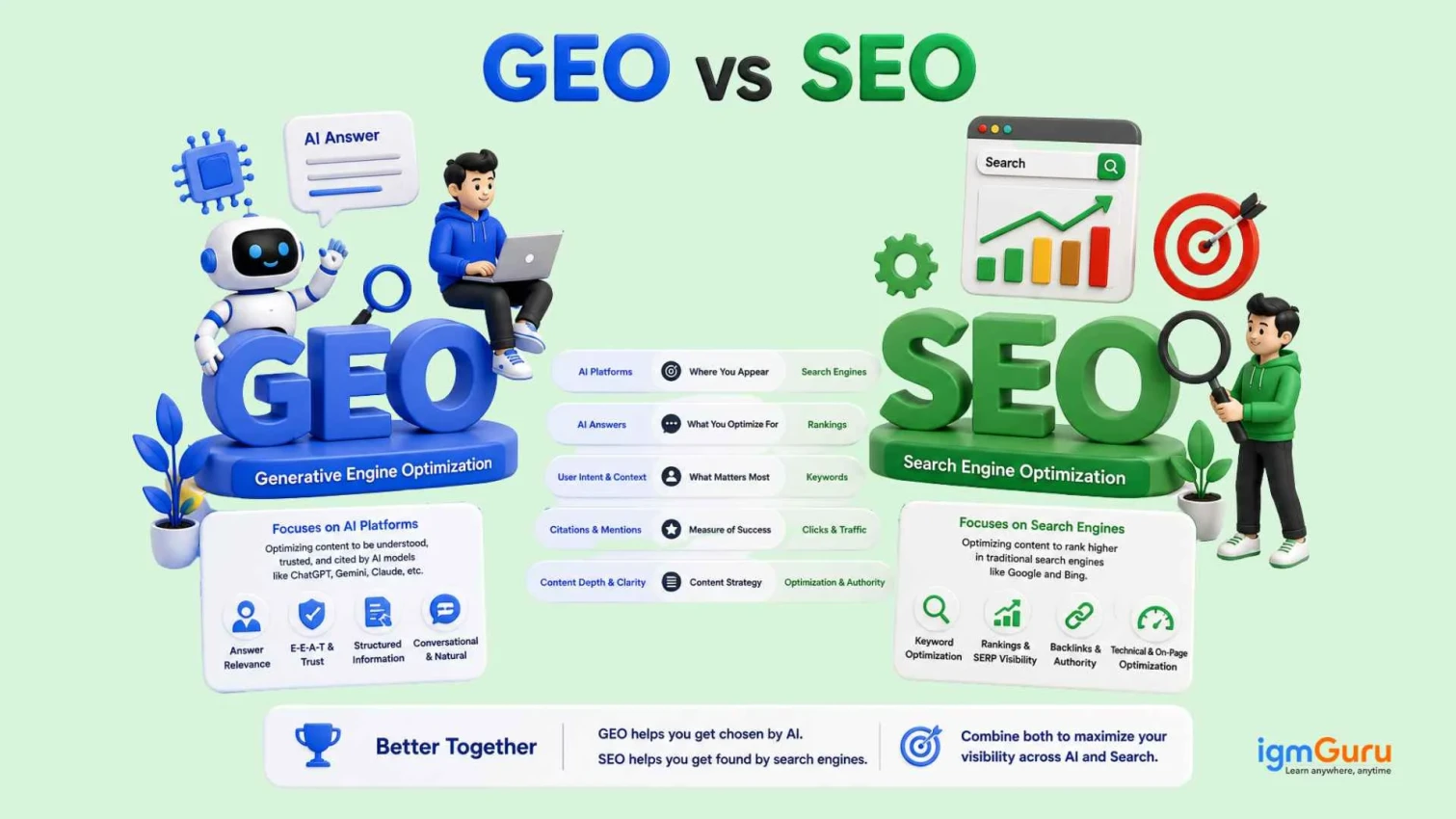
Before we go deep into each one, here's a quick side-by-side so you know the basis of this comparison:
| Aspect | SEO | GEO |
|---|---|---|
| Primary goal | Earn higher rankings in traditional search results | Increase the chance of being cited or mentioned in AI-generated answers |
| Main surface | Search engine results pages (SERPs) | Generative AI answers and overviews |
| Query style | Short, keyword-based searches | Longer, conversational prompts and questions |
| Content style | Page-level content built around target keywords | Self-contained, clearly written sections that answer one question at a time |
| Trust signals | Backlinks, domain authority, and technical SEO | Content clarity, brand consistency, topical authority, and cross-web mentions |
| Structure | Full pages optimized for indexing and ranking | Modular content that AI systems can extract, summarize, and cite |
| Technical focus | Crawlability, indexability, metadata, and site performance | Crawlability plus AI-readable formatting, structured data, and accessible content |
| Success metrics | Rankings, organic traffic, CTR, and conversions | Citations, brand mentions, share of voice, and AI visibility |
| Content freshness | Useful for long periods if it remains relevant | Needs regular updates to stay accurate and citation-worthy |
SEO is the practice of improving a website’s visibility on traditional search engines like Google and Bing without paying for ads. It simply means setting up your website and your content in a way that helps it show up when someone searches for something on search engines. It is the traditional key to getting organic traffic to your website.
It's built around many things, like:
There are many more things to consider while using this pracitce, but the end goal is always the same. It is done to rank your page as high as possible on the results page, because that's what gets you the clicks.
For Example: Check the image below where one of my articles is ranking in the 1st position on the SERP with the best SEO practices. The article is getting a great amount of traffic to my website.

SEO is still one of the biggest reasons people find a website in the first place. Here's why it still matters:
It brings in free, ongoing traffic. Once a page ranks well, it can keep bringing visitors for months or years without you paying for ads.
It builds trust. People still associate a high Google ranking with credibility, even if they don't think about it consciously.
It's measurable. You can see exactly how many people visited, what they searched, and where they came from.
It's the foundation everything else sits on. Even AI tools rely on well-built, well-organized websites to pull their answers from.
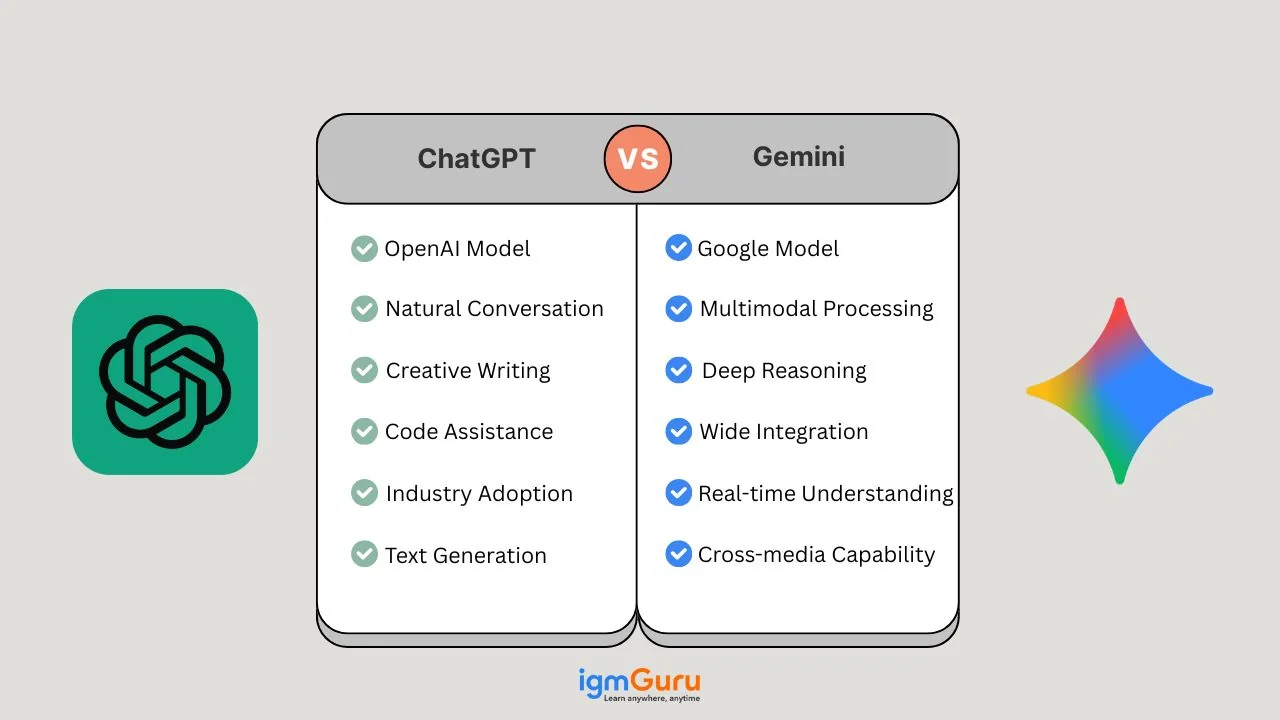
GEO means setting up your content so that AI tools like ChatGPT, Google AI Overviews, Perplexity, and Gemini can find it, understand it, and actually use it when they answer someone's question.
These tools read through a bunch of sources, pick out the useful bits, and write one answer using them. They also mention where the information came from, if the source meets their decided criteria. GEO helps you do the same. It makes sure your content is one of the pieces they pick, and your website is cited with the answer.
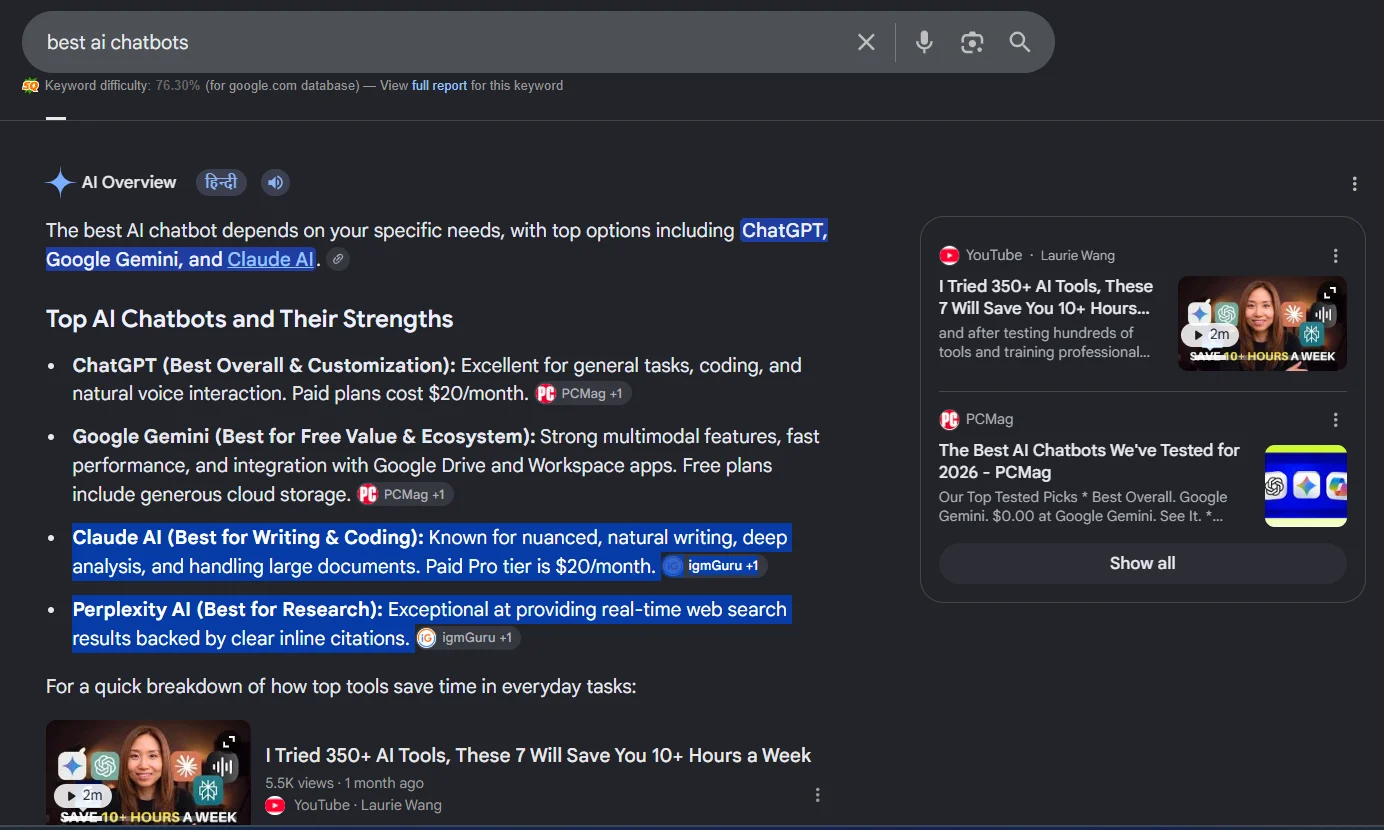
Note: The big difference here is that these AI tools don't hand the user a list of links to explore. They do it themselves and give summarised results with citations. You can check it in the image given below, where Google has extracted information from my article and given a citation alongside. In case the reader wants detailed information, they may click on the link that gives my website traffic.
Here are the main factors that make GEO important:
A growing number of searches never lead to a click anymore. People get their answer straight from the AI and move on.
It's how you stay visible in a "zero-click" world. If your content never gets referenced by AI tools, you simply don't exist for that part of the search.
Buyers are starting to trust AI answers early in their research. By the time someone visits a website, they may have already formed an opinion based on what an AI told them.
Early movers have an advantage. GEO is still new enough that most brands haven't optimized for it yet. That's a real opportunity if you act now.
Read Also: Best SEO Tools
Now let’s explore the core differences between traditional SEO and GEO.
Traditional SEO has a clear picture of success metrics. If you are ranking on the first page of the SERP, you will gain traffic and potential customers based on your position. The main dimensions of this success matrix is:
We have different types of tools to measure this success. For example, Google has Google Search Console, where you can measure how much traffic you are getting from Google.
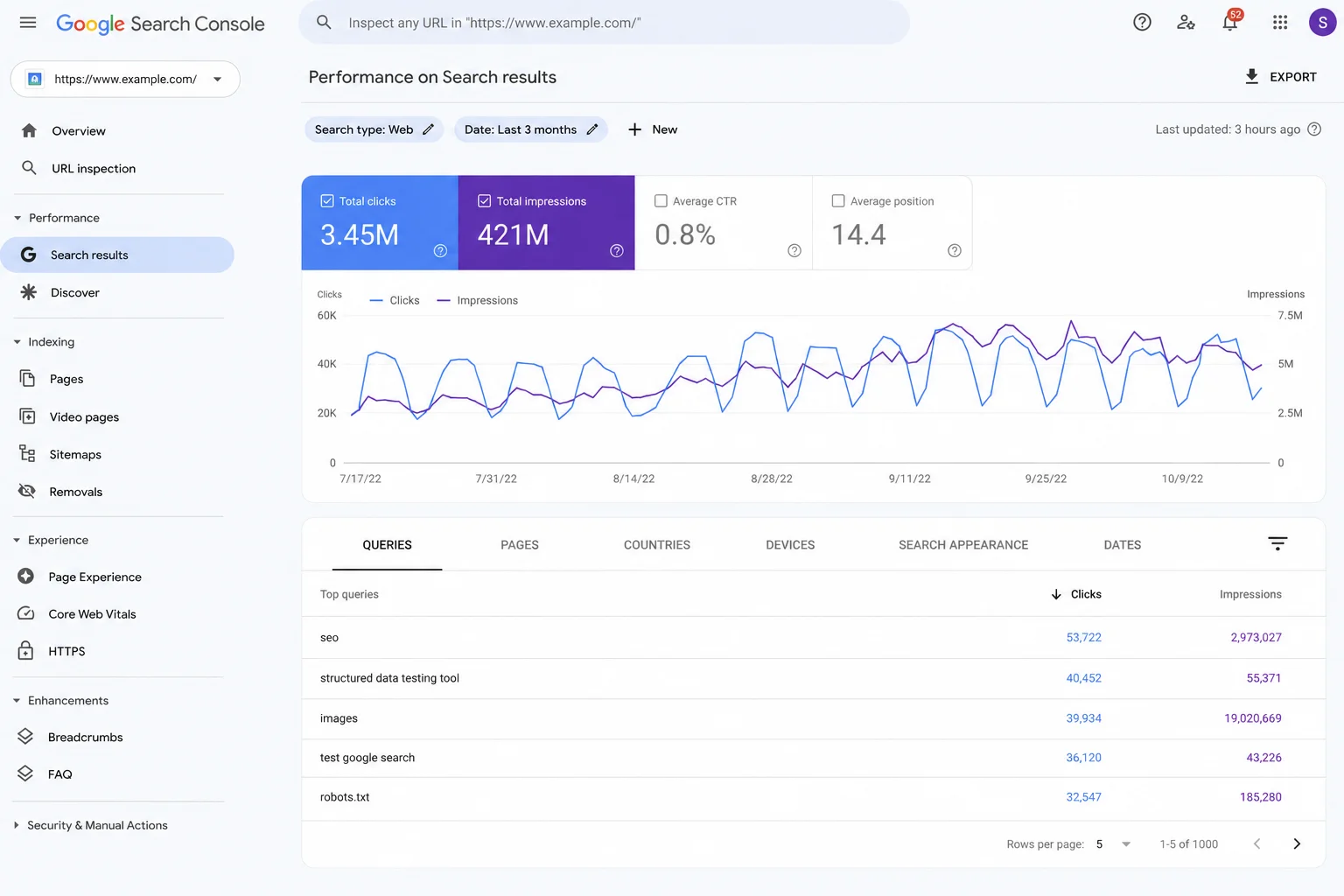
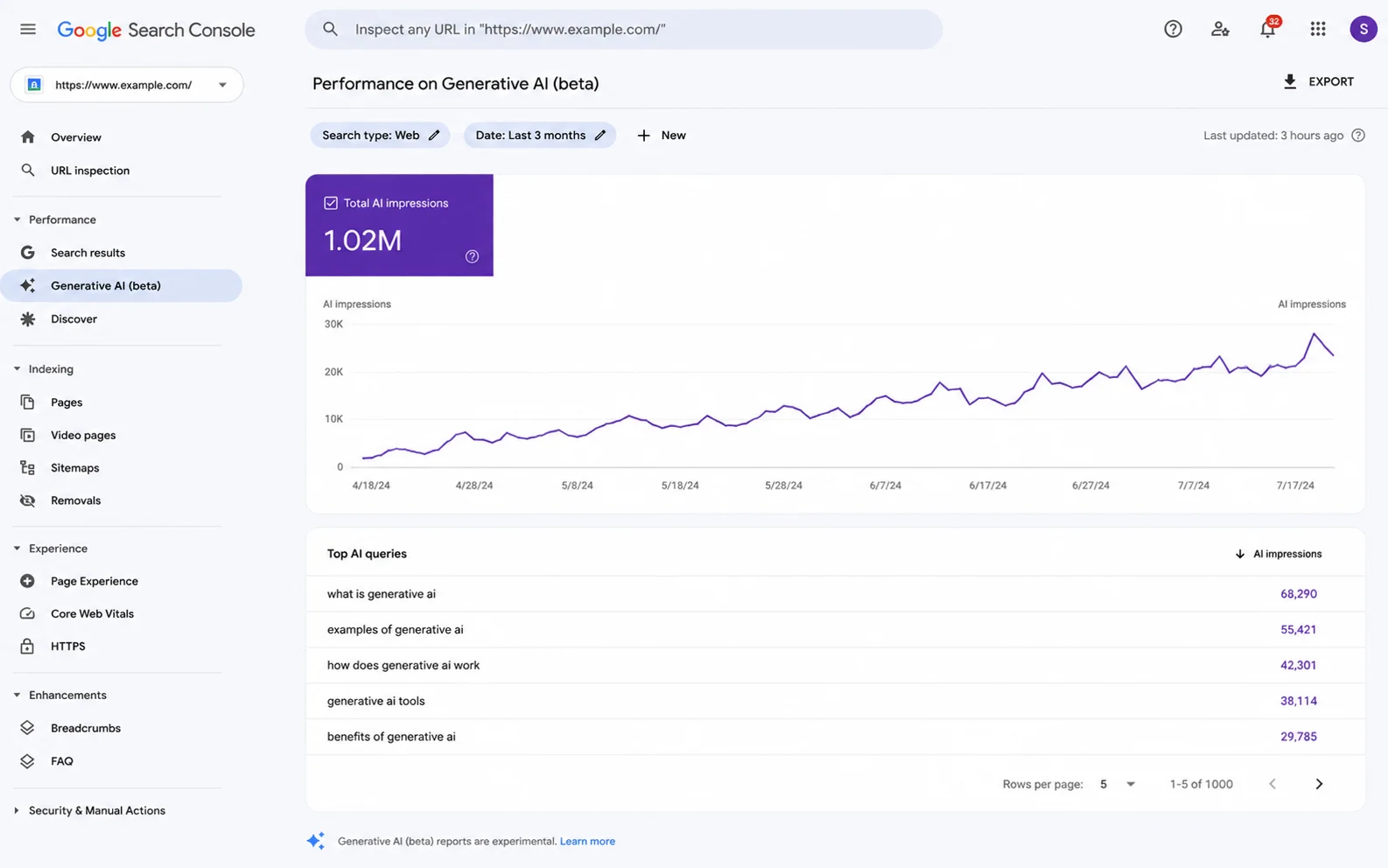
When it comes to GEO, there's no single position to check yet. You have to track something called Share of Model. This basically means, out of many times an AI tool answers a question in your category, how often does it mention your brand? It's not a yes or no answer. It is more like a percentage that can go up or down over time. Google Search Console has also just introduced a new generative AI feature where you can see impressions only.
SEO content is usually written as one full page built around a keyword, a common approach used in content marketing strategies. You have got a title, headers, an intro, a middle, and a conclusion, all working together to satisfy one search intent. It is also a good structure for users, so they can understand the topic easily.
GEO content needs to work differently. AI tools do not read your whole page. They just pull out small, informational sections that answer the user query perfectly. So every part of your content needs to make sense on its own. Start with a clear answer, back it up with a real number or fact, and don't make it depend on the paragraph before it. Short, complete, and to the point is the best option here.
SEO works through crawling. Search engines send bots to scan your site, add it to their index, and rank it based on things like backlinks, E-E-A-T, and content quality. If your technical part is good, and not blocking the crawler, have worked on SEO practices, and given accurate and user-friendly content, no one can stop you from ranking.
GEO works a bit differently. When someone asks an AI a question, it searches through many sources in real time, pulls out relevant pieces, and builds an answer from them. One thing to watch out for here is if your website blocks AI bots in your robots.txt file, or your content is hidden behind heavy JavaScript, AI tools may never even see it, no matter how well you rank on Google.
For SEO, trust is mostly built through backlinks. The more good websites that link to you, the more Google trusts your page. It was basically based on a fixed algorithm, where you just have to follow all the best practices.
For GEO, the algorithm works differently. It is not just about backlinks or getting maximum reviews; you have to be consistent also. If your brand, your products, and your claims are described the same way across your own site, review sites, forums, and other places online, AI tools are more likely to trust and mention you. If your information contradicts itself across different places, AI tools tend to just skip you.
An SEO page can rank well for years with barely any changes. You may have also noticed many of the oldest pages on the internet still rank high without any changes. The reason is simple: the page has more authority signals like backlinks and internal linking.
GEO does not work like that. Here, content that gets picked up by AI tools can lose its spot within a couple of weeks if it isn't updated. If GEO matters to you, you can't just publish and forget. It needs regular check-ins and small updates to stay relevant.
Traditional SEO helps you get users to your page, and they read through it, maybe scroll, or compare it with other tabs open. Your content has some room to build up to an answer.
With GEO, there's no second chance. The AI is trying to fully answer the question in one shot, using your content as part of that answer. If your content does not clearly and fully answer the question, the AI will simply use a different source that does.
Read Also: Top 15 Benefits of Digital Marketing in 2026
SEO and GEO both depend on useful, accessible, and trustworthy content, but the signals that influence visibility are not exactly the same. SEO is primarily concerned with how a webpage is crawled, indexed, and ranked in traditional search results. GEO is more concerned with whether an AI system can understand the information, identify its relevance, and use it when generating an answer.
Here is a simple comparison of the major factors:
| Ranking Factor | SEO | GEO |
|---|---|---|
| Content quality | Important for satisfying search intent and ranking well. | Important because AI systems need useful and accurate information to build answers. |
| Keyword relevance | Keywords help search engines understand the topic and match queries. | Relevant terms and natural language help AI systems understand the subject and context. |
| Content structure | Headings, paragraphs, internal links, and page structure help users and search engines understand the page. | Clear, self-contained sections make individual pieces of information easier for AI systems to extract and use. |
| Backlinks | Quality backlinks remain an important authority signal. | Mentions and references across trusted websites can contribute to how consistently a brand is represented online. |
| Technical accessibility | Crawlability, indexability, site speed, and technical health are important. | AI systems also need accessible content that can be discovered, crawled, and understood. |
| Topical authority | A strong collection of related content can establish authority around a subject. | Broad and consistent coverage gives AI systems more reliable information about a topic and brand. |
| Freshness | Freshness can matter when information changes frequently. | Regular updates are particularly important when AI-generated answers depend on current information. |
| Brand consistency | Useful for establishing a clear and trustworthy online presence. | Especially important because conflicting information across different sources can make it harder for AI systems to determine what is accurate. |
| Structured data | Helps search engines understand entities and page information. | Can provide clearer machine-readable context about the content and entities on a page. |
The important point is that GEO does not create an entirely separate set of optimization rules. There is considerable overlap between the two. A technically accessible website with accurate, well-structured, authoritative content has a stronger foundation for both traditional search and AI-powered search.
The main difference is what happens after the information is discovered. SEO focuses heavily on earning a position in search results, while GEO focuses on increasing the likelihood that useful information from your content can be understood, selected, and represented in an AI-generated response.
The traditional search journey usually starts with a user entering a query into a search engine. The search engine displays a list of results, and the user chooses which webpage to visit. The website then becomes responsible for providing the information and moving the user toward the next action.
GEO changes this journey because the answer can appear before the user ever reaches a website. Instead of simply providing links, AI-powered search systems can collect information from different sources, summarize it, and present the user with a direct response.
For example, a traditional journey might look like:
Query → Search results → Website visit → Content consumption → Decision |
With AI-powered search, the journey can become:
Question → AI-generated answer → Follow-up question → Comparison or recommendation → Website visit or decision |
This changes the role of a website. It is no longer only trying to win the click. Its information may be used to construct the answer that the user sees before visiting the website.
That creates several new opportunities for brands:
This means GEO does not simply change how content is optimized. It changes where content can influence the customer journey. SEO primarily focuses on getting the user to the webpage, while GEO also focuses on making the information useful enough to become part of the answer itself.
For this reason, businesses should think beyond the traditional question of "How do I rank?" and also ask, "How can my information become part of the answer?"
Read Also: What Is AI Optimization?
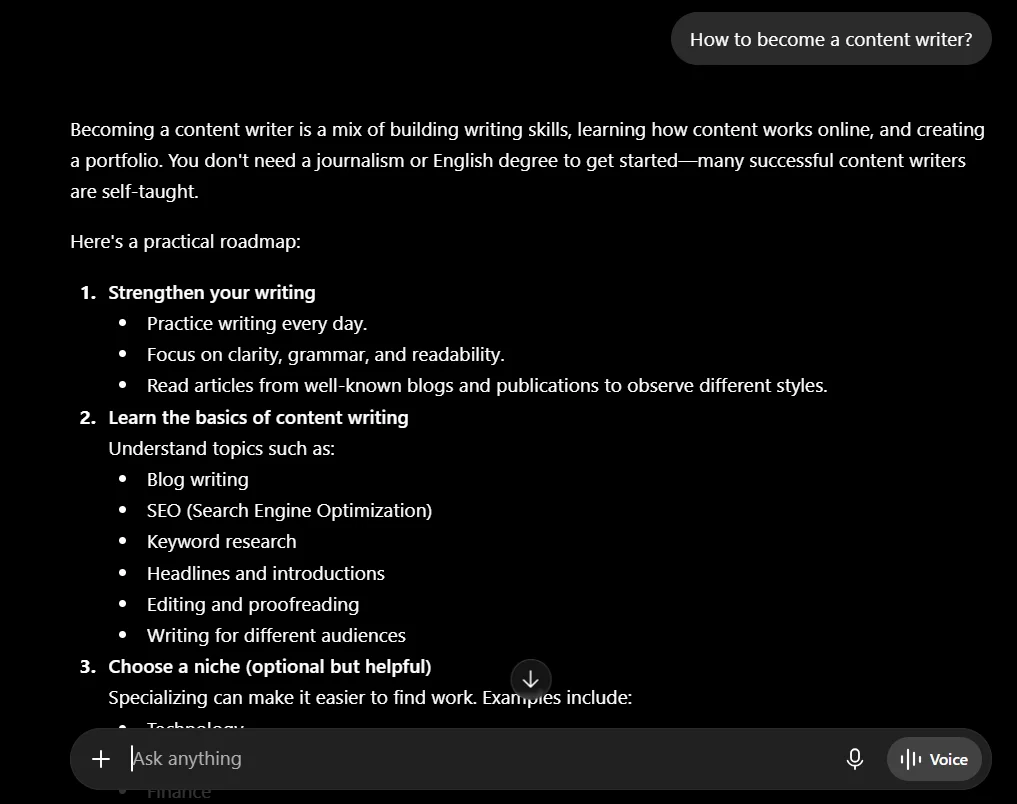
You don't need any special tool to see this gap. Just open two tabs, Google and ChatGPT, and ask a simple query: “How to become a content writer?”
1. The first thing you see on Google is an AI overview that gives you the answer with the citation from where it extracted the information. (Reason–SEO+GEO)
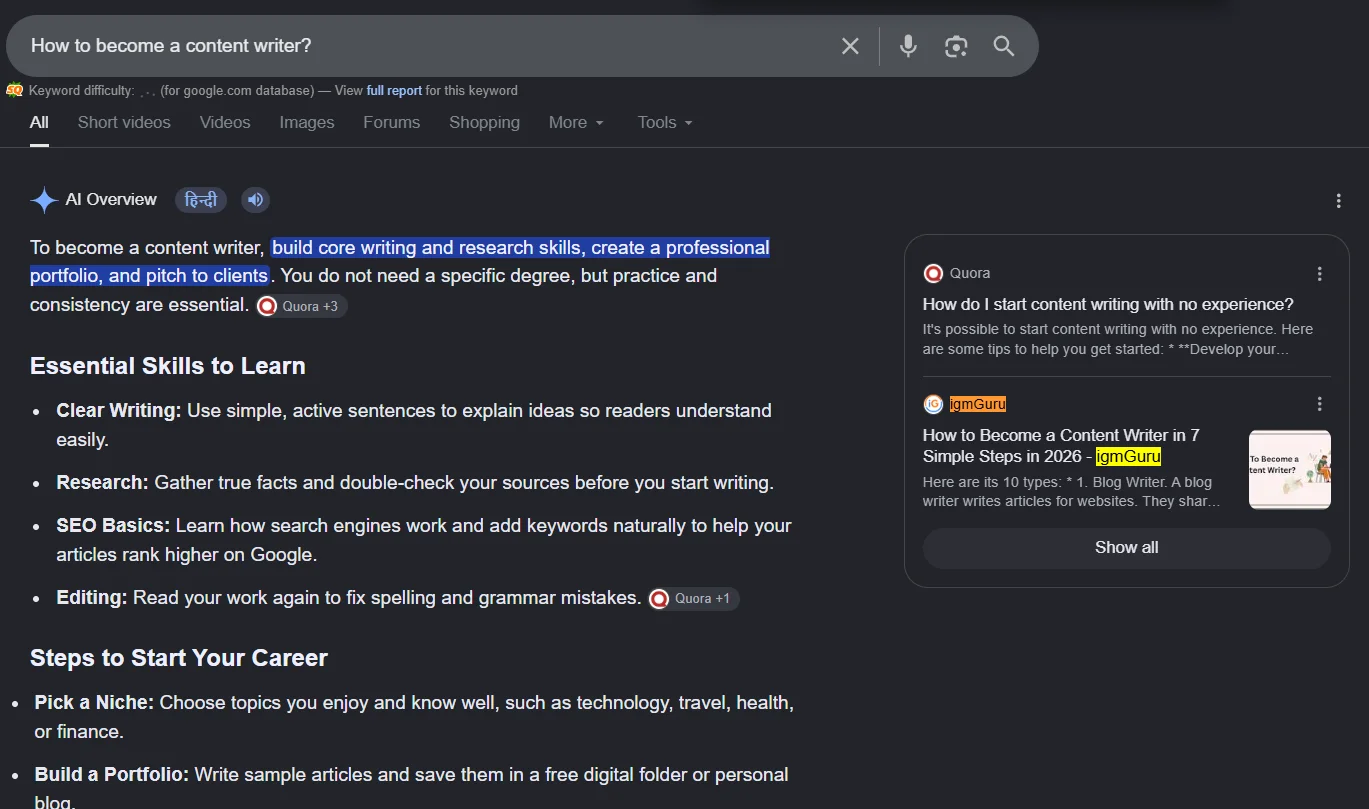
2. After the Google AI overview, you see the webpages that answer your query in the best way. (Reason–SEO)

3. There is no citation on ChatGPT, just a complete roadmap. It is also because the behaviour is not constant, it may show or may not. The other reason is it does not take any of the websites with the best content. (Reason–GEO)
This really depends on where you want to get traffic.
You want to rank on traditional search engines like Google.
Your customers usually compare a few websites before deciding.
Your website still has basic issues like slow loading or broken links.
You need clear, trackable numbers for reporting.
Your customers are already asking for ChatGPT or similar tools before visiting any website.
You're in a space where being recommended matters more than being clicked,
Your SEO basics are already solid, and you want the next layer of visibility.
You're okay with updating your content regularly, not just publishing once.
Realistically, most businesses need both. SEO keeps the traffic you already have coming in, while GEO helps you stay visible in the searches that never even reach a website anymore.
Here's a simple example to make this less abstract. Say there's a small company that sells standing desks online.
With SEO, they'd build a page around "best standing desk for home office," add good product photos, get a few reviews, and try to earn backlinks from furniture blogs. Over time, if it's done well, that page ranks on Google and brings in steady traffic.
With GEO, the same company would also make sure a clear, standalone answer exists somewhere on their site, something like "the best standing desks for a home office are ones with a memory height setting, a weight capacity of at least 100kg, and a stable frame." That sentence is specific and complete enough that an AI tool could actually lift it and use it in an answer, even if the person never visits the site.
Same product, same company, but two very different ways of getting found.
Read Also: What is Social Media Optimization (SMO)?
Search behaviour is changing because people are no longer depending only on traditional search engines to find information. Instead of typing a few keywords into Google and opening several websites, users are increasingly asking complete questions to AI tools and expecting a direct answer.
This does not mean traditional search is disappearing. Instead, search is becoming more conversational, personalized, and answer-focused. Users may start their journey on Google, continue with an AI Overview, ask a follow-up question in ChatGPT, and then visit a website only when they need more detailed information.
Some of the major marketing trends shaping search behaviour are:
For businesses, this means that ranking for one keyword is no longer the complete picture of search visibility. A brand also needs to be discoverable when users ask conversational questions, compare products or services, and look for recommendations through AI-powered platforms.
This is where GEO becomes important. SEO helps a website remain visible in traditional search, while GEO focuses on making the same information easier for AI systems to understand, extract, and potentially include in their answers.
Even with all these differences, GEO and SEO are not enemies. They actually share a lot of the same ground:
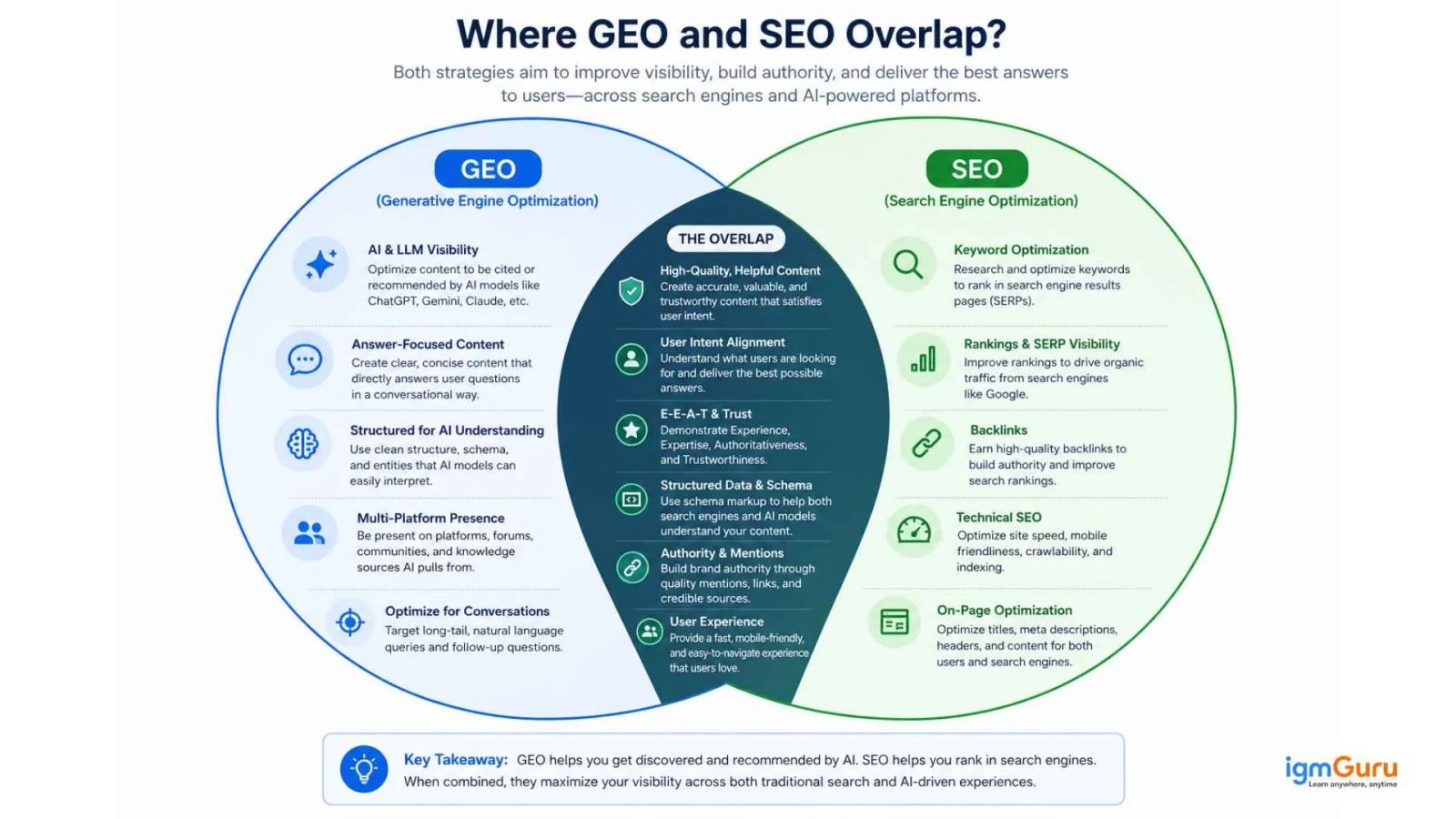
Basically, SEO is the base, and GEO is a newer layer built on top of it.
You don't need two separate strategies here. We were comparing the GEO with traditional SEO. But now you have to implement advanced SEO that includes GEO as its one of the essential parts. A few practical steps can cover both:
Check if AI bots can even reach your site. Look at your robots.txt file and any firewall settings that might be blocking them.
Write clear answers early in each section, not just at the end after a long build-up.
Keep each section short enough to stand alone, roughly 100 to 150 words, with one clear point.
Use real numbers and facts, not just words like "best" or "top rated," which don't mean much on their own.
Add FAQ sections with real questions as headers. This helps both Google snippets and AI answers.
Keep your brand description consistent everywhere, your website, your social pages, review sites, and anywhere else you're listed.
Get mentioned on other sites too, not just backlinks, but reviews, forum posts and comparison articles.
Update your content regularly, and update the "last modified" date when you do.
Track both sets of numbers. Keep using Search Console for rankings, and start checking how often you show up in AI answers too.
Related Article: Best AI Visibility Tools
SEO and GEO aren't really competing with each other. They're solving two different problems as one smart solution. Both start from the same place, content that's actually worth finding. SEO still gets you the click. GEO gets you the mention, even in the searches that never turn into a visit at all.
The businesses that come out ahead here won't be the ones that dropped SEO for GEO. They'll be the ones that kept their SEO practices strong, and then added the extra structure GEO needs on top of it.
No. GEO is built on top of SEO, not instead of it. You still need SEO working before GEO can do much for you.
Not completely separate, but you do need to structure it differently. The same content can work for both if it's organized into clear, complete sections along with your usual keyword-focused writing.
Normal analytics won't show this. You need to either use an AI visibility tool or manually test by asking the same question to a few AI tools and checking how often your brand shows up.
ChatGPT, Google's AI Overviews, and Perplexity are the ones people use most for research right now. Gemini and Copilot are also worth keeping an eye on.
Keywords are useful, but you also have to include the actual questions people type or speak to AI tools. They are a kind of new type of keywords for you that are also identical to LSI we have been using in our content.