TensorFlow is a robust framework for developing deep learning (DL) and machine learning (ML) models. It has now become a valuable asset for individuals nowadays. Especially professionals like data science and machine learning engineers can grab this skill to get competitive salaries around $144,189 per annum. Are you also one of them? Then, you need to prepare for the most asked TensorFlow interview questions.
This article is your go-to guide. Here, you will get the top 30 TensorFlow interview questions along with expertly curated answers. This list is designed by the top experienced working professionals who have sat on both sides; interviewees and interviewers. It will prepare you to excel in your next interview. Let's begin!
Enroll in igmGuru's TensorFlow training program to learn Deep Learning with industry experts.
Entry level positions in TensorFlow development often focus on assessing a candidate's foundational knowledge. Here are some common TensorFlow interview questions for beginners. These questions include feature, limitation, TensorBoard, CNN, RNN, etc.
TensorFlow is a Python programming language based library for creating machine learning applications. It was originally created by engineers and researchers of Google Brain Team in 2015. The term 'TensorFlow' is curated from two words Tensor and Flow. Tensor means a data view of multi-dimensional arrays and flow means a pattern of functions executed on tensors.
It builds and trains complicated machine learning models that further can simplify various sophisticated tasks. It has a flexible and intuitive interface for working with a variety of machine learning tasks including image recognition, NLP and predictive analytics.
It also comes with an extensive library of tools and APIs, which are used to perform complicated tasks that require maths and algorithms. It can create both simple linear regression and sophisticated neural networks for ML models. These models handle large datasets and complicated computations.
There are three kinds of Tensors available, including variable, constant and PlaceHolder. Each of them have different functions and properties.
TensorBoard tools examine and comprehend runs and graphs. It is among the easiest solutions for visualizing data in the form of graphs. It plots quantitative metrics about the graph along with additional data like images that can be fed into it.
Listed below are the features of this framework:
This toolkit has a few limitations including -
TensorBoard provides different visualization functionalities like -
CNNs (Convolutional Neural Networks) and RNNs (Recurrent Neural Networks) are both types of neural networks, but they are designed for different types of data and tasks. The table given below shows their difference in detail:
| S.No. | Feature | Convolutional Neural Network (CNN) | Recurrent Neural Network (RNN) |
| 1. | Data Type | Primarily for spatial data (images, videos). | Primarily for sequential data (text, time series). |
| 2. | Core Operation | It analyzes spectacle data like images. | It analyzes sequential and temporal data like videos and text. |
| 3. | Key Concept | Feature extraction through filters. | Memory and context understanding through hidden states. |
| 4. | Architecture | Composed of convolutional layers, pooling layers and fully connected layers. | Composed of recurrent units (e.g., LSTM, GRU). |
| 5. | Applications | Image classification, object detection, image segmentation and medical image analysis. | Natural Language processing (NLP), speech recognition, machine translation and time series analysis. |
| 6. | Advantages | Efficient for spatial data and fewer parameters. | Captures temporal dependencies and suitable for sequential data. |
| 7. | Disadvantages | Less effective for sequential data, requires large datasets. | Can be computationally expensive and prone to vanishing/exploding gradients. |
Listed below algorithms are applicable in this toolkit -
It supports various kinds of dashboards like, scalar, image, graph, text, distributer and histogram.
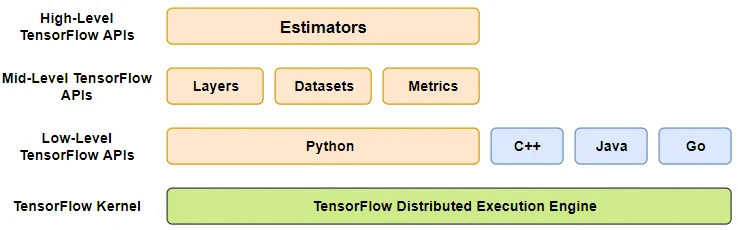
TensorFlow supports a variety of programming languages including Python, Go, C++ and Java. Python is one of the most used languages.
Related Article- TensorFlow Tutorial for Beginners
Intermediate interviews require preparing for more complicated concepts and practical applications. Here we will explore the top TensorFlow interview questions for intermediates that can prepare candidates for their next technical challenge.
Both of these are leading deep learning frameworks and different from each other at the same time. TensorFlow excels in scalability and production readiness that has a graph-based architecture and a rich set of tools.
Simplicity and flexibility are PyTorch's priority for dynamic computation graphs for an intuitive user experience. While TensorFlow boasts a larger ecosystem and broader platform support PyTorch is preferred for its user-friendliness and strong research community.
Loading the information to this framework is the first step to training an ML algorithm. There are two methods that can be used to perform this operation (ops) including -
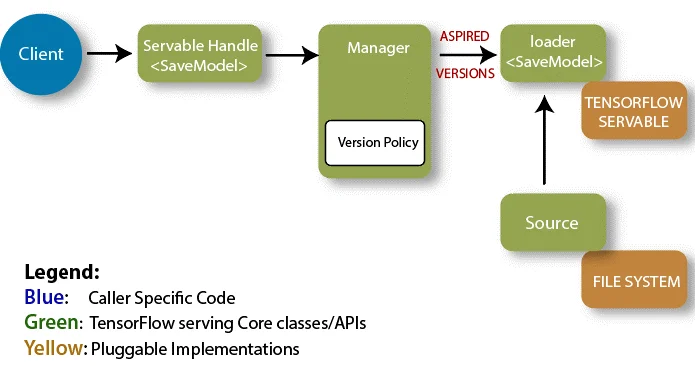
The objects used by clients to perform computations are known as servables. It is a flexible object that can contain anything from a single model to a lookup model. These objects are the central rudimentary unit of serving for production environments.
Serving is a high-performance and scalable serving system used for ML models. It easily implements new experiments and algorithms while maintaining the ideal server APIs and architecture. It gives out-of-the-box integration with models of this framework. One can easily extend it to serve additional models and information when needed.
There are different variations occurring while training data. Overfitting conditions are often seen when these different conditions reach up to high margins. The ML models will definitely train well in this condition but cannot read the new data. This condition has to be solved by removing the noise from the available information as much as possible.
Graph explorer is a powerful tool to evaluate the trained model and check the conceptual graph to see if the model is working as intended. It gives an op-level plot representation that shows how the model is understanding the program.
There are different challenges one may find while training deep learning models including underfitting, overfitting and exploding/vanishing gradients. These challenges can be addressed by different methods. Overfitting is mitigated by regularization techniques like weight decay and dropout. Underfitting is removed by upgrading model complications or training more epochs. Gradient issues are managed with techniques like gradient clipping and careful initialization.
The entire model can be saved by model.save() method including their architecture, weights and optimizer state. We can later load the model by using tf.keras.models.load_model() function. The code given below is an instance of this method-
# Save the model model.save('igmGuru_model.h5') # Load the model loaded_model = tf.keras.models.load_model('igmGuru_model.h5') |
The execution model of this framework involves determining and executing computational graphs. Both of these operations are performed on the teasers. This process is divided in the following two parts -
Tensors are mostly built with constant() function only. We use 'tf. Constant' to build a Const node with exact values at graph construction. These values are given to the tensors as arguments as given below-
t1 = tf.constant([[1, 2, 3], [4, 5, 6], [7, 8, 9]]) t2 = tf.constant(["String One", "String Two", "String Three"]) sess = tf.Session() print(t1) print(sess.run(t1)) print("\n") print(t2) print(sess.run(t2)) |
Operations are defined as instances of the tf.Operation class. An ops shows a computational node in a graph by taking both zero or more tensor objects as input and output. These operations might be simple as basic math like summation and multiplication or complicated as custom computation. The easiest way to create an ops is using Python scripts like-
import tensorflow as tf # Define constant tensors a = tf.constant(3) b = tf.constant(2) # Define add operation add_operation = tf.add(a, b) # Run the operation using TensorFlow session in TensorFlow 1.x with tf.compat.v1.Session() as sess - print("Addition - ", sess.run(add_operation)) |
It is important to note that eager execution is enabled by default in TensorFlow 2.x. This feature returns the values immediately. One can use tf.py_function or tf.numpy_function to define complicated custom operations. An instance is given below-
def my_func(x, y) - return np.sinh(x) + np.cosh(y) a = tf.constant(3.0) b = tf.constant(3.0) # Use tf.numpy_function to create the operation op = tf.numpy_function(my_func, [a, b], tf.float32) print(op) |
Related Article- How to Install TensorFlow?
Listed below are the frequently asked TensorFlow interview questions for experienced ones. These questions will help you to be positioned at a Silicon Valley organization with a high salary. This salary may range up to $200,000 per annum.
tf.Checkpoint and tf.SavedModel are mechanisms of model management. These mechanisms save and load model weights while training, testing and execution. tf.SavedModel presents in serialized format that consists of both the trained parameters and model architecture. The primary use of this mechanism is to save a model and its weights which can be restored and reloaded for several tasks.
tf.Checkpoint presents in a lightweight format. It is particularly focused on managing and saving the internal state of the model while training. It is different from tf.SavedModel as it does not save the architecture of the model. This saving strategy can be used only in an integration with the other model.
TensorFlow optimizer is a component used in the training process of ML or DL models. This component is responsible for minimizing the loss function and updating the weights of models. It uses several optimization algorithms like RMSprop, Adam, Gradient Descent and AdaGrad. This improves the performance of the model iteratively over time.
These algorithms calculate the change in the loss function compared to each weight by different tests. The techniques include backpropagation and adjusting the weights accordingly. These components are available in the tf.keras.optimizers module and anyone can easily integrate these in their testing processes.
Backpropagation is implemented by automatic differentiation. It builds a computation graph that shows where edges are tensors and nodes are operations. The framework automatically creates a reverse mode gradient computation graph during computing gradients.
It computes the gradient of the loss function compared to each bias and weight as it moves from the input layer to the output layer. These gradients are used by optimizers for updating model parameters. This ultimately decreases the loss function.
Custom layers are the specialized layers that are created by individuals as per their requirements. They can define the trainable parameters, forward pass logic and some additional custom operations needed for the layer. It is done by subclassing the base tf.keras.layers.Layer class. These layers are flexible which can encompass novel operations, execute complicated architectures and use available layers for particular needs.
Both of these frameworks have different roles in the field of artificial intelligence. The main difference between them is their applications. TensorFlow creates and trains ML models while OpenAI focuses on improving AI abilities with research and development of AI technologies.
There are different types of gradient descent optimization algorithms available in this framework. Some of them are as follows -
This framework plays an important role in artificial intelligence by training and developing ML models. It is used in different AI applications like NPL, speech recognition, computer vision and many more. It is a set of APIs and tools that benefit researchers and developers for experimenting and implementing several architectures and algorithms.
Estimators are basically a type of high-level APIs that ease the process of training, defining and evaluating ML models. They give a variety of abstraction that encourages program consistency and reusability. These APIs are especially useful to build models for classification, regression and clustering tasks.
The embedding projector is basically a visualization tool. It is apt for exploring and understanding complicated data like embeddings created via ML models. It gives an intuitive and interactive UI to explore embeddings in a low-dimensional space. It simplifies to grasp patterns and relationships from the available information.
Attention mechanisms are implemented by the tf.keras.layers.Attention layer. It takes two different inputs, which are key and query. Keys are patterns of the vectors that show the encoder output. A query is a vector itself that indicates the current state of the decoder.
A weighted sum of the key vectors is calculated in the attention layer. Here weights are computed according to the similarity between key and query vectors. The output received from the attention layer will represent the attention weights in the form of a vector. This vector will attend to particular sections of the encoder output while making the decoder output.
There are a total of six parameters that should be considered while implementing a random forest algorithm including:
This is high time to start your preparation as experts in this field are highly demanded in the industry. These latest and most asked TensorFlow interview questions and answers are apt for both candidates and recruiting managers. It assists managers in recruiting the right candidates and candidates to impress interviewers.
It is one of the most crucial frameworks in different tech areas like ML, DL and data science and can provide competitive salaries to the skilled professionals. Therefore, the competition is also high with the demand. Preparing for these top questions can set you apart in this competition.
It depends on the role you are going for. The beginner level role often includes questions on fundamentals, whereas the intermediate and experienced roles require a deep understanding and hands-on experience. This article includes all the questions you need to prepare for.
Mastering this framework can provide you the following jobs:
Yes, TensorFlow is still used in 2026, especially for building and running machine learning and deep learning models.
Yes, basic Python coding is needed to create, train and test models, though TensorFlow also provides high-level APIs to simplify common tasks.
Course Schedule
| Course Name | Batch Type | Details |
| TensorFlow Course | Every Weekday | View Details |
| TensorFlow Course | Every Weekend | View Details |