Every 39 seconds, a cyber attack hits somewhere on the internet. Whether you run a small business or manage IT for a large company, understanding cybersecurity threats is no longer optional. Hackers, criminal groups, and even hostile nations are constantly looking for weak points to exploit.
This guide breaks down the most common types of cybersecurity threats, where they come from, and why every organization needs a solid defense strategy. By the end, you will know exactly what you are protecting against and how to stay one step ahead
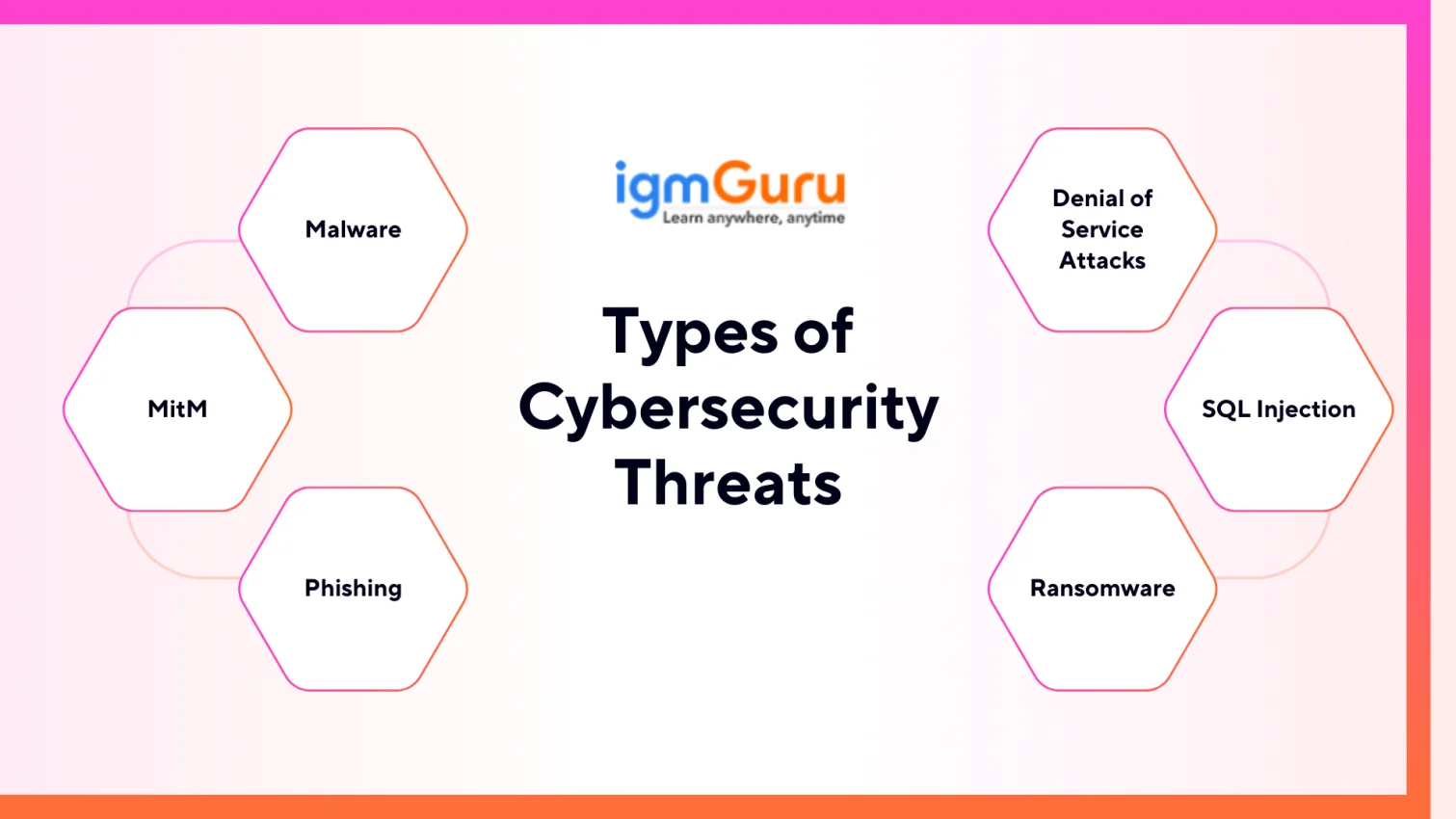
Cybersecurity threats refer to the acts that are performed by individuals or groups with a harmful intent. The goal could be to cause damage, disrupt computing systems or even steal data. There are many categories within it known as types of cybersecurity threats. Some of the common ones are social engineering, malware, man-in-the-middle attacks, injection attacks and denial of service.
Cyber threats can sprout from many different sources. These can either be from terrorist groups, individual hackers, trusted employees or contractors, or hostile nation states. Thus, it is always best to stay prepared as any source could be a threat.
Want to learn more about Cyber Security? Go through our Cybersecurity tutorial, crafted by Cybersecurity experts, to learn about Cyber Security in depth.
Let's discuss some common sources of cyber threats that prevail today. There are too many to sum up here and hence, we'll be discussing the most common ones.
A hostile country may launch a cyber attack against local institutions or companies. The goal is to interfere with their communications, cause damage and create disorder.
Terrorists have often resorted to conducting cyber attacks that threaten national security, target critical infrastructure, cause bodily harm to citizens and disrupt economies.
Many organized hacker groups intend to get into a computing system for monetary gain. They utilize different techniques like spam, phishing, malware and spyware. The goal is to steal private information, execute online scams and extort.
Individual hackers often make organizations their target. For this, they use different attack techniques. Their key motive is revenge, personal gain, political agendas or financial profit. They usually create new threats to heighten their criminal capabilities as well as make their standing stronger within the hacker community.
Employees who have access to a company's assets may also misuse their privileges. They could easily damage systems or steal information for personal or monetary gain. These persons could be contractors, employees, partners or suppliers. Outsiders having compromised privileged accounts can also impersonate the account owner and pose significant threats.
Cyber attacks are not just a technical problem. They carry a real financial and human cost. A single data breach can cost a mid-sized company millions of dollars in recovery, legal fees and lost business. Beyond money, attacks damage customer trust, disrupt daily operations and sometimes put lives at risk, especially when hospitals, power grids or water systems are targeted.
In recent years, ransomware attacks have shut down hospitals for days, delaying critical patient care. Supply chain attacks have compromised software used by thousands of businesses at once, turning one weak link into a widespread crisis. These incidents show why understanding cybersecurity threats is not optional anymore. It is a basic requirement for running any modern organization safely.
Many types of cybersecurity threats are constantly evolving. Each of these targets a different side of information technology to exploit its vulnerabilities. It is important to understand the different types of cybersecurity threats to develop robust defenses. The key types of cybersecurity threats are as follows:
ats to develop robust defenses. The key types of cybersecurity threats are as follows:
Malware refers to malicious software that is crafted to exploit, compromise or harm a computer system. It has multiple subtypes, including-
You May Also Read- How To Become A Cyber Security Engineer
Man-in-the-Middle attacks, also referred to as MitM, take place when an attacker seizes and alters the communication happening between two parties. These parties do not get any whiff about this attack. It results in the theft of sensitive information. This usually includes financial data and login credentials.
There are many examples of MitM attacks. Common ones are session hijacking, wi-fi eavesdropping, DNS spoofing, HTTPS spoofing and IP spoofing.
Phishing attacks are ones where the attacker employs deceptive messages, websites or emails. They trick users into sharing their personal information, like financial information or login credentials. Spear-phishing refers to a more targeted phishing type. In this, attackers customize their messages as per their specific targets, which can be individuals or organizations. It helps in increasing the chances of success.
DoS attacks, or denial of service attacks, are done with the purpose of making a service, network or system unavailable. This is usually done by overwhelming it with a whole lot of internet traffic. These attacks may also cripple the website and online services, leading to financial losses and significant disruption. Different DoS attack techniques include HTTP flood DDoS, UDP flood DDoD and NTP amplification.
SQL injection attacks are executed with the purpose of exploiting vulnerabilities of an app's software. The goal is to inject various malicious SQL queries post-exploitation. These queries have the ability to change a database to modify, delete or access data without any authorization needed. SQL injections are generally employed to breach websites as well as extract sensitive information.
A zero-day exploit targets a software vulnerability that the vendor does not know about yet. Since there is no patch or fix available, attackers get a window to cause damage before developers can respond. These attacks are especially dangerous because traditional security tools often fail to detect them in time.
Cross-site scripting happens when an attacker injects malicious scripts into a trusted website. When a user visits that website, the script runs in their browser without their knowledge. This can steal session data, login credentials or redirect users to harmful sites.
Credential attacks aim to steal or guess login details to gain unauthorized access. Common methods include brute force attacks, where attackers try many password combinations, and credential stuffing, where stolen username and password pairs from one breach are tested on other platforms. Weak or reused passwords make this attack highly effective.
Cryptojacking occurs when an attacker secretly uses a victim's computer or device to mine cryptocurrency. The victim usually notices slower performance, higher electricity bills or overheating devices, without realizing malicious code is running in the background.
A supply chain attack targets a trusted vendor, supplier, or software provider to reach a much larger group of victims. Instead of attacking a company directly, hackers compromise a tool or service that company already trusts and uses daily. This makes supply chain attacks extremely difficult to detect and stop early, since the entry point looks legitimate.
Password salting is not a cyber threat itself but a security technique used to defend against password-related attacks. A salt is a unique, randomly generated value added to each password before it is hashed and stored in a database. This ensures that even if two users choose the same password, their stored password hashes are completely different.
Without salting, attackers who steal a password database can use precomputed rainbow tables or compare identical hashes to crack passwords much faster. By adding a unique salt to every password, these attacks become significantly more difficult because each password hash must be cracked individually.
Modern authentication systems combine password salting with strong hashing algorithms such as bcrypt, Argon2, or scrypt. This approach provides much stronger protection against brute-force attacks, credential theft, and password cracking attempts, making it one of the most important security practices in modern cybersecurity.
Understanding threats is only half the job. Taking action to prevent them is what actually keeps your systems safe. Here are practical steps every organization should follow.
1. Keep software updated: Regular patching closes known vulnerabilities before attackers can exploit them.
2. Train employees regularly: Most attacks succeed because of human error. Teaching staff to recognize phishing emails and suspicious links reduces risk significantly.
3. Use multi-factor authentication: Adding a second verification step makes stolen passwords far less useful to attackers.
4. Install firewalls and endpoint protection: These tools monitor traffic and block malicious activity before it reaches your systems.
5. Back up data consistently: Regular backups ensure you can recover quickly from ransomware or data loss without paying a ransom.
6. Create an incident response plan: Knowing exactly what steps to take during an attack reduces panic and limits damage.
Combining these steps with real-time threat intelligence and continuous monitoring gives your organization a strong, layered defense against evolving cyber threats.
Related Article- Cybersecurity 101: How to Protect Your Tech from Hackers
As technology advances, threats driven by automation and artificial intelligence are expected to grow, making it even more important to stay informed and prepared. Understanding these threats today helps you build the defenses your business will need tomorrow. If you are unsure where your organization stands, consider getting a professional security audit to identify weak points before attackers do.
Cybersecurity threats are constantly evolving, and attackers are becoming more sophisticated every year. From malware and phishing to newer risks like supply chain attacks and cryptojacking, no organization is completely immune. The best defense combines awareness, the right security tools and a proactive prevention strategy rather than a reactive one.
There are many different types of cybersecurity threats which a company needs to protect itself against. The only thing that can make it happen is an all round visibility, a mobilizable security infrastructure and real time threat intelligence. The article above states the different types of such threats to make one more aware of the malicious practices being used today.
Malware, Phishing, Man-in-the-Middle (MitM) Attacks, Denial-of-Service (DoS) Attacks, and SQL Injection are the types of Types of Cybersecurity Threats.
Plan, Protect, Prove, Promote, and Partner are five possible Ps of cybersecurity.
Phishing is the most common type of cybersecurity threat. Attackers use fake emails and websites to trick users into sharing passwords or financial details. It remains popular because it targets human error rather than technical flaws.
Businesses can protect themselves with strong firewalls, regular software updates, employee training, and multi-factor authentication. Real time threat monitoring also helps detect and stop attacks before they cause damage.
Yes, cybersecurity threats increase every year. As technology grows, attackers find new methods and tools to exploit systems. This makes ongoing awareness and updated security measures essential for every organization.
Course Schedule
| Course Name | Batch Type | Details |
| Cyber Security Training | Every Weekday | View Details |
| Cyber Security Training | Every Weekend | View Details |