Want to Master UiPath Automation Now?
Explore Our Comprehensive Article on How to Learn UiPath?


UiPath is a robotic process automation (RPA) platform for complete high-scale automation. This software presents solutions for companies to automate various repetitive office tasks to bring about rapid business transformation. Multiple tools convert boring tasks into highly automated processes.
Gartner, Inc. has also positioned this platform as a leader in the 2024 Gartner, sixth year in a row. This UiPath tutorial is aimed at software developers and engineers who wish to automate repetitive tasks. Business analysts, process experts, testers, and quality assurance professionals will also learn a lot from it.
TL;DR
This UiPath tutorial is for learning how to automate repetitive business processes using robotic process automation (RPA). It helps developers, business analysts, testers, and automation professionals understand UiPath architecture, installation, key concepts, products, and automation workflows. By mastering UiPath, users can improve efficiency, reduce manual effort, lower operational costs, and build valuable automation skills for career growth.
To gain expertise in this platform, one should fulfill a few basic prerequisites:
UiPath offers solutions for enterprises to automate repetitive and mundane business operations, improve efficiency, reduce costs, and increase accuracy. Founded by Romanian entrepreneur Daniel Dines in the year 2005, its 'robots' are trained to perform practically anything a user can do with a keyboard or mouse. These tasks include copy-paste, drag-and-drop, launch/log in to applications, run reports, access/read your email, etc.
The biggest advantage of digitization is the speed of execution. However, its challenge is the need for diverse tools and consequent manpower demand with a concentrated skillset to handle those tools. This platform is a reliable, robust and intelligent solution to resolve this issue.
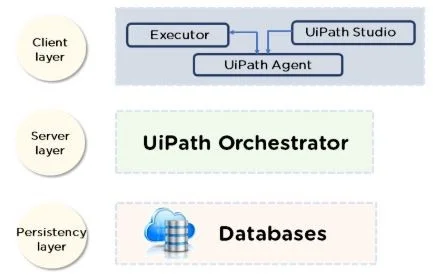
The UiPath architecture has been categorized into three components:
The Client Layer includes two platforms: UiPath Studio (for development) and UiPath Robot (for execution). Both of them simply execute the tasks or automation workflows created by users.
The robot has two components:
Once the robot is ready, the project is uploaded to the Orchestrator Server. Orchestrator is a web-based platform that monitors deployment, configures, manages queues, and handles logging across multiple PCs and robots.
This layer consists of a database, which deals with queues and their items. It also holds information about robot configuration and their assigned processes.
It is essential to install UiPath before moving forward. There are two main types of editions available, namely community and enterprise. You can choose any of them according to your specific requirements. The installation process involves the following steps:
For a complete installation guide, you can visit our UiPath Installation - A Step-by-Step Guide.
This RPA platform has an intuitive interface consisting of multiple panels. Understanding its user interface (UI) and the shift to the Modern Design Experience is essential before starting. The key panels of the Studio UI include:
The ribbon at the top of the screen consists of four main tabs (Start, Design, Execute, and Setup) for project management and execution.
To quickly familiarize yourself with the interface, start a new Blank Process and perform a simple automation:
Now that you are familiar with the interface, let's explore the fundamental terminologies, including the latest enterprise concepts.
RPA is a robust technology that automates software robots (bots) to mimic almost every human operation, such as data entry, report creation, and invoice processing, with better speed and precision. It is widely used in Banking, Healthcare, Finance, and Supply Chain Management.
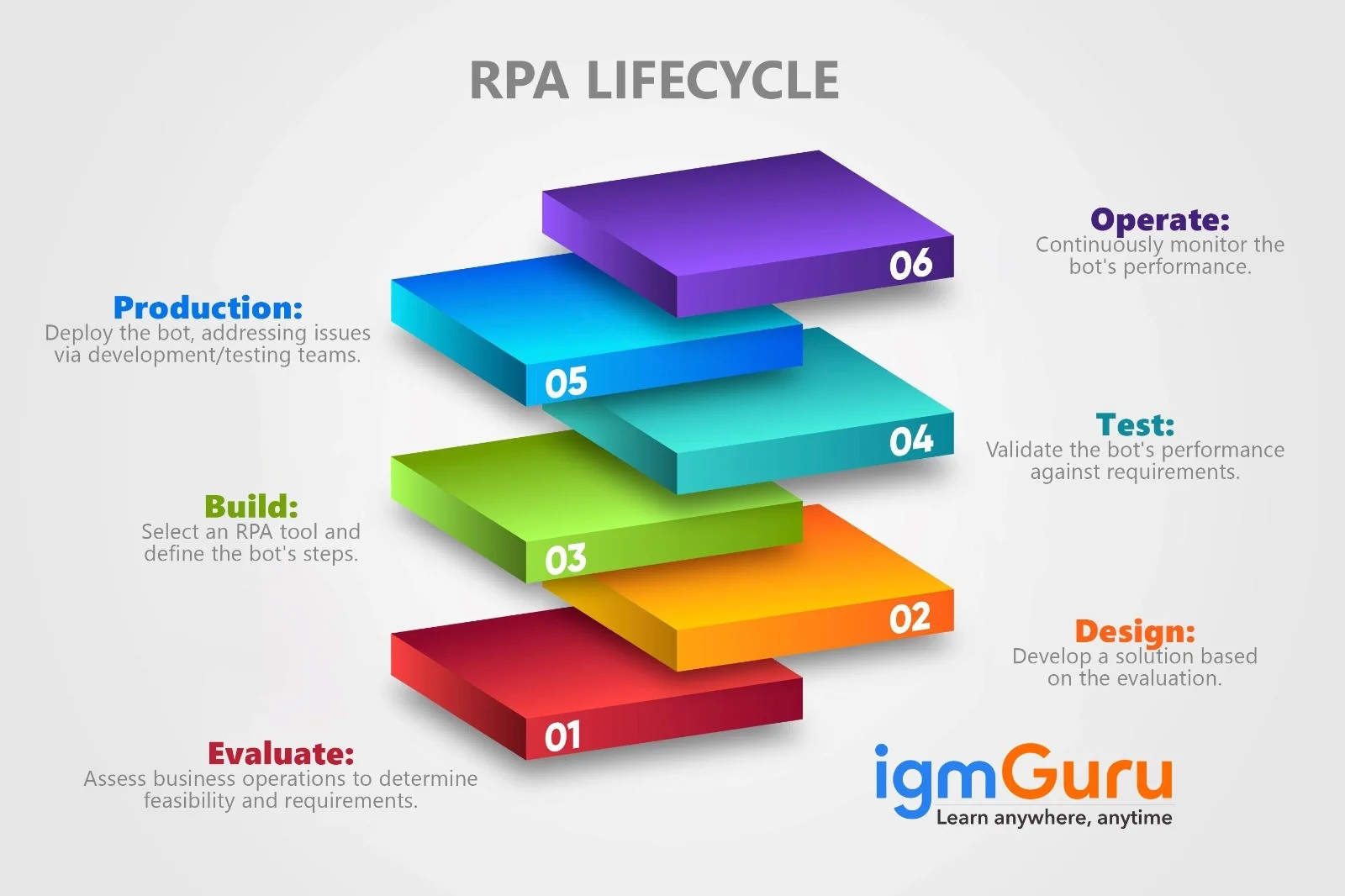
While the lifecycle is flexible, the industry standard for complex projects is the Robotic Enterprise Framework (REFramework), which follows these core stages:
UiPath is rapidly moving beyond simple RPA to Agentic Automation. This involves an ecosystem where sophisticated AI Agents (which can reason and make decisions using models like Generative AI) are orchestrated by the UiPath Platform to initiate or execute tasks, which are then completed by traditional software Robots.
Concepts like UiPath Autopilot™ and Clipboard AI are key products driving this agentic transformation, enabling higher-value automation that can handle unstructured data and dynamic decisions.
A Data Table is a variable that stores data in rows and columns, similar to an Excel spreadsheet. It is central to data manipulation in an automation process.
Example: You use the Read Range activity to pull data from an Excel file into a Data Table variable. Then, you use the For Each Row in Data Table activity to process or migrate each record to a target application like SAP or Salesforce.
A Queue is a container in Orchestrator that securely stores data (Transaction Items) related to processes. It decouples the robot's execution from the data flow, allowing for large-scale, resilient, and load-balanced process execution (e.g., processing 10,000 invoices).
Screen scraping is a core component for extracting data from applications and web pages. It uses a wizard to select a UI element and extract raw text as a string value.
Method: Full Text
Method: Native
Method: OCR (Optical Character Recognition)
UiPath facilitates mobile automation and app development through two primary methods:
UiPath's core product suite is built on three pillars:
The visual development environment where users create automation processes using flowcharts, sequences, and the modern drag-and-drop interface. It now supports both classic and modern design experiences.
The execution agent that runs the processes built in Studio. Robots can be Attended (run alongside a human, triggered by a user) or Unattended (run autonomously, scheduled via Orchestrator).
A web-based, centralized platform used to schedule deployment, monitor all robots, manage assets, queues, and user permissions across the entire enterprise automation program.
This tool's popularity stems from a robust set of features:
Businesses globally are adopting this platform to save time and money. By mastering this UiPath tutorial, you are grabbing the opportunity to become highly skilled in the competitive market, especially with the industry shift towards Agentic AI and enterprise-scale automation.
Mastering this platform is indeed easy as there is no need for an extensive coding background. Anyone can learn easily with a common knowledge of programming and logic.
Being the leading RPA platform, it provides a variety of excellent career opportunities, like RPA Developer, Solution Architect, and Business Analyst. These roles are in humongous demand across industries globally.
With high demand, professionals in this field with two years of experience typically earn a competitive salary. In India, this ranges from ₹4.1 Lakhs to ₹26.4 Lakhs per year, varying significantly based on city, company, and certifications (e.g., UiARD).
UiPath is used to automate repetitive tasks like data entry, report generation, invoice processing and system updates, helping businesses save time and reduce manual work.


Top Advantages And Disadvantages of Artificial Intelligence (AI)
October 16th, 2026
File Handling in Python: Understand Step-by-Step With Examples
October 16th, 2026