Tokenization is one of those words that means different things depending on who says it. An AI engineer uses it to describe how language models read text. A security professional uses it to describe how payment data gets protected. A blockchain developer uses it to describe how real-world assets become digital tokens.
All three meanings are correct and in 2026, all three are more important than ever.
This guide covers every type of tokenization, including how each one works, where it is used today, and where it is heading. Whether you are building AI systems, securing payment infrastructure, or exploring digital asset markets, this is the complete reference you need.
Read Also: What Is Ransomware?
Tokenization is the process of replacing a meaningful piece of data with a smaller, manageable unit, known as a token.
That definition applies across three distinct fields:
NLP Tokenization: breaking text into smaller units so AI can read and process language
Data Security Tokenization: replacing sensitive data like credit card numbers with harmless placeholder tokens
Blockchain Tokenization: converting real-world assets like property or financial instruments into digital tokens on a blockchain
Each type follows the same core idea: take something complex or sensitive, represent it as a token, and make it easier to process, store, or transfer securely.
In 2026, these three fields are converging. AI systems are interacting with blockchain tokens. Payment tokenization is powering agentic commerce. Tokenized identity is managing access to AI agents. Understanding all three is no longer optional for anyone building in tech or finance.
Knowing what tokenization is gets you halfway there. Knowing how it actually operates under the hood is what separates a surface-level understanding from a working one.
The mechanics differ by field, but the logic is consistent across all three.
Tokenization splits raw text into pieces a machine can analyze. The sentence "AI is powerful" becomes ["AI", "is", "powerful"]. The model processes each token individually and learns relationships between them. In 2026, frontier models handle up to 1 million tokens in a single context window, meaning they can process entire codebases or document libraries in one pass.
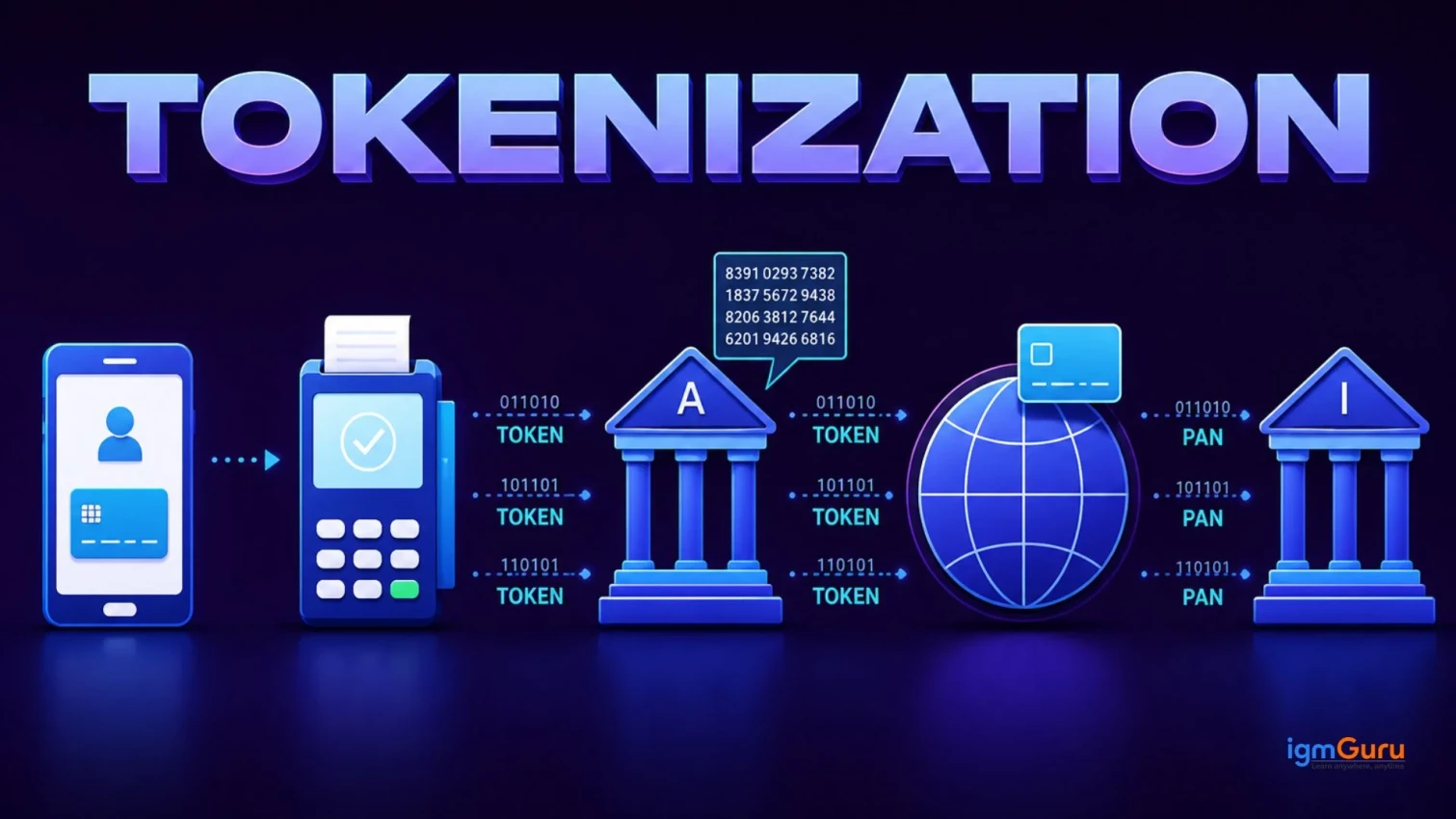
Tokenization replaces a real value — say, a credit card number like 4111 1111 1111 1111 — with a randomly generated token like 8f3d-9a2c-1b7e. The original number lives securely in a separate token vault. Anyone who intercepts the token gets nothing useful.
Tokenization converts ownership rights of a real-world asset into a digital token. That token lives on the blockchain and can be bought, sold, or fractionalized without physical paperwork. By early 2026, on-chain tokenized real-world assets exceeded $24 billion in total value.
All three methods reduce exposure, improve processing efficiency, and create a clean layer of abstraction between raw data and the system handling it.
Also Read: SailPoint Tutorial For Beginners
Not all tokenization works the same way. The method you use depends entirely on what you are tokenizing and why. Here is a breakdown of every major type across all three domains.
NLP tokenization has several sub-types. Here is how each one works:
Splits text by individual words. It is the most common approach and works well for languages like English where words have clear boundaries.
"Machine learning is great." → ["Machine", "learning", "is", "great", "."]
Breaks text down letter by letter. It is useful for spelling correction and languages without clear word boundaries like Chinese or Japanese.
Sits between word and character tokenization. It splits rare words into smaller known pieces. For example, "unbelievable" becomes ["un", "##believ", "##able"]. BERT and GPT both use subword tokenization because it handles unknown words far better than whole-word approaches. This is also the method used by most frontier models in 2026, including GPT-5, Claude, and Gemini.
Divides a paragraph into individual sentences. This is useful for summarization, translation, and any task needing sentence-level context.
Creates tokens from consecutive word groups. A bigram of "natural language processing" gives ["natural language", "language processing"]. This captures more context than single-word tokens and is widely used in search and retrieval systems.
In cybersecurity and payments, tokenization replaces sensitive data with a non-sensitive substitute.
Keeps the token in the same format as the original. A 16-digit card number stays 16 digits. This makes it easy to work with existing systems without changing any underlying code.
Creates a completely random token with no mathematical relationship to the original data. This is the most secure approach and the standard for high-risk payment environments.
Stores the original data in a secure token vault and maps each token to its real value. Only authorized systems with vault access can de-tokenize.
It uses cryptographic algorithms to generate tokens without storing a lookup table. This reduces infrastructure costs but requires more computational work at runtime.
Related Article: How to Become a SOC Analyst?
Blockchain tokenization converts asset ownership into digital tokens.
They are interchangeable. One token equals another of the same type. Bitcoin and most cryptocurrencies are fungible tokens.
It represents unique assets. Each token is unique. NFTs are widely used in digital art, gaming, intellectual property, and identity.
They represent ownership in a real-world asset like company equity or real estate. They are regulated like traditional securities and are seeing rapid institutional adoption in 2026.
Give holders access to a product or service within a blockchain ecosystem.
They are the fastest-growing category in 2026. They represent ownership stakes in physical assets such as real estate, private credit, government bonds, gold, and corporate equity.

If you have ever used an AI chatbot, a translation tool, or a writing assistant, tokenization was running in the background before the model processed a single word. It is the step that makes language readable to machines, and in 2026 it has grown significantly more sophisticated.
Tokenization is the first step in how any AI model understands language. Without it, a language model cannot process a single sentence.
When you type a prompt into any large language model (LLM), the system does not read your words the way you do. It converts your text into tokens, assigns a numerical ID to each token, and passes those numbers into the neural network.
Here is what makes this critical in 2026:
Frontier models, including Claude, GPT-5, Gemini 3.1, and DeepSeek-V4, now support context windows of up to 1 million tokens. This means a single session can process an entire book, a full codebase, or hundreds of documents at once. A year ago, this was impossible.
Most AI APIs in 2026 use multi-bucket pricing that charges separately for input tokens, cached input tokens, output tokens, and reasoning tokens. A longer prompt genuinely costs more, and engineers now optimize prompts with token efficiency in mind.
Modern AI models tokenize not just text but images, audio, and video. Each modality is converted into tokens through its own pipeline before being passed to the model's unified attention mechanism. This is how models like GPT-5 and Gemini 3.1 can answer questions about images, transcribe speech, and analyze video in the same session.
Models that use chain-of-thought reasoning generate internal "thinking" tokens that do not appear in the final response. These tokens represent the model's scratchpad. They consume context and cost money, but they significantly improve accuracy on complex tasks.
Modern AI tokenizers include Byte Pair Encoding (BPE), WordPiece, and SentencePiece. Each is optimized to create the smallest, most efficient vocabulary while preserving meaning across languages.
Also Read: Information Security vs Cybersecurity
Every time you tap your phone to pay for something, tokenization is the reason your actual card number never leaves your device. In the world of data security, tokenization is not a feature — it is the foundation.
Data security tokenization is one of the strongest tools available for protecting sensitive information. In 2026, it has become foundational infrastructure for payments, healthcare, and any enterprise system that handles personal data.
When a customer uses a card or digital wallet, the payment system immediately replaces the card number with a token. That token travels through the network. Even if an attacker intercepts it, the token is worthless without vault access. Over 85% of online merchants now use tokenization to secure customer payment data.
Visa, Mastercard, and major card networks are pushing network-level tokenization as the standard for all digital commerce. In April 2026, Visa launched the Digital Commerce Authentication Program (VDCAP) in the US and Canada, incentivizing merchants to provide richer token data including device ID and billing address to improve fraud detection alongside tokenization.
AI agents that autonomously shop, book, and pay on behalf of users have created a new frontier for tokenization. Secure token management is now a core requirement for any AI agent that handles payments, because the agent must process transactions without ever touching raw card data.
The Payment Card Industry Data Security Standard recommends tokenization as the primary method to reduce compliance scope. Systems that store and process only tokens face significantly fewer PCI requirements than systems touching raw card data. Over 70% of financial institutions have reported reduced payment fraud after implementing tokenization.
Hospitals and health systems use tokenization to protect patient identifiers in operational databases. A patient's social security number or health record ID is replaced with a token, limiting exposure in any breach scenario.
In 2026, the shift toward zero-trust security models is accelerating tokenization adoption. Tokenizing sensitive data at the field level — rather than just protecting the perimeter — is now considered a core requirement of any zero-trust implementation.
A few years ago, blockchain tokenization was mostly theoretical. Today, the world's largest banks, asset managers, and stock exchanges are using it to move real capital. The shift from experiment to infrastructure is complete.
Blockchain tokenization has moved from experiment to infrastructure in 2026. Major financial institutions are no longer just exploring it. They are deploying it at scale.
Tokenized real-world assets exceeded $24 billion in on-chain value by early 2026, following 266% growth in 2025. The market has diversified beyond US Treasuries into at least six asset categories each independently exceeding $1 billion in on-chain value. Private credit, tokenized government bonds, tokenized gold, real estate, corporate bonds, and tokenized equities are all active markets.
Franklin Templeton, JPMorgan, BlackRock, Fidelity, and Apollo all launched or significantly expanded tokenized products in 2025 and into 2026. JPMorgan tokenized a private equity fund. Siemens issued a 300 million Euro corporate bond on-chain. Nasdaq filed to list tokenized equities. The NYSE announced a dedicated venue to trade and settle tokenized securities around the clock.
It allows a single property to be divided into thousands of digital tokens. Investors can buy fractional ownership the way they would buy shares in a company. A $10 million building can become accessible at $100 per token.
It automate token transactions. A smart contract can simultaneously transfer a property token to a buyer and release payment to the seller at the exact same moment, without any intermediary and without any paperwork.
They are forecast to be the fastest-growing category through 2026, with 200 to 300% expansion expected following anticipated regulatory clarity in the US during mid-2026.
Related Article: What is Imperva? A Guide For Beginners
Theory is useful. But seeing where tokenization actually operates in the real world makes its importance click. Across payments, healthcare, AI, and finance, tokenization is already doing the work — most of the time without anyone noticing.
Tokenization is active across dozens of industries right now. Here are the most prominent examples in 2026:
1. Payments and Digital Wallets: Apple Pay, Google Pay, and Samsung Pay all use tokenization. Your actual card number never leaves your device. A device-specific token handles every transaction. In 2026, agentic AI systems that make purchases on your behalf rely on the same tokenized infrastructure.
2. Healthcare: Electronic health record platforms tokenize patient identifiers to comply with HIPAA while still enabling fast data retrieval and interoperability between health systems.
3. E-commerce: Stripe, PayPal, and Shopify tokenize card data so merchants never directly handle raw payment information. This reduces liability and dramatically simplifies PCI compliance for millions of businesses.
AI and Language Models: Every interaction with any major AI assistant is tokenized 4. before the model processes it. In 2026, this includes not just text but images, voice inputs, and video. Tokenization is the invisible first step in every AI conversation.
5. Institutional Finance: BlackRock's BUIDL tokenized money market fund, JPMorgan's Kinexys tokenization service, and Franklin Templeton's on-chain fund are all live and processing real capital in 2026.
6. Gaming and Digital Ownership: In-game assets in blockchain games are tokenized as NFTs, giving players genuine ownership they can transfer or sell. This model is expanding into broader digital content ownership including music, writing, and software licenses.
7. Supply Chain: Companies tokenize product identifiers to track goods from manufacture to delivery with an immutable, verifiable blockchain record that all parties can audit.
8. Identity and Access Management: Tokenized identity is emerging as a standard for controlling access to AI agents, digital services, and financial systems without exposing underlying personal data.
Tokenization has spread across AI, payments, and finance for a reason. The benefits are concrete, measurable, and difficult to replicate with any other approach. Here is what it actually delivers.
Tokenization delivers concrete, measurable benefits in every domain.
1. Enhanced Security removes sensitive data from operational systems entirely. A breach exposes only tokens, which are worthless to an attacker without vault access.
2. Regulatory Compliance becomes more manageable. PCI DSS, HIPAA, GDPR, and similar frameworks are much easier to satisfy when sensitive data is replaced with tokens throughout your stack.
3. Improved AI Performance comes from efficient tokenization. Good tokenizers reduce vocabulary size, speed up inference, lower API costs, and help models generalize better to new or rare language.
4. Fractional Ownership through blockchain tokenization democratizes access to high-value assets. Real estate, private credit, and institutional-grade investments that were previously accessible only to large investors are now available in small fractions.
5. 24/7 Markets are a core blockchain advantage. Tokenized assets can be traded any time, across borders, without the operational windows that constrain traditional exchanges. The NYSE's tokenized securities venue reflects exactly this shift.
6. Reduced Compliance Cost in payments. Merchants that use tokenization shrink their PCI compliance scope, which cuts audit costs significantly. The payment processor handles the sensitive data; the merchant never touches it.
7. Liquidity for Illiquid Assets is the most transformative blockchain benefit. Real estate, private equity, and fine art have historically been difficult to sell quickly. Tokenization creates secondary markets where fractional ownership can be traded without waiting for a full asset sale.
Also Read: What is Phishing?
Tokenization solves real problems, but it also creates new ones. Understanding these limitations is just as important as understanding the benefits — especially if you are building or evaluating a tokenization system.
No technology is without its constraints. Here is an honest look at where tokenization still falls short.
Language ambiguity remains a real problem. The word "bank" in "river bank" and "bank account" tokenizes identically. Context-aware models handle this better than older approaches, but edge cases still cause errors in specialized domains.
Languages without word boundaries — Chinese, Japanese, Thai — require entirely different tokenization strategies. Standard whitespace-based tokenizers fail completely on these languages.
Out-of-vocabulary words still challenge models trained on fixed vocabularies. Subword tokenization helps, but brand-new proper nouns, technical terms, and domain-specific jargon still cause occasional errors.
Compound words and multi-word expressions like "New York" or "machine learning" can lose meaning when split into separate tokens unless the model has learned to recognize them as units.
Token vault management adds infrastructure complexity. The vault becomes the highest-value target in the system. If the vault is compromised, the entire tokenization scheme is at risk.
Performance overhead from tokenization and de-tokenization can slow down high-throughput systems if the implementation is not properly optimized and cached.
Interoperability across different tokenization systems remains a challenge. A token issued by one system is meaningless to another. This creates friction in multi-vendor environments.
Regulatory uncertainty, while improving in 2026, is still uneven across jurisdictions. Security token regulations vary significantly by country, and global compliance adds significant complexity for issuers.
Smart contract vulnerabilities continue to pose real financial risk. Bugs in contract code have caused billions in losses across the industry. Independent security audits are essential but not foolproof.
Secondary market liquidity outside major asset categories is still thin. Tokenized real estate and private credit markets are growing, but a seller still needs buyers, and liquidity varies widely by asset type and platform.
These are two of the most important data protection techniques available, and they are frequently mixed up. Both secure data. But they do it differently, and choosing the wrong one for the job creates real gaps in your security posture.
These two methods are often confused. Both protect data, but they work very differently and serve different purposes.
| Feature | Tokenization | Encryption |
| Reversible | Only via vault access | Yes, with the decryption key |
| Mathematical link to original | None | Yes |
| Performance impact | Low (lookup-based) | Higher (computation-based) |
| Best use case | Payment data, PII fields | Data in transit, stored files |
| Key management required | No | Yes |
| Brute force vulnerability | None | Theoretically possible |
| Compliance fit | PCI DSS, HIPAA field-level | GDPR, data at rest/transit |
Tokenization is the right choice when you need to remove sensitive data from operational systems entirely and the system never needs to recover the original value in real time. Payment processing is the classic example. The merchant never needs to see the actual card number.
Encryption is the right choice when you need to protect data but must regularly recover the original value. File storage and secure data transmission rely on encryption because the recipient genuinely needs to read the content.
Most modern enterprise security architectures use both. They encrypt data at rest and in transit while tokenizing specific high-risk fields like card numbers, social security numbers, and health record identifiers.
Read Also: How To Learn Cybersecurity?
The method behind a token matters. Different techniques have different strengths, and the right one depends on whether you are working with language models, payment systems, or physical assets. Here is what each technique actually does.
1. Byte Pair Encoding (BPE) starts with individual characters and merges the most frequent pairs repeatedly until it reaches the target vocabulary size. GPT models use BPE. It is fast, widely supported, and handles most languages well.
2. WordPiece works similarly to BPE but optimizes for language model likelihood rather than raw frequency. Google's BERT uses WordPiece. It tends to produce slightly more semantically coherent subword units.
3. SentencePiece operates directly on raw text without any pre-tokenization step. It handles any language, including those without spaces, and is used in models like T5, LLaMA, and Gemma. It is the most language-agnostic option available.
4. Unigram Language Model tokenization selects the subword set that maximizes the likelihood of the training corpus. It produces a more flexible vocabulary than BPE and handles morphologically complex languages well.
5. Format-Preserving Tokenization generates tokens that match the structure of the original value. A 16-digit card number produces a 16-digit token. This is widely used in payment systems to maintain backward compatibility with existing infrastructure.
6. HSM-based tokenization uses Hardware Security Modules to generate and store tokens in tamper-proof hardware. This is the gold standard for financial institutions where the token vault itself must be physically secured.
Getting tokenization right is not just about picking the right method. It is about implementation discipline. A poorly configured tokenization system can create a false sense of security. These practices help you avoid the most common mistakes.
Always use the tokenizer that was trained alongside the model you are deploying. A GPT tokenizer used with a BERT model will produce mismatched token IDs and meaningless output.
Normalize your text before tokenizing. Standardize Unicode, handle special characters consistently, and remove irrelevant whitespace. Inconsistent input produces inconsistent tokens.
Handle special tokens correctly. Most models require tokens like [CLS], [SEP], and [PAD]. Make sure your pipeline adds these in the right positions.
Test tokenization on your specific domain. Medical, legal, financial, and technical text often tokenizes poorly with general-purpose tokenizers. Evaluate on real examples from your domain before deploying.
In 2026, also account for multimodal inputs. If your application processes images or audio alongside text, make sure your tokenization pipeline handles each modality correctly and that you understand how each modality contributes to token count and cost.
Use a validated tokenization service rather than building from scratch. PCI-validated solutions from Visa, Mastercard, and enterprise vendors like Tokenex, Protegrity, and Thales are independently audited and battle-tested.
Treat the token vault as your highest-priority security asset. Use Hardware Security Modules wherever feasible. Implement strict access controls and log every de-tokenization event.
Only grant vault access to systems that genuinely require it. Every system with de-tokenization access expands your attack surface. Apply the principle of least privilege rigorously.
Audit token usage on a regular schedule. Monitor which systems access the vault, flag unusual patterns, and rotate tokens periodically for long-lived data records.
Conduct independent smart contract security audits before any deployment. Do not rely solely on your development team. Engage specialized firms and allow time to remediate findings.
Choose the right token standard for your use case. ERC-20 for fungible tokens, ERC-721 for NFTs, ERC-1400 or ERC-3643 for regulated security tokens. Using the wrong standard creates interoperability problems.
Understand regulatory requirements in every jurisdiction where your token will be offered. The regulatory landscape is improving in 2026 but it is still complex and varies significantly by country.
Plan for liquidity from launch. A tokenized asset with no active secondary market is difficult to sell, which undermines the core value proposition of tokenization for investors.
Also Read: Best Cybersecurity Tools in 2026
Tokenization is not slowing down. Across AI, security, and blockchain, each domain is growing fast — and all three are starting to intersect in ways that will define the next generation of digital infrastructure.
All three branches of tokenization are accelerating in 2026, and they are converging in ways that were not possible just a year ago.
Context windows have reached 1 million tokens at frontier models, and researchers are actively working to push beyond that. Multimodal tokenization is now standard. The next frontier is more efficient tokenization that reduces compute costs while maintaining accuracy. Token compression, dynamic token pruning, and adaptive context management are active research areas that will shape how AI models work over the next two years.
Network tokenization is becoming the default infrastructure for all digital commerce. Visa's VDCAP program and similar initiatives from Mastercard and major banks are standardizing tokenization at the network level, not just the merchant level. Agentic AI commerce — where AI agents shop, subscribe, and transact on your behalf — is creating new requirements for secure token management that the industry is actively building out.
The tokenization of real-world assets is the defining story of 2026. The market has passed $24 billion in on-chain value and is growing strongly. Tokenized equities are expected to grow 200 to 300% following regulatory clarity in mid-2026. Major exchanges including the NYSE are building dedicated infrastructure for tokenized securities trading around the clock. By 2030, a multi-trillion-dollar tokenized asset market is a realistic projection based on current growth trajectories and institutional pipeline.
AI agents are making decisions about tokenized financial assets. Smart contracts are using AI to automate compliance decisions. Tokenized identity is controlling access to AI systems. The three domains of tokenization are no longer separate. They are becoming infrastructure layers that support each other.
The organizations that understand all three layers of tokenization today are the ones best positioned to build and operate the systems that will define finance, security, and AI over the next decade.
Tokenization is not a single concept. It is a foundational principle applied across three of the most important technology fields of our time.
In NLP, it gives AI the ability to read and understand language. In cybersecurity, it protects sensitive data by making it worthless to attackers. In blockchain, it democratizes ownership and creates new financial infrastructure.
In 2026, these three fields are converging. AI agents are transacting with tokenized assets. Tokenized identity is managing system access. Payment networks are standardizing on token-based infrastructure. Understanding all three types is now a genuine competitive advantage, whether you are building products, securing systems, or investing in digital assets.
Tokenization is not a technical detail. It is the invisible layer that makes modern AI, digital payments, and decentralized finance possible.
Related Article: The Role of Artificial Intelligence (AI) in Cybersecurity
It depends on the model. GPT models use Byte Pair Encoding (BPE). BERT uses WordPiece. T5, LLaMA, and Gemma use SentencePiece. Always use the tokenizer that was trained with the specific model you are deploying. Mixing tokenizers produces incorrect token IDs and broken outputs.
No, hashing is a one-way function that produces a fixed output from any input. It is not reversible. Tokenization replaces data with a token and stores the original securely in a vault, so authorized parties can recover the original value when needed. Hashing is used for password verification; tokenization is used for protecting operational data like payment records.
When a merchant uses tokenization, raw card numbers never pass through or get stored in their systems. Only tokens move through the merchant's infrastructure. PCI DSS applies primarily to systems that store, process, or transmit real cardholder data. Removing that data through tokenization dramatically shrinks the compliance scope and the associated audit requirements.