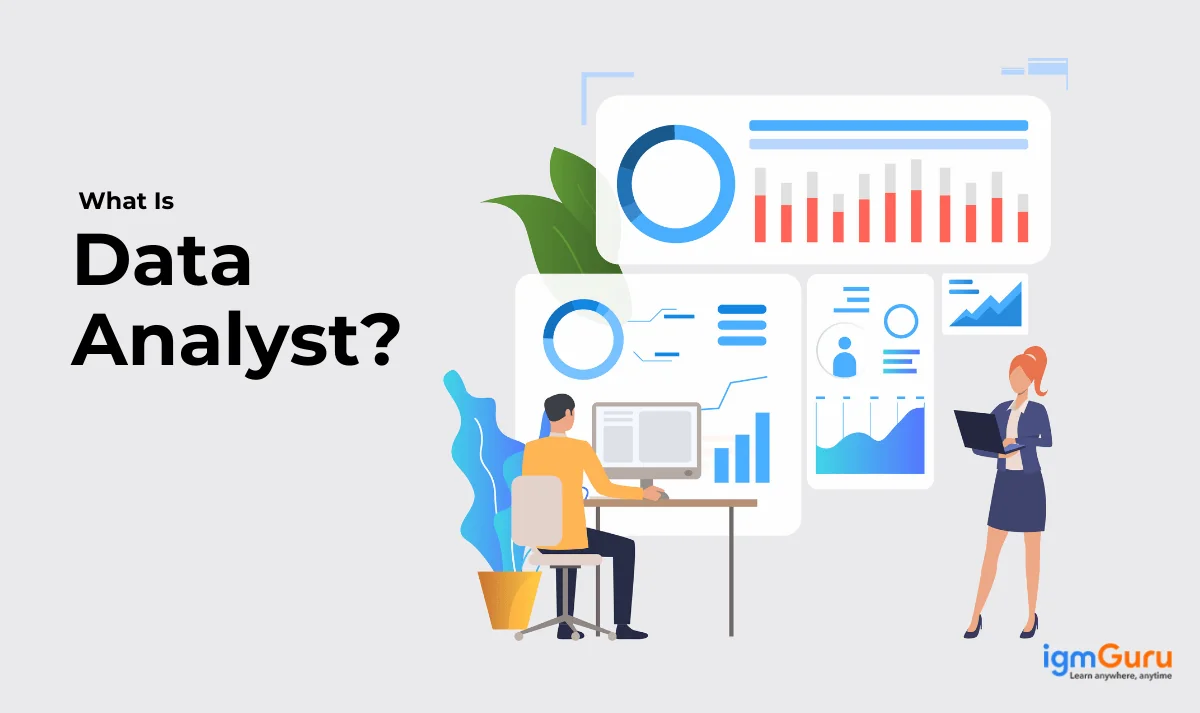
Businesses everywhere are flooded with data but it is meaningless without someone to make sense out of it. Data analysts are here for the rescue but what is a data analyst? They simplify tricky information so companies can make smart choices. Companies are actively looking for these skilled experts to make sense out of all this big data around.
The job market for data analysts is expected to grow a lot. This shows how important data has become for businesses. These folks are receiving the spotlight today but that also calls for an answer to a lot of questions. Understanding these professionals better needs lots of learning and this guide covers exactly that.
Explore igmGuru's Tableau Training Certification Course for better Career Possibilities in this field.
Let's go through an even more detailed answer to our question 'what is a data analyst'. Data analysts are professionals capable of entirely transforming the data into valuable and actionable information. They gather data or information from a wide variety of sources like social media platforms, websites, surveys and much more. They execute a complete process of analyzing and organizing the information once it's collected.
Organizations can take empowered decisions with the discovered patterns and trends. These experts utilize a number of data visualization tools like Excel, Power BI, SQL, etc., and statistical methods to achieve success. Businesses are strengthened through these insights, across different industries as mentioned below -
The success of a newly launched product depends on the demand of the customers. A product must meet their needs to survive in the market and become profitable. Data analysts highlight what features customers are looking for through analyzing the customer behavior. They come up with useful solutions to guide the product development process, enabling it to become a hit.
Data analysis is a useful process to highlight the weaker aspects in processes. This enhances improvement and promotes cost effectiveness.
Professionals help companies find out which customer segments are the most profitable. This way, businesses can tailor their marketing efforts and boost their return on investment.
One must understand the data lifecycle to get a grip of the data analyst profession. This section discusses the four steps in this process to sum up the tasks of an adept analyst.
The initial step is to gather data from diverse sources like customer surveys, sites, company databases or social media platforms.
The collected data typically consists of inconsistencies, errors or missing values which require to be addressed and fixed immediately. The gathered information must go through a proper correction process before it is utilized.
There are sufficient techniques, data visualization software, tools available for professionals to examine the data thoroughly to reveal concealed patterns and trends.
The discovered insights must be presented in a clarified and precise manner. A number of visual representations like graphs, charts, reports and dashboard are used to display this data.
Data analytics is a large field that has different areas of work. There is not one single type of data analyst but many. One can use their skills in many ways and learn about different things as a part of this interesting field. Here are some types of data analysts and their area of skills.
These analysts look at data about money and productivity. They convert data into usable solutions for business operations in a better way. Organizations beat competitors and make smart decisions based on the provided data. These professionals have solid numerical skills, expertise in data visualization, proficiency in querying languages and much more.
These folks study how people behave, how campaigns are doing and market trends. Their findings make marketing plans work better. A marketing analyst looks at data to boost a company's marketing. They guide decisions to increase sales or refine marketing campaigns. They have a great knowledge of computer science, mathematics or business. These experts generally have experience with marketing tools and mastery of SQL.
These professionals take data to make healthcare better. They gather and look at information from different places. This is a way to better patient care and healthcare systems to work well. They have knowledge of mathematics and statistics along with proficiency in data storage, data wrangling, data warehousing and mining.
These analysts look at how products are doing. They gather user feedback to boost product development and make customers happier. Product analysts exist to plan and develop products. They share important details about customers and markets. This includes pointing out how to improve products along the way. Their insights guide management on where to take the product and how to invest in it. They collect, measure and sort data with their math skills. They are familiar with programming languages and understand how to design databases and use data mining techniques.
They manage and analyze IT systems. They improve system performance and fix tech issues by gathering, cleaning and looking at data to answer questions or solve problems. These can be found in all kinds of fields like business, finance, law enforcement, science, medicine and government. These professionals are familiar with data analysis and data visualization tools. They have an in-depth Knowledge of machine learning technologies.
Read Also: How To Become A Data Analyst
Data analysts play a pivotal part in ultimately driving success among organizations. Here are some more points to perceive the importance of this profession -
These professionals work towards equipping businesses with relevant trends or patterns through data analysis, enabling them to expand their growth and eliminate risks.
They assist organizations to get a good grasp of what their customers prefer. This is achieved by analyzing customer data, enabling companies to deliver better services and products.
Data analysts assist companies to come up with effective and strategic decisions by providing them with actionable insights extracted from raw data.
They make sure that businesses remain in power in the market and adapt to evolving demands and trends.
These professionals deliver information which leads to enhanced product development, robust business models and other technologies.
Data analyst tools can make the most out of given data. These tools are for professionals of all kinds to analyze data and make better decisions. One must find the right tool to remain ahead in their career of data analytics.
Tableau is amongst the easiest data analysis tools in terms of both learning and using. It has a simple setup for quickly creating cool visuals and dashboards. Companies can change raw data into simple visuals right away. Technological background is not a must for using this tool.
This tool has smart features and visuals to analyze data in minutes and pick out insights. Its user interface is simple for learners to start with. It works well with other Microsoft products and one can connect it to Excel sheets, online databases and even local data sources.
Apache Spark is really fast for data processing and analysis. Its memory processing makes certain processes faster. It's a trustworthy platform that handles big amounts of data. It's easy to learn as it has an user friendly API. It works well with distributed computing as well.
This tool by Google analyses data and supports machine learning. It adds machine learning to a company's task easily. This tool works with different coding languages. It can also run on GPUs and TPUs to make everything faster.
This tool by Apache stores and processes big data and is absolutely free. MapReduce is a method to break tasks into smaller pieces so they can be done at the same time. This is great for working with large sets of data. Hadoop can grow in accordance with the user's needs. It keeps running smoothly If one part of the system fails. It can handle different data formats without a problem.
Read Also: How to Become a Data Scientist
In India, the average salary for a data analyst can range around INR 6.99 Lakh per year, depending on experience. For those with less than a year of experience, it's on the lower end, while those with up to 6 years can earn more. Here is a table to display the average salary of these professionals based on different countries of the world -
| COUNTRIES | AVERAGE SALARY |
| USA | USD 82,663 |
| United Kingdom | Pound 30,353 |
| Germany | EURO 92,324 |
| Switzerland | CHF 130'104 |
| Netherland | EURO 82.080 |
Working in data analytics has its benefits and it's not going anywhere in the future. More and more data would be generated as technology grows and we spend more time online. This pushes more companies to choose data analytics and look for more modern knowledge workers called data analysts.
This statistics claims that most entry-level data analyst jobs need a bachelor's degree. Some companies want people with a master's degree in data analytics or something similar.
There is not one specific examination for this role. There are different approved courses and certifications offered by different companies. Certificates like Google data analytics professional certificate, IBM data analyst professional certificate, Microsoft certified: Power BI data analyst associate are great choices for learners.
Some analysts do have to code as part of their everyday work. Coding skills are not compulsory for such jobs.
Explore These Trending Articles
What Is Power BI Desktop? Everything You Need To Know
What is Data Science in Python in 2026? Complete Raodmap
What is Azure Databricks? Everything You Need to Know
What is PostgreSQL and What It Is Used For?
What is Cloud Computing? Everything You Need To Know
Couse Schedule
| Course Name | Batch Type | Details |
| Business intelligence Courses | Every Weekday | View Details |
| Business intelligence Courses | Every Weekend | View Details |