Snowflake is a cloud-based data and AI platform that enables organizations to store, manage, and analyze massive amounts of data. It is used to build data pipelines, train machine learning models, and create data-driven applications without managing underlying infrastructure. This makes it one of the best tools for businesses that find it challenging to work with large amounts of data.
It is a favorite tool among data engineers, analysts, and developers for its amazing performance, scalability, and cost-control features. If you want to learn or implement this tool in your business or skill set, you must start from the basics. This guide is all about the same. It explains what Snowflake is, how it works, and where it fits best. Basically, your perfect guide to get started with Snowflake.
Snowflake is a cloud-based data warehouse platform that is designed to store, process, and analyze large volumes of data with high performance and scalability. It is a fully managed SaaS platform that separates storage, compute, and cloud services. It enables organizations to scale resources independently according to workload needs.
Snowflake supports both structured and semi-structured data, and it works across multiple cloud providers, including AWS, Azure, and Google Cloud. It is widely used for data analytics, business intelligence, data engineering, and machine learning, enabling teams to run complex queries without managing infrastructure.
Explore igmGuru's Snowflake Course program to become an analyst in a cloud platform.
Snowflake was founded in 2012 by Benoit Dageville, Thierry Cruanes, and Marcin Żukowski to build a data warehouse platform designed specifically for the cloud. Unlike traditional on-premise systems, Snowflake was created to take full advantage of cloud scalability and performance.
The company gained strong adoption among enterprises and went public in September 2020, marking one of the largest software IPOs at the time. Since then, Snowflake has continued to evolve by expanding its platform to support data engineering, analytics, and machine learning use cases across multiple cloud environments.
Snowflake is used for storing, processing, and analyzing large datasets in an environment. It enables scalable data warehousing, analytics, business intelligence, data engineering, and AI/ML across cloud platforms. Here are the main uses of Snowflake.
Structured and semi-structured data gets streamed into the business from various sources. Data ingestion at a considerable speed can be a hectic task because of the influx of data. Data sets that need continuous ELT or ETL of the data are also becoming challenging.
Snowpipe's service offers continuous data ingestion. It thus enables companies to load the data from outside storage locations like S3, Azure Blob, and GCP (Google Cloud Platform) bucket immediately upon becoming available to stage. Employing auto ingest as well as configuring cloud provider notification facilitates continuous data loading in tables.
Many enterprises use Machine Learning algorithms to make predictions around data. Feature engineering needs data engineers for building, testing, and picking apt attributes for ML models. The real challenge after models are deployed is a huge quantity of clean, historical, and new data. This ensures ML model accuracy. Its zero-copy cloning feature copies complete data sets to support every experiment.
Apache Spark can be utilized as well as directly integrated with this platform. This helps quickly prepare data and build Machine Learning models. It supports programming languages like Python, Java, C++, and R.
Data security and governance play an important role in a company's sensitive data. It can be challenging and cumbersome to safeguard the data from internal and external data breaches with a traditional data warehouse. This platform supports unprecedented connectivity with many third-party data governance tools. These include Collibra, Immuta, Informatica and others. It helps in protecting the data and inserts data access controls with policies.
Snowflake is widely used as a cloud data warehouse to store and manage large volumes of structured and semi-structured data. It allows organizations to scale storage and compute independently, ensuring high performance without managing infrastructure.
Snowflake supports fast analytical queries, making it ideal for reporting and business intelligence. Teams can run ad-hoc SQL queries and connect BI tools like Power BI and Tableau to gain real-time insights.
Snowflake is commonly used for ELT processes, where raw data is loaded first and transformed later. This simplifies data pipelines and supports efficient data processing at scale.
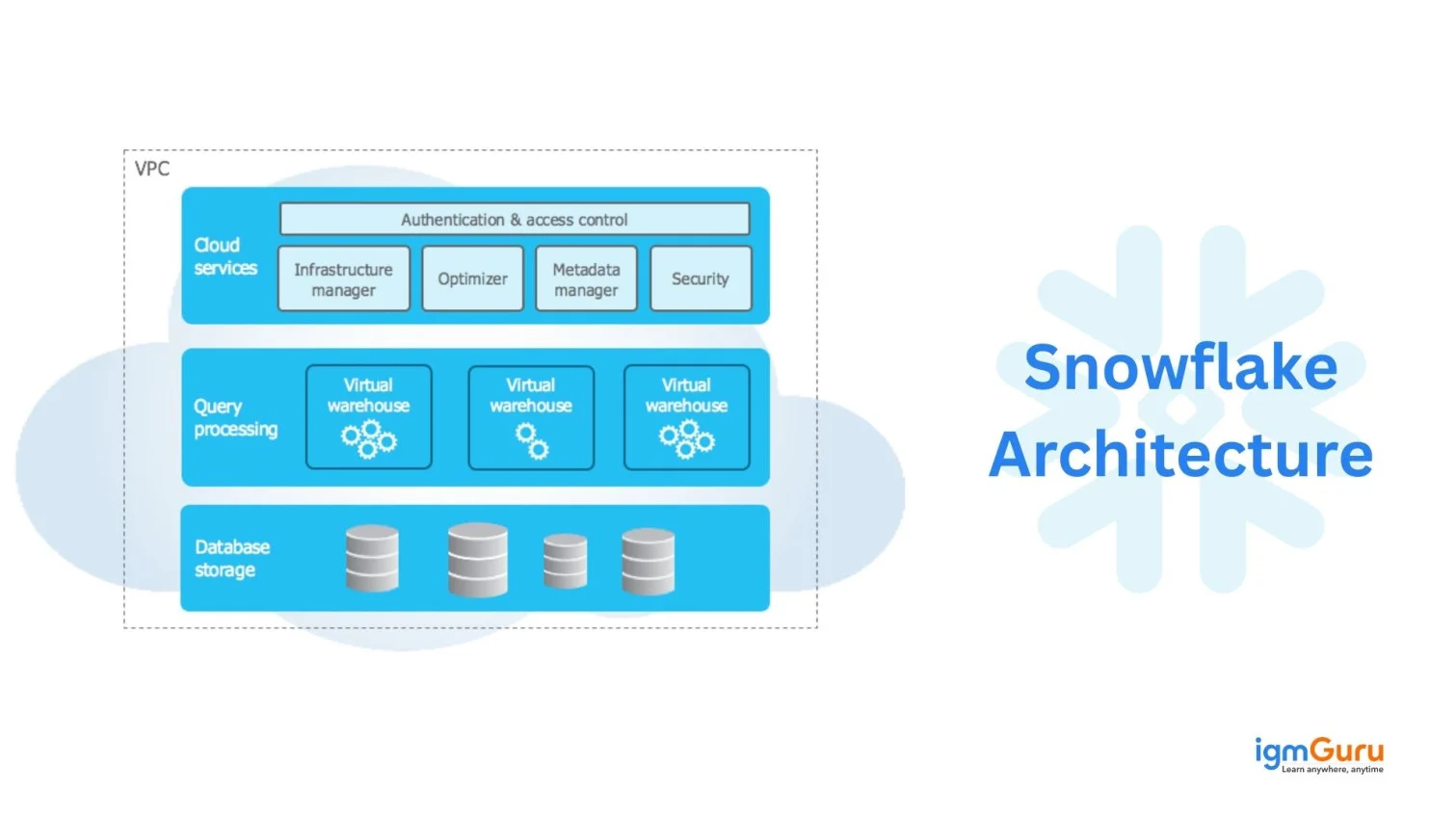
How Snowflake works is a valid question that's often asked. The answer is simply a result of its unique architecture. It works on a cloud-native architecture that clearly separates storage, compute, and cloud services to optimize performance and cost while supporting data modernization. Its core characteristics are-
First, all data is stored centrally in cloud storage that allows it to scale automatically as data grows. When a user runs a query, Snowflake uses virtual warehouses to process that request, ensuring queries run independently without resource conflicts.
The cloud services layer handles tasks like authentication, metadata management, and query optimization in the background.
This approach allows Snowflake to deliver fast performance, handle multiple workloads at the same time, and optimize costs by using resources only when they are needed.
Related Article- What Is Google Cloud Platform
The long list of Snowflake features is what makes this platform so widely accepted. Here are the ones to learn about-
Its innovative data-sharing prowess empowers the sharing of live and updated data with internal and external partners. It all happens efficiently and securely. It breaks down data silos to foster a highly collaborative environment for informed decision-making.
Its groundbreaking elasticity ensures that resources are optimally aligned with business requirements. Be it long-term growth or sudden spikes in demand, its elastic scaling is brilliant. It delivers amazing performance without pinching the pocket.
Its zero-copy cloning feature is what makes creating, testing, and deploying data environments a breeze. All this happens without any impact on the performance or storage. Running experiments, troubleshooting issues and developing new features make zero-copy cloning apt for maximum agility and efficiency.
Its exceptional integration capabilities and compatibility help unlock the true potential of a data stack. One can connect seamlessly with plenty of popular ETL, data visualization and BI tools. It empowers businesses to utilize preferred cloud providers with its cloud-agnostic architecture.
Related Article- Google Cloud Platform Interview Questions
Snowflake supports Multi-Cluster Virtual Warehouses that automatically add or remove compute clusters based on query demand. This helps maintain consistent performance even when thousands of users run concurrent workloads. Organizations can isolate workloads for different teams while using auto-suspend and auto-resume features to optimize infrastructure costs.
Time Travel enables users to recover data that has been accidentally modified or deleted by accessing previous versions of databases, schemas, and tables. After the Time Travel retention period ends, Snowflake's Fail-safe feature provides an additional recovery layer for disaster recovery scenarios, making data protection more reliable.
Snowflake allows developers to build and deploy native applications directly within its platform through the Native App Framework. Combined with Snowpark Container Services, developers can run containerized workloads, custom applications, and AI models without moving data outside the Snowflake environment, improving security and simplifying application deployment.
Snowflake supports Apache Iceberg tables, allowing organizations to work with open table formats while maintaining centralized governance. This improves interoperability between Snowflake and other modern analytics engines, making it easier to build flexible lakehouse architectures without vendor lock-in.
Snowflake now includes built-in AI capabilities through Cortex services. Developers can use large language models, vector search, document processing, and AI-powered SQL functions directly within the platform without managing separate AI infrastructure. This enables organizations to build generative AI and intelligent analytics applications while keeping their data secure.
Snowpark serves as an adaptable developer environment within Snowflake. It is curated to deploy non-SQL code securely and with ease. Developers are free to work in their chosen programming language as a wide variety of languages are supported by Snowpark, including Scala, Python and Java. It also comes with useful libraries that make it easier to write queries and handle data transformations using DataFrames, which lets you take advantage of Snowflake's powerful processing capabilities.
DataFrame API is one of the primary features of Snowpark as it directly simplifies Machine Learning training execution along with systematic scaling of feature engineering. Snowpark also has a Model Registry, which acts as a central place for all your ML models, making MLOps a lot smoother and more efficient.
Developers can create User-Defined Functions (UDFs) in Snowflake to execute their own Python, Scala and Java code, which can include things like machine learning models they've trained or business logic There's also an Anaconda repository built in, making it easy to access a lot of open-source libraries.
Furthermore, it enables the deployment and running of container images in Snowflake-managed infrastructure through Snowpark Container Services. Snowpark makes it easier to run DataFrame operations and custom code on a set schedule and at scale.
When answering the question 'What is Snowpark?', it's important to tap into the benefits of Snowflake too. Let's see some perks companies enjoy with this data warehouse.
It is a cloud data warehouse. In short, one doesn't have to invest in any expensive hardware for storing and analyzing data.
Users can easily create an unlimited number of virtual warehouses. Each one could run its own workload as opposed to the data in its DB. The quantity of nodes in each cluster can be resized quickly and easily for optimal performance. Connectivity is improved and database storage is optimized.
This data warehouse comes with many top industry-oriented data security features. This includes multi-factor authentication, automatic 256-bit AES encryption and IP allow and block lists. This platform is also compliant with data security standards like HIPAA, GDPR, SOC 1, PCI DSS, and SOC 2.
Built-in automatic query performance optimization is included through a query optimization engine. Users do not even need to manually change the settings.
Control who gets access to sensitive data. This prevents even insiders from viewing any sort of confidential information.
Snowflake has its perks, but there are a few things to watch out for:
Their pay-as-you-go pricing is flexible, but you really need to keep an eye on spending, especially if you're running heavy computations.
Being able to switch between different cloud providers is great, but it also means you have to think about how it works with your overall cloud strategy, especially when looking at options that are built into specific cloud services.
Snowflake uses its own SQL extensions and platform-specific features. While it supports standard SQL, moving complex workloads or logic to another data warehouse later can require significant rework.
Snowflake is fully managed, which is great for simplicity, but it also means you don’t have control over the underlying hardware, OS, or tuning at a low level. This can be restrictive for teams that need deep system-level customization.
Although Snowflake handles scaling automatically, performance tuning is mostly abstracted. You cannot directly see or fine-tune how resources are allocated internally, which can make troubleshooting performance issues less transparent.
Although Snowflake is one of the leading cloud data platforms, it is not the perfect solution for every workload. Organizations should understand its limitations before adopting it for large-scale projects.
Snowflake follows a consumption-based pricing model where compute resources are billed while virtual warehouses are running. Poor warehouse sizing, inefficient SQL queries, or forgotten running warehouses can significantly increase operational costs if resource usage is not monitored properly.
Snowflake is a fully managed platform, meaning users cannot configure the underlying operating system, storage engine, or hardware. While this reduces administrative effort, it may not suit organizations that require deep infrastructure customization or low-level performance tuning.
Features such as Snowpark, Cortex services, and Snowflake-specific SQL capabilities provide powerful functionality but can make migration to another data platform more challenging. Organizations using these advanced capabilities should consider long-term portability during architecture planning.
Snowflake is optimized for analytical workloads rather than high-volume online transaction processing (OLTP). Applications requiring thousands of small transactional updates every second are generally better suited to traditional relational database systems.
Basic data warehousing tasks are relatively easy to learn, but advanced capabilities such as Snowpark, Streams, Tasks, Dynamic Tables, Cortex AI, and data sharing require a deeper understanding of cloud architecture and modern data engineering concepts.
Here are the main differences between Snowflake and a few other well-known data warehouses.
| Distinctions Based on Factors | Snowflake | Amazon RedShift | Azure Synapse |
| Data Types | Structured and semi-structured | Structured and semi-structured | Structured and semi-structured |
| Architecture | Hybrid | Shared-nothing MPP | MPP |
| Data Backup and Recovery | Yes | Yes | Yes |
| Database Model | Relational | Relational | Relational |
| Deployment | Cloud-based | Cloud-based | Cloud-based |
| Cost | Payment for storage and computing time | On-demand or Reserved instances | Payment for storage and computing time |
| Analytics Ecosystem | Supports the main BI tools and data analytics | AWS Quicksight for Business Intelligence and other BI tools integration. | Power BI for business and Azure ecosystems for analytics. |
| Maintenance | Fully managed | Fully managed | Needs manual maintenance |
| Scalability | It automatically adds or removes nodes. This allows users to manage and scale storage on their own. | Check the RA3 nodes and separate the storage. | You'll need more storage for the dedicated option, but the serverless option takes care of it automatically. |
| In-memory capability | No | Yes | Yes |
Snowflake pricing follows a flexible pay-as-you-use model where you pay separately for compute and storage based on actual consumption. Here is the table explaining the pricing of Snowflake.
| Pricing Component | How It Is Charged | Approximate Cost |
| Compute (Credits) | Charged per second while virtual warehouses are running | $2-$4 per credit |
| Storage | Charged monthly based on compressed data stored | $23-$40 per TB/month |
| Cloud Services | Metadata, query optimization, and authentication | Included (limited free usage) |
| Data Transfer (Same Region) | Data movement within the same cloud region | Free |
| Data Transfer (Cross-Region / Cross-Cloud) | Moving data across regions or clouds | Cloud provider rates apply |
| Standard Edition | Basic data warehousing features | Lowest cost tier |
| Enterprise Edition | Advanced performance & governance | Higher than Standard |
| Business Critical Edition | High security & compliance | Premium pricing |
| Virtual Private Snowflake | Dedicated isolated environment | Custom pricing |
Snowflake's capabilities are implemented across diverse fields worldwide. This makes it a versatile tool for multiple use cases. Let's discuss the top six Snowflake use cases.
Semi-structured and structured data workloads such as data science, lakes, warehousing and engineering are supported by Snowflake. This factor makes it an ideal choice for artificial intelligence and machine learning applications. For example, Snowflake is implemented in healthcare organizations for trend research. This enhances the patient outcomes by detecting conditions and other environmental factors.
Snowflake ensures data security by offering role-based access and enabling users to limit available fields with Secured Views or mask PII data. This maintains adherence to governance standards along with ensuring that teams can view the needed data to perform tasks.
Snowflake's robust cloud data warehouse permits users to save time and utilize it on analyzing data. This makes it a go-to tool for Business Intelligence (BI) and analytics. For example, organizations can analyze reward programs. Retail sales and understanding seasonal impacts with Snowflake.
The massive amount of business settings consists of session data, which can be handled by Snowflake with ease. For instance, transaction data comes in great quantities in the retail environment. With Snowflake, it's easy to address and resolve problems like backups, role-based access and abstraction.
Snowflake supports ACID-compliant transaction processing to capture and analyze streaming data in near real-time. A financial institution can use Snowflake to process and analyze high volumes of transactional data in real-time. This enables them to detect fraudulent activity quickly and take immediate action.
'What is Snowflake' is quite an important question to get started in this field. There are many things that data has done and one of them is creating numerous job opportunities. As data warehouses like this one grow in popularity, the demand for its professionals grows too.
Snowflake is a database. An enterprise's uploaded semi-structured and structured data sets are compiled here for processing and analysis.
It supports transformation both during (ETL) and after (ELT) loading.
Snowflake was originally built as a cloud data warehouse, but it has evolved into a cloud-native data platform that supports both data warehousing and data lake workloads. With features like Apache Iceberg support, Snowpark, and native AI capabilities, organizations can store, process, and analyze structured and semi-structured data within a single platform.
Snowflake is available on the three major cloud providers: Amazon Web Services (AWS), Microsoft Azure, and Google Cloud Platform (GCP). Its cross-cloud architecture allows organizations to deploy workloads on their preferred cloud provider while securely sharing data across different cloud environments.
Snowflake primarily uses SQL for querying and managing data. However, through Snowpark, developers can also build applications and data pipelines using Python, Java, Scala, and JavaScript. This enables teams to perform data engineering, machine learning, and application development directly within the Snowflake platform.