Nowadays, data has become a crucial thing in every field and is relevant everywhere. Whether it is making informed decisions, driving innovation and improving many aspects of life from business to healthcare. Data scientists are basically problem solvers who provide insights to businesses. They are very much in demand due to their skills to work with data for understanding and explaining the situation at hand. Also, their research makes better decisions for the companies. So, how do we become one? This blog will completely guide you on how to become a data scientist, what they do, the skills needed and so much more. So let's start!
Data scientists are those experts who mix statistical analysis, programming skills and domain expertise for deriving meaningful insights. They extract important insights from large datasets and change raw data into actionable information. Then, further those insights are used for making business decisions and solving complicated issues across different companies.
So what is a data scientist now? They are a blend of mathematicians, computer scientists and trend spotters. These experts identify patterns and predict future outcomes through data.
You might wonder about the next question that comes to our minds: What does a data scientist do? So basically, they control the questions their team should be asking and figuring out how to answer those questions through data. These experts extract insights and knowledge through data. This is for businesses, nonprofits and other organizations for better decisions as per the company's needs. They combine code with statistics to change data.
Their role is a bit complicated, as they concentrate on deriving practical insights to inform business decisions. Read on to understand what data scientists do:
The major skills required to become a data scientist are technical skills like maneuvering and wrangling huge amounts of data. Skills like interpersonal skills are also important, as data scientists work in collaboration with business analysts to conduct analysis and communicate with the stakeholders. Here are the essential skills required to become a data scientist while embarking on this journey.
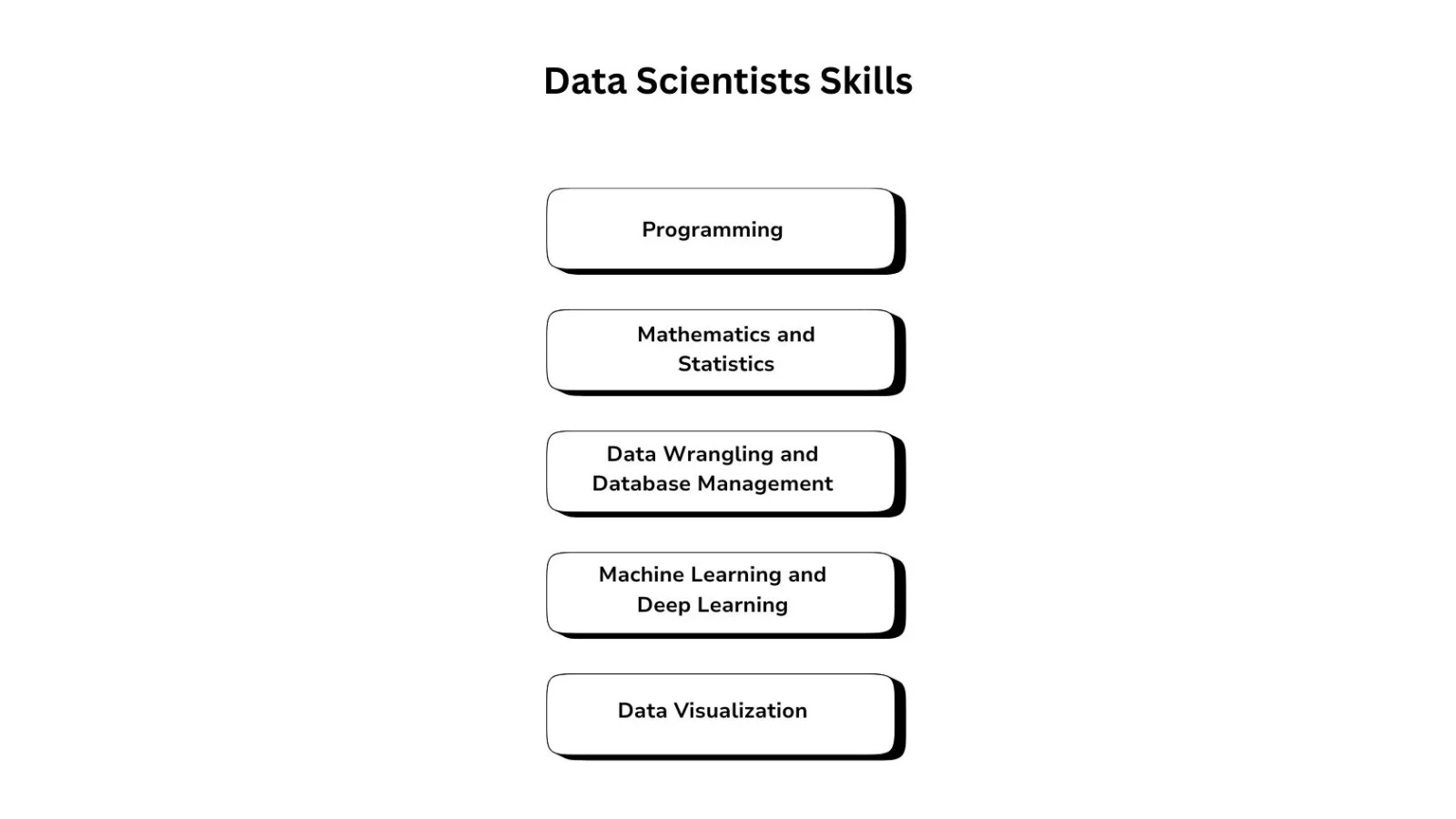
Programming languages like Python or R are required for data scientists for sorting, analyzing and managing huge amounts of data. As a fresher, you must know the basic concepts of data science and familiarize yourself with Python. Other popular programming languages include Python, R, SAS, and SQL.
To write high-quality machine learning models and algorithms, they need to learn statistics and mathematics. In machine learning, it is important to use statistical analysis concepts like linear regression. They need to be able to collect, interpret, organize and present data. These skills are needed for completely comprehending concepts like mean, mode, median, variance and standard deviation. The different types of statistical skills one should know are probability distributions, over and undersampling, bayesian and frequentist statistics, and dimension reduction.
It is the procedure of cleaning and organizing complicated data sets to make them easier to access and analyze. Manipulating data to differentiate it by patterns and trends, and for correcting any input data values can lag but is important for making data-driven decisions. This is also connected to understanding database management. Data scientists are expected to extract data from various sources and change it into a suitable format for queries and analysis. After the data is extracted, one is expected to load it in a data warehouse system.
Data scientists must immerse themselves in machine learning and deep learning. These techniques will keep improving as you will be able to collect and synthesize data more beneficially. These experts need to predict the outcomes of future data sets while incorporating these techniques. One can boost up their knowledge by including more sophisticated models like Random Forest. Some machine learning algorithms one needs to know are linear regression, logistic regression, random forest algorithm, etc.
Not only do these experts need to know how to analyze, organize and categorize data, but one need to build their skills in data visualization. Creating charts and graphs is important for becoming a data scientist. Through visualization skills, you can represent their work to stakeholders so that the data tells a compelling story of the business insights. One needs to be familiar with tools like Tableau, Microsoft Excel and Power BI.
Read Also: Data Science Tutorial for Beginners
As we read that data Science has become one of the most in-demand careers all over the world. Whether you're in India or the USA, industries are hiring skilled data scientists for analyzing data, building models and making data-driven decisions. Now, you might be wondering, 'How do I become a data scientist?' This complete roadmap will walk you through everything you need to know about how to become a data scientist.
A data scientist is someone who makes use of statistics, programming and domain knowledge to derive insights from data. They play a major role in industries like finance, healthcare, e-commerce and technology. Data scientists analyze large datasets to uncover patterns, build predictive models, and drive decision-making.
They use tools like Python, R, SQL and sometimes C++ for high-performance tasks, alongside skills in statistics, machine learning, and data visualization. They also need domain knowledge like in finance or healthcare to contextualize findings.
Their main responsibilities are:
There is not just one 'correct' path, but here are the most common options:
In India, many learners choose online courses as an affordable entry point. In the USA, employers usually value advanced degrees combined with hands-on experience.
A successful data scientist needs a blend of both technical and soft skills. Data science relies heavily on mathematics. Let us see what both these skills include:
Data scientists need to communicate insights effectively, they require soft skills such as:
Your portfolio is usually more important than your degree, as it needs to be impressive to get good jobs. There are ways in which you can improve your portfolio. So, here is how you can stand out:
As you know, projects represent your skills to employers. You can begin with datasets from Kaggle, UCI Machine Learning Repository, or public APIs, for instance you can: Analyze a retail dataset for predicting sales, or build a recommendation system for movies.
There are many internships and jobs you can apply for. Entry-level roles include data analyst, junior data scientist, or machine learning engineer. Tailor your resume to highlight projects, skills and certifications. Stay up to date with the latest tools and techniques, as data science evolves rapidly. Entry-level roles to look for:
Job Portals Famous in India: Naukri.com, LinkedIn, iimjobs, internshala
Job Portals Famous in the USA: LinkedIn, Glassdoor, Indeed
Read Also: Top 35 Data Science Interview Questions and Answers
Most learners often wonder how much time it takes to become a data scientist. Becoming one of them is totally realistic in 6 to 12 months if you follow a clear plan, stay consistent, and build real projects as you learn. Below is a month-by-month roadmap designed for beginners who want to go from zero to job-ready.
The data scientist profession is considered as one of the most valuable in the contemporary tech world and analytics. Not just in India, but it is pretty valuable on an international level too. They are a part of organizational teams that assist in translating huge datasets into useful information for planning and making decisions. Whereas the number of new jobs in skilled professions keeps on growing, people stay interested in potential pay while entering this realm. Let us take a look at the salary expectations of a data scientist in India and the USA.
| Profile/Role | Experience Level | Salary in India (per annum) | Salary in the USA (per annum) | Key Skills & Notes |
| Data Scientist | Entry-Level (0-2 years) | ₹6 - ₹12 Lakhs | $90,000 - $130,000 | Strong foundation in statistics, Python/R, SQL, and basic machine learning algorithms. |
| Mid-Level (3-7 years) | ₹15 - ₹30 Lakhs | $130,000 - $180,000 | Advanced machine learning, data visualization tools (Tableau, Power BI), and big data technologies (Spark). | |
| Senior-Level (8+ years) | ₹35 - ₹70+ Lakhs | $180,000 - $250,000+ | Expertise in deep learning, NLP, strategic thinking, and team leadership. Often involves managing projects and mentoring junior scientists. | |
| Machine Learning Engineer | Entry-Level (0-2 years) | ₹7 - ₹15 Lakhs | $100,000 - $140,000 | Proficiency in programming (Python), software engineering principles, and implementing ML models. |
| Mid-Level (3-7 years) | ₹18 - ₹35 Lakhs | $140,000 - $200,000 | Experience with MLOps, cloud platforms (AWS, Azure, GCP), and scaling machine learning models. | |
| Senior-Level (8+ years) | ₹40 - ₹80+ Lakhs | $200,000 - $300,000+ | Architectural design of ML systems, research and implementation of cutting-edge algorithms. | |
| Data Analyst | Entry-Level (0-2 years) | ₹4 - ₹8 Lakhs | $60,000 - $80,000 | Strong SQL, Excel, and data visualization skills. Focus on descriptive and diagnostic analytics. |
| Mid-Level (3-7 years) | ₹8 - ₹15 Lakhs | $80,000 - $110,000 | Advanced SQL, Python/R for data analysis, and experience with BI tools. | |
| Senior-Level (8+ years) | ₹15 - ₹25+ Lakhs | $110,000 - $150,000+ | Leading analytics projects, mentoring junior analysts, and providing strategic insights. |
Your geographical location plays a crucial role in determining your salary due to differences in the cost of living and the concentration of tech companies.
High-Paying Cities: Bengaluru, Mumbai, and Gurugram/NCR are the top-paying cities for data scientists in India, offering salaries that can be 20-30% higher than the national average.
Other Major Hubs: Cities like Hyderabad, Pune, and Chennai also offer competitive salaries and a growing number of opportunities in the data science field.
Top-Tier Cities: San Francisco/Bay Area, Seattle, and New York City offer the highest salaries, often exceeding the national average by a significant margin to compensate for the high cost of living.
Emerging Tech Hubs: Cities like Austin, Boston, and Chicago are becoming prominent tech hubs with a strong demand for data scientists and offer competitive compensation packages.
This guide, How to Become a Data Scientist, gives a structured path for mastering the critical concepts and skills needed for becoming a data scientist. Remember that data science is dynamic and so staying updated with trends and technologies is the key. Attaining real-life experiences via projects and internships will uplift your skills and credibility. The foreign demand for data scientists is on the rise and is offering profitable salaries and impactful work opportunities.
You can still become a data scientist by learning core skills like Python, SQL, statistics, and machine learning. Many people transition from fields like math, economics, or engineering with the right training and projects.
It depends on your starting point. With focused effort, a beginner can take 12-18 months to become job-ready, while someone with related experience might take less time.
A degree helps, but it’s not mandatory. Many employers value practical skills, projects, and problem-solving ability more than formal qualifications.
Yes, coding is important. Python is the most commonly used language in data science.
Course Schedule
| Course Name | Batch Type | Details |
| Data Science Courses | Every Weekday | View Details |
| Data Science Courses | Every Weekend | View Details |