C programming interviews are designed to test not only a candidate’s knowledge of syntax but also their understanding of programming concepts such as memory management, pointers, data structures and problem solving ability.
From my experience of both taking interviews as a candidate and conducting interviews as an interviewer, I have seen that strong candidates are those who can clearly explain concepts, write clean code and think logically through real world scenarios. C remains a foundational language in computer science, so interview questions often focus on fundamentals like pointers, memory allocation, structures and program behavior.
In this blog, I have compiled the most commonly asked C programming interview questions for freshers, intermediate developers and experienced professionals with practical scenario based questions.
Test Your C Programms with Online C Compiler
The following are some questions that will test your basic knowledge on C Programming:
C is a general-purpose programming language used to write computer programs. Developed by Dennis Ritchie in the early 1970s at Bell Labs. It is widely used as it is fast, powerful and efficient. Many operating systems and software programs are written in C.
C is called a mid-level programming language because it has features of both low level and high level languages. It can work closely with hardware like low level languages and is also easy to write and understand like high level languages.
The individual elements of a program are known as Tokens. The following 6 types of tokens are available in C:
For example:
|
In this, the tokens are: int, a, =, 10, ;
In C programming, variables store data values. A variable must first be declared to specify its name and data type. Initialization assigns an initial value to the variable when it is created.
| Parameters | Declaration | Initialization |
| Definition | Declaration means specifying the name and data type of a variable. | Initialization means assigning an initial value to a variable when it is created. |
| Purpose | It tells the compiler to reserve memory for the variable. | It gives the variable a starting value to work with in the program. |
| Value Assignment | In declaration, the variable does not necessarily have a value. | In initialization, the variable is given a value immediately. |
| Syntax Example | int a; | int a = 10; |
| Usage | Used when you only want to declare the variable first and assign a value later. | Used when you want the variable to start with a specific value at the time of declaration. |
C does not support function overloading because it identifies functions only by their names, not by their parameter lists. This means that in C, every function name must be unique within a scope.
A built-in function is a predefined function already available in C libraries. These functions help perform common tasks so programmers do not need to write them from scratch.
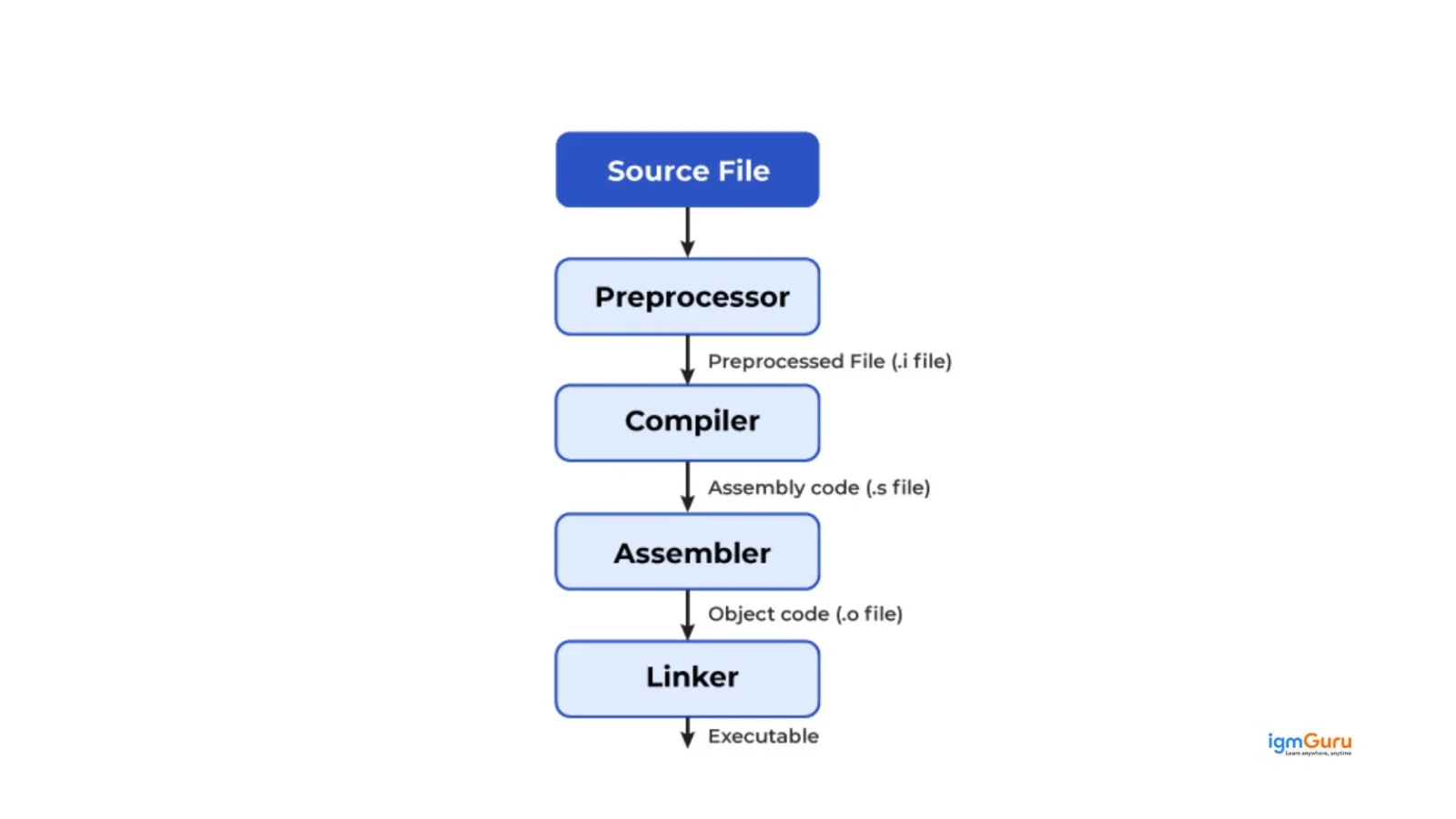
A preprocessor is a software program that processes a source file before sending it to be compiled. Inclusion of header files, macro expansions, conditional compilation and line control are all possible with the preprocessor.
Keywords are reserved words in C that have a special meaning and cannot be used as variable names.
For example:
The original C language defined 32 keywords.
Storage classes define the scope, lifetime and visibility of variables in a program.
Recursion is a process where a function calls itself to solve a problem. It is usually used for problems that can be broken into smaller parts.
For example:
|
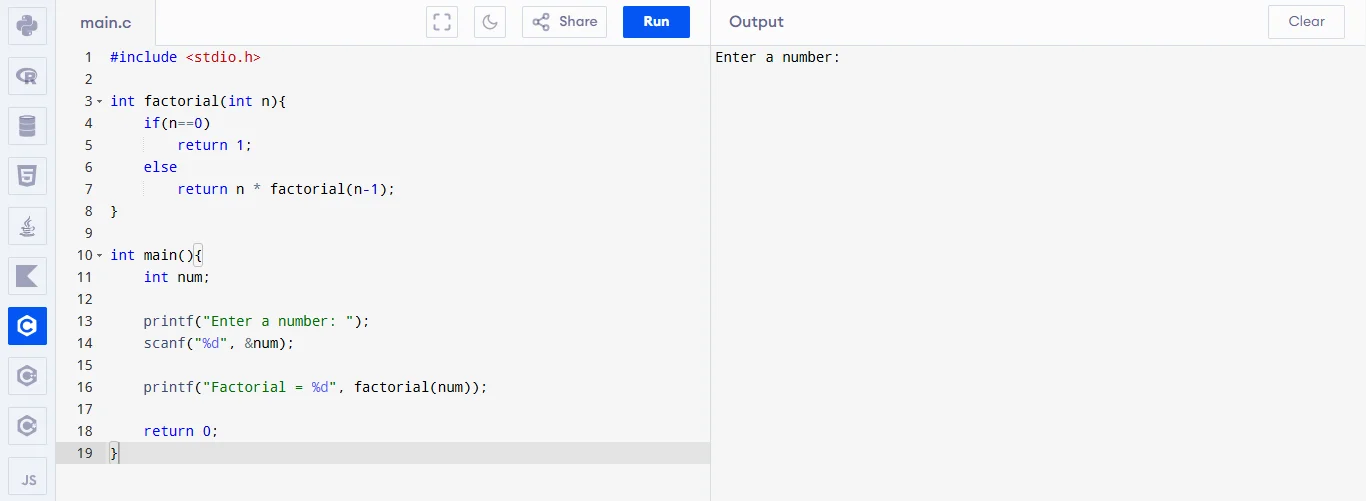
Code Explanation:
Read Also: Java Tutorial for Beginners
Following intermediate questions helps a recruiter to check if the candidates are ready to work independently and handle moderately complex tasks:
Dangling pointer is a pointer that points to a memory location that has already been freed or deleted. Accessing this pointer can lead to undefined behavior such as crashes or unexpected results.
Example:
|
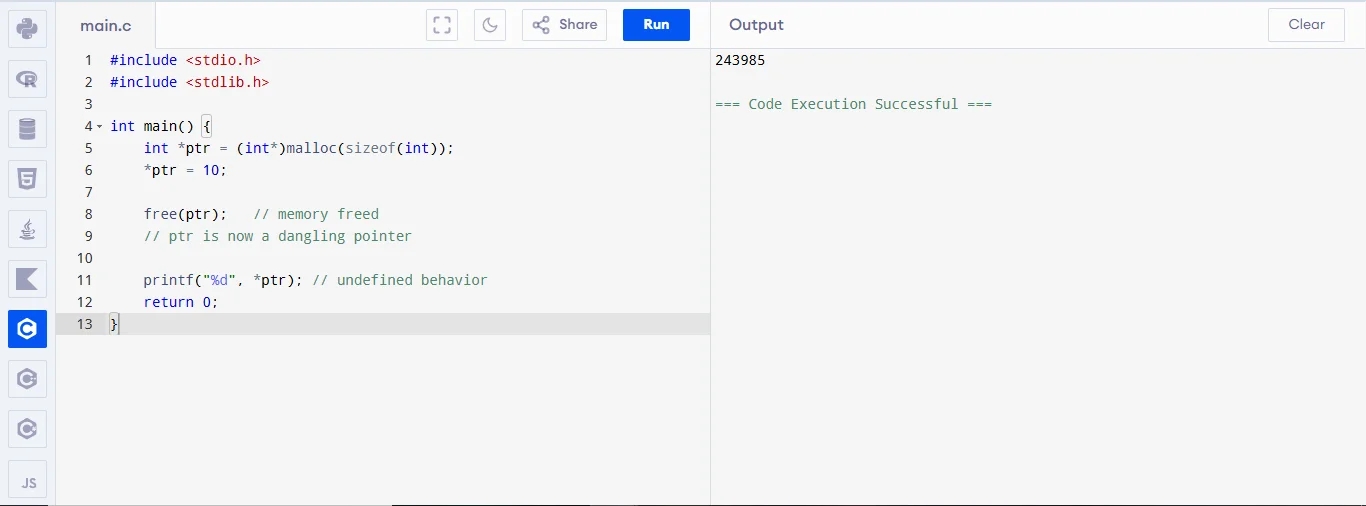
In C programming, pointers are variables that store the memory address of another variable. Using pointers, we can directly manipulate data in memory.
Reversing a string using pointers means we swap characters from the beginning and the end of the string using pointer variables instead of array indexing. This approach demonstrates how pointers move through memory and modify values efficiently.
Program:
|
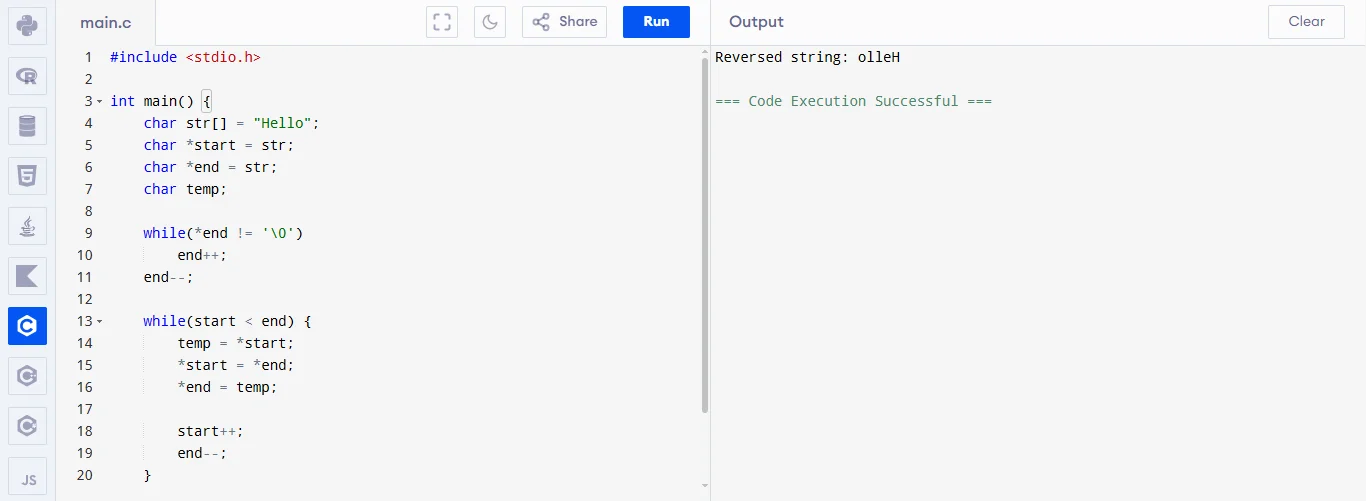
Pointer arithmetic refers to operations performed on pointers such as incrementing, decrementing, adding, or subtracting integers.
When a pointer is incremented, it moves to the next memory location of its data type size.
Example:
|
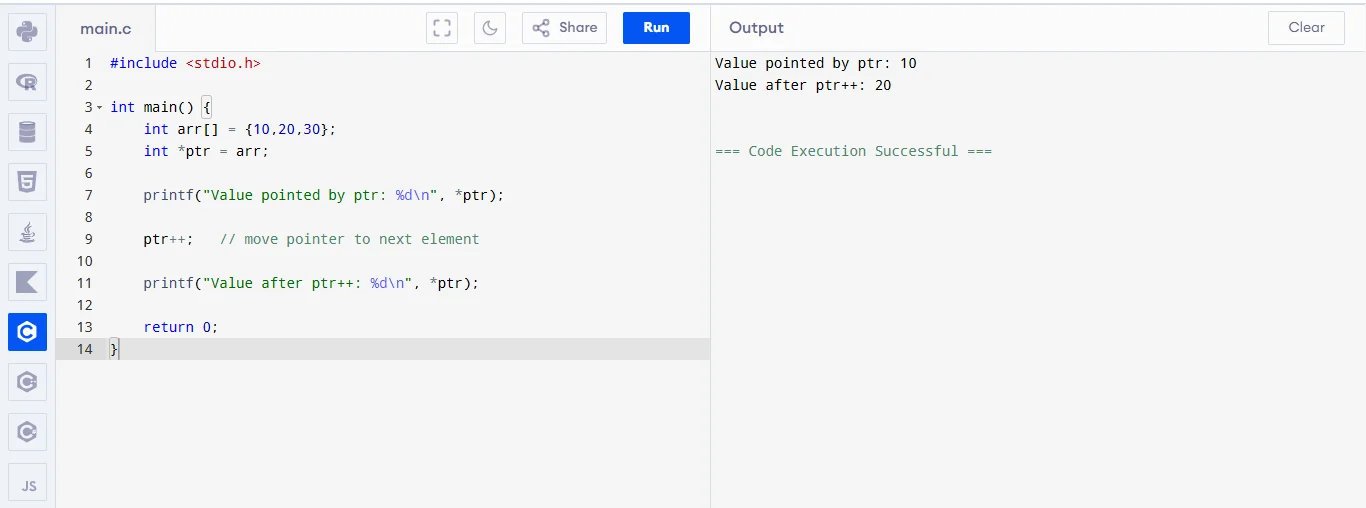
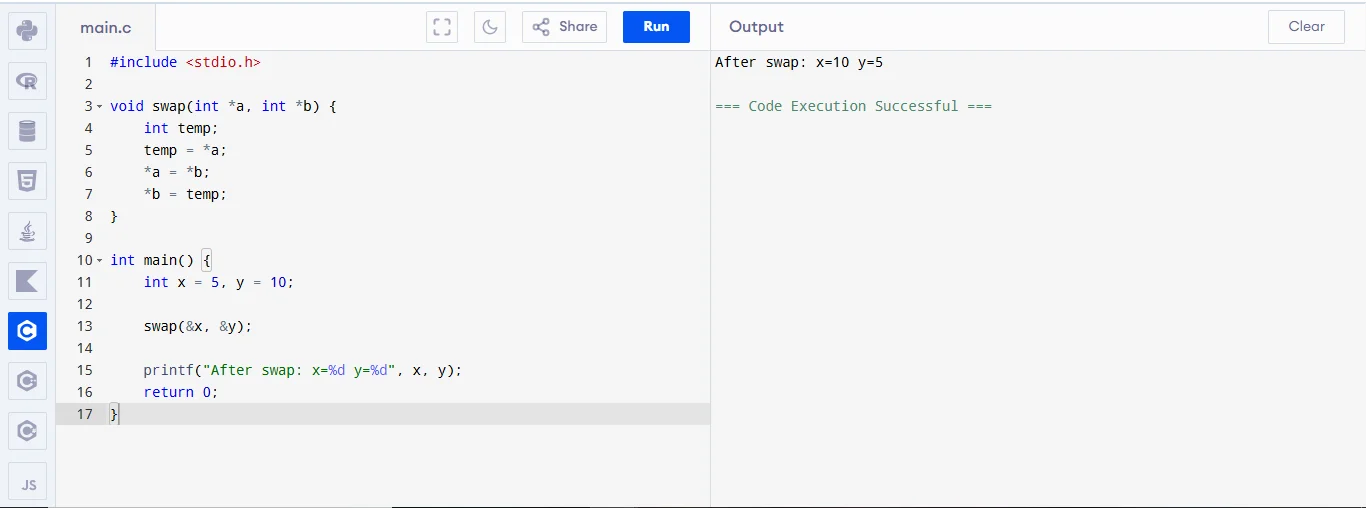
Swapping two numbers using pointers in C demonstrates how pointers can access and modify variables through their memory addresses. Instead of returning values, the function directly changes the original variables by passing their addresses. This method is efficient and commonly used to understand pointer concepts and parameter passing in C programming.
Program:
|
A function pointer in C is a pointer that stores the address of a function instead of a normal variable. It allows you to call a function indirectly using the pointer. Function pointers are useful when passing functions as arguments to other functions or implementing callbacks. They make programs more flexible and reusable. For example, a pointer can store the address of a function and later execute it using that pointer, just like calling the function normally.
Structure padding is the extra memory added by the compiler inside a structure to align data in memory properly. It helps the CPU access data faster and more efficiently. Because different data types require different memory alignment, the compiler may insert unused bytes between structure members. This increases the overall size of the structure but improves performance. For example, if a char and an int are in a structure, padding may be added between them.
A static variable inside a function is a variable that keeps its value between function calls. Normally, local variables are created and destroyed every time the function runs. But a static variable is created only once and retains its previous value when the function is called again. It is only accessible inside that function but remembers its last stored value. Static variables are often used when a function needs to track how many times it has been called.
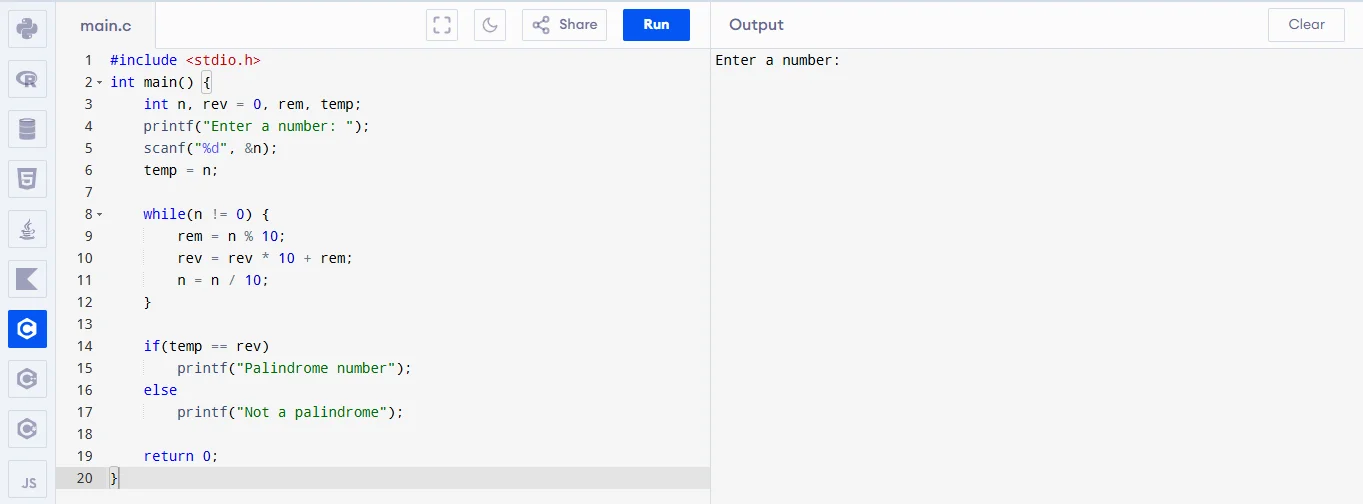
Palindrome number is a number that reads the same forward and backward, like 121 or 1331.
Program:
|
If free() is not used after malloc(), the memory allocated dynamically will not be released back to the system. This causes a memory leak, which means the program keeps using memory even when it no longer needs it. Over time, this can reduce available memory and slow down the system, especially in large or long-running programs. Therefore, it is important to always free dynamically allocated memory when it is no longer required.
A pointer to pointer is a pointer that stores the address of another pointer. In other words, it points to a pointer variable instead of a normal variable. It is declared using two asterisks (**). Pointer to pointer is useful when you want to modify a pointer inside a function or work with dynamic memory structures. For example, if p is a pointer to an integer, then pp can store the address of p.
Read Also: Java Interview Questions and Answers
Following question are for those candidates who have 5+ years of work experience:
The memory layout of a C program shows how memory is divided when a program runs. It usually contains text segment, data segment, BSS segment, heap and stack. The text segment stores compiled code. The data segment stores initialized global and static variables, while BSS stores uninitialized ones. The heap is used for dynamic memory allocation using malloc() and free(). The stack stores function calls, parameters and local variables. This layout helps manage memory efficiently during program execution.
A shallow copy copies only the reference or address of the original data, not the actual content. It means both variables point to the same memory location. If one changes the data, the other is affected. A deep copy, on the other hand, copies the actual data into a new memory location. Each variable has its own separate copy of the data. In C, shallow copy can happen when copying structures with pointers, while deep copy requires manually allocating memory and copying the contents.
Undefined behavior in C occurs when a program performs an operation that the C standard does not define. This means the compiler may produce unexpected results, crashes, or different outputs on different systems. Examples include accessing an array out of bounds, using uninitialized variables, dividing by zero, or modifying a variable multiple times in one expression. Since the behavior is not defined, the compiler does not guarantee how the program will behave.
A segmentation fault is a runtime error that occurs when a program tries to access memory that it is not allowed to access. This usually happens due to invalid pointers, accessing memory outside array bounds, dereferencing a null pointer, or accessing freed memory. The operating system stops the program to prevent memory corruption. Segmentation faults are common in C because the language allows direct memory access using pointers.
Const correctness means using the const keyword properly to ensure that certain variables or data cannot be modified. It helps make programs safer and easier to understand. For example, declaring a variable as const int x means its value cannot be changed after initialization. It is also used with pointers to prevent modification of data through them. Using const correctly helps avoid accidental changes and improves code reliability.
Stack and heap are two areas of memory used in C programs to store data. The stack stores local variables and function calls automatically, while the heap is used for dynamic memory allocation managed manually by the programmer.
| Parameters | Stack | Heap |
| Memory Allocation | Memory is allocated automatically by the compiler when a function is called. | Memory is allocated manually by the programmer using functions like malloc(), calloc(), or realloc(). |
| Memory Deallocation | Memory is automatically freed when the function finishes execution. | Memory must be freed manually using free(). If not freed, it can cause memory leaks. |
| Speed | Stack allocation and deallocation are faster because memory management is simple. | Heap allocation is slower because it involves complex memory management. |
| Size Limit | Stack memory is limited and smaller in size. | Heap memory is larger and can store large amounts of data. |
| Usage | Used for storing local variables, function parameters and return addresses. | Used for dynamic memory allocation when the size of data is not known at compile time. |
A reentrant function is a function that can be safely used by multiple threads or interrupts at the same time without causing problems. It does not rely on shared or global data and only uses local variables or parameters. Because of this, each call to the function works independently. Reentrant functions are important in multitasking systems and embedded programming because they avoid data corruption when the function is interrupted or called simultaneously.
The difference between char *p and char p[] is important in C programming because both deal with strings but work differently in memory, pointer behavior and how they store and modify character data.
| Parameters | char *p (Pointer to char) | char p[] (Character Array) |
| Definition | It is a pointer variable that stores the address of a character or string. | It is an array that stores characters directly in memory. |
| Memory Allocation | Memory for the string is usually stored in a read-only memory location (string literal). | Memory is allocated in the array itself, usually on the stack. |
| Modifying the String | The string usually cannot be modified because it may point to read-only memory. | The characters in the array can be modified. |
| Pointer Behavior | The pointer can be changed to point to another string. | The array name cannot be reassigned to another address. |
The volatile keyword tells the compiler that the value of a variable may change at any time without the program modifying it directly. Because of this, the compiler should not apply certain optimizations that assume the value stays constant. It is commonly used in embedded systems, hardware registers, interrupt service routines and shared variables in multithreading environments where values can change unexpectedly.
The static keyword behaves differently depending on where it is used. Inside a function, a static variable keeps its value between function calls instead of being recreated each time. For global variables, static restricts their visibility to the current file only. For functions, static means the function can only be accessed within the same source file. This helps control scope and preserve values when needed.
A memory-mapped file is a technique that maps the contents of a file directly into a process's virtual memory. On POSIX systems, this is commonly done using the mmap() function. Once mapped, the program can access file data through memory addresses instead of repeatedly using traditional read() and write() operations.
Memory mapping can improve performance when working with large files or when random access to file data is required. However, developers must carefully manage mapping size, permissions, synchronization, and cleanup using functions such as munmap(). Memory-mapped files are commonly used in high-performance applications, databases, and inter-process communication.
The following advanced C programming interview questions are designed for experienced developers who need to work with low-level systems, performance-critical applications, concurrency, and modern C programming practices:
C23 is the latest major revision of the C programming language and introduces several improvements to make the language safer, simpler and more modern. It adds features such as nullptr for null pointer constants, improved attributes, binary integer constants, digit separators, and better support for modern programming practices.
C23 also removes some outdated features and improves standard library functionality. Developers working on modern C projects should understand these changes because they can improve code readability, portability, and maintainability while reducing some common programming issues.
AddressSanitizer (ASan) and UndefinedBehaviorSanitizer (UBSan) are compiler-based tools used to detect common memory and undefined behavior problems in C programs. I would enable these sanitizers during development and testing to identify issues that may not be immediately visible during normal execution.
AddressSanitizer can detect problems such as buffer overflows, use-after-free, and memory access outside allocated regions. UndefinedBehaviorSanitizer can detect certain forms of undefined behavior such as signed integer overflow, invalid shifts and other runtime issues.
I would combine sanitizers with unit tests and automated testing so that memory and undefined behavior issues are detected before the application reaches production. After identifying an issue, I would fix the underlying code instead of simply suppressing the sanitizer warning.
Atomic operations allow a program to safely access and modify shared variables without another thread observing a partially completed operation. C provides atomic types and operations through the <stdatomic.h> header.
They are useful when multiple threads need to update shared data without always using a traditional mutex. For example, an atomic counter can be safely incremented by multiple threads without creating a race condition.
However, I would not use atomic operations for every synchronization problem. When multiple operations must be treated as one consistent transaction, I would use a mutex or another suitable synchronization mechanism. The correct approach depends on the data being shared and the required memory ordering.
Memory fragmentation can occur when a program repeatedly allocates and frees blocks of different sizes, leaving small unused areas that cannot be efficiently reused. In a long-running application, this can increase memory usage and reduce allocation performance.
I would first profile the application's allocation patterns and identify which components are responsible for frequent dynamic allocations. I would then reduce unnecessary allocations, reuse buffers and allocate related objects in larger blocks where appropriate.
For performance-critical applications, I may use custom memory pools or allocators that are designed around the application's allocation pattern. This can reduce fragmentation and improve allocation speed while giving the application better control over memory usage.
I would first profile the application instead of making assumptions about which part of the code is slow. Profiling helps identify CPU hotspots, inefficient functions, excessive memory operations and other performance bottlenecks.
After identifying the bottleneck, I would optimize the algorithm or data structure first because algorithmic improvements usually provide a larger performance benefit than small code-level changes. I would also review memory access patterns, reduce unnecessary copying, improve cache locality, and avoid repeated expensive operations.
After each optimization, I would benchmark the application and verify that the output remains correct. I would also use compiler optimization options carefully and check the generated code when necessary. The goal is to improve performance without sacrificing correctness, portability or maintainability.
Scenario-based C programming interview questions are asked to evaluate how candidates apply theoretical knowledge to real problems. They help interviewers assess problem-solving skills, debugging ability and practical understanding of C programming concepts.
If my program keeps using more memory over time, I would first suspect a memory leak, meaning memory allocated with malloc() or calloc() is not being freed. To find it, I would use debugging tools like Valgrind on Linux to detect memory leaks. I would also review the code and check if every malloc() has a corresponding free(). Once I identify the location, I would add the missing free() calls and make sure memory is released when it is no longer needed.
Since the file is larger than available memory, I would not load the entire file at once.
Instead, I would process the file in small chunks or line by line using functions like fgets() or fread(). The program would read a portion of the file, process it and then move to the next part. This method keeps memory usage low and allows the program to handle very large files efficiently.
For a system with very limited memory, I would focus on efficient memory usage.
First, I would avoid dynamic allocation and prefer static or stack memory. I would use smaller data types like uint8_t instead of int when possible. I would also reuse buffers, reduce unnecessary variables and avoid large structures. Careful code design and memory optimization are important in embedded systems.
If multiple threads update shared data, the problem could be a race condition. This happens when two or more threads access the same data at the same time without proper synchronization. To fix this, I would use mutexes or locks to protect shared variables. This ensures that only one thread modifies the data at a time, which prevents inconsistent results.
A segmentation fault usually occurs when a program accesses invalid memory, such as a null pointer, an uninitialized pointer, or freed memory. I would use a debugger like gdb to find the exact line where the crash happens. Then I would check if the pointer is properly initialized and pointing to valid memory. I would also add checks like verifying pointers are not NULL before using them.
If the program is slow, I would first profile the program to identify which part takes the most time. Tools like gprof or performance analyzers can help find bottlenecks.
Then I would optimize the algorithm, reduce unnecessary loops, improve data structures and minimize expensive operations like repeated disk access. Sometimes caching results or improving memory access patterns can significantly improve performance.
Using unsafe functions like gets() can cause a buffer overflow, where input exceeds the array size and overwrites memory. To prevent this, I would use safer functions such as fgets() or scanf() with length limits. I would also validate user input and always ensure that input does not exceed the buffer size.
To support plugins, I would design the program using function pointers and dynamic libraries. External developers could write shared libraries (.so files). The main program could load them using functions like dlopen() and get function addresses using dlsym(). This allows the main program to call plugin functions without modifying the original code.
In Linux, hardware devices are usually accessed through device files. I would use system calls like:
These system calls allow the program to communicate directly with the hardware driver.
For a scheduler where the highest priority task must execute first, I would use a priority queue. A priority queue automatically keeps tasks sorted based on priority. The task with the highest priority is always removed first. This structure is efficient because inserting and removing tasks can be done quickly, which makes it suitable for scheduling systems.
This article has covered a comprehensive list of C Programming interview questions with detailed answers. Exploring them will make you ready to tackle your next interview with full confidence. Keep practicing and exploring new trending technologies to stay updated with real-time knowledge.
C helps interviewers test a candidate’s understanding of core programming concepts such as memory management, pointers, data structures and problem-solving skills.
No, C questions are also asked in interviews for software engineering, embedded systems and system programming roles because they test strong programming fundamentals.
Common topics include pointers, arrays, strings, structures, memory allocation, recursion, file handling and basic algorithms.
Yes, many interviews include coding questions where candidates must write programs to solve problems using C.
Explore Our Trending Articles-