The static keyword in Java is amongst the concepts that plays an important role in how Java programs are designed, optimized and executed. Therefore, both beginners and experienced Java developers are often expected to have a good understanding of it. It helps beginners to understand how Java really works and is most asked by interviewers.
I have designed this guide particularly to explain it from the very basics to practical usage. You will not only know what static Keyword is, but also when and why to use it.
The static keyword in Java is a special utility used to declare class-level members. It is basically a variable, method or block belonging to the class itself and does not belong to any individual objects created from that class.
Let me explain it to you with an example. Think of it as a company policy. The policy belongs to the company, not to each employee individually. Every employee follows the same policy, just like every object shares the same static member.
It was introduced to allow data and behavior that should be shared across all objects. Without them every object would unnecessarily create its own copy of common data that wastes memory and complicates design.

There are many reasons why static Keywords in Java are important. Here are some of them.
Forcing everything to be static can cause design problems. It breaks object-oriented principles, reduces flexibility and makes testing difficult. This means it should be used deliberately, not everywhere.
Read Also: What are Classes and Objects in Java?
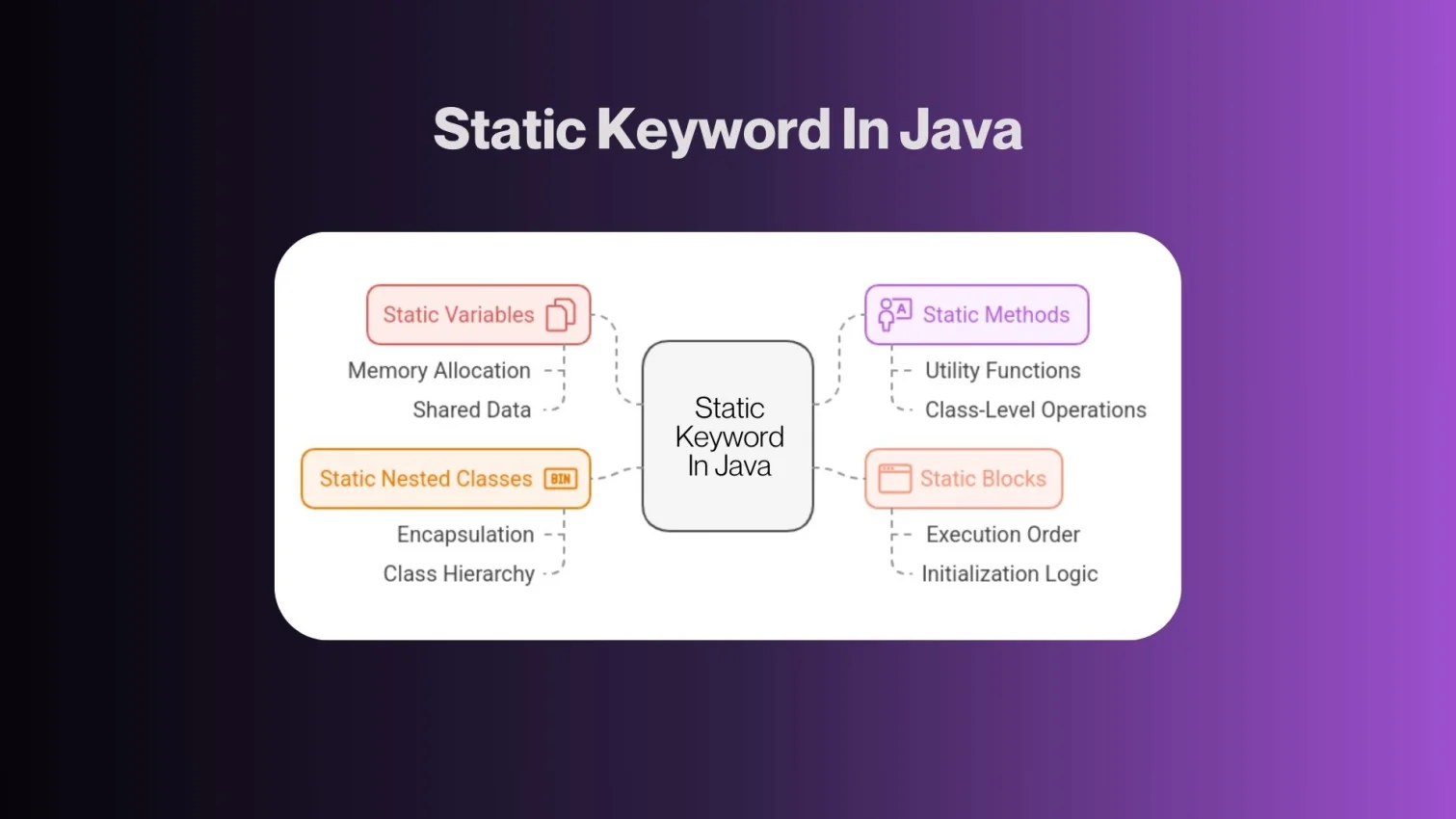
Now, we will discuss each static member in Java one by one to understand their syntax working and use properly. It will help you to know how to use them in real-world applications. This Programming language allows static usage in four main areas. Each serves a specific purpose and must be used carefully.
A static variable is always shared in all objects of a class. No matter how many objects you create, there is only one copy of the static variable. They are commonly used for counters, configuration values, constants and shared state. Every time you create a Counter object, the same count variable will be updated. This makes static variables ideal for tracking shared information.
|
| Feature | static Variable | Instance Variable |
| Belongs to | Class | Object |
| Copies | One | One per object |
| Memory | Method Area | Heap |
| Access | Class name | Object reference |
A static method is always available in the class and you can call it without creating an object. This is why the main method is static. static methods cannot access non-static members as instance members require an object, and static methods are invoked without one.
Common use cases include utility methods, helper functions, validation logic and mathematical operations. One more important thing is that classes like Math and Collections heavily rely on static methods.
|
static methods are resolved at compile time and do not support polymorphism, while instance methods support runtime binding and object-specific behavior.
A static block is generally used for initializing static data. It only runs when the class is loaded into memory. These blocks execute before the main method and before any object is created. They are useful when initialization logic is complex and cannot be handled in a single line. Their order of execution is from top to bottom exactly as written in the class.
|
A static nested class is a class defined inside another class, marked as static. Unlike inner classes, it does not require an instance of the outer class. They exist to group related classes logically without tying them to object state. They are commonly used in builder patterns and helper components.
|
Also Explore: What is JDBC?
The internal working of static keywords in Java is straightforward. Understanding it will help you know what happens inside the JVM when a Java program runs. static members follow a very specific lifecycle that is different from instance members. Let’s understand their working step by step:
1. When a class is referenced for the first time, the ClassLoader loads the class into memory.
2. The JVM allocates memory for static variables and static methods in the Method Area (Metaspace).
3. static variables are initialized in the order they appear in the class.
4. static blocks execute once, from top to bottom.
5. The class is marked as initialized, and all static members become accessible.
6. Objects are created later (if needed), and instance variables are allocated in the heap.
7. static members remain shared and are not re-created for new objects.
Read Also: Java Interview Questions and Answers
Understanding the difference between static and non-static in Java is critical for writing clean and maintainable Java code for both beginners and experienced professionals. Here is how they differ:
| Aspect | static | Non-static |
| Belongs to | Class | Object |
| Memory | Method Area | Heap |
| Access | Class name | Object reference |
| Polymorphism | No | Yes |
| Flexibility | Low | High |
| Use Case | Shared logic | Object behavior |
Many developers confuse static and final because they are often used together. However, they serve completely different purposes in Java. The static keyword defines ownership at the class level. The final keyword defines immutability. When combined, they create constants that belong to the class and cannot be modified after initialization.
| Aspect | static | final | static final |
| Belongs To | Class | Instance or Class | Class |
| Purpose | Defines class-level ownership | Defines immutability | Defines class-level constant |
| Number of Copies | One shared copy across all objects | Depends on declaration (instance or class) | One shared constant |
| Can It Change? | Yes (unless declared final) | No, once initialized | No, once initialized |
| Memory Behavior | One per class | Per instance (if non-static) | One per class |
| Common Use Case | Counters, shared configurations | Fixed values per object | Constants like PI, configuration values |
| Example | static int counter = 0; | final int age = 25; | static final double PI = 3.14159; |
static import allows you to access static members without using the class name. They improve readability in small, focused classes. However, overusing it can reduce clarity, especially in large projects where method origins become unclear. This is why you should understand them. Let’s see an example for better understanding:
|
The static keyword is commonly used in Java when a single shared behavior or value is required across the application. Below are the most practical and industry-relevant use cases you should know about:
| Use Case | Why static Fits |
| Utility Classes | Methods do not depend on object state |
| Constants | One shared, immutable value |
| Configuration Values | Loaded once and reused |
| Factory Methods | Centralized object creation |
| Logging Frameworks | Single logger per class |
| Singleton Support | Ensures one shared instance |
One of the most overlooked aspects of the static keyword in Java is how it behaves in a multithreaded environment. Since static variables belong to the class rather than individual objects, they are shared across all instances and across all threads running in the application. This shared nature makes them powerful but also potentially dangerous if not handled correctly.
When multiple threads modify a static variable at the same time, it can lead to race conditions and inconsistent results. The static keyword itself does not guarantee thread safety. Proper synchronization techniques must be applied when a shared mutable state is involved.
class Counter {
   static int count = 0;

   static void increment() {
       count++;
   }
}
|
If two threads call increment() simultaneously, the count++ operation may not behave as expected because it is not atomic. This can result in lost updates. You can make it thread safe by using:
class Counter {
   static int count = 0;

   static synchronized void increment() {
       count++;
   }
}
|
Understanding what triggers class initialization is important for mastering how static members behave inside the JVM. A class is initialized only once during its lifecycle, and this process controls when static variables and static blocks execute.
1. Accessing a static Variable: When a static variable is accessed for the first time, the class is initialized.
System.out.println(MyClass.value); |
2. Invoking a static Method: Calling a static method forces the JVM to initialize the class.
MyClass.display(); |
3. Creating an Object: Creating an instance of the class triggers initialization if it has not already occurred.
MyClass obj = new MyClass(); |
4. Reflection Usage: Using reflection (for example, Class.forName("MyClass")) also triggers class loading and initialization.
This lifecycle explains why static blocks run only once and why static members remain shared throughout the application runtime.
Common Mistakes with static Keyword
static is definitely a powerful concept, but its misuse can quickly degrade code quality. These mistakes are frequently seen in real projects. Here are some of the common ones:
Although the static keyword is useful, overusing it can harm application design. Excessive static usage often converts object-oriented design into procedural programming, reducing flexibility and maintainability. Here are important design-level problems caused by too much static usage:
1. Breaks Dependency Injection: Modern frameworks like Spring Boot rely heavily on dependency injection. static methods cannot be injected or managed by containers, which makes integration harder and less flexible.
2. Difficult to Unit Test: static methods are hard to mock in traditional testing frameworks. This increases testing complexity and reduces maintainability.
3. Tight Coupling: When classes directly depend on static methods of other classes, they become tightly coupled. This reduces modularity and makes refactoring more difficult.
4. Reduced Polymorphism: static methods do not support runtime polymorphism. If behavior needs to vary by object type, static methods prevent that flexibility.
5. Hidden Global State: static variables behave like global variables. If mutable, they can introduce unexpected side effects across the application.
6. When to avoid static:
The static keyword should be used intentionally rather than as a shortcut. Following best practices helps maintain clean, scalable and testable code.
This comprehensive guide explained many things about the static Keywords in Java. Now you know how powerful, efficient and essential it is when used correctly. It helps manage memory, improve performance and design shared behavior. Further you can explore other key concepts through our Java tutorial to become a successful Java developer.
static is not bad. The result always depends on how you use them. It should be used only when shared behavior or data is required.
static members are faster as they are resolved at compile time but the gain is usually minor.
They live as long as the class is loaded and are eligible for garbage collection only when the class is unloaded.
static methods themselves are not thread-safe. Thread safety depends on the data they access.
All variables in interfaces are implicitly static and final.
static methods are hidden, not overridden, as method binding happens at compile time.
No. Constructors initialize objects, and static members belong to the class, not objects.
Yes. static methods can be overloaded because overloading depends on method signatures, not runtime behavior.
Explore Our Trending Articles-