Are you preparing for a Kubernetes interview? It can feel overwhelming at first with the growing demand for DevOps and cloud-native skills. Whether you are a beginner learning container orchestration or an experienced professional aiming for a senior DevOps role, understanding Kubernetes concepts is essential for modern infrastructure management.
In this guide, we have compiled the most important Kubernetes interview questions and answers to help you strengthen your knowledge and improve your confidence before interviews. From Kubernetes architecture and pods to deployments, services, scaling, and cluster management, these questions cover both basic and advanced topics commonly asked by recruiters and technical interviewers.
If you want to crack DevOps, cloud engineer, or site reliability engineer interviews, this list of Kubernetes interview questions will help you understand key concepts in a simple and practical way.
Let's start with Kubernetes basic interview questions. Being basic ones does not imply that these are only for beginners. This section is essential for fresher as well as experienced candidates.
K8s or Kubernetes is an open-source platform that is used to automate the deployment and scaling of containerized applications. This platform makes it easy to manage applications in application deployment with various features. We also know this process as orchestration.
In spite of having the same application and features, these platforms are very different from each other in various aspects, which are -
| Differences | Kubernetes | Docker |
| Definitions | It is a container orchestration tool that helps to manage schedule and scale containerized applications. | It is a container runtime technology that helps developers to create, deploy and run containerized applications. |
| Architecture | The architecture of this tool includes two main components, known as Worker Node and Master Node. Apart from these components, it has a central control plane that has various in-built elements, such as scheduler, API servers, controller manager, etc. | It has a simple architecture with simple nodes that communicate through the gossip protocol. |
| Functionality | This platform provides a number of advanced functionalities and services. For instance, self healing, rolling updates, ingress controllers, health check, replicated, demonsets and statefulsets. | Just like its architecture Docker Swarm offers a simple functionality for container administration and orchestration. It only has one type of service called replicated. |
| Installation | It is very complex to set up this tool due to its less intuitive interface. This complexity results in high maintenance and overhead cost. | It is simple to set up this tool as it has a simple and intuitive command-line interface. Additionally, it does not require high maintenance and overhead costs. |
| Maturity | This platform has numerous advanced features that help users to perform operations more maturely. It also has rich community support and documentation. | This platform does not have any advanced features, community support and documentation. It can not perform operations better than Kubernetes. |
Container orchestration (dummies) is a method of deploying, operating, and scaling containerized applications. These containers can be managed on a single or more than one server. With this practice, users can easily automate various operations, such as container provisioning, availability, load balancing, etc.
It also helps to manage the lifecycle of containers like design, deploy, scale and destruction. It also helps to ensure that all containers are working together, efficiently and seamlessly to provide desired services.
It is an orchestration technique in which organizations can manage the containerized applications throughout the lifecycle. It allows developers to manage complex workloads and environments without dealing with underlying infrastructure. This technique reduces extra costs and increases scalability and efficiency to get improved performance.
Headless service does not have any single access point or cluster IP. It is generally used for services that do not require any IP address for load balancing or service discovery. It allows users to access each pod that is presented in the service.
With this feature they can now reach any pod without using any proxy. Headless services are useful in scenarios where load balancing or a single service IP is not required.
Following are the common features K8s provides -
Related Article- Kubernetes Tutorial For Beginners
Going deeper into the concepts, the next asked questions will be based on its architecture. We have included most frequently asked Kubernetes architecture interview questions in this section.
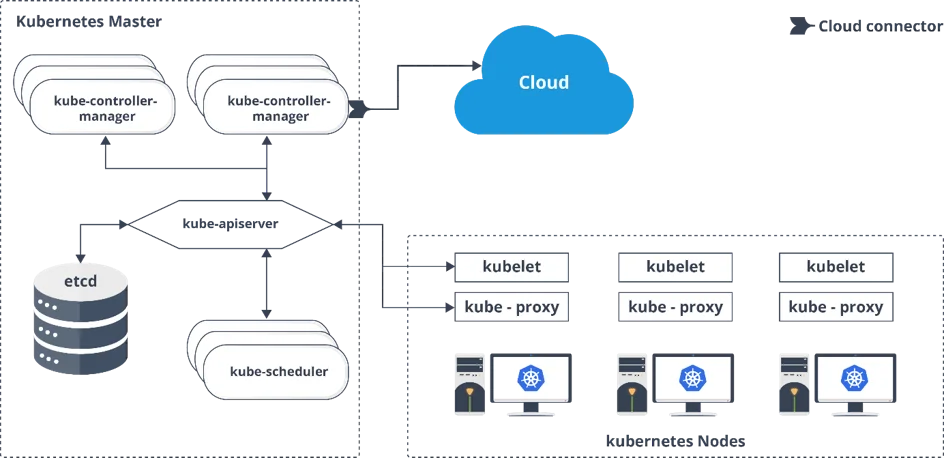
This platform's architecture includes two main components, which are known as Master Node and Worker Node. Further these two have their in-built components within them. The master code consists Etcd, Kube-apiserver, Kube-scheduler and Kube-controller-manager. Whereas, the worker node includes Kube-proxy and Kubelet, which runs on each node. The Etcd helps to store the configuration of clusters.
This tool has numerous controllers on the master node that are embedded together to perform as a single operation. It is crucial to run each controller efficiently. It is where a controller manager is needed, it compiles controllers and namespace creation and garbage collection. The controller manager is also responsible for communication between API servers and endpoints. Following are some examples of different controller manager -
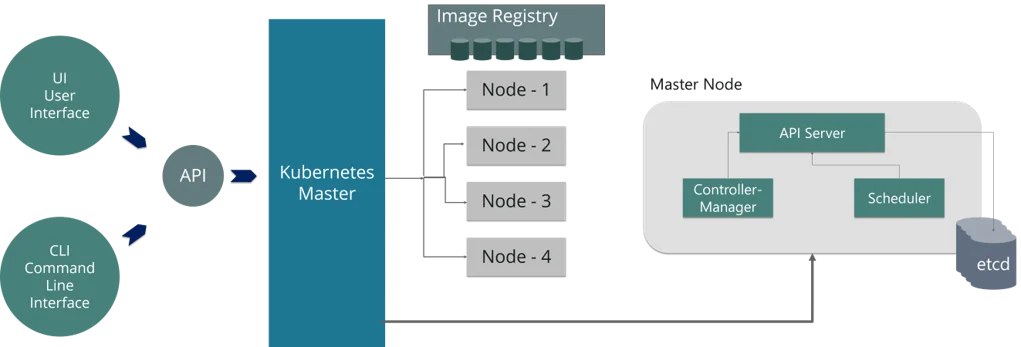
Kubernetes master operates the nodes and containers. A number of containers are present in a particular pod based on requirement and configuration. These pods can be deployed via user interface or command-line interface. Further, these nodes are allocated on nodes based on the resource requirements. At last, the Kube-apiserver ensures that there is a proper communication between nodes and master components.
Kube-apiserver: This is an API server of this platform and stands as the front-end of the master controller. It follows a scale-out architecture. This API helps to create secured communication between master components and nodes. It also exposes all APIs presented in Kubernetes Master node components.
Kube-schedulers: It is an in-built scheduler of this tool that assigns nodes to cluster. This procedure is done on the basis of resources and constraints. In this process, it ranks the nodes and binds them with the best suitable pods. It can also make copies of pods and distribute them among various nodes to achieve improved scalability.
Etcd is an open-source key value store that manages the crucial data of a distributed system. It comes under the non-relational database and stores information in the form of values and keys. It works as a leader election incase of tolerance or partition machine failure. Due to its simple interface, anyone can read or write values with standard HTTP tools.
Load balancer is a fundamental approach to expose service on this platform. There are only two kinds of load balancers available on this platform. First is the internal load balancer that automatically balances loads and allocates the pods with necessary configuration. Second is the external load balancer that redirects entire traffic from the outer load to backend pods.
Related Article- How to Install Kubernetes? 4 Different Ways
This platform is not completely accurate, there might be some errors during the operations. It is important for a company to detect and resolve these errors. It means the panel can also ask Kubernetes troubleshoot interview questions. Let's discuss them!
In case of cluster issues, the platform may give some common signs like high memory or CPU use, pod eviction and slow response time. It can be identified by using tools like 'Kubectl top' or reviewing cluster metrics. Once the problem is detected, it can be removed by scaling the required resource limits. The best way to mitigate the potential issues before happening is to optimize it frequently.
Developers should have to detect the issue has risen. They can do it by evaluating the system components like Kube-proxy, Kubelet and pod statuses. In order to bring back the healthy state of the cluster, we have to recover or restart failed components.
There are various possible reasons by which a cluster can go in 'Pending state'. For instance, node affinity, resource constraints, insufficient resources or anti-affinity rules. We can detect them by troubleshooting resource limits/requests, event logs or node availability. Then it can be resolved by modifying node assignments and resources.
To solve this connectivity issue developers first have to detect why and where the error has risen. These errors can be a result of misconfigured network policies, incorrect service definition or firewall rules. They can use tools like 'nslookup' and 'Kubectl exec'.
It can be also done by inspecting podes connectivity, network policies and service definitions to detect the problem. Once the error has been found, they can resolve it by configuring inter-pod communication according to the network policies.
If a pod's PV goes inaccessible, instant data recovery becomes necessary. To recover that data, connect the pods to a new node, if possible, or use restore or backup techniques.
There are various security risks in this platform, which are mentioned below.
These risks can be mitigated by applying the best security practices or repairing misconfiguration of the clusters.
Related Article- Kubernetes vs Docker: What's the Difference
To check the in-depth skills of a candidate, the panel will ask them complex and advanced questions. The following are the top Kubernetes advanced interview questions that might be asked in an interview -
Horizontal Pod Autoscaler works as part of the control loop. HPA can automatically reshape workflows in order to maintain required states by frequently comparing its own metrics.
It is an API extension that is not always available in this tool. This is why APIs have to be installed in the system to build and access their components with kubectl. Its modularity enables users to build numerous core functions.
With dynamic registration, it can be used anywhere in a running cluster. The cluster admin can also update the resources independently to integrate with external systems. It can extend the functionality of this platform for domain-specific concepts.
The sensitive information stored in a cluster can be safeguarded via using several encryption and access restrictions techniques. Usually this data is stored in a rest or transit mode to secure it from unauthorized access.
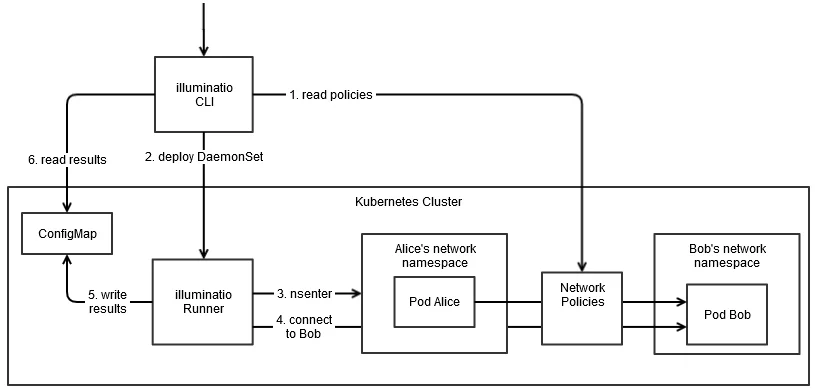
This platform is a network-centric platform and requires a secure connection between various entities. That is why network policies are crucial for this platform. These policies are mostly applied on the inter-connection of pods only.
Helm leverage a packaging format known as charts, which are a group of files that define the cohesive sets of resources. All the files are stored in a single chart from simple components like Memcached pod to complex web app stack, such as HTTP servers, caches, databases, etc. these packages also provide all the necessary resources for deploying an application to a cluster.
Basically a pod includes various containers within it with a specified one. This specified container is known as init container. These containers are just like the regular ones but have slightly different working. It always runs before the other containers and does not stop working until the operation completes.
Read Also- Best DevOps Tools To Look
For testing the expertise of experienced professionals, interviewers often ask technical questions to them. This section includes the top Kubernetes interview questions for experienced professionals.
Following are the security measure of this platform -
Kube-proxy is a controller that runs on each node of a cluster. It is used to monitor the communication between services and pods just like a load balancer or network policy. Engineers or developers also use Kube-proxy to perform various general tasks, such as UDP, SCTP forwarding, TCP, etc. They can use this tool to run services on every node.
Kubectl is command line code especially used to manage and deploy applications on this tool. It also has some additional uses like inspecting the cluster resources and creating, deleting or updating components.
It is a daemon, which is used for embedding the core control loops that regulates system performance. It is a crucial loop of this platform and can not be terminated.
The load balancing is related to services. In this platform, two kinds of load balancing are available.
GKE is a managed service that allows users to deploy and run containerized applications on GCP. GKE provides various functionalities for container orchestration, such as management, security, governance, and configuration of clusters. This tool can independently manage the entire infrastructure of clusters. For instance, nodes, components and control planes can be easily managed through this tool.
Read Also- Top DevOps Certifications
Interviewers may also ask some scenario based questions to test individuals proficiency in this platform. In this section, we have mentioned Kubernetes scenario based interview questions.
The company is using thousands of containers in which numerous tasks run across various nodes in a worldwide distributed system. It will require a platform that can improve their agility, scalability with cloud based applications. This is where that company can use this tool to support multiple containers at single time.
Definitely yes. To meet these requirements, this company may need a platform that can offer digital experience to millions of clients. Kubernetes is one such platform, it can easily get data to the client websites. In order to use this platform, they have to adopt cloud environments such as AWS.
Additionally, they also need to implement micro service architecture that enables them to use Docker containers. After these processes, they can leverage the benefits of this platform, which make them autonomous in creating and deploying applications. It also improves their scalability and response.
The best approach to meet this goal is implementation of DevOps practices like building CI/CD pipelines. This approach will definitely reduce the expenses but it may take more time to process. This is where they should use this tool to schedule and orchestrate all containers on a cluster. By completing this procedure they can achieve high efficiency with minimum expenses and higher speed.
To solve this issue that organization must replace their monolithic code base with microservice design. Every microservice works like a container, which can be orchestrated and deployed by using this platform. This transition is a complex procedure and requires careful planning and execution.
My first step will be detecting the error. It can be detected by evaluating logs or using command fiction like 'Kubectl'. With this process, the system will show which pod has failed to work. After detecting the error in application, it will require a reconfiguration to ensure that dependencies are accurately working or not.
Later, I will delete the failed pods and create new ones in order to restart the application. Once the application has been successfully recovered, I will monitor the pod's log and metrics to check its working.
In order to scatter the traffic across different nodes I will follow this procedure -
This section lists the most asked Kubernetes interview questions and answers for administrators. These are specially curated for candidates who want to appear in Kubernetes admin interviews.
It requires the use of etcdctl snapshot save command. This command creates a snapshot of the etcd database, which is a key-value store that holds all of the cluster's state. The snapshot should be stored in a secure and remote location. For a live cluster, you should run this on the etcd leader node. Here are steps to follow for restoring an etcd cluster from a snapshot:
Upgrading a Kubernetes cluster typically involves a sequence of steps to ensure minimal downtime and a smooth transition. The most common tool for this is kubeadm. Here are the steps:
This process is repeated for each worker node.
Securing a Kubernetes cluster is a multi-layered approach. It includes focusing the given key areas:
Implementing multi-tenancy in Kubernetes involves isolating different teams or users (tenants) within a single cluster. This can be achieved through:
First, I would check the pod status and review its logs using kubectl get pods and kubectl logs. I would also use kubectl describe pod to check events, resource limits, probes, and the reason for previous container restarts.
Next, I would check CPU and memory usage using kubectl top pod. If the container is exceeding its memory limit, it may be terminated due to an OOMKilled event. I would review the application's resource requests and limits and increase them if required. I would also investigate the application for memory leaks or inefficient resource usage instead of simply increasing the limits.
I would use Kubernetes Namespaces to separate the teams and apply ResourceQuotas to limit the CPU, memory, and other resources that each team can consume. I would also define LimitRanges to establish default and maximum resource requests and limits for containers.
I would combine these controls with RBAC so that each team can manage only its own resources. I would monitor resource utilization regularly and adjust quotas based on actual requirements. This approach prevents one team from consuming excessive cluster resources while maintaining isolation and controlled access.
These top Kubernetes interview questions are suitable for both freshmen and experienced experts. With several new job openings, anyone can start or improve their career in this field. Go through these questions and keep learning to get this opportunity.
Explore Our Trending Articles -
Kubernetes is mainly used to run and manage containerized applications. It helps automatically scale and maintain applications across servers.
A pod is the smallest unit in Kubernetes that runs one or more containers. It allows containers to share the same network and storage resources.
Docker mainly creates and runs containers, while Kubernetes mainly manages and scales those containers.