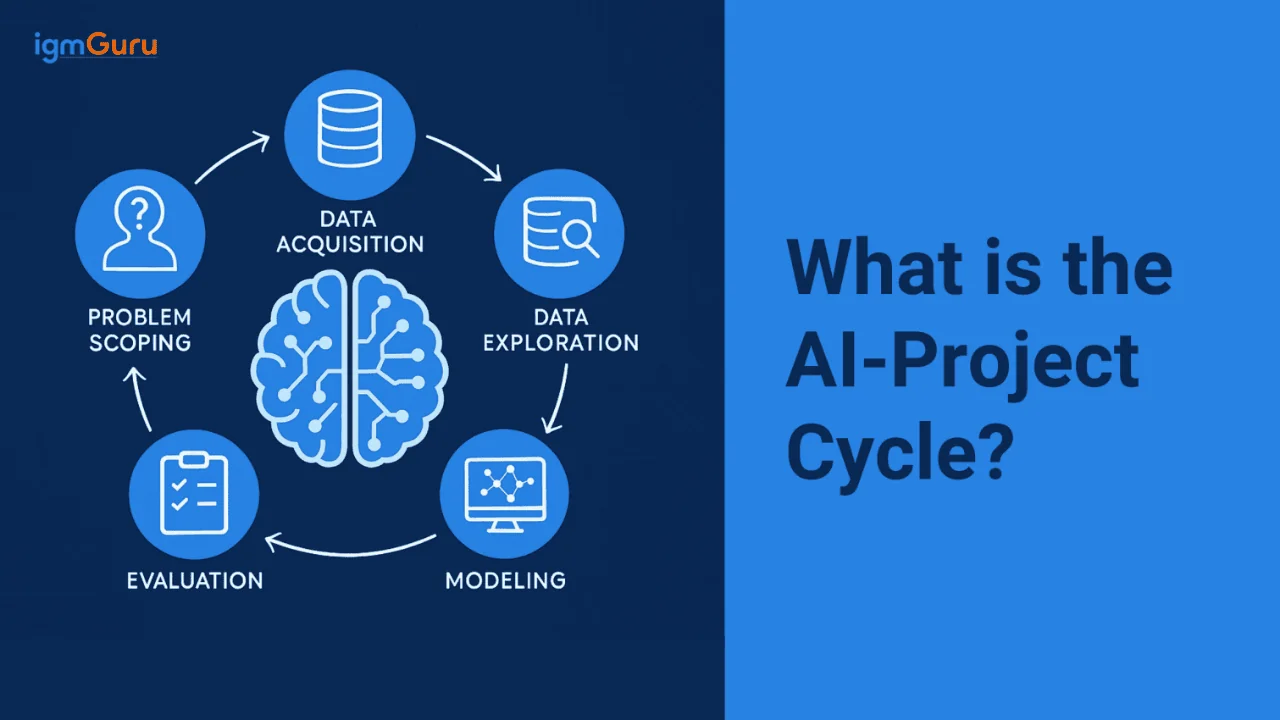
The AI Project Cycle is a structured process that guides the development of artificial intelligence solutions from start to finish. It involves problem definition, data collection, model development, evaluation, deployment and continuous monitoring to build and manage effective AI systems. By following a systematic approach, organizations can transform raw data and business challenges into intelligent and data-driven solutions.
This step-by-step framework ensures that every phase of the project is clearly defined, reducing risks and improving overall efficiency. It helps teams move from identifying a real-world problem to successfully implementing, maintaining and improving an AI system over time.
In this blog, we will discuss the stages, real-world examples, benefits, challenges, and much more.
Read Also: What is an AI Engineer?
The AI Project Cycle is a systematic framework. It is used to develop, deploy and manage artificial intelligence solutions. It divides the AI development process into structured stages, including problem scoping, data acquisition, data exploration, modeling, evaluation, deployment, and monitoring.
This structured life cycle ensures that AI projects are executed efficiently, aligned with business objectives, and continuously improved after implementation. By following these defined steps, organizations can reduce risks, enhance model performance and can successfully implement AI systems in real-world environments.
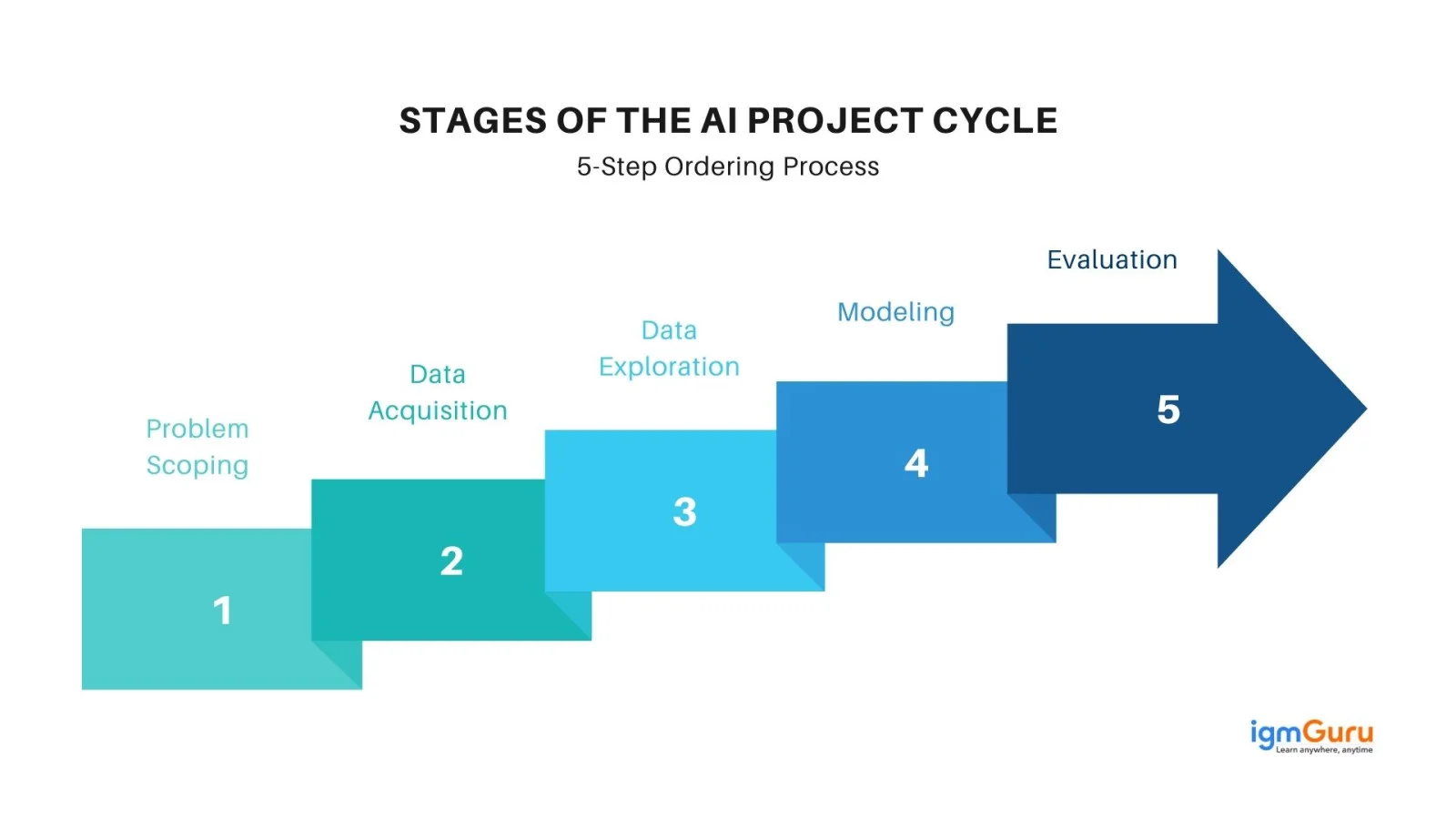
This section discusses the five stages of the AI project cycle. Let's take a look at each stage one by one.
Problem scoping highlights a concern or issue that needs to be handled with artificial intelligence. It also includes clarifying objectives and a strategy to accomplish those. It is not as easy as it sounds and requires a strong comprehension of the specific issue to implement it successfully. 4Ws problem canvas is an approach that assists in obtaining a better understanding of the concern or problem.
The 4Ws problem canvas brings out the key elements causing the problem. It has 4Ws, including Who, What, Where and Why. Let's discuss each W one by one.
i) Gathering evidence to prove the existence of an issue from sources like articles and reports.
ii) Discovering characteristics of the problem.
iii) Comprehend what makes it a problem
The second step in the project process is all about collecting information that is required for the project. One must train the AI system with accurate data to enable it to make predictions.
Let's say one wants to invent a system that is capable of predicting an employee's future earnings. In order to achieve this, one must also have the historical salary information of that particular employee. We call this past salary data 'training data', while the data used for making future predictions is known as 'testing data'.
The specific details you want to collect are called data features. In our example, these could include the employee's salary, the percentage increase they got, the time between raises, any bonuses, and so on. There are different ways to gather this data, like:
Data can be tricky and confusing, especially data involving numbers. This is where data visualization comes to the rescue and helps in making sense out of the complicated information. It turns the numbers into visuals that are easy to comprehend. One can turn data more user-friendly through visuals like bar graphs, histograms, pie and line charts. This enables one to:
Modeling is an important element in the AI project process to simplify complicated data for computers. This enables the computer to understand and come up with the right predictions. Initially, data might be shown in charts or graphs for pattern spotting. For AI systems to function, we need to turn this data into a format that computers can work with, which usually means converting it into binary (0s and 1s).
Modeling is about creating a mathematical framework that shows how different data points relate to one another. It's similar to how computers are taught to recognize patterns or make choices. These models can range from simple equations to complex neural networks, depending on what you need to accomplish. The system can make predictions with new data once it learns the rules from historical data.
Evaluation is the final stage of the AI project process. After creating and training a model, it's essential to test it thoroughly to see how well it performs. For this, we use a separate dataset called the testing data. We evaluate the model's performance based on several criteria:
Read Also: What is Perplexity AI?
The AI project cycle plays a crucial role in achieving predefined objectives with systematic planning, collaboration and offering a complete development of a project. Similar to how individuals make plans to get things done, the AI project cycle provides structured ways to work on AI projects.
Understanding the steps or phases of the AI project cycle is not enough to create an efficient model. It requires more than just collecting data and training models. One must follow proper planning, testing, monitoring, and collaboration practices throughout the AI project cycle. Following the right approach helps improve model accuracy, reduce risks and ensure the AI solution delivers real business value.
By following these best practices, one can improve the success rate of AI initiatives and build more reliable, scalable and efficient AI solutions.
Also Explore: Best AI Agent Frameworks
Neural networks are an inseparable part of artificial intelligence. The most fascinating part about neural networks is how their structure is inspired by the human brain. These are useful to perform tasks like making predictions, recognizing images and understanding language. They have the capacity to learn and find patterns in data on their own without specific instructions.
Neural networks are used to create models in artificial intelligence. This is the "learning" phase, where we train the neural network on data so it can understand patterns and make predictions. Neural networks are the brains of AI, helping systems learn from data and make smart decisions. They are essential for developing and using AI solutions.
A neural network consists of various layers, each layer has nodes or units. The input layer is the first layer of the neural network, which takes in data without doing much with it. The hidden layers are found in the middle, and this is where the data gets processed. It is important to note that there can be multiple hidden layers.
At last, the last hidden layer hands over the processed data to the output layer, which gives out the final result. Sharing similarities with how the brain functions, neural networks are able to find patterns in data.. Each node in a neural network functions as a little data detective. This is super useful when we're dealing with lots and lots of data, especially in the AI project cycle.
Also Read: What Is Janitor AI? Features, Pricing and How to Use
Understanding the stages of the AI project cycle becomes easier when we see how they work together in a real-world scenario. Consider an e-commerce company that wants to use artificial intelligence to identify customers who are likely to stop purchasing from its platform. The company can follow the AI project cycle to develop a customer churn prediction system.
The first step is to clearly define the problem. In this case, the company wants to identify customers who are likely to become inactive or stop making purchases. The objective is to predict customer churn early so that the business can take actions such as offering personalized discounts, improving customer support, or sending targeted recommendations.
Next, the company collects relevant historical customer data. This may include purchase history, order frequency, website activity, customer support interactions, product returns, and the time since the customer's last purchase. High-quality and relevant data helps the AI model identify patterns associated with customers who previously stopped using the platform.
During data exploration, the collected information is cleaned, organized, and analyzed to discover useful patterns. The team may find that customers with fewer purchases, frequent returns, reduced website activity, or long gaps between orders are more likely to leave. Charts, graphs, and other data visualization techniques can make these trends easier to identify and understand.
In the modeling stage, the team selects and trains a suitable machine learning model using historical customer data. The model learns from patterns associated with active and inactive customers. Once trained, it can analyze new customer data and predict which customers have a higher probability of leaving the platform.
Finally, the model is tested using data it has not previously seen. Performance metrics such as accuracy, precision, recall, and F1 score can be used to evaluate how effectively the model identifies customers at risk of churn. If the results are not satisfactory, the team can improve the data, adjust the model, and test it again before using it in a real-world environment.
This example shows how each stage of the AI project cycle contributes to solving a practical business problem. The same structured approach can also be applied to other AI applications, such as fraud detection, healthcare diagnosis, recommendation systems, predictive maintenance, and demand forecasting.
Read Also: What is Google AI Studio?
It is safe to conclude that the AI project cycle plays a beneficial role for organizations and individuals by highlighting the concerns they must resolve. It provides a step-by-step guide to handling real-life problems with artificial intelligence. One must follow this cycle to achieve goals and acquire the best results.
Read Our Trending Articles
The AI Project Cycle includes five key stages: Problem Scoping, Data Acquisition, Data Exploration, Modeling, and Evaluation. Each stage helps structure the AI development process to ensure effective and goal-oriented solutions.
The 4Ws Problem Canvas helps in clearly defining the problem by identifying who is affected, what the problem is, where and when it occurs, and why it's important to solve. This ensures a deep understanding of the issue before moving forward.
Neural networks play a critical role during the modeling phase by enabling AI systems to learn patterns from data and make intelligent predictions, similar to how the human brain processes information.
Yes, the AI Project Cycle is an iterative process because teams may need to revisit earlier stages based on evaluation results. For example, if an AI model does not achieve the expected performance, developers may collect better data, explore it again, or modify the model. This continuous refinement helps improve the accuracy and effectiveness of the AI solution.
Course Schedule
| Course Name | Batch Type | Details |
| AI and ML Certification Courses | Every Weekday | View Details |
| AI and ML Certification Courses | Every Weekend | View Details |