What if your software could not only understand what is happening around it but could also think, reason, and act like a real assistant? That is exactly what AI agents are designed to do and how to create AI agents.
It is not like some traditional programs that simply follow commands. These AI agents can make decisions on the go. They can analyse inputs, plan next steps and learn from feedback. AI agents are transforming how we interact with technology, whether it is about sorting your inbox, answering customer queries or helping doctors detect diseases.
In this blog- how to build AI Agents, we will dive into how these agents work, why the ReAct pattern is changing the game and how you can start building one yourself. Let's begin.
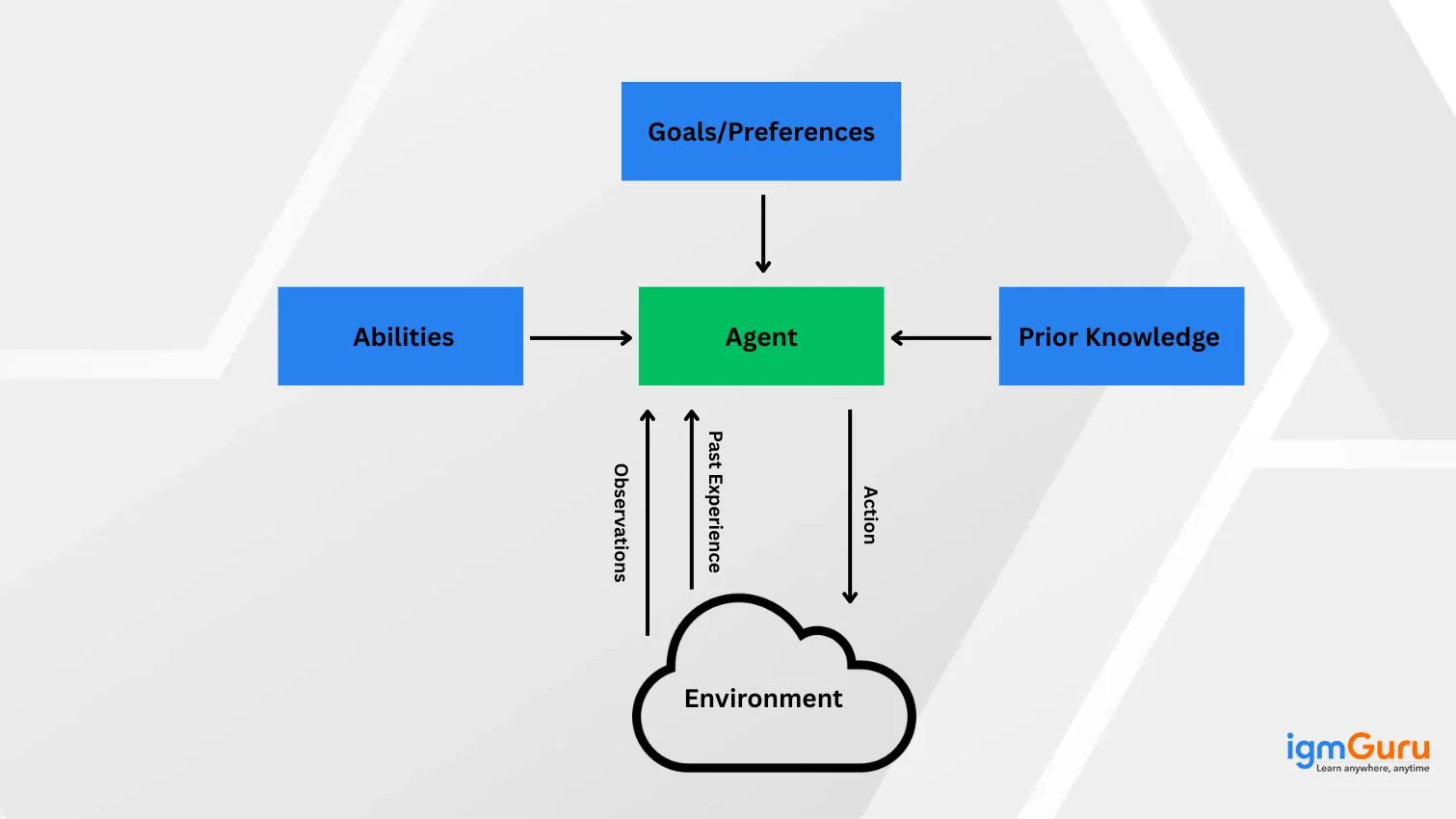
An AI agent is a computer program that can observe, think and act just like a mini digital assistant trying to complete a task intelligently. In simple terms, we can say that an AI agent is like a smart helper that takes input from its surroundings (like emails, text, or sensor data), thinks about what to do using logic or machine learning and then takes action to achieve a goal.
Enroll in igmGuru's Agentic AI training program to explore exceptional career options in AI.
Today, AI agents are becoming very important, since they help automate tasks that are repetitive, time-consuming or mentally exhausting. AI agents bring speed, consistency and intelligent decision-making, which traditional systems cannot match.
What sets AI agents apart is their ability to learn, adapt and improve over time. They are not like regular programs that follow fixed rules. AI agents evolve with experience that makes them highly valuable across industries like healthcare, finance, education and e-commerce. AI agents are no longer futuristic tools, they are actively reshaping how we work, communicate and solve problems every day.
There are 6 core components of AI Agents. They are explained in the below given table:
| Component | Description |
| Perception | This is how the agent observes or receives input from its environment. It could be through sensors, user input or data feeds like emails, text or system logs. |
| Reasoning / Decision-Making | This can be called the brain of an AI agent. It thinks about what actions to take based on the input, using logic, rules or AI techniques like machine learning. |
| Learning | Many of the AI agents can improve with time. They learn from past actions, feedback or data, which helps in making future decisions smarter and more accurate. |
| Action / Actuator | After thinking, the agent acts. This could be sending an email, triggering a process, controlling a device or giving a response. |
| Memory / Knowledge Base | In this, it stores past experiences, rules and data. It helps the agent in remembering things and making better decisions over time. |
| Goal / Objective | Every AI agent is designed with a specific purpose or goal. Everything it does, from sensing and thinking to acting to achieve this target. |
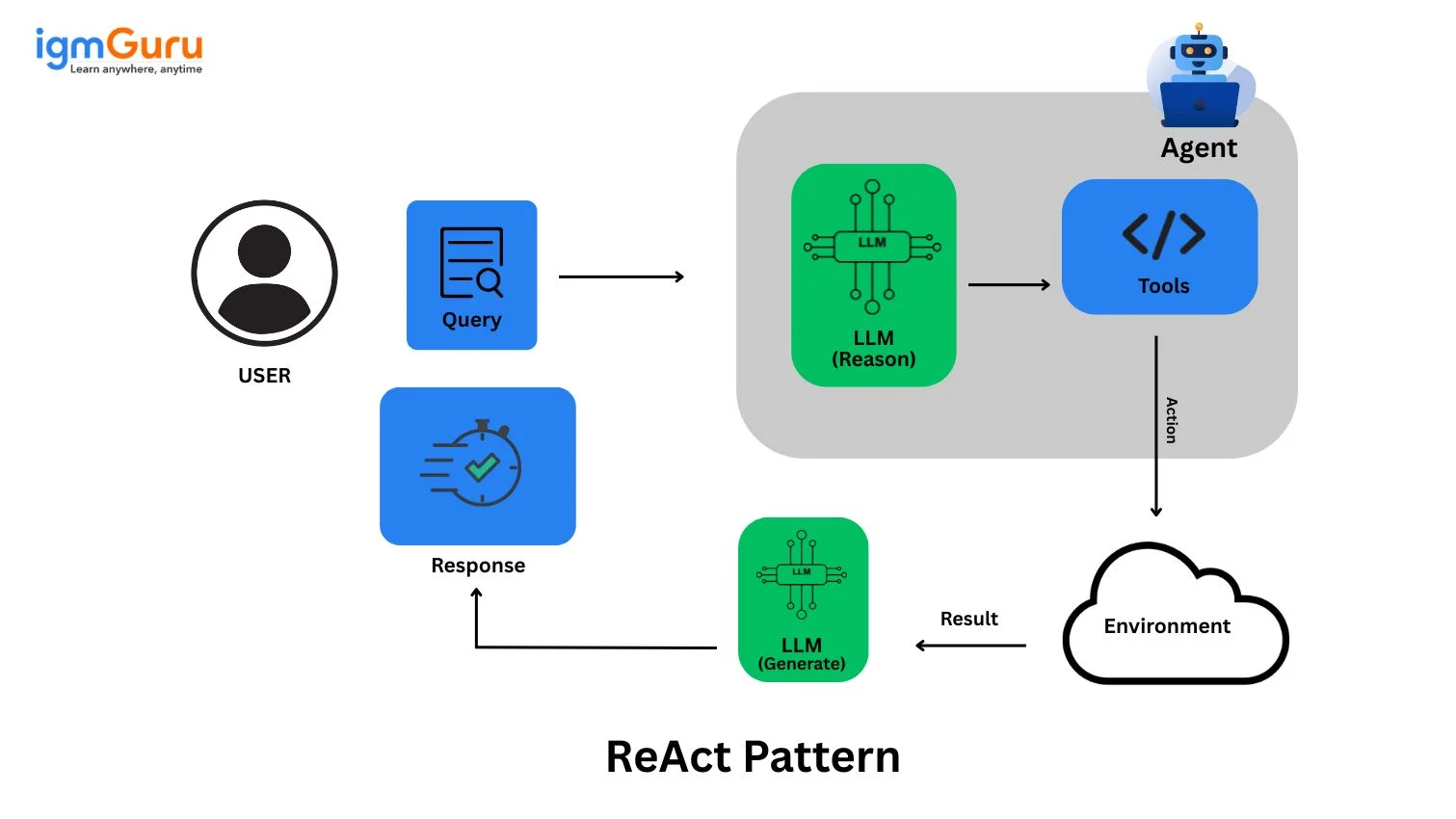
The ReAct Pattern stands for Reasoning + Acting. It is a smart approach used in building advanced AI agents. ReAct-based agents think and act in loops step-by-step, instead of following a strict pre-programmed sequence. First, the agent reasons about what it sees or knows, then it takes action and then reasons again based on what it changed after the action. This cycle continues until the task is complete.
You can think of it like a detective solving a mystery. The agent first observes clues, then forms a hypothesis (reasoning), then checks the next room (action), finds something new and again rethinks the plan. The first and fourth steps, i.e., reasoning and acting, allow AI agents to handle complex and dynamic problems flexibly and efficiently.
Want to know how to become a Machine Learning Engineer? Explore this article outlining all the details.
The ReAct pattern matters because it gives AI agents the power to solve real-world problems more intelligently and efficiently. It is not like a basic responder that follows a fixed sequence of steps. ReAct agents can dynamically switch between thinking and doing, which is important in unpredictable environments. This flexibility makes them ideal for tasks where the next step depends on what just happened like customer support, research assistance or even robotics.
Most importantly, ReAct agents do not get stuck. If they face a confusing or incomplete situation, they can pause, think and try a different approach. This makes them more human-like and far more capable when solving open-ended or multi-step tasks. They exactly solve the kind of problems we want Artificial Intelligence or AI to solve today.
The benefits of ReAct Patterns are:
Related article - What is RAG (Retrieval Augmented Generation)?
Let's have a look at how to build AI agents. The ReAct Pattern stands for Reasoning + Acting - a method where an AI agent doesn't just perform a task, but thinks through it step-by-step like a human would. This gives the agent flexibility, awareness, and the ability to deal with unexpected scenarios intelligently.
Let's break it down through a practical example:
Imagine you're building an AI Email Assistant that reads incoming emails and crafts smart, context-aware replies.
The agent first observes its environment. In this case of the incoming email. Let's say it reads:
Hi, could you please send the Zoom link for our 2 PM meeting?
At this point, the agent simply absorbs the raw input, i.e., the text of the email, the sender, timestamps and maybe even past conversations. This is the perception stage, which humans would call reading and understanding the message.
email = "Hi, could you please send the Zoom link for our 2 PM meeting?" agent_memory = {"current_email": email} |
Now comes the intelligent part which is reasoning. The agent needs to figure out:
In this case, it reasons: The user is asking for a Zoom link for a meeting scheduled at 2 PM. I need to fetch or generate that link. In a real-world agent, this reasoning step would typically involve a call to one of the powerful Large Language Models (LLMs) like ChatGPT, Claude, Perplexity, etc., to understand the user's intent with much greater nuance.
def reason(email_text): if "Zoom link" in email_text and "meeting" in email_text: return "User is requesting a Zoom link for a meeting." else: return "Unclear request. Need more information." thought = reason(agent_memory["current_email"]) print("Agent's Thought:", thought) |
This thought process can use NLP techniques, internal memory or external tools to come to a logical conclusion. The agent does not just jump into action, it thinks first as a human.
Once the reasoning is done, the agent takes action. It replies with something like: Sure, here's your Zoom link for the 2 PM meeting: [Zoom_Link]. Let me know if you need anything else.
This response is not fixed, it is dynamically generated based on the reasoning step. It reflects both context and purpose, not just keyword matching or templates.
def act(thought): if "Zoom link" in thought: zoom_link = "https://zoom.us/j/1234567890" response = f"Sure, here's your Zoom link for the 2 PM meeting: {zoom_link}. Let me know if you need anything else." else: response = "Could you please clarify your request?" return response final_reply = act(thought) print("Agent's Reply:", final_reply) |
Every time a new email comes, the agent goes through the same ReAct cycle:
Over time, you can train it to handle complex queries, remember past interactions and improve its replies using feedback. This makes the AI agent truly smart, adaptable, and capable of working in real-world dynamic environments. To make this loop automatic:
def react_agent(email_input): agent_memory["current_email"] = email_input thought = reason(email_input) reply = act(thought) return reply # Simulate a new email new_email = "Can you share today's Zoom link?" print("Final Output:", react_agent(new_email)) |
By combining thinking and doing, ReAct agents offer a huge leap forward from basic automation.
Read Also- What is ChatGPT Agent: A Complete Guide (2026)
Let us explore some real-world domains where ReAct-based AI agents are actively transforming workflows through intelligent decision-making and actions:
| Domain | AI Agent Use Case | How ReAct Helps |
| Customer Support | Virtual assistants handling customer complaints or queries | Reason: Understand intent -> Act: Solve or escalate issue thoughtfully |
| Email Automation | Smart email reply agents for scheduling, confirmations, or support | Reason: Interpret email tone and purpose -> Act: Generate appropriate contextual replies |
| Healthcare | Diagnostic assistants (e.g., for radiology, symptom triage) | Reason: Analyze medical data -> Act: Recommend next diagnostic test or refer to specialist |
| E-commerce | Personal shopping agents that help users find products | Reason: Understand user preferences and budget -> Act: Suggest personalized products |
| Finance & Banking | Fraud detection agents that monitor suspicious activity | Reason: Analyze transaction history -> Act: Flag/block transaction or notify customer |
| Education | AI tutors or learning assistants | Reason: Assess student's progress -> Act: Recommend targeted resources or feedback |
| Travel & Hospitality | Smart booking agents (flights, hotels, packages) | Reason: Understand constraints like budget/dates -> Act: Offer best-fit personalized options |
| Enterprise Tools | Meeting schedulers integrated with calendars and inboxes | Reason: Find free slots and priorities -> Act: Schedule meetings, send reminders |
| Recruitment | Resume screening and candidate interaction bots | Reason: Match job criteria to resume -> Act: Shortlist, schedule interviews, or communicate decisions |
| Smart Homes / IoT | Home assistants (e.g., Alexa, Google Assistant) | Reason: Understand complex voice commands -> Act: Control devices, provide responses, suggest routines |
| LegalTech | Contract analysis bots | Reason: Read legal language, find key clauses -> Act: Summarize, flag risks, suggest edits |
| Sales/CRM | AI sales agents that follow-up with leads or respond to FAQs | Reason: Gauge lead interest/tone -> Act: Craft timely, persuasive follow-up messages |
AI agents are no longer just a concept, they are becoming practical tools embedded in how we work, interact and solve problems every day. By combining reasoning with action, the ReAct pattern unlocks a new level of intelligence and adaptability.
Through this blog on how to build AI agents, you have seen how a simple mail-based AI agent can be built using ReAct logic. This same approach can be scaled for far more advanced use cases from customer support to finance, healthcare and smart assistants. If you are looking to get started with AI agents, mastering ReAct-based design is one of the smartest paths forward.
Explore our trending articles-
The right programming language for building AI agents depends on the application and the environment. Python is commonly used for AI due to its extensive libraries such as TensorFlow and PyTorch. Other languages, such as JavaScript for web-based agents or Java for enterprise applications, are also suitable.
There are various tools and frameworks available for building AI agents. The choice of tools depends on the specific requirements of the AI agent. These tools include -
To create your own AI agent, you will need to define its purpose, choose a platform, develop its skills, integrate it with relevant systems and then test and refine it. You can also try the above guide (practical example) we have create for you.
Course Schedule
| Course Name | Batch Type | Details |
| Generative AI Training | Every Weekday | View Details |
| Generative AI Training | Every Weekend | View Details |