Artificial Intelligence (AI) is a transformative technology shaping every industry from education and healthcare to business and development. Think of it as a simulation of human intelligence and the brain in machines that holds the ability to revolutionize multiple facets of our lives and work.
These intelligent systems are highly capable of undertaking tasks that usually need human intelligence. Speech recognition, visual perception, language translation, and decision-making are a few examples. In this guide, we will discuss 'Introduction to Artificial Intelligence' and many important things related to it.
In this 'Introduction to Artificial Intelligence' guide, we will discuss 'What is Artificial Intelligence?' AI roots can be rooted back to the 1950s. This is when pioneering computer scientists such as John McCarthy and Alan Turing started exploring concepts of machines with the ability to simulate human intelligence. AI has since evolved significantly. It is majorly driven by advancements in neural networks, big data and machine learning. AI comprises a gigantic range of subfields, such as robotics, computer vision and natural language processing.
AI's ability to analyze gigantic amounts of data at a super speed is one of its most compelling aspects. It further aids in uncovering insights and patterns that humans might have overlooked. This has further led to extensive breakthroughs in leading industries like finance, transportation and healthcare.
Artificial Intelligence works as a simulation of human intelligence within machines. These machines are crafted to learn, solve problems and think like humans. It comprises multiple technologies, ranging from advanced Machine Learning models to rule-based systems. All these technologies facilitate computers to carry out tasks that traditionally required human cognition. Common tasks are recognizing patterns, understanding natural language, learning from experience and making decisions.
AI technologies are built over multiple subfields. These include machine learning, neural networks and natural language processing. ML enables systems to learn from data. Neural networks copy the interconnected neuron structure of the human brain. NLP facilitates machines to completely understand and respond to a human's language. AI is evolving and promises to transform daily life and industries. It's driving innovation but also poses important societal and ethical challenges.
AI can simply be bifurcated into two main types- general AI and narrow AI.
| Enroll in igmGuru's Generative AI Online Training program to become master in AI. |
Let's discuss history of AI in this Artificial Intelligence Introduction guide. The history of AI goes back to the mid-20th century. This is when the idea of idealizing intelligent machines was explored first. British mathematician, Alan Turing, brought forth the Turing Test in 1950. It gave a criterion to determine the ability of a machine to showcase human-like intelligence. Hence, marking the commencement of AI.
The term artificial intelligence was coined in 1956 at the Dartmouth Conference. This was organized by Marvin Minsky, John McCarthy, Claude Shannon and Nathaniel Rochester. This event is generally said to be the place where the birth of AI research happened. The 1960s and 1970s witnessed a flourish in AI research. This led to symbolic AI and neural networks development, which worked on rule-based systems.
The 1980s witnessed a rise in expert systems. These utilized knowledge-based approaches for solving complicated issues in specific domains. There was also a period where funding and interest in AI research declined due to limitations in data availability and computing power.
AI surged in the 1990s and 2000s due to advances in ML and development of algorithms that learned from large datasets. Deep learning significantly enhanced AI's capabilities in fields like speech and image recognition. AI is an important aspect of technology today. It drives innovations in different fields like finance, autonomous systems and healthcare.
Artificial intelligence is extremely important as it holds the potential to change almost every aspect of industries and our lives. It drives innovation, new possibilities and efficiency. AI is so important because-
AI automates everyday processes and tasks. This allows humans to work on more creative and complex aspects of their work. For instance, in manufacturing, AI-driven robots work on repetitive tasks with speed and precision. This reduces errors and production time. AI tools can easily handle administrative tasks in offices. These include data entry and scheduling.
AI systems analyze enormous data amounts rapidly and accurately. These offer insights that aid individuals and businesses in making informed decisions. AI algorithms are used to analyze medical records in healthcare. These can recommend personalized treatments, assist in diagnostics and predict disease outbreaks. AI models may assess credit risks and detect fraudulent transactions more effectively in finance.
AI facilitates highly customized user experiences. For instance, in e-commerce, these algorithms recommend products as per the individual's browsing history and preferences. This enhances customer satisfaction and increases sales. In the entertainment field, streaming platforms like Spotify and Netflix employ AI to suggest content as per the users' preference.
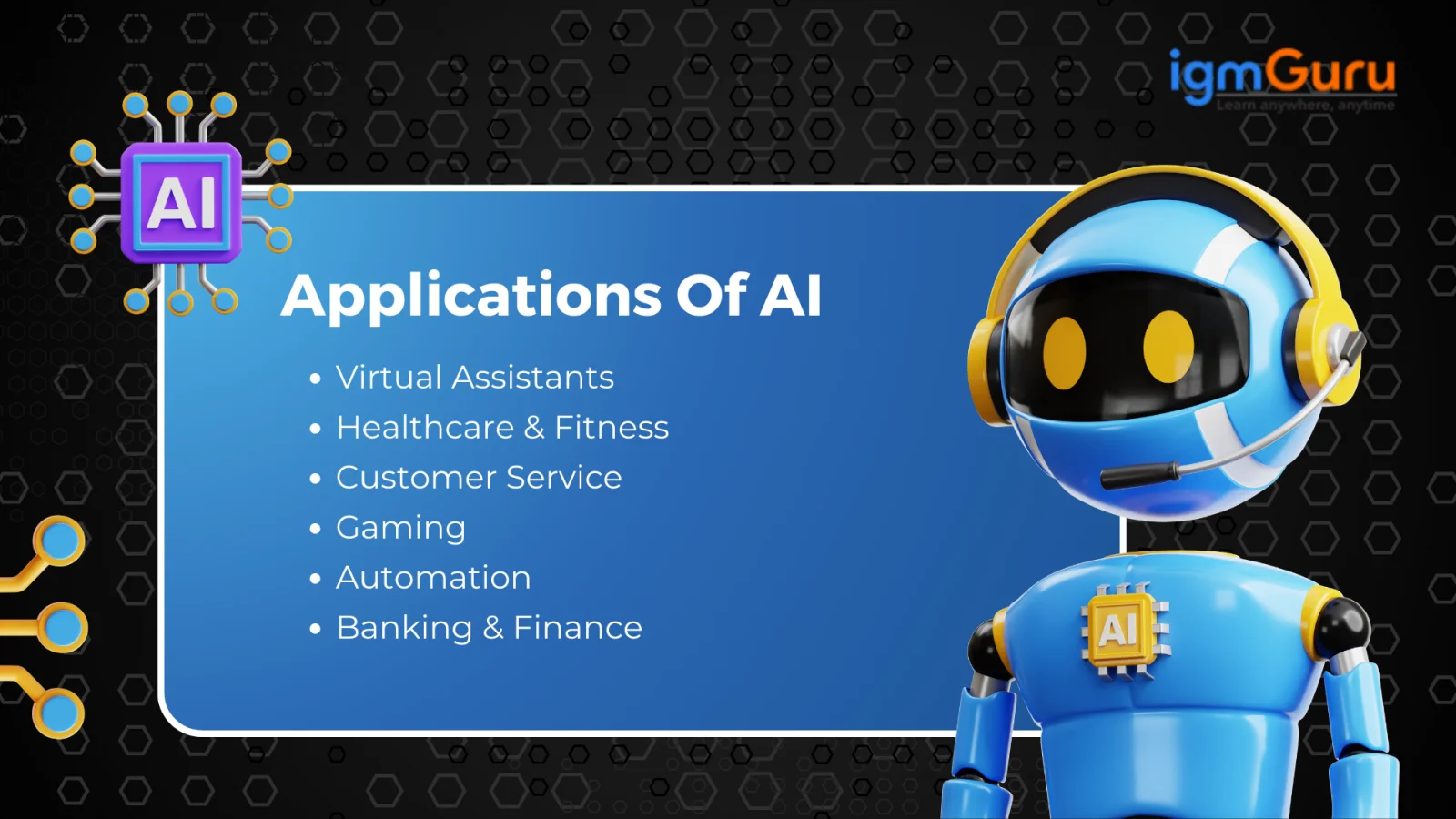
In this guide 'Introduction to Artificial Intelligence', we will explore applications of Artificial Intelligence. Basically, Artificial Intelligence significantly impacts daily life, offering practical solutions and enhancing user experiences across various activities. Here are some key applications of AI from a user perspective:
AI algorithms analyze purchasing and browsing history to suggest movies, products, music, and other content. Hence, every suggestion is tailored as per preferences. Platforms like Spotify, Amazon and Netflix employ AI to offer personalized recommendations. This makes it simpler to discover new products and content.
Alexa, Google Assistant and Siri are AI-powered virtual assistants that aid in managing daily tasks. They can answer questions, set reminders, engage in natural language conversations and control smart home devices. Hence, they make life more efficient and convenient.
AI improves personal health management via fitness trackers and virtual health assistants. These tools help in providing workout recommendations, offering preliminary medical advice and monitoring health metrics. It all aids in maintaining a healthy lifestyle.
AI enhances navigation systems along optimal route suggestions and real-time traffic updates. Google Maps and Waze are AI apps that analyze traffic patterns to offer the user the fastest routes. Hence, saving time as well as reducing travel stress.
AI-powered chatbots offer customer support instantly by answering queries as well as resolving issues quickly. These are available 24/7 and they handle all tasks. They work with troubleshooting technical problems and assisting with product purchases.
AI can transform a home into a smart home by controlling different systems and devices. Smart lighting, security systems and thermostats quickly learn user preferences and behaviors. Hence, they can automatically adjust settings to improve security, energy and comfort efficiency.
Artificial Intelligence offers multiple advantages and disadvantages. All these leave their impact on industries, individual lives and the society as a whole. Here is a comprehensive view of both these aspects for better understanding-
In this guide 'Introduction to Artificial Intelligence', we will talk about types of Artificial Intelligence. Artificial intelligence is a pretty widespread and huge field. It encompasses multiple levels and types of complexity. Gaining an understanding of these distinctions aids in learning more about how AI can be applied as well as its potential impact. Let's understand the primary types of artificial intelligence -
Narrow artificial intelligence is crafted and trained for only a specific task. It works within a very limited context and thus, does not have the ability to perform beyond its confined function. There are plenty of AI applications used today that fall under this specific category.
General artificial intelligence refers to machines with the ability to learn, apply and understand knowledge across multiple tasks. This is quite similar to human intelligence. General AI is still a theoretical concept and has not been realized yet. It's key features would be-
Artificial Superintelligence is the type that surpasses human capability and intelligence. It refers to an advanced kind of AI with the ability to outperform even the best human brains across all fields. This includes general wisdom, social skills and creativity. ASI is still a hypothetical concept as of now. However, there is much speculation and debate going on around the same among experts. It's potential would be -
Artificial intelligence has also been often categorized on the basis of its functionality. Another influencing factor is how AI simulates human cognitive abilities.
These are basic AI systems with the ability to perceive and react directly to the world. These do not store past experiences or memories. For instance, Deep Blue by IBM can efficiently play chess and make decisions as per the other player's current moves. It has no stored memory of the previous games.
AI systems that have the ability to employ past experiences to make informed future decisions. Their stored memory can influence their actions. For instance, self-driving cars utilize stored data from recent trips for effective driving decisions.
AI systems with the ability to understand beliefs, thoughts and emotions of other entities. This AI can also understand human intentions and interact socially. This is still mostly experimental and has not been fully realized yet.
AI that has its own self-awareness, understanding and consciousness about its own existence. Its current status is entirely theoretical. It is also an extension of the previously mentioned ‘Theory of Mind AI'.
Read Also- How to Build Career In Generative AI
The coming five years seem highly promising for artificial intelligence with significant advancements. The coming years are expected to shape and transform multiple aspects of industries, societal structures and our lives. Here are a few things one can expect to witness in the coming years.
AI will certainly continue to revolutionize the healthcare sector via personalized treatment plans, advanced drug discovery and better diagnostics. ML models are expected to analyze medical data with better precision, leading to disease outbreaks prediction and customized treatments. This will be as per individual genetic profiles. Thus, enhancing patient outcomes and minimizing healthcare costs.
NLP technologies are forecast to dramatically enhance, which will enable more nuanced and accurate understanding of human language. It will consequently enhance apps like customer service bots, translation services and virtual assistants. Interactions with machines will become more human-like and seamless.
Want to know how to start career in Artificial Intelligence? This guide 'Introduction to Artificial Intelligence' will help you understand it. Commencing a career in artificial intelligence is both exciting and challenging. Being a rapidly evolving field, it usually comes with its share of challenges in terms of staying updated. This comprehensive guide is aimed at helping aspirants navigate through the process and achieving a successful career in AI-
The first thing to do is to understand everything that AI entails. It involves creating machines or systems with the ability to perform tasks that usually require human intelligence. Common tasks include reasoning, learning, perception, language understanding and problem-solving. Its various subfields include machine learning, robotics, natural language processing and computer vision.
Having an undergraduate degree in computer science, mathematics, engineering or such field is imperative. These programs offer an in-depth and strong foundation in algorithms, programming, mathematical concepts and data structures. All these are essential for AI.
Enrolling in a specialized course or going for a majors in ML and AI can also be beneficial. These courses may offer a more targeted education.
There are plenty of online learning platforms that offer exceptional courses and training programs in artificial intelligence. These are often taught by industry professionals with good experience and expertise. Earning certifications can give the resume a boost. Reputable programs from esteemed platforms are highly valuable.
There are two ways of gaining practical experience. The first is to work on projects and the second is to go for an internship. Begin by building projects that will help in demonstrating AI concepts understanding. These can be simple models or complex systems such as chatbots, image classifiers or recommendation engines.
One can also apply for internships at startups, research labs or tech companies. Internships offer practical experience as well as exposure to industry practices. These also offer networking opportunities. Attending AI meetups, workshops and conferences help to network with professionals.
Let's explore AI Engineer Salary in this 'Introduction To Artificial Intelligence' guide. Artificial intelligence is expected to grow tremendously. Let us first take a look at some of its key statistics to better understand its future.
These statistics and numbers clearly state the current position and growing culture of AI. It is amid all this that the demand for AI engineers is on the rise. These are highly skilled, trained and certified professionals with extensive field knowledge. They have all necessary means to bring out the best from this technology.
An AI Engineer's salary may vary significantly. There are plenty of reasons for the same. Some of the most common factors that influence what an AI engineer is paid includes level of education, geographic location, years of experience, their specific skills and industry.
That said, they are still among the top-paid professionals in the tech world. This is primarily due to the rising demand for people with their skills and the increasing complexity of their job. This is an in-depth study of the factors that determine their salaries.
The geographical location of a person plays an imperative role here. Since remote work culture has grown significantly in recent years, it is more about where the company is located. In either case, geography is one of the biggest influencing factors in a person's income.
Explore Our Trending Articles
So, in this article, we have discussed the 'Introduction to Artificial Intelligence' and many important things related to it. Artificial intelligence has evolved drastically from just a theoretical concept to a highly transformative technology. Its significant societal impact and applications have also grown along with this tech. Its usefulness spans various sectors, improving decision-making, innovation and efficiency.
AI offers multiple advantages like improved accuracy and automation. At the same time, it poses various challenges too, like job displacement and ethical concerns. The future of AI is certainly exciting, with advancements expected to further integration of AI into everyday tasks.
Those who aspire to enter this dynamic and evolving field must ensure a strong educational foundation. Continuous learning is also a big part of being in the field of artificial intelligence. AI engineering promises a rewarding career and unlimited opportunities with competitive salaries. Thus, reflecting the value of this expertise and skills.
Course Schedule
| Course Name | Batch Type | Details |
| Artificial Intelligence Courses | Every Weekday | View Details |
| Artificial Intelligence Courses | Every Weekend | View Details |