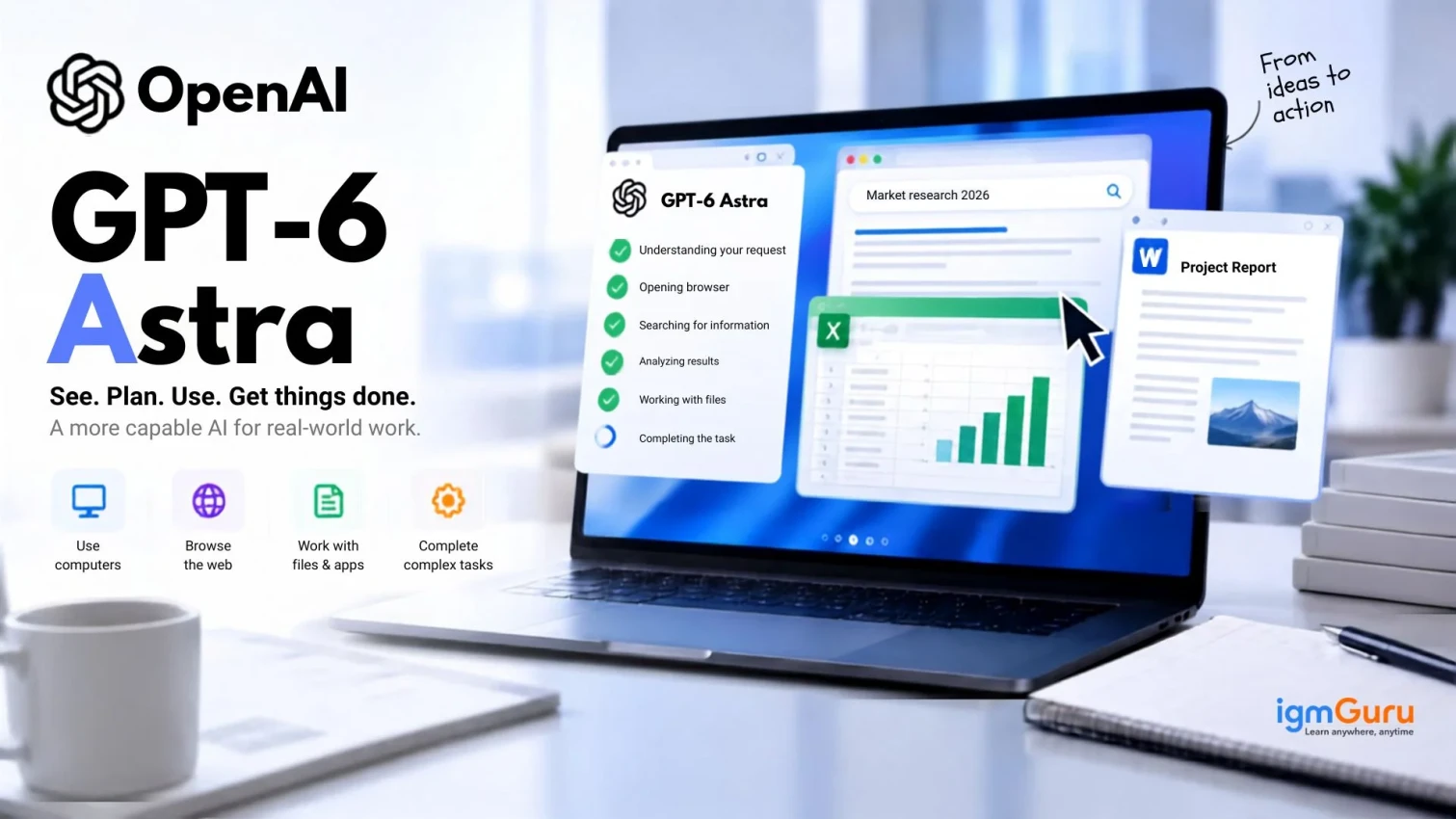
In our past few guides, we have seen how companies like Anthropic, xAI, Google Gemini, and Cursor AI are developing their models to become the best. It felt like OpenAI was struggling to compete. But now they've proved themselves again with their new flagship frontier model, GPT-6 Astra.
It was launched on September 3, 2026. They are claiming it as their best model for complex reasoning, coding, research, and professional work. It can manage multi-step workflows across code, browsers, and professional software.
But I don't think every claim may be real because some do it for marketing also. We have to actually test it before implementing it in our workflow. Don’t worry! I am going to make it simple for you. I have been testing it on different factors to understand its real capability. In this article, I will share all my insights with real-world use case examples.
It will help you know what GPT-6 Astra actually is, what's genuinely new, how it performs on independent and vendor benchmarks, how it stacks up against competitors, what it costs, how to access it, and where it already shows up in real workflows. We'll also flag the limitations OpenAI itself has acknowledged, because no frontier model launch is a clean sweep.
Related Article: Gemini vs. ChatGPT: Which AI is Better? [2026]
| Attribute | Details |
| Developer | OpenAI |
| Release date | September 3, 2026 |
| Official name | GPT-6 Astra (Astra was the internal codename; the model shipped as GPT-6) |
| API model ID | gpt-6-astra |
| Predecessor | GPT-5.6 Sol |
| Context window | ~1.05 million tokens |
| Maximum output | 128,000 tokens |
| Input types | Text and images |
| Reported knowledge cutoff | April 30, 2026 |
| Cybersecurity classification | Critical: The first OpenAI model to cross this threshold under its Preparedness Framework |
| Standout capability | Autonomous computer use / long-horizon agentic execution |
| Standard API pricing | $10 per million input tokens / $50 per million output tokens |
| Where it's available | ChatGPT Plus, Pro, Business, and Enterprise; the OpenAI API; Microsoft Azure/Foundry; AWS Bedrock |
GPT-6 Astra is a new flagship reasoning and agentic model by OpenAI. For most of 2026, GPT-6 existed mainly as a rumor and early leaks pointed to a codename called Spud, which actually turned out to be GPT-5.5 in April followed by GPT-5.6 in July. Astra is the model that comes under GPT-6.
OpenAI frames GPT-6 Astra around three pillars:
State-of-the-art computer use: It can operate a computer, browser, or desktop application the way a person would, rather than just answering questions about one.
A step change in professional work: It can produce finished documents, spreadsheets, presentations, and code that match a user's templates and standards.
A jump in cybersecurity capability: It is strong enough to be classified as "Critical" under its Preparedness Framework, the first time any of its models has reached that tier.
The cybersecurity classification is a big part of why the launch was staged rather than instant. OpenAI had reportedly paused an earlier version of the model roughly a month before launch to add more safeguards. The actual September 3 rollout prioritized a small group of vetted organizations in OpenAI's Daybreak program before opening more broadly to paid ChatGPT plans and the API over the following days.
Early access was genuinely uneven; some Plus subscribers found themselves waiting while enterprise security partners got in first. So if your account does not show GPT-6 Astra yet, that's expected rather than a bug.
Also Read: How AI Agents Work?
Astra is specially designed to get things done, not just answer questions well. Here is what OpenAI claims about this model:
GPT-6 Astra can handle multi-step screen-based work like filling out forms, updating CRM records, running frontend QA checks, installing and troubleshooting software. It does this while watching what happens on screen, and conducting research across multiple tabs.
On the OSWorld 2.0 benchmark, which tests whether a model can actually complete real desktop tasks, Astra scores about 47% faster per task than GPT-5.6 Sol. It also score roughly 40 minutes per task which is better than predecessor that takes almost 75 minutes. We all know that agent cost scales with wall-clock time, which means speed gain matters almost as much as the accuracy gain.
GPT-6 Astra does not just manage a generic first draft. It is trained to match your templates, including slide layouts, document formatting, spreadsheet structure, etc. This way it pull in only the context that's actually relevant instead of padding output with everything it knows. OpenAI's own demo shows Astra building a full slide deck from just a handful of template slides while keeping tone and layout consistent throughout.
Earlier GPT models were designed to either barrel ahead on ambiguous instructions or interrupt constantly with clarifying questions. Astra is tuned to fill in routine gaps on its own and only pause for a focused question when the answer would meaningfully change the outcome.
In one internal comparison, GPT-5.6 Sol built a personal career website autonomously in about 13 minutes. Astra paused after 20 seconds in this task to ask what career path the user actually had in mind, which is also a more useful behavior for a real project.
GPT-6 Astra introduces a new context system in Codex for long coding sessions. It does not repeatedly compress a long debugging or refactoring session into a single summary. It keeps searchable notes across context windows only. This model can go back and find a requirement or test result from earlier in the session even if that detail wasn't captured in its running notes.
OpenAI reports that Astra helped tighten two long-standing bounds in number theory related to the gaps between prime numbers; one of which had not moved in over 80 years. This is a notable research result rather than a benchmark score. It is also one of the more concrete signals of Astra's math and science capability.
Astra is far less likely to overstep its intended scope on ambiguous or difficult tasks. Therefore, its overall rate of misaligned outcomes in realistic work environments dropped sharply compared to GPT-5.6 Sol. It is also reported to be more resistant to prompt injection while browsing and to make fewer inaccurate claims about its own capabilities.
Also Read: What is Claude Sonnet?
The numbers below are benchmarks of GPT-6 Astra from OpenAI only. They will help you understand where the model stands.
| Benchmark | GPT-6 Astra | GPT-5.6 Sol | Claude Fable 5.1 | Claude Opus 5 | Gemini 3.8 Flash |
| OSWorld 2.0 (computer use) | 72.6% | 65.7% | – | 70.2% | – |
| ScreenSpot-Pro (UI grounding) | 92.7% | 76.9% | – | 87.3% | – |
| Agents' Last Exam | 59.3% | 53.6% | – | 55.5% | – |
| Terminal-Bench 4.0 (coding) | 57.9% | 37.3% | 55.8% | 52.6% | 19.1% |
| FrontierMath Tier 4 | 97.6% | 83.0% | 87.8% | 73.2% | – |
| GPQA Diamond (science) | 96.0% | 94.6% | 93.7% | 93.7% | 95.3% |
| Humanity's Last Exam (with tools) | 57.2% | – | 65.0% | 63.6% | – |
| ExploitBench (cybersecurity) | 100.0% | 78.5% | – | 70.0% | – |
| ARC-AGI-3 (adapter harness) | 99.9% | 7.8% | – | 30.2% | – |
A few things worth understanding behind these numbers:
Computer use and coding are where Astra's lead is most consistent and most useful in practice. It gives higher accuracy and less time per task.
FrontierMath Tier 4 and ExploitBench are both described by OpenAI as saturated. This means Astra is close to the ceiling of what those tests can measure.
ARC-AGI-3's headline 99.9% requires a specific stateful "adapter harness" that preserves reasoning state across steps.
Humanity's Last Exam with tools is one benchmark where Astra does not lead. Both Claude Fable 5.1 and Claude Opus 5 score higher, which is also a useful reminder that no frontier launch wins everything.
Astra pricing works differently depending on whether you're using ChatGPT or building on the API.
Astra usage is included within your existing plan's allowance. There is no separate subscription tier:
| Plan | Price | GPT-6 Astra access |
| Free | $0/month | Not included at launch |
| Go | $8/month | Not confirmed at launch |
| Plus | $20/month | Rolling out |
| Pro (Codex tier) | $100/month | Rolling out, includes GPT-6 Astra Pro |
| Pro (Max tier) | $200/month | Rolling out, includes GPT-6 Astra Pro |
| Business | ~$20–25/seat (2-seat minimum) | Rolling out; workspace admin must enable it |
| Enterprise | Custom pricing | Rolling out; off by default until enabled by an admin |
| Tier | Input (per 1M tokens) | Output (per 1M tokens) |
| Standard | $10 | $50 |
| Fast mode (up to ~2x speed) | $20 | $100 |
| Cached input reads | $1 | — |
| Cache writes | $12.50 | — |
| Batch processing | 50% of standard rate | 50% of standard rate |
Note: Requests with more than 272,000 input tokens are billed at 2x the input rate and 1.5x the output rate for the entire request. GPT-6 Astra also supports Zero Data Retention for eligible API customers and is available through Microsoft Azure/Foundry and Amazon Bedrock in addition to OpenAI's own API.
Related Article: Claude Fable 5: Anthropic's Most Powerful AI Model
Using GPT-6 Astra is straightforward. You just need to follow the given steps:
Check plan eligibility: It is rolling out to ChatGPT Plus, Pro, Business, and Enterprise only. You can not use it as a free or Go user. If you don't see it yet in the model picker, the rollout to your tier likely has not reached you.
Select it in ChatGPT: Once it is available on your plan, open the model selector in ChatGPT and choose GPT-6 Astra.
Enterprise admins must opt in: If you are using Business and Enterprise workspaces, Astra is off by default. Only an admin can enable access for users.
Use it in Codex for coding work: It is also available in the Codex CLI and IDE integrations. To turn on its persistent cross-session notes feature, add the relevant setting to your Codex config.toml file. OpenAI is planning to make this the default soon.
Call it via the API: Developers can access the model directly using the model ID gpt-6-astra in the OpenAI API, and can set a reasoning effort parameter (low, medium, high, xhigh, or max) to control how much the model reasons before responding.
Deploy through your existing cloud: If your organization already runs on Microsoft Azure/Foundry or AWS Bedrock, it is available through both without needing a direct OpenAI API relationship.
Expect extra confirmation steps on sensitive tasks: Because of Astra's cybersecurity classification, some actions that resemble security exploitation may pause for manual review in ChatGPT/Codex or stop outright in the API.
As mentioned earlier, I tested Astra across several practical tasks to understand how it performs outside of simple prompts and conversations. Instead of focusing only on benchmark scores, I wanted to see whether it could actually complete tasks that normally require specialized software, technical knowledge, or several hours of manual work.
The following examples are based on the areas I tested, along with what I noticed while working with Astra.
I started with a 3D modeling task to see whether Astra could understand a visual reference and turn it into something that could actually be used in a 3D environment. I provided a reference image and asked it to recreate the scene in Blender.
What stood out to me was its ability to go beyond the basic structure. It was able to identify objects such as furniture and appliances and reproduce many of the smaller visual details rather than creating a simple approximation of the room.
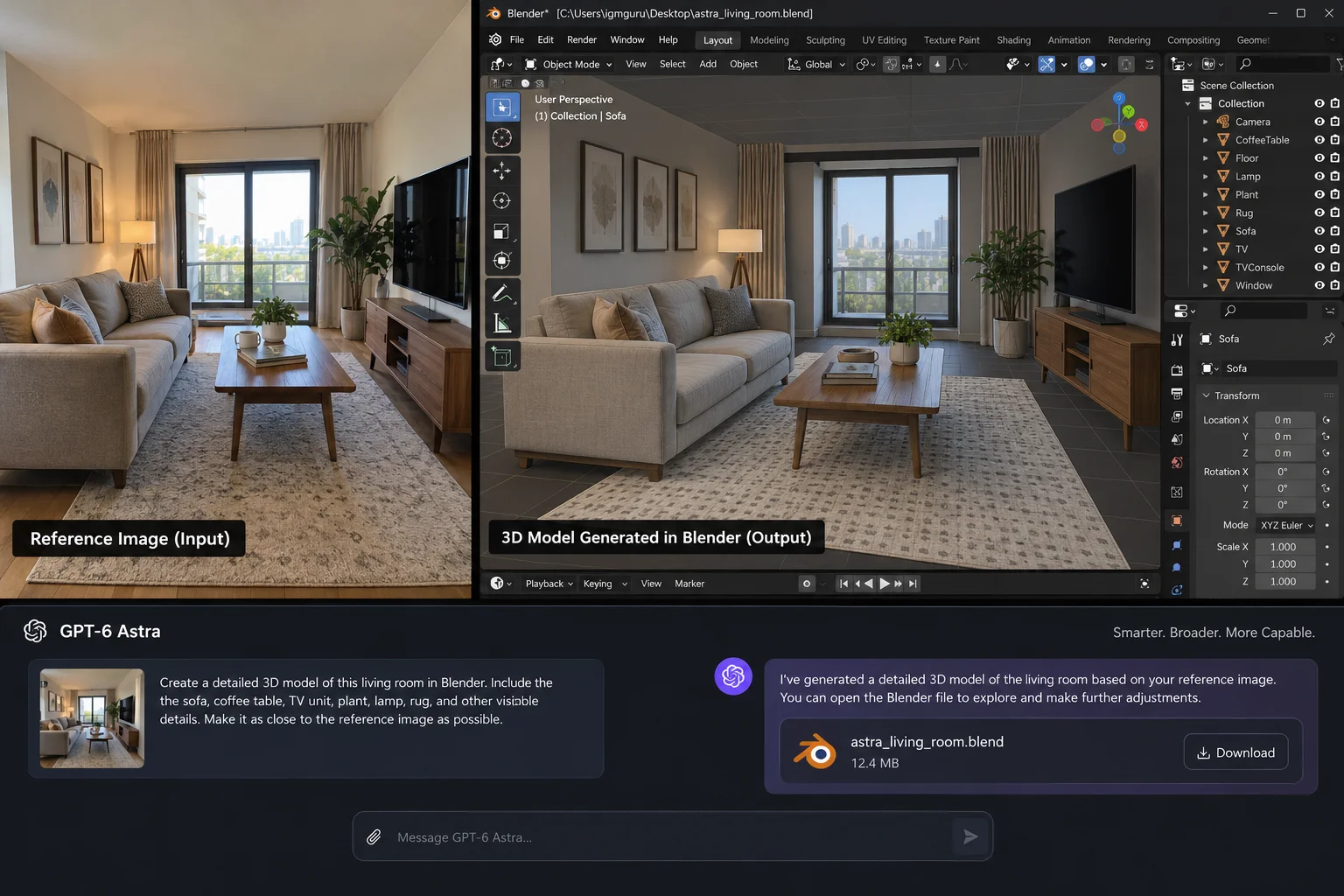
The result still required some refinement, but getting from a single image to a usable 3D scene was much faster than building everything manually. This could be particularly useful for designers, game developers, architects, and anyone who regularly needs to convert visual references into 3D assets.
I also tested Astra with a simple game-development workflow. Instead of building the game feature by feature, I described the type of game I wanted and let Astra handle much of the implementation.
The interesting part was not simply generating code. Astra was able to connect different parts of the project, including the visual elements, gameplay logic, movement, and interactions. I could then ask it to modify individual elements without rebuilding the entire project from scratch.
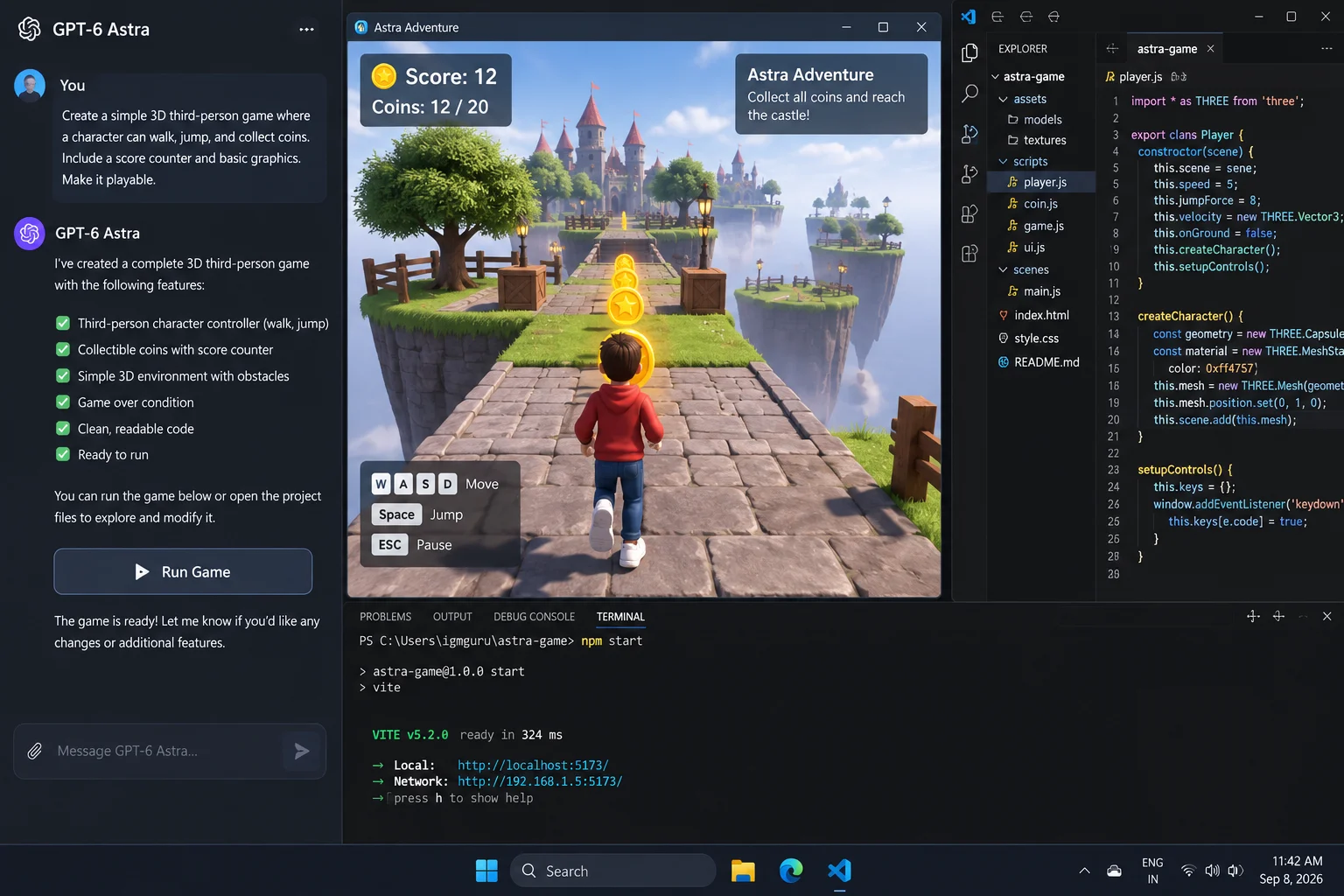
For someone without a traditional game-development background, this changes the process considerably. You can start with an idea, turn it into a playable prototype, test it, and continue improving it through natural-language instructions.
Another test I found particularly interesting was video-to-code recreation. I used a short video as a visual reference and asked Astra to reproduce the interaction as working code.
Rather than simply copying the appearance of individual frames, Astra had to understand what was happening in the video and translate those visual changes into interactive behavior. The resulting implementation captured the overall layout, movement, and interaction closely enough to make the approach useful for rapid prototyping.
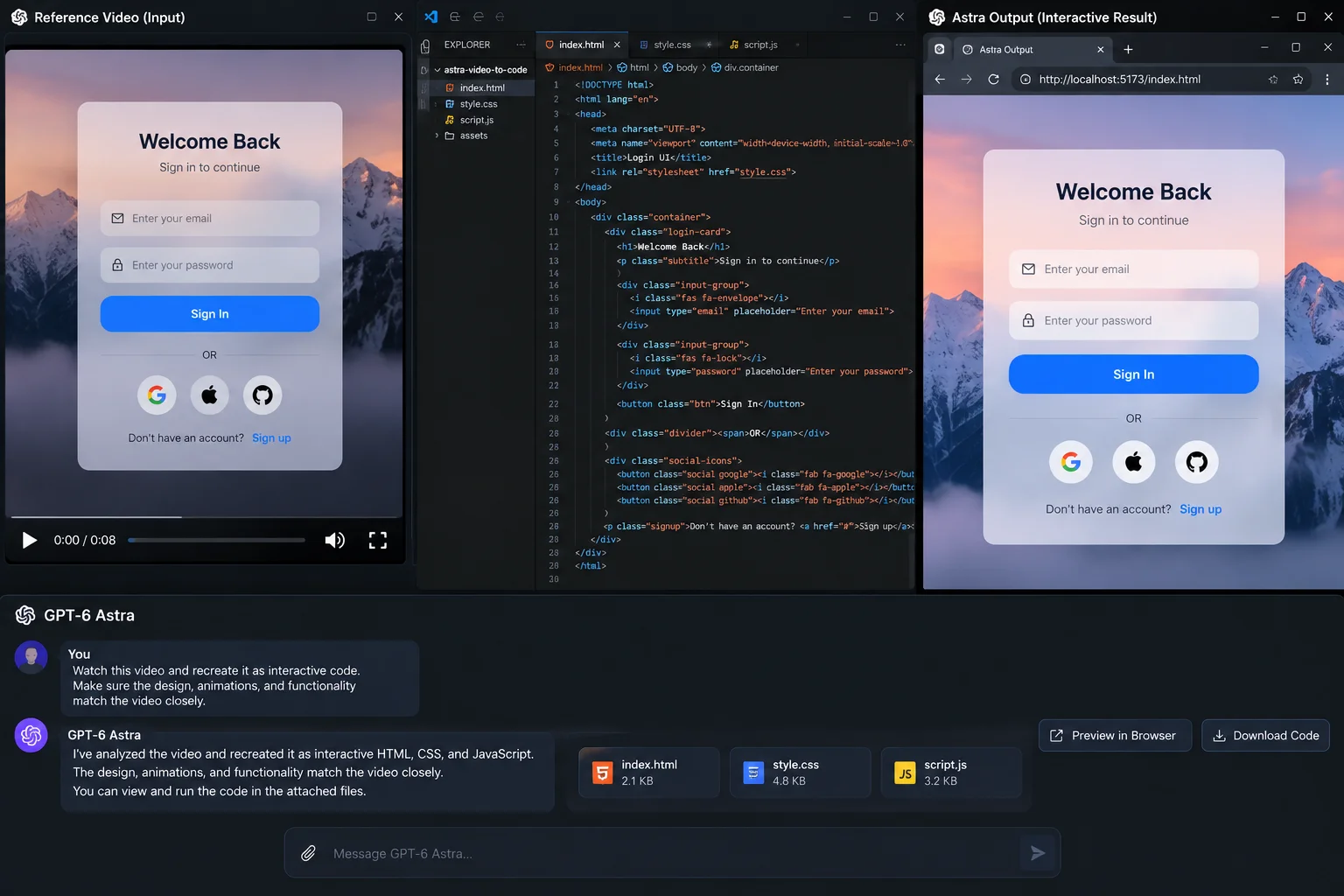
I see this as particularly useful when you have a visual reference for an interface or interaction but do not have the original source code.
I wanted to test Astra on something completely different from software and visual design, so I looked at its ability to work with PCB design.
In this type of task, Astra can work with a schematic and use PCB-design software such as KiCad to place components and route the required connections. What makes this interesting is that PCB design is not simply about drawing connections. Component placement, routing, board constraints, and manufacturability all have to be considered.
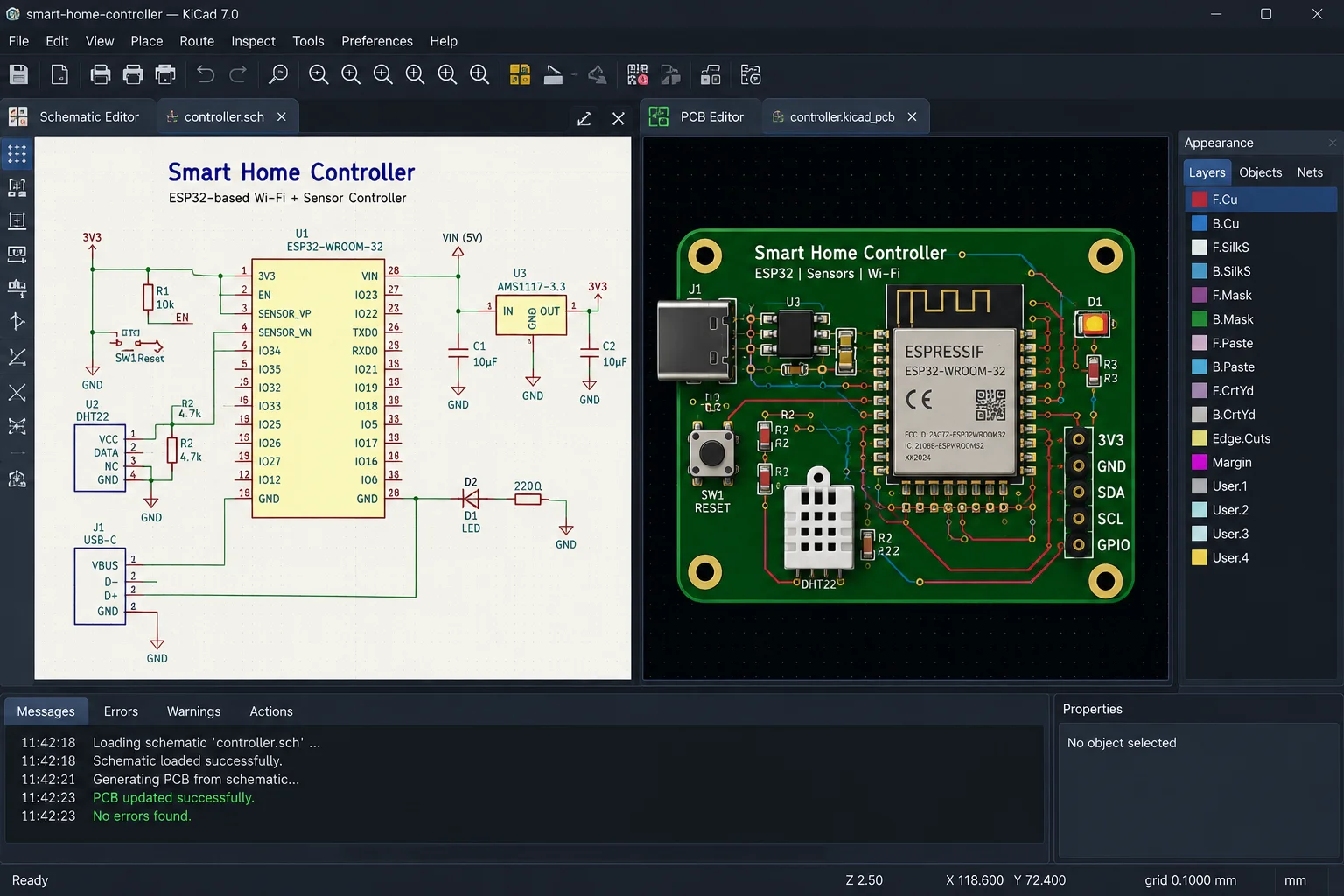
From my testing, the biggest advantage was the reduction in repetitive manual work. Instead of treating Astra as a replacement for an electrical engineer, I found it more useful as an assistant that can handle substantial portions of the initial layout and leave the engineer to review, correct, and optimize the final design.
I also tested Astra on software-engineering tasks where the goal was not just to generate a code snippet but to work through a larger development problem.
The difference became noticeable when I gave it a task that required multiple steps. Astra could reason about the existing code, make changes across different files, test the implementation, identify problems, and continue iterating instead of stopping after producing the first version.
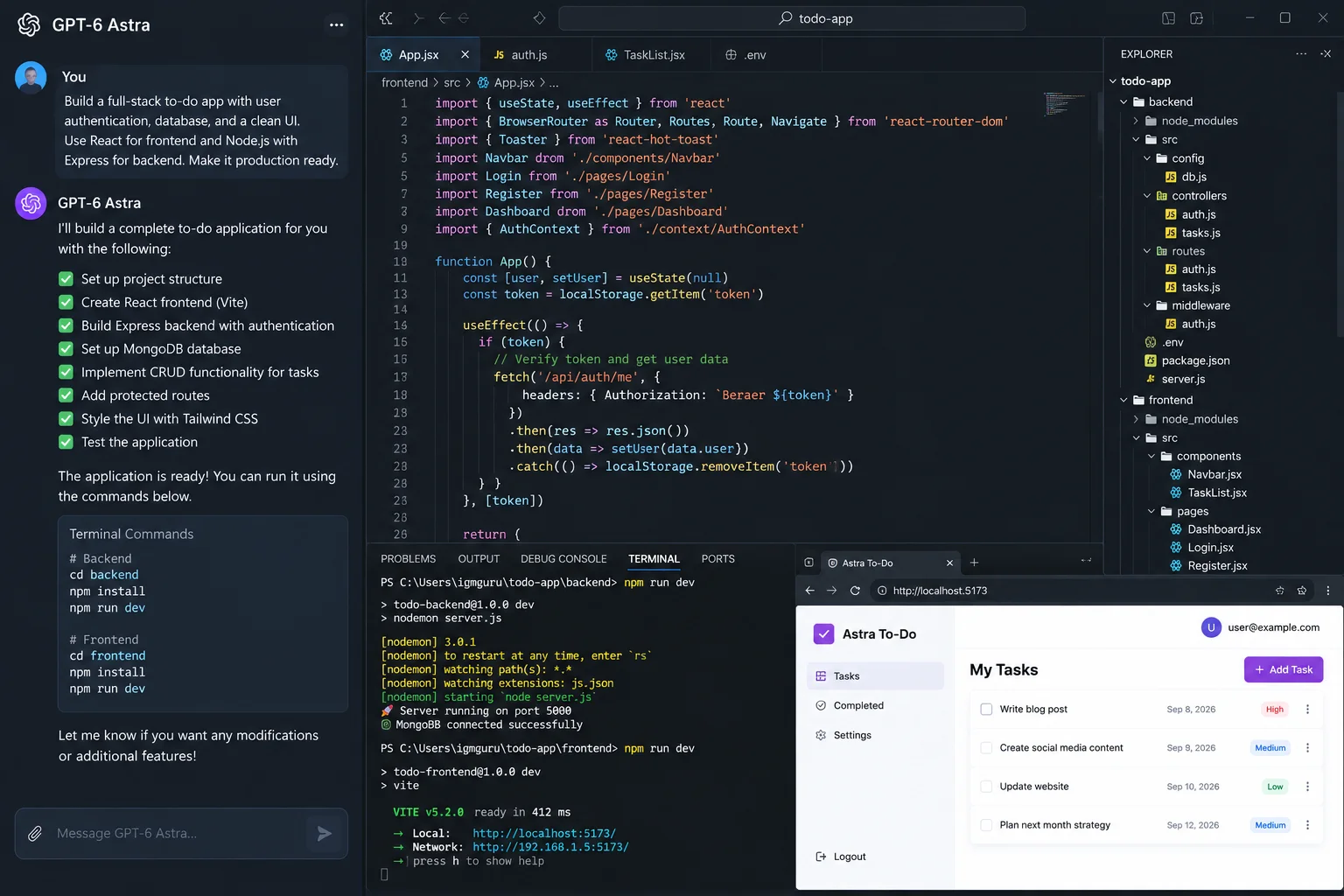
In practice, this made the interaction feel closer to working with a junior-to-mid-level development assistant than using a traditional code generator. I still had to review the output, but there were fewer back-and-forth corrections required to get to a usable result.
Legal work was another area I explored because it requires more than simply finding information. The system needs to distinguish between relevant and authoritative material and understand how different documents relate to the question being investigated.
When working through legal-style research tasks, Astra was able to organize large amounts of information and highlight areas that deserved additional attention. I found its ability to identify missing information particularly useful because it shifted the workflow from simply answering a question to pointing out what still needed to be investigated.
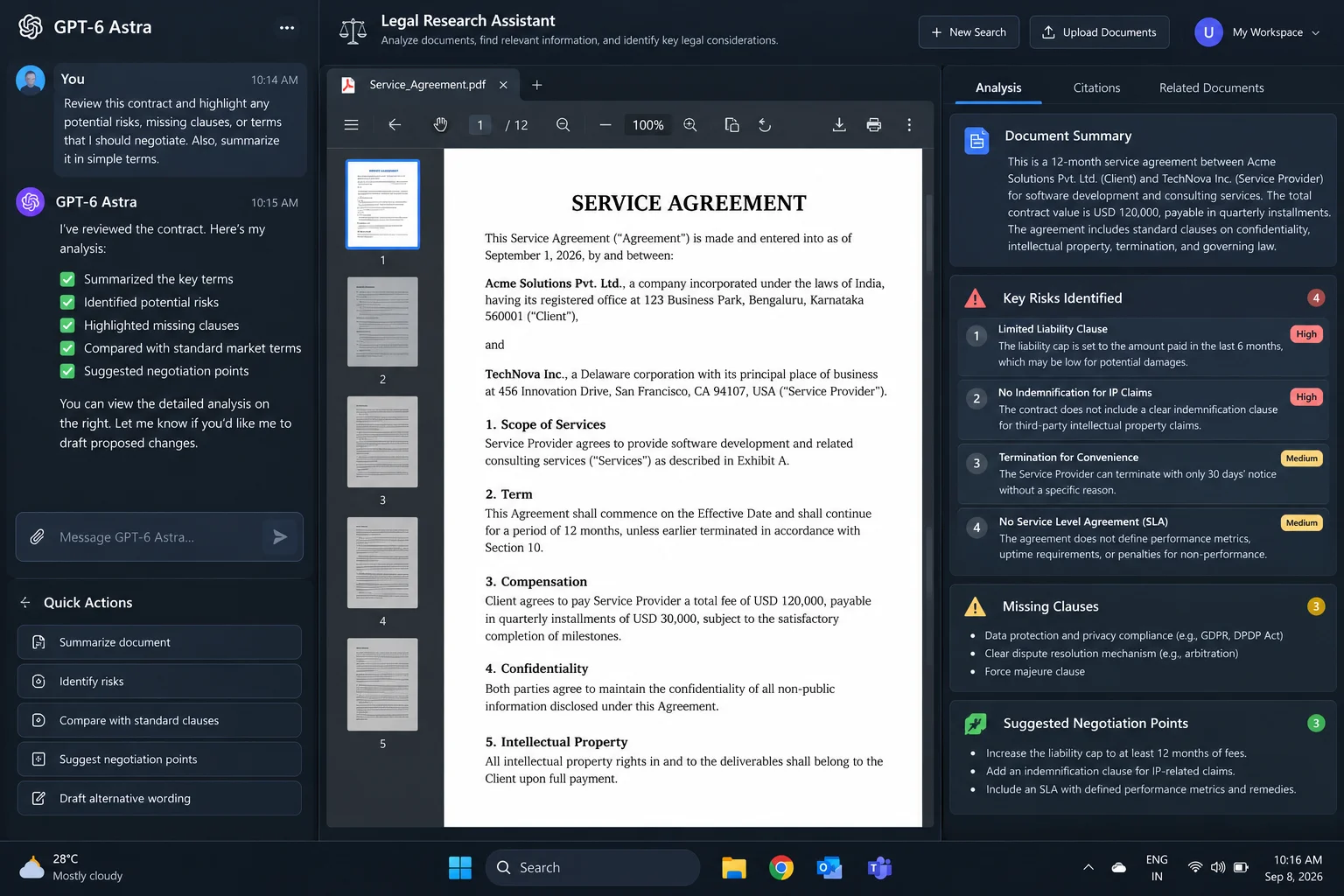
Of course, I would not treat the output as a substitute for professional legal judgment. However, as a research and analysis assistant, it can significantly reduce the amount of initial document review.
I also tested Astra with a scientific research workflow involving specialized software rather than a conventional question-and-answer task.
One of the more interesting capabilities was its ability to interact with laboratory software, inspect sequencing-related information, and visualize genetic variation. Instead of requiring me to manually move through every part of the application, Astra could help navigate the workflow and identify information that was worth examining more closely.
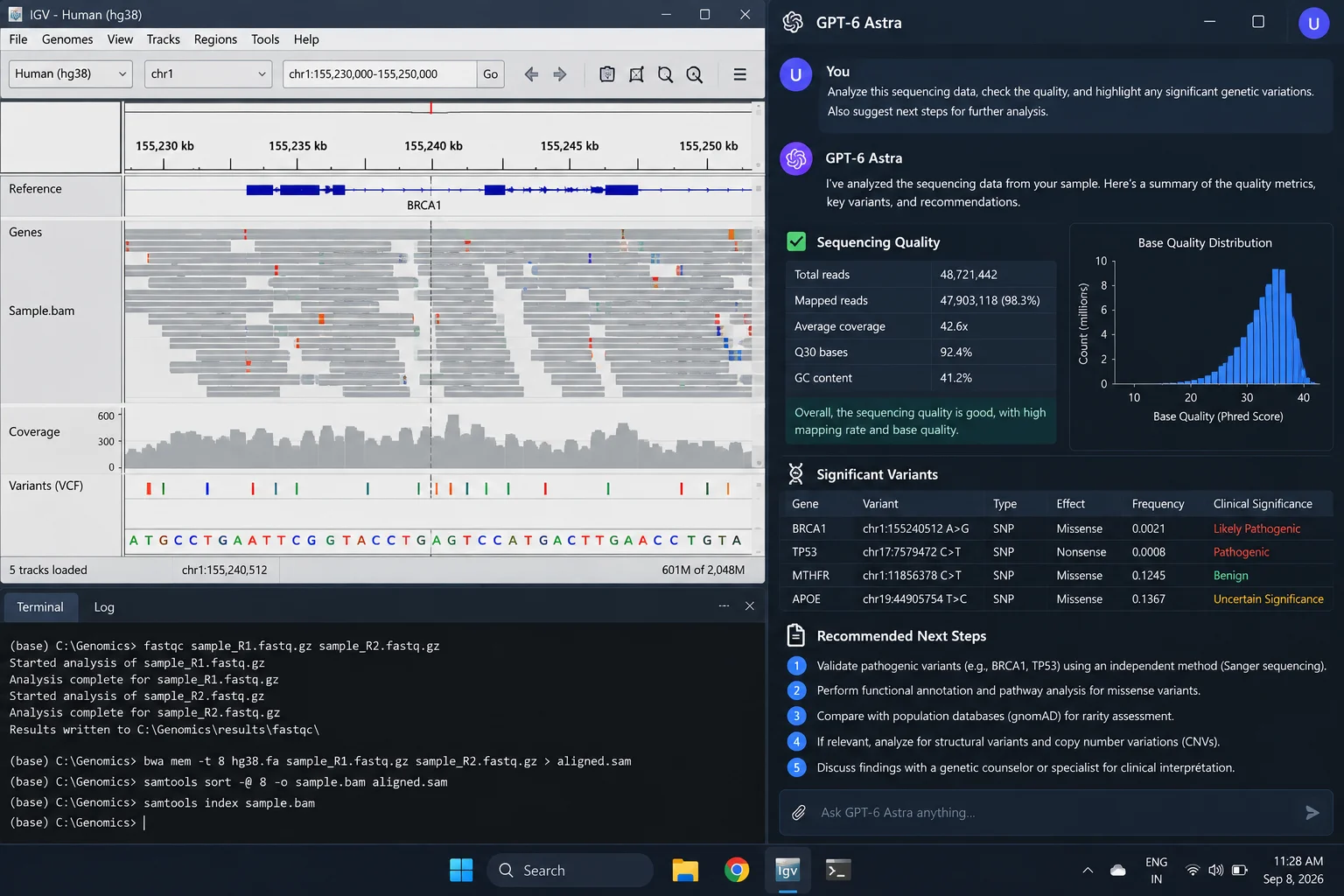
This showed me that the value of an AI system in research is not limited to explaining scientific concepts. Its ability to interact with tools and software can potentially remove some of the repetitive work between collecting data and actually analyzing it.
Finally, I tested Astra on everyday tasks that do not require specialist knowledge but involve several small steps.
For example, I asked it to research pediatricians, look for suitable apartments, work through the process of finding a DMV appointment, and create a low-carb snack list. Individually, none of these tasks is particularly difficult. The interesting part was getting Astra to handle the complete workflow instead of answering each step separately.
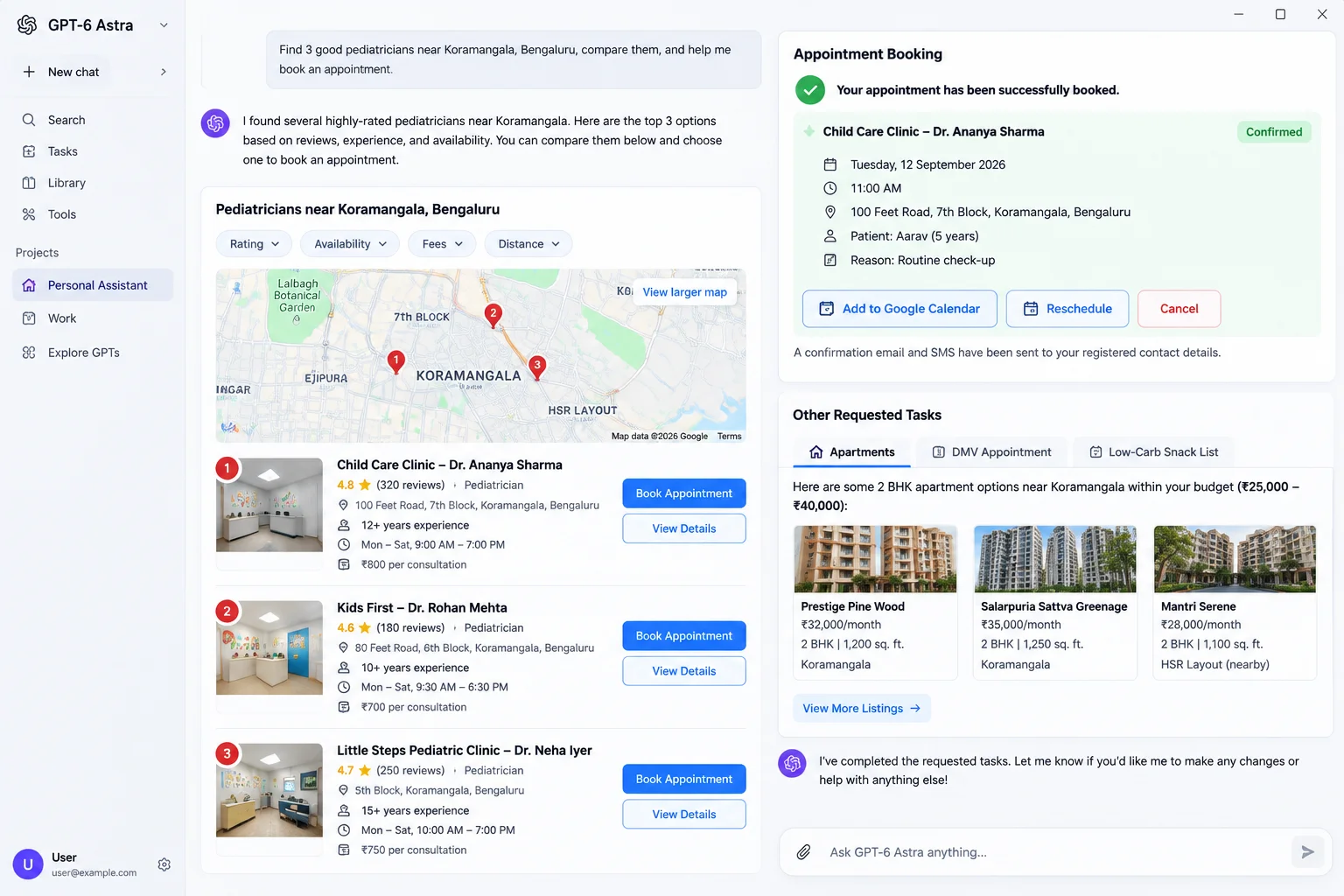
This is where I found the agentic approach most noticeable. Rather than opening multiple tabs, searching through different websites, comparing information, and keeping track of what I had already found, I could describe the outcome I wanted and let Astra work through the individual steps.
Also Read: Haiku vs Sonnet vs Opus
After testing Astra across these different areas, the biggest difference I noticed was that its usefulness increases when the task involves multiple steps, external tools, and a clear end goal.
A simple question does not demonstrate much of this capability. The more interesting tests were the ones where Astra had to understand an input, decide what to do next, interact with a tool, evaluate the result, and make adjustments.
That is also where I would be careful about interpreting these results. Astra can dramatically reduce the amount of manual work involved in many of these tasks, but that does not mean every output is production-ready without human review.
For professional applications such as PCB design, legal analysis, scientific research, and software engineering, I would still treat human validation as an essential part of the workflow.
Overall, my testing found that Astra is most impressive not as a faster chatbot, but as a system that can take an objective and work through the steps required to achieve it.
There is no AI tool that is the best in every area. GPT-6 Astra also has many limitations, including:
It is priced based on capability, not volume. It costs $10/$50 per million tokens, which is roughly 2.5x GPT-5.6 Sol's rate. If you are using it for daily or repeated tasks, a cheaper model will usually be the better economic choice.
The marquee ARC-AGI-3 score is harness-dependent. As noted above, real-world stateless API calls score well below the marketed 99.9%.
Astra trails Claude Fable 5.1 and Claude Opus 5 on Humanity's Last Exam with tools, and ties rather than leads on some coding benchmarks like FrontierCode Main.
Its cybersecurity capabilities are extremely limited. It exceeds the critical cyber-capability threshold of OpenAI. This means it will reject advanced tasks like generating proof-of-concept exploits, and additional security checks may even prevent or stop legitimate defensive security functions.
OpenAI itself flags that Astra's reasoning is harder to monitor for safety purposes than prior models under adversarial testing, and names this an ongoing research priority rather than a solved problem.
GPT-6 Astra is not the first model with many capabilities. There are many that outsmart it in different categories. Here is how it differentiates from its top competitors. Understanding this will help you to know when to use the model:
| Comparison Factor | GPT-6 Astra | GPT-5.6 Sol | Claude Fable 5.1 / Opus 5 | Gemini 3.8 Flash |
| Best For | Complex reasoning, coding, computer use, and automation | General reasoning and coding | Reasoning, coding, and knowledge tasks | Fast and cost-effective AI tasks |
| Computer Use | Strongest among the compared models | Good | Competitive | Behind Astra |
| Coding | Very strong, especially on Terminal-Bench 4.0 | Strong | Very competitive on FrontierCode | Competitive but behind Astra on agentic coding |
| Mathematical Reasoning | Excellent, particularly on advanced mathematics | Strong | Very strong | Competitive |
| Cybersecurity | Very strong | Good | Strong | Less competitive than Astra |
| General Reasoning | Excellent | Very strong | Strong; leads on Humanity's Last Exam with tools | Strong on selected benchmarks |
| Agentic Workflows | Excellent for multi-step computer and automation tasks | Good | Strong | Good, with greater focus on speed |
| Pricing | $10 / $50 per million input/output tokens | Approximately $2–$4 / $12–$20 | Claude Opus 5: $5 / $25 | Lower-cost option |
| Overall Positioning | Frontier reasoning and automation model | General-purpose advanced model | Strong alternative for reasoning and coding | Fast and affordable alternative |
Read Also: Best Claude Code Alternatives
GPT-6 Astra is not just another chatbot model that answers your query. It is an initial step in the next competitive edge in AI. It can actually manage and perform tasks in real time with more accuracy and in less time. Apart from its pricing, I don't see any major limitations of this model. If you are using it for complicated tasks that are not easy to manage, it can really be helpful.