Natural Language Processing is one of the most in-demand tech skills right now. Companies are hiring NLP engineers, data scientists, and machine learning engineers to build chatbots, search engines, sentiment analysis tools, and large language model applications. If you have an NLP interview coming up, you need more than textbook definitions. You need answers that show you understand the concepts and can apply them to real problems.
I have been on both sides of the table for NLP interviews, as a candidate and as an interviewer. That experience shapes every answer in this guide, since I know exactly what interviewers listen for and where most candidates lose marks.
This guide covers NLP interview questions and answers for every experience level. We start with the basics for freshers, move into intermediate topics like word embeddings and transformers, then cover advanced concepts that experienced professionals are expected to know. We also include scenario-based questions because many interviewers now test how you think through real-world problems, not just how well you memorize definitions.
Let's get started!
Read Also: Deep Learning vs Machine Learning: Beginner's Guide
These questions test your foundational knowledge. Interviewers ask them to check if you understand the building blocks of NLP before moving into deeper technical topics.
Natural Language Processing, or NLP, is a branch of artificial intelligence that helps computers understand, interpret, and generate human language. It combines linguistics with machine learning so that machines can work with text and speech the way humans do. You see NLP in action every day through tools like spell checkers, voice assistants, translation apps, and chatbots.
NLP covers a wide range of tasks. Some common ones include text classification, sentiment analysis, named entity recognition, machine translation, text summarization, question answering, and speech recognition. Each task solves a different problem, but they all rely on the same core idea: teaching machines to process language in a structured way.
Tokenization is the process of breaking text into smaller units called tokens. These tokens can be words, subwords, or even characters, depending on the method used. For example, the sentence "NLP is fun" gets split into three tokens: "NLP," "is," and "fun." Tokenization is usually the first step in any NLP pipeline because models cannot work with raw text directly.
Stemming and lemmatization both reduce words to their base form, but they work differently. Stemming chops off word endings using simple rules, so it can produce incomplete words like "studi" from "studies." Lemmatization uses vocabulary and grammar rules to return the actual dictionary form of a word, so "studies" becomes "study." Lemmatization is more accurate, but stemming is faster and needs fewer resources.
Stop words are common words like "the," "is," "and," and "a" that appear frequently in text but carry little meaning on their own. We remove them in many NLP tasks to reduce noise and focus on the words that actually matter for the analysis. That said, stop word removal is not always a good idea. Tasks like sentiment analysis or machine translation often need those words to preserve context and meaning.
The Bag of Words model represents text as a collection of word counts, ignoring grammar and word order. It builds a vocabulary from the entire dataset and then represents each document as a vector showing how many times each word appears. BoW is simple and easy to implement, but it loses information about word order and context, which limits its accuracy on complex tasks.
TF-IDF stands for Term Frequency-Inverse Document Frequency. It measures how important a word is to a specific document within a larger collection of documents. Unlike BoW, which treats every word equally, TF-IDF gives higher weight to words that appear often in one document but rarely across others. This helps highlight meaningful words and reduces the influence of common terms that add little value.
Related Article: CatBoost in Machine Learning
Text classification is the task of assigning predefined categories or labels to a piece of text. Spam detection, sentiment analysis, and topic labeling are all examples of text classification. The process usually involves converting text into numerical features and then training a model to predict the correct label based on those features.
Supervised learning uses labeled data, meaning each input has a known correct output. Tasks like spam detection or sentiment classification often use supervised learning because you train the model on examples that already have labels. Unsupervised learning works with unlabeled data and tries to find patterns or structure on its own. Topic modeling and word clustering are good examples of unsupervised NLP tasks.
POS tagging is the process of labeling each word in a sentence with its grammatical role, such as noun, verb, adjective, or adverb. It helps machines understand sentence structure and meaning. POS tagging is used in tasks like named entity recognition, grammar checking, and information extraction, where knowing a word's role changes how it should be interpreted.
Once you know the basics, interviewers want to see if you understand how modern NLP systems actually work. These questions focus on embeddings, language models, and the shift toward transformer-based architectures.
Word2Vec learns word embeddings by predicting a word from its surrounding context or predicting the context from a word. GloVe takes a different approach and builds embeddings using global word co-occurrence statistics across the entire corpus. FastText improves on both by breaking words into character n-grams, which lets it generate embeddings for rare words and even words it has never seen before. This makes FastText especially useful for languages with complex word forms.
Contextual embeddings assign a different vector representation to a word depending on the sentence it appears in. This solves a major limitation of older embeddings like Word2Vec, where a word like "bank" always got the same vector regardless of whether it meant a riverbank or a financial institution. Models like BERT and ELMo generate contextual embeddings, which is a big reason modern NLP systems perform so much better on tasks that involve ambiguity.
An N-gram language model predicts the next word in a sequence based on the previous N-1 words. A bigram model looks at one previous word, and a trigram model looks at two. These models are simple and fast, but they struggle with long-range dependencies because they only consider a fixed, short window of context. This limitation is one of the main reasons the field moved toward neural network-based language models.
Recurrent Neural Networks process text word by word while carrying information forward through a hidden state. The problem is that gradients tend to shrink or explode as they travel back through many time steps during training, a problem known as vanishing or exploding gradients. This makes it hard for RNNs to remember information from earlier in a long sequence. LSTMs, or Long Short-Term Memory networks, solve this with a gating mechanism that controls what information to keep, update, or forget, allowing them to retain relevant context over much longer sequences.
The attention mechanism allows a model to focus on the most relevant parts of the input when producing each part of the output. Instead of relying on a single fixed vector to represent an entire sentence, attention lets the model look back at every input token and decide how much weight to give each one. This was a breakthrough because it solved the bottleneck problem in earlier sequence models and became the foundation for transformer architectures.
Also Read: How To Learn Machine Learning?
Fine-tuning starts with a pretrained model that already understands general language patterns from large-scale training. You add a task-specific layer on top, such as a classification head, and then train the whole model on your labeled dataset with a small learning rate. This lets the model adapt its existing knowledge to your specific task, like sentiment analysis or named entity recognition, without needing to train from scratch.
Class imbalance happens when one label has far more examples than another, which can bias the model toward the majority class. You can address this by oversampling the minority class, undersampling the majority class, or using techniques like SMOTE to generate synthetic examples. Another approach is adjusting class weights during training so the model pays more attention to underrepresented labels. Choosing the right evaluation metric, like F1 score instead of accuracy, also matters a lot in imbalanced settings.
Encoder-only models, like BERT, read the entire input at once and build a rich representation of it, which makes them great for classification and understanding tasks. Decoder-only models, like GPT, generate text one token at a time based only on previous tokens, which makes them well suited for text generation. Encoder-decoder models, like T5 and the original transformer, use an encoder to understand the input and a decoder to generate an output, which works well for tasks like translation and summarization.
Preprocessing for transformers looks different from traditional NLP preprocessing. You generally skip aggressive steps like stemming or stop word removal because transformers learn context on their own and perform better with natural text. The main steps are cleaning the raw text, applying the model's own tokenizer, which usually uses subword tokenization, and formatting the input with special tokens and attention masks that the model expects.
Transfer learning means taking a model trained on one large task, usually general language understanding, and reusing that knowledge for a different, often smaller, task. In NLP, this usually means starting with a pretrained language model and fine-tuning it on your specific dataset. It is useful because training large language models from scratch requires huge amounts of data and compute, which most teams do not have. Transfer learning gives you strong performance with far less data and training time.
At this level, interviewers expect you to explain how modern architectures work under the hood and how you would solve real production challenges involving large language models.
The transformer architecture processes an entire input sequence at once instead of step by step, which makes it much faster to train than RNNs. It relies on self-attention layers to understand relationships between words regardless of their distance in the sentence, along with feed-forward layers, layer normalization, and residual connections. The original design has an encoder that processes the input and a decoder that generates the output, though many modern models use only one of these two components.
Self-attention lets each word in a sequence look at every other word and decide how relevant they are to each other. It does this by creating query, key, and value vectors for each token and using them to calculate attention scores. Multi-head attention runs this process multiple times in parallel with different learned projections, which allows the model to capture different types of relationships, like grammar in one head and meaning in another, all at the same time.
Transformers process all tokens in parallel, so they have no built-in sense of word order the way RNNs do. Positional encoding solves this by adding a vector to each token's embedding that represents its position in the sequence. This way, the model can tell the difference between "the dog bit the man" and "the man bit the dog," even though both sentences contain the same words.
Masked Language Modeling hides certain words in a sentence and trains the model to predict them using context from both directions, which is how BERT is trained. Causal Language Modeling trains the model to predict the next word using only the words that came before it, which is how GPT-style models are trained. This difference is why BERT-style models are strong at understanding tasks, while GPT-style models are strong at generating fluent text.
Byte Pair Encoding, or BPE, builds a vocabulary by repeatedly merging the most frequent pairs of characters or character sequences until it reaches a target vocabulary size. WordPiece works in a similar way but chooses merges based on which pairs increase the likelihood of the training data the most, rather than just frequency. Both methods break rare or unknown words into smaller subword units, which helps models handle new words without needing a massive vocabulary.
Related Article: Real-World Examples of Machine Learning (ML)
BLEU measures how closely generated text matches reference text based on overlapping word sequences, and it is commonly used for evaluating machine translation. ROUGE measures overlap in a similar way but is more common in text summarization, since it focuses on recall as much as precision. Perplexity measures how well a language model predicts a sample of text, with lower perplexity meaning the model is less "surprised" by the actual text. You would use perplexity to evaluate a language model's fluency, and BLEU or ROUGE when you have a specific reference output to compare against.
Training large language models comes with several challenges. The compute and cost required are massive, often needing thousands of GPUs running for weeks. Getting enough high-quality, diverse training data without introducing bias is difficult. Training stability is another issue, since large models can suffer from problems like loss spikes. On top of that, teams need to think about energy consumption, model evaluation, and how to prevent the model from memorizing sensitive data.
Reducing hallucinations usually involves a combination of techniques. Retrieval-Augmented Generation grounds the model's responses in real, verified documents instead of relying only on what it memorized during training. Careful prompt engineering, lower temperature settings, and fact-checking layers after generation also help. Fine-tuning on high-quality, domain-specific data and adding guardrails that flag low-confidence answers can further reduce the chances of the model making things up.
You can start by using a smaller, distilled version of the model that keeps most of the performance while cutting down on size and computation. Quantization, which reduces the precision of the model's weights, also speeds up inference without a big drop in accuracy. Other techniques include caching frequent responses, batching requests efficiently, and using optimized inference engines. Choosing the right hardware and serving infrastructure matters just as much as the model itself.
RAG systems combine a retrieval step with a generation step. Instead of relying only on what the model learned during training, the system first searches a knowledge base or document store for relevant information and then feeds that information to the language model along with the user's query. This grounds the model's response in real data, reduces hallucinations, and lets you update the system's knowledge simply by updating the document store, without retraining the model.
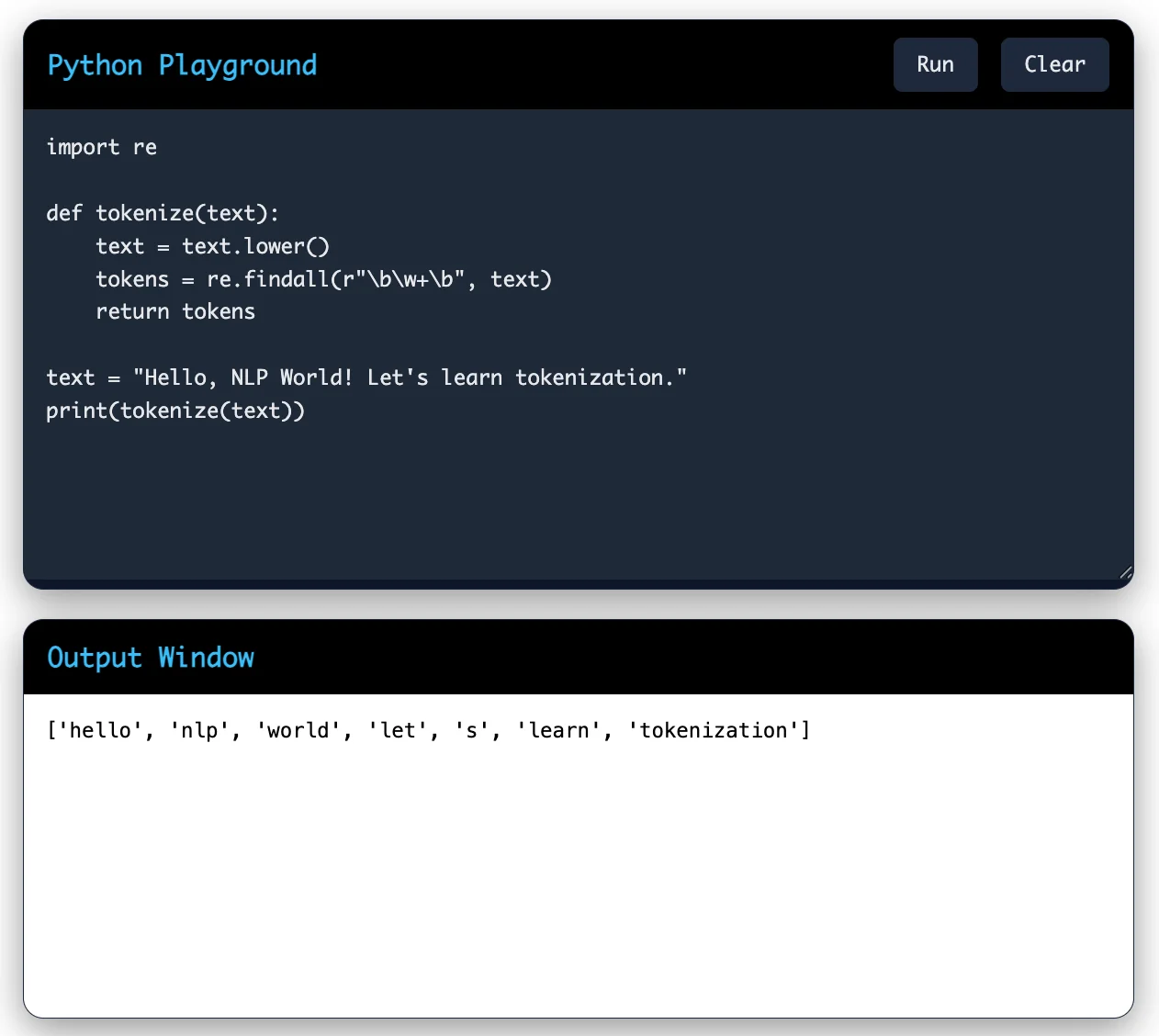
I'll first normalize the text by converting it to lowercase (optional depending on the use case). Then I'll remove unwanted punctuation using regular expressions and split the text into words based on whitespace. For production systems, I'd also consider handling contractions, emojis, hyphenated words, URLs, and Unicode characters.
|
import re def tokenize(text): text = text.lower() tokens = re.findall(r"\b\w+\b", text) return tokens text = "Hello, NLP World! Let's learn tokenization." print(tokenize(text)) |
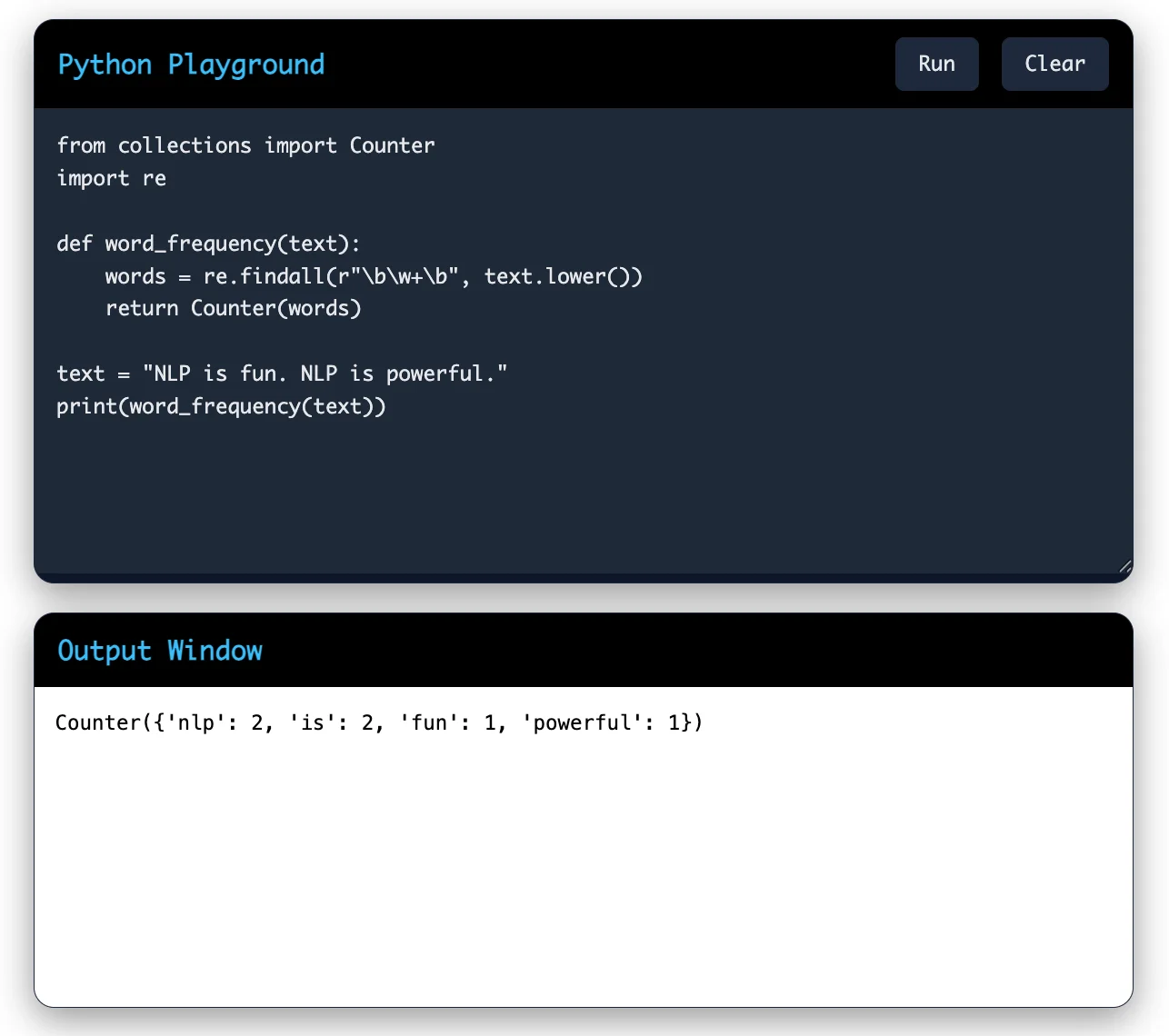
After tokenizing the text, I'll iterate through every word and maintain a dictionary where the key is the word and the value is its count.
|
from collections import Counter import re def word_frequency(text): words = re.findall(r"\b\w+\b", text.lower()) return Counter(words) text = "NLP is fun. NLP is powerful." print(word_frequency(text)) |
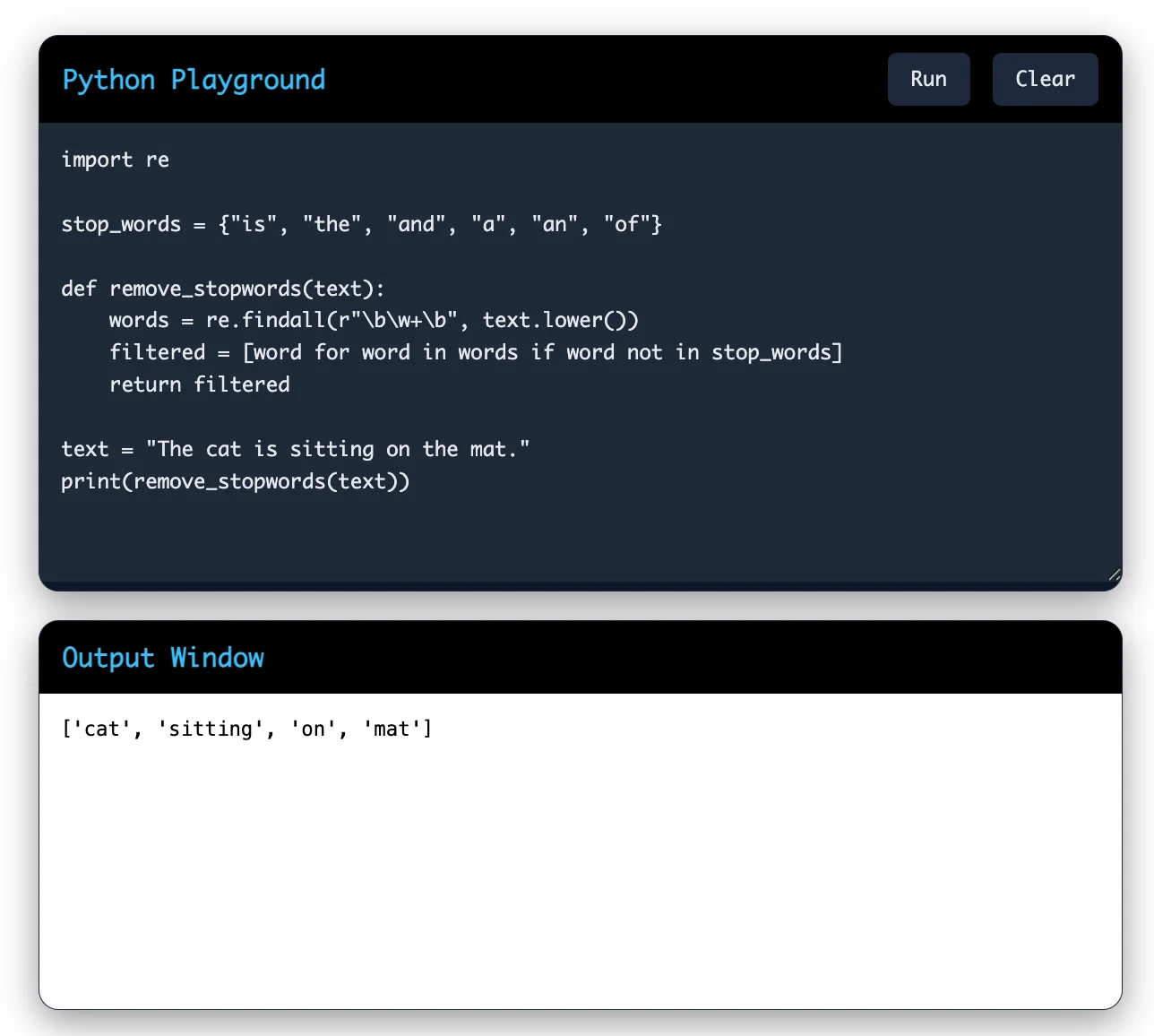
I'll create a predefined set of stop words and remove every token that belongs to that set. Using a set makes membership lookup O(1).
|
import re stop_words = {"is", "the", "and", "a", "an", "of"} def remove_stopwords(text): words = re.findall(r"\b\w+\b", text.lower()) filtered = [word for word in words if word not in stop_words] return filtered text = "The cat is sitting on the mat." print(remove_stopwords(text)) |
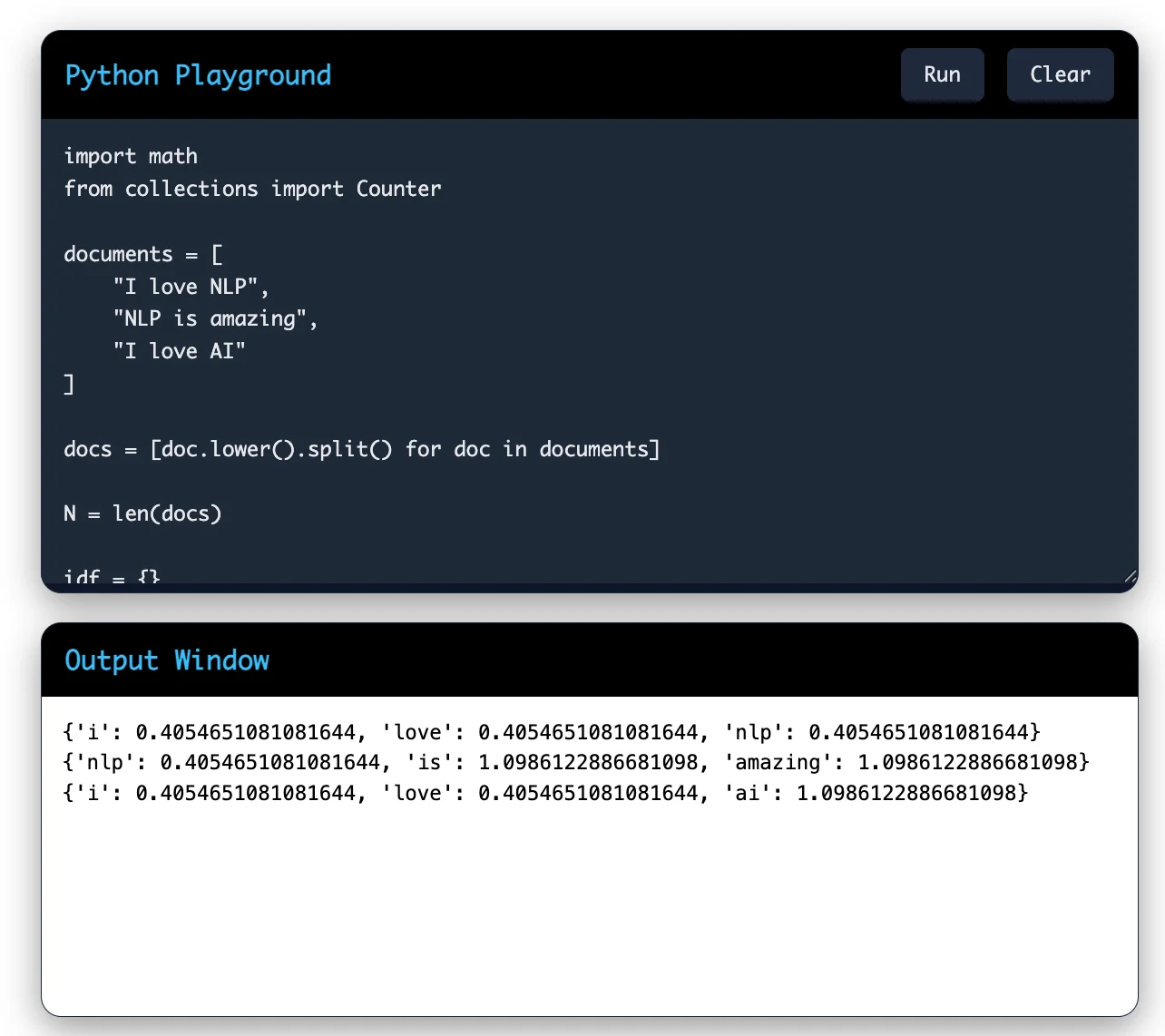
I'll first calculate Term Frequency (TF), then compute Inverse Document Frequency (IDF), and finally multiply both values.
|
import math from collections import Counter documents = [ "I love NLP", "NLP is amazing", "I love AI" ] docs = [doc.lower().split() for doc in documents] N = len(docs) idf = {} for word in set(sum(docs, [])): df = sum(word in doc for doc in docs) idf[word] = math.log(N / df) for doc in docs: tf = Counter(doc) tfidf = {} for word in tf: tfidf[word] = tf[word] * idf[word] print(tfidf) |
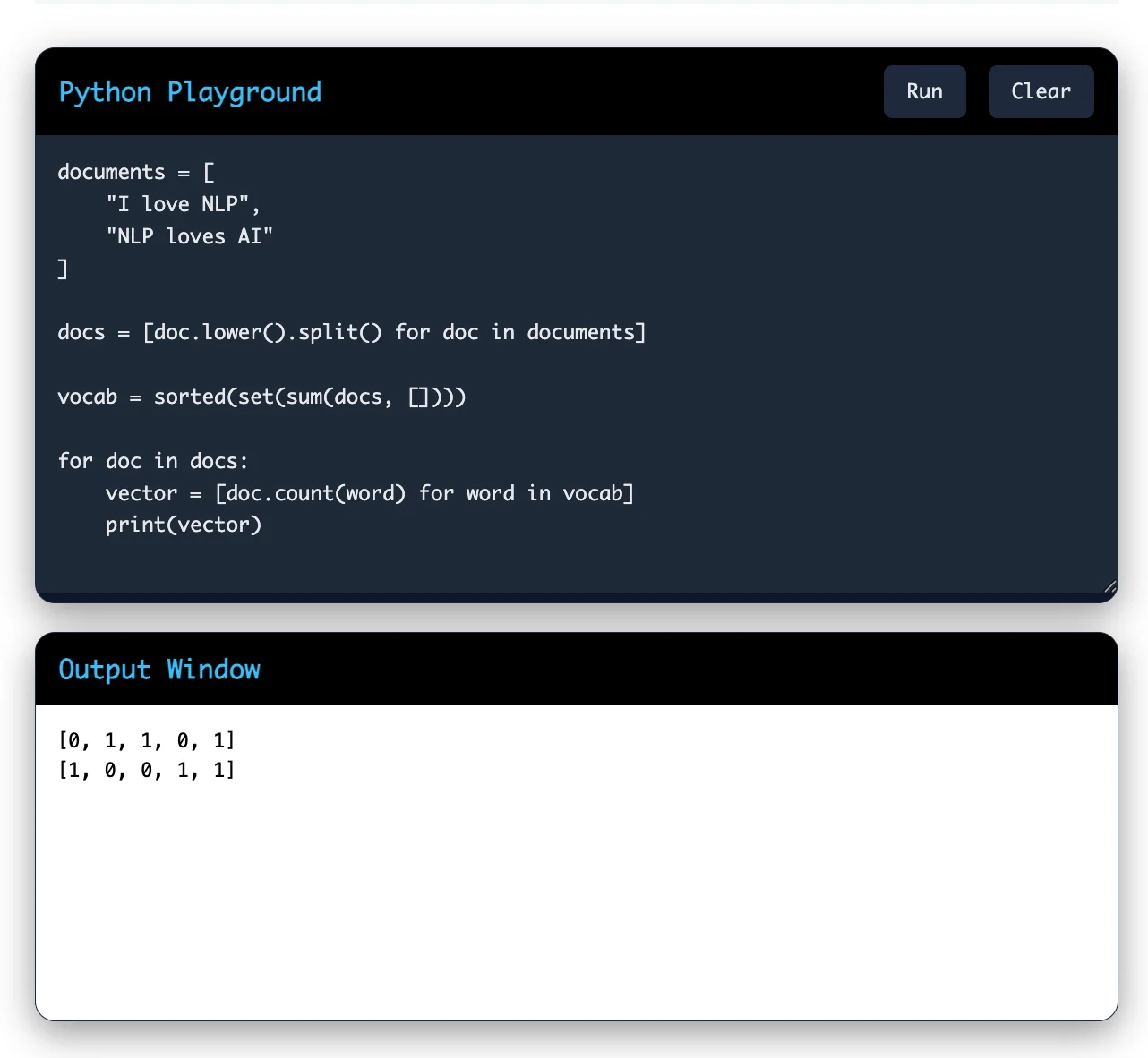
I'll build a vocabulary from all unique words and then create a vector where each position stores the frequency of that vocabulary word.
|
documents = [ "I love NLP", "NLP loves AI" ] docs = [doc.lower().split() for doc in documents] vocab = sorted(set(sum(docs, []))) for doc in docs: vector = [doc.count(word) for word in vocab] print(vector) |
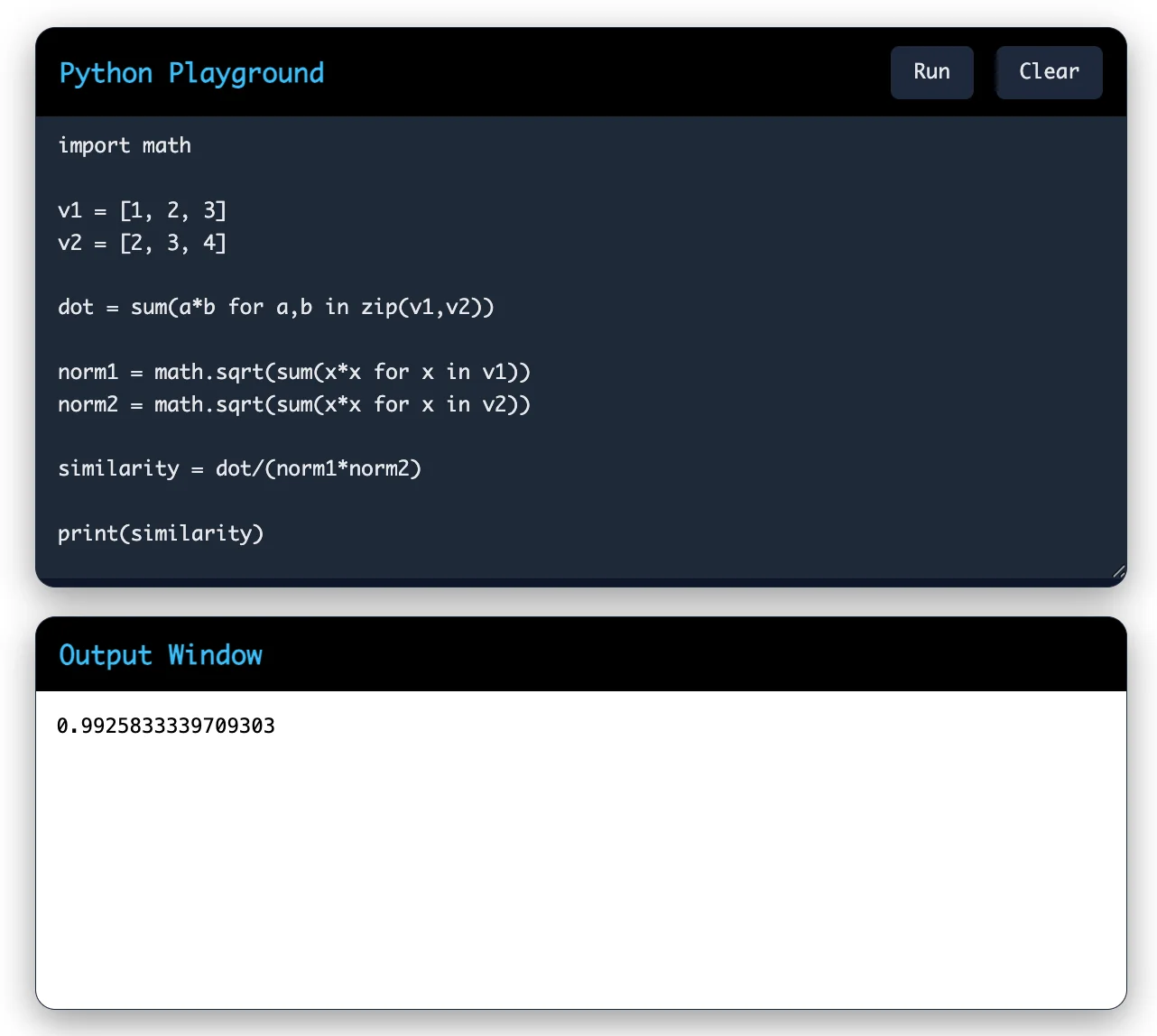
I'll first convert both documents into vectors and then compute the cosine of the angle between them using the dot product and vector magnitudes.
|
import math v1 = [1, 2, 3] v2 = [2, 3, 4] dot = sum(a*b for a,b in zip(v1,v2)) norm1 = math.sqrt(sum(x*x for x in v1)) norm2 = math.sqrt(sum(x*x for x in v2)) similarity = dot/(norm1*norm2) print(similarity) |
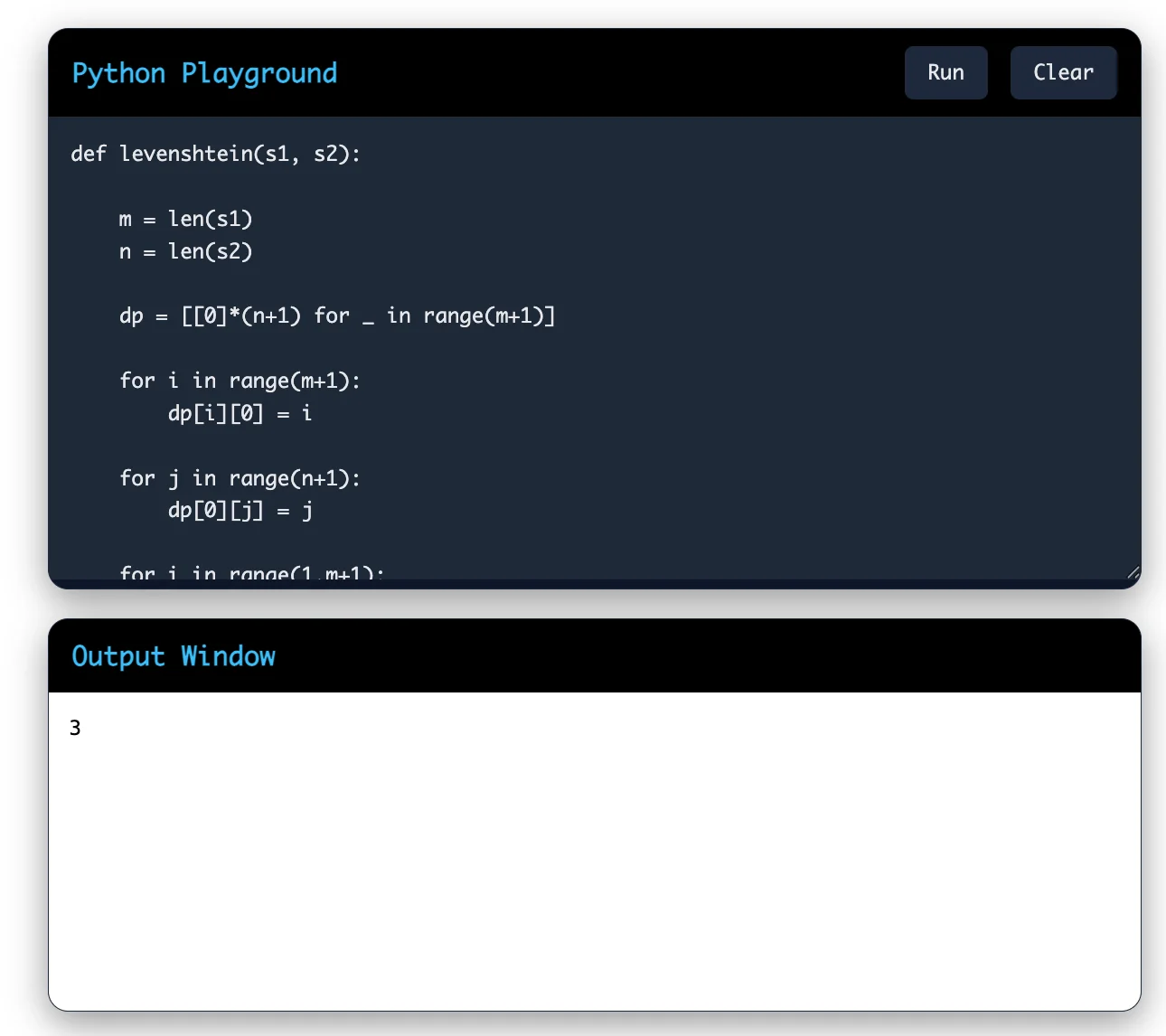
I'll use Dynamic Programming where each cell represents the minimum edits required to convert one prefix into another.
|
def levenshtein(s1, s2): m = len(s1) n = len(s2) dp = [[0]*(n+1) for _ in range(m+1)] for i in range(m+1): dp[i][0] = i for j in range(n+1): dp[0][j] = j for i in range(1,m+1): for j in range(1,n+1): if s1[i-1] == s2[j-1]: dp[i][j] = dp[i-1][j-1] else: dp[i][j] = 1 + min( dp[i-1][j], dp[i][j-1], dp[i-1][j-1] ) return dp[m][n] print(levenshtein("kitten","sitting")) |
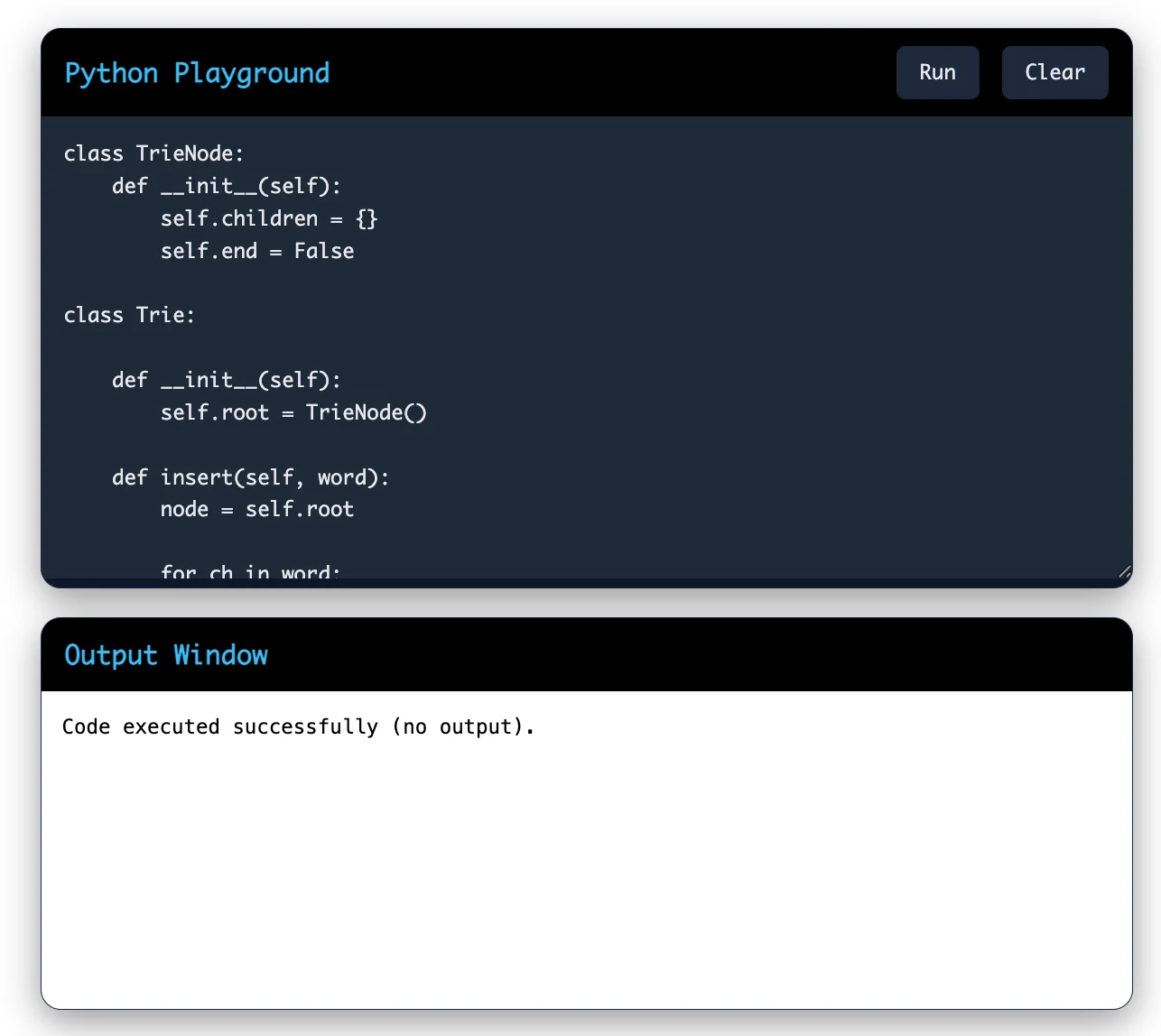
I'll use a Trie because it supports efficient prefix-based search. Each node represents a character, and words are inserted character by character. During lookup, I traverse the Trie using the input prefix and then perform a DFS to collect all valid word completions.
|
class TrieNode: def __init__(self): self.children = {} self.end = False class Trie: def __init__(self): self.root = TrieNode() def insert(self, word): node = self.root for ch in word: if ch not in node.children: node.children[ch] = TrieNode() node = node.children[ch] node.end = True |
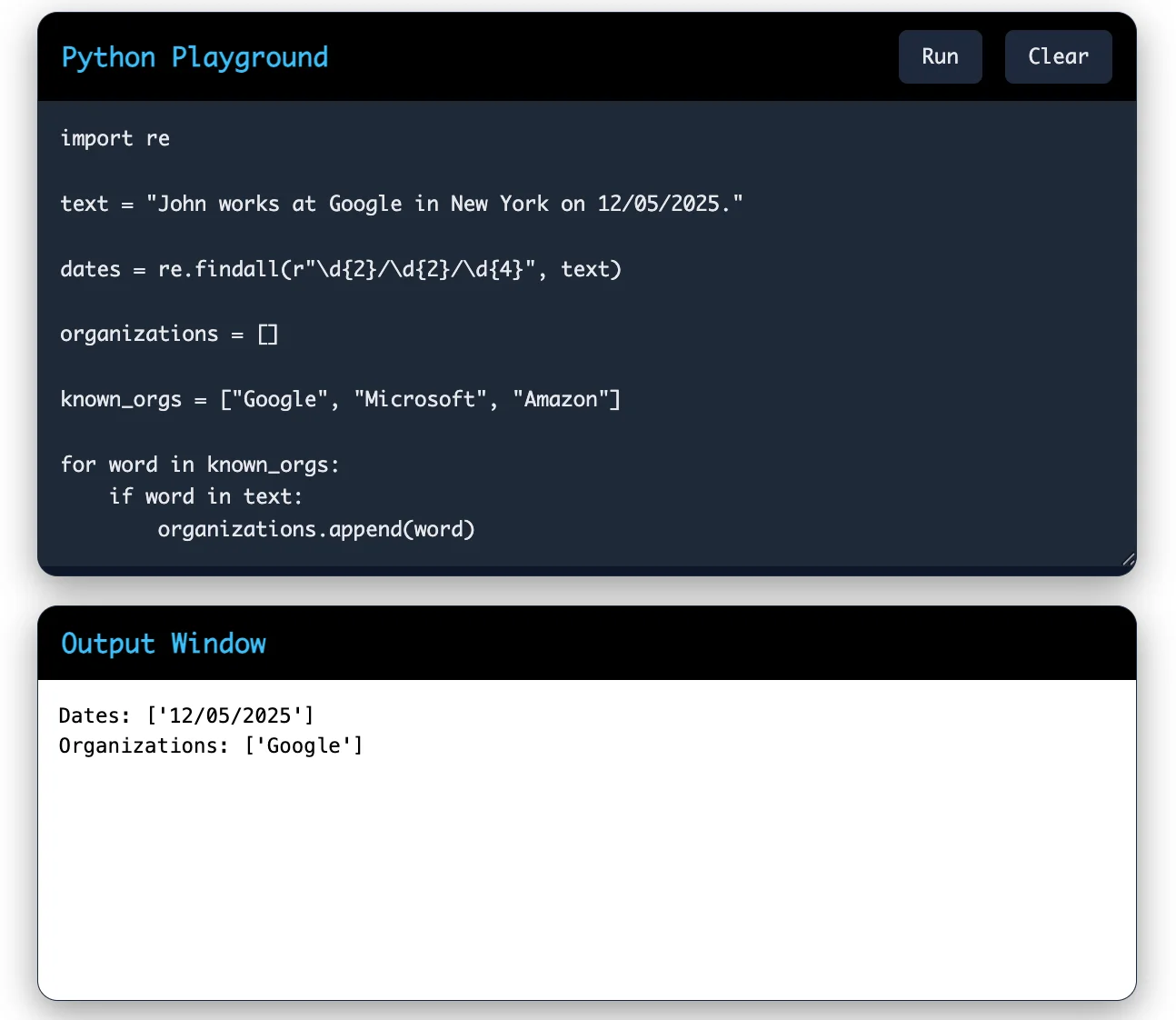
For a basic rule-based NER, I'll define patterns or dictionaries for known entities. For example, I can use regular expressions to detect dates and emails, and lookup lists for cities or organization names. While this approach is simple and interpretable, it doesn't generalize well to unseen entities.
|
import re text = "John works at Google in New York on 12/05/2025." dates = re.findall(r"\d{2}/\d{2}/\d{4}", text) organizations = [] known_orgs = ["Google", "Microsoft", "Amazon"] for word in known_orgs: if word in text: organizations.append(word) print("Dates:", dates) print("Organizations:", organizations) |
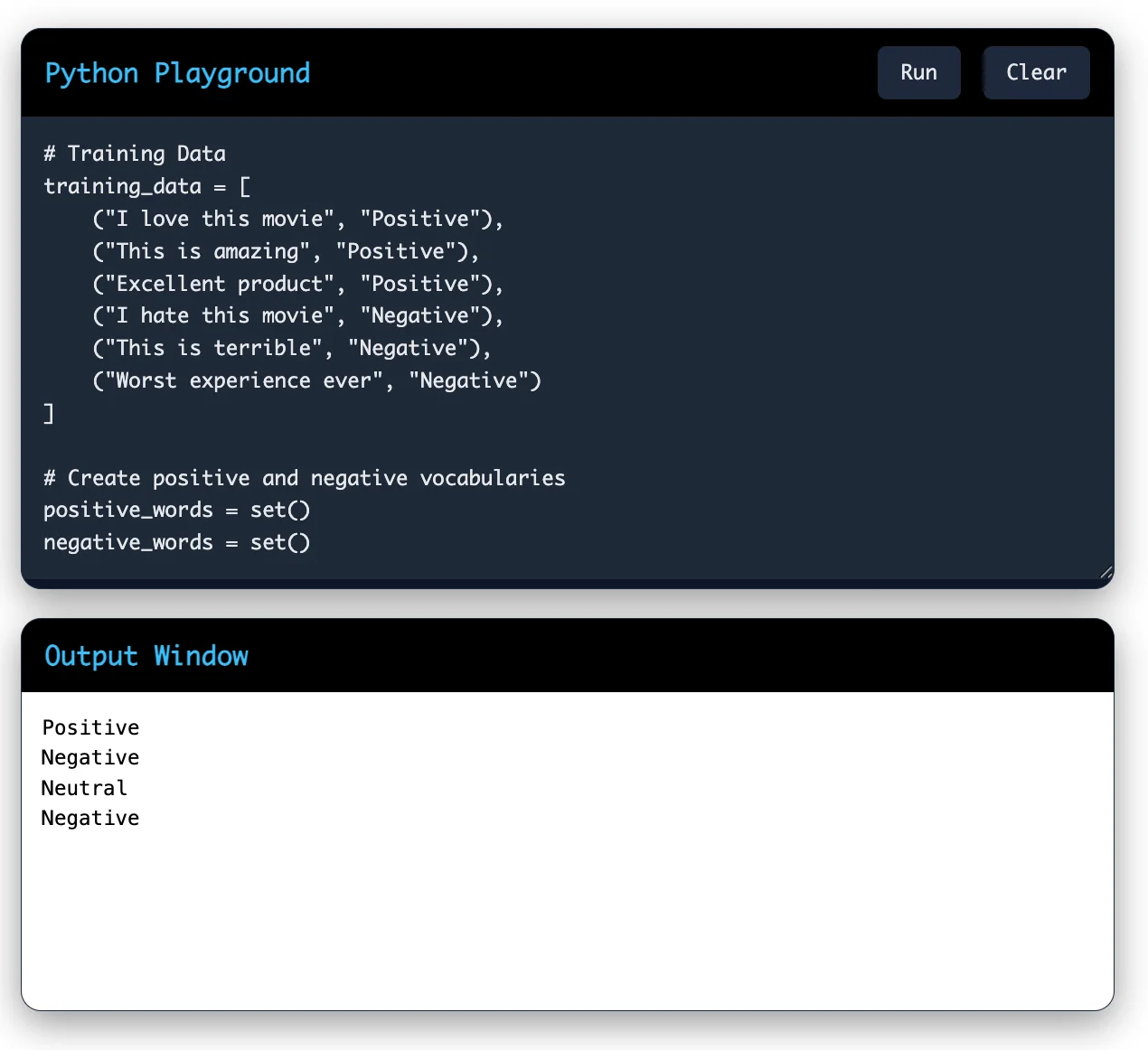
I'll collect and label text data, preprocess it (tokenization, normalization, optional stop-word removal), convert the text into numerical features such as TF-IDF or embeddings, split the data into training and testing sets, train a classifier (e.g., Naive Bayes, Logistic Regression, or an LSTM/Transformer for deep learning), and evaluate it using metrics like accuracy, precision, recall, F1-score, and confusion matrix.
|
# Training Data training_data = [ ("I love this movie", "Positive"), ("This is amazing", "Positive"), ("Excellent product", "Positive"), ("I hate this movie", "Negative"), ("This is terrible", "Negative"), ("Worst experience ever", "Negative") ] # Create positive and negative vocabularies positive_words = set() negative_words = set() for sentence, label in training_data: words = sentence.lower().split() if label == "Positive": positive_words.update(words) else: negative_words.update(words) # Prediction Function def predict_sentiment(text): words = text.lower().split() positive_score = 0 negative_score = 0 for word in words: if word in positive_words: positive_score += 1 if word in negative_words: negative_score += 1 if positive_score > negative_score: return "Positive" elif negative_score > positive_score: return "Negative" else: return "Neutral" # Test Sentences print(predict_sentiment("I love this product")) print(predict_sentiment("Worst movie")) print(predict_sentiment("Amazing experience")) print(predict_sentiment("I hate this")) |
Scenario-based questions test how you apply your knowledge to messy, real-world situations. Interviewers use these to see how you think, not just what you know.
I would start by checking whether the training data reflects the real distribution of customer reviews. If the training set lacks slang, emojis, and sarcastic language, the model has never learned those patterns, which explains the gap between test accuracy and real-world performance. I would collect more representative training examples, add preprocessing steps that handle emojis meaningfully instead of stripping them out, and consider using a pretrained model that already understands informal language. For sarcasm specifically, I would look at adding features or training examples that capture tone and context, since sarcasm often depends on more than just the words used.
I would use a multilingual pretrained model like mBERT or XLM-R as the foundation, since these are trained across many languages and share representations well. Preprocessing needs to be language-aware, meaning tokenization and normalization rules should account for each language's script and structure. I would fine-tune the model on labeled data from all three languages rather than relying only on English data with translation. For evaluation, I would track accuracy and F1 score separately for each language, not just in aggregate, so I can catch cases where the model performs well overall but poorly on one specific language.
I would implement a Retrieval-Augmented Generation setup so the chatbot pulls answers from verified company documentation instead of generating them purely from memory. I would also lower the model's temperature setting to reduce randomness and add a confidence check that tells the bot to say "I'm not sure" or escalate to a human agent rather than guessing. Regularly reviewing flagged conversations and updating the knowledge base would help catch new gaps over time. The goal is to reduce hallucinations without making the bot feel robotic or unhelpful, so I would balance accuracy improvements with monitoring actual customer satisfaction scores.
I would start with a document ingestion pipeline that cleans and chunks the documents into manageable pieces, since feeding entire documents into the system at once hurts retrieval accuracy. Each chunk would be converted into an embedding using a strong embedding model and stored in a vector database. When a user asks a question, the system would embed the query, retrieve the most relevant chunks, and pass them to the language model along with the original question as context. I would also add a reranking step to improve retrieval quality and set up logging so I can monitor which queries return weak results and improve the pipeline over time.
I would first collect examples of the misidentified entities and check whether the training data included enough examples of company and product names, especially ones specific to our industry. If the model was trained on a general dataset, it likely never learned these domain-specific entities well. I would fine-tune the model further using labeled examples from our actual production data and consider adding a custom dictionary or gazetteer for known company and product names as a supporting layer. Going forward, I would set up ongoing monitoring that samples production predictions regularly, so we can catch new entity types or naming patterns before they become widespread errors.
Also Read: How to Become MLOps Engineer?
NLP interviews test a mix of theory and practical thinking. Freshers need to be solid on the fundamentals like tokenization, stemming, and text representation. Intermediate candidates should understand embeddings, attention, and how to work with pretrained models. Experienced professionals need to explain transformer architecture clearly and talk through real production challenges like reducing hallucinations or optimizing inference.
The best way to prepare is to practice explaining these concepts out loud, in your own words, and then apply them to real scenarios. Interviewers remember candidates who can connect theory to practical problem-solving, not just recite definitions.
A strong understanding of text preprocessing, word embeddings, transformer architecture, and hands-on experience with libraries like Hugging Face Transformers, spaCy, or NLTK are all important. For senior roles, you should also be comfortable discussing model evaluation, deployment, and LLM-specific challenges like hallucination and latency.
Yes, for intermediate and advanced roles. Most modern NLP systems are built on neural networks, especially transformers, so you need a working understanding of how these models are trained and how architectures like attention and embeddings function.
Practice thinking through problems step by step: identify the root cause, propose a solution, and mention how you would measure success. Interviewers want to see structured thinking, not just a list of techniques.
Yes. Many NLP interviews include a coding round where you might be asked to implement tokenization, build a simple classifier, or work with a library like Hugging Face to fine-tune a model. Practicing hands-on coding alongside theory is important.
An NLP engineer typically works across a broad range of language tasks, including traditional methods and deep learning models. An LLM engineer focuses specifically on large language models, covering areas like prompt engineering, fine-tuning, RAG systems, and optimizing LLMs for production use. There is a lot of overlap, and many companies use the terms interchangeably.