AI agents are no longer just an experimental option. Within the next few years, they would be able to write code, manage tickets, and conduct research work and processes without human intervention. They are limited by the systems used in their development.
However, there is a little ambiguity about the number of AI agent systems available today and claims of all the developers that their systems are the best. It was this claim that prompted me to look deeper into the subject in order to check the most appropriate platforms for development from the points of view that matter.
This article includes the description of the most effective AI agent systems that can help you choose and use the one you really need.
Let’s get into it!
Read Also: What Is Janitor AI? Features, Pricing and How to Use
AI agent frameworks are software toolkits that provide the core building blocks, such as reasoning, memory, tool integration, and multi-agent coordination, needed to build and run autonomous AI applications.
Instead of writing your own logic for reasoning, memory, and tool calls, a framework gives you ready-made components for:
1. Decision Logic: How the agent thinks through a task and decides its next step.
2. Memory: How the agent remembers past actions, conversations, or results within a task, or across sessions.
3. Tool Integration: How the agent calls external tools, APIs, or databases to get work done.
4. Multi-Agent Communication: How multiple agents talk to each other, delegate tasks, and share context.
5. Lifecycle Management: How the agent starts, runs, recovers from errors, and shuts down cleanly.
Not every framework deserves a spot on this list. I looked at the tools that developers and enterprises are actually using in production, not just the ones with a flashy GitHub README. Here is the criteria I used:
1. Orchestration Model: How does the framework manage the agent's reasoning and decision loop? Is it graph-based, role-based, or a simple tool-calling loop?
2. Multi-Agent Support: Can it handle multiple agents working together, delegating tasks and sharing context?
3. Memory and State: Does it support persistent memory, session state, and recovery if something breaks mid-task?
4. Ease of Use: How steep is the learning curve for a developer getting started?
5. Tool and Protocol Integration: Does it support external tools, APIs, and newer standards, such as MCP (Model Context Protocol) and A2A (Agent2Agent)?
6. Production Readiness: Does it offer observability, human-in-the-loop controls, and the stability needed for real deployments?
7. Community and Ecosystem: How active is the community, and how much documentation and third-party support exist?
Now, let's look at the top AI agent frameworks that came out on top.
Also Read: What Is Meta Muse Spark 1.1?
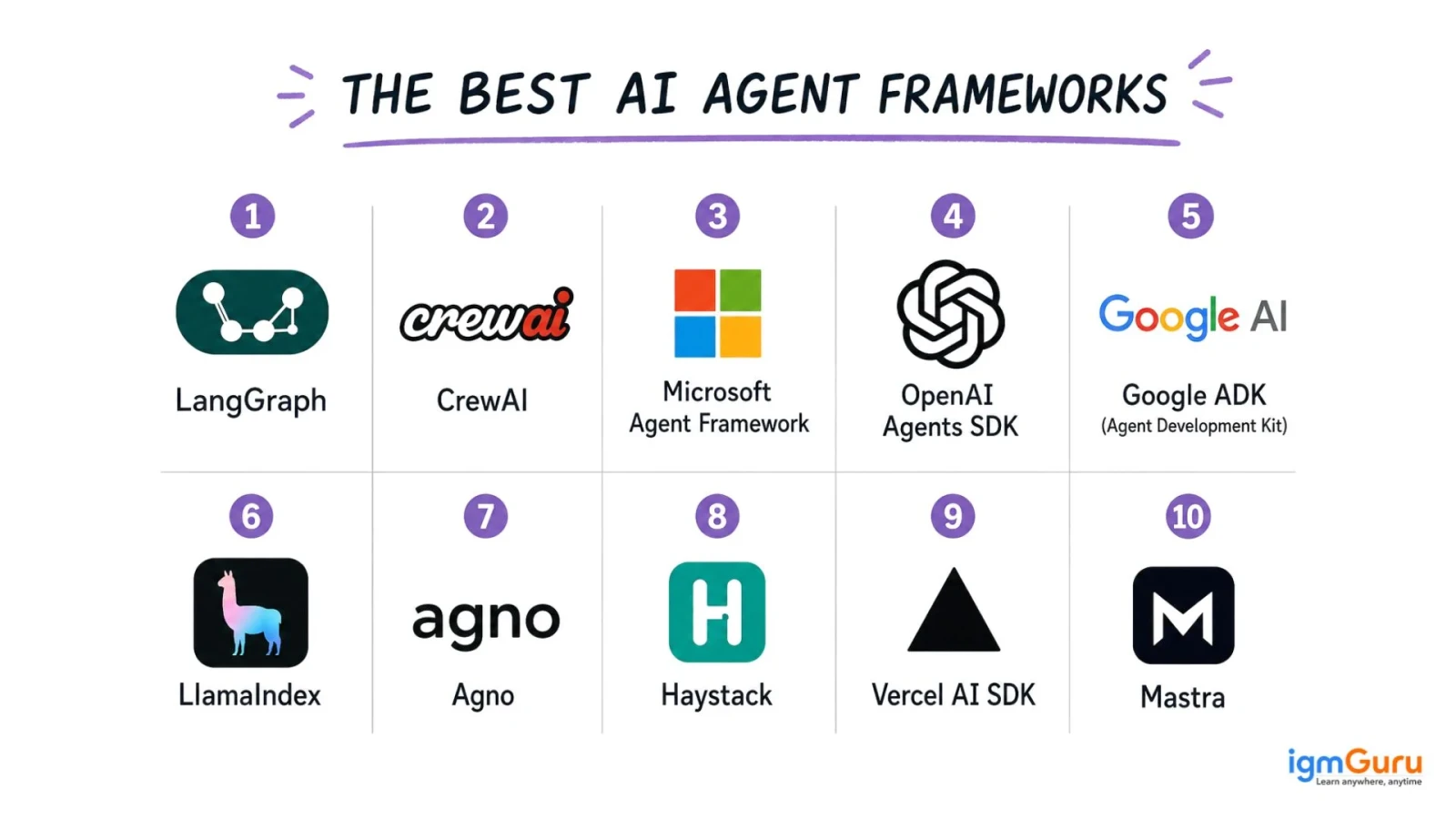
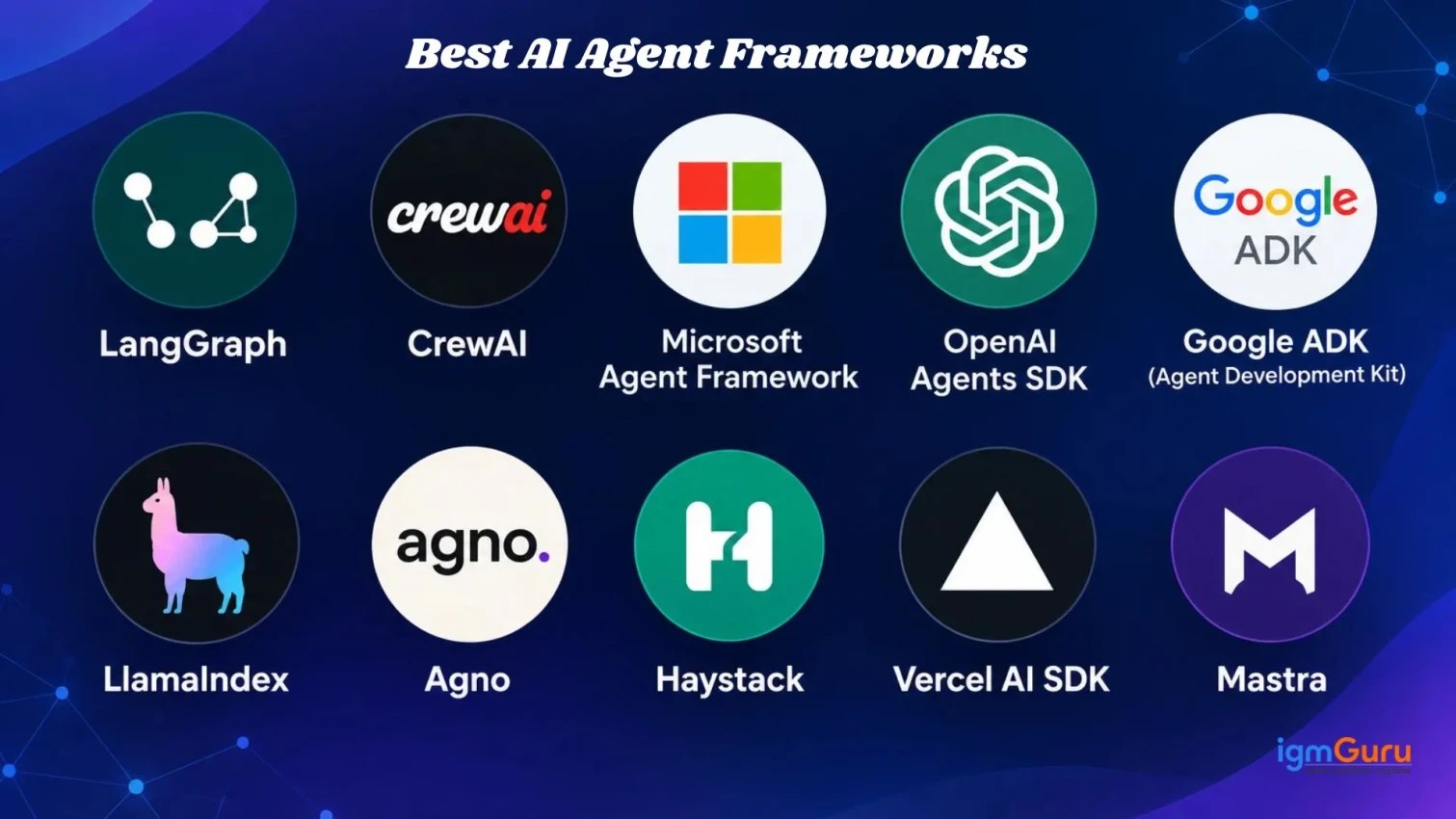
Here is my breakdown of the leading AI agent frameworks in 2026, based on what they do best, who they are made for, and how they perform in real projects.
LangGraph is built by the LangChain team, and it has become the go-to choice for teams building production-grade agent workflows. It models agent behavior as a directed graph, where nodes represent steps and edges represent transitions. This gives you fine-grained control over how state flows through your agent.
The graph-based approach is not the easiest to learn. You need to think in graphs instead of simple chains, and that takes some adjustment. But this structure is exactly why LangGraph handles state persistence, conditional routing, and rollback so well. If your agent needs to survive a server restart mid-task, LangGraph is built for that.
Complex, multi-step agent workflows
Production systems that need state persistence and recovery
Teams that already use the LangChain ecosystem
Conditional logic and branching agent behavior
Good to know: LangGraph can feel like overkill if you are building a simple, single-purpose agent. In that case, a lighter framework will get you moving faster.
CrewAI takes a role-based approach to multi-agent systems. Instead of designing a graph, you assign roles to different agents, like a researcher, a writer, and a reviewer, and CrewAI handles how they collaborate to complete a task. It reads more like assembling a team than writing orchestration logic.
This makes CrewAI one of the fastest frameworks for prototyping. It is popular among startups and solo developers who want to see a working multi-agent system without a steep setup process. The tradeoff is that it is a younger framework, so some teams are still cautious about using it at large scale.
Fast prototyping of multi-agent systems
Role-based task delegation (researcher, writer, planner, and so on)
Startups and small teams that want quick results
Content generation, research, and workflow automation use cases
Microsoft merged AutoGen and Semantic Kernel into a single, unified framework called Microsoft Agent Framework. It supports graph-based workflows, ships with Python and .NET runtimes, and integrates directly with Azure AI Foundry for responsible AI guardrails.
If you are already on the Microsoft stack, this is the natural choice. It comes with built-in task-adherence guardrails to keep agents on task, PII protection to flag sensitive data access, and native MCP support for connecting external tools. Existing AutoGen and Semantic Kernel projects still get support during the transition, so you do not need to migrate overnight.
Enterprises already using Azure and the Microsoft ecosystem
Teams that need responsible AI guardrails out of the box
Declarative, version-controlled agent configuration through YAML
Migrating existing AutoGen or Semantic Kernel projects
OpenAI's own SDK takes a tool-use-first approach. Instead of designing complex orchestration graphs, you build agents as models equipped with tools, including the ability to call other agents as tools. The agent loop is simple: it receives a prompt, calls the tools it needs, and returns a structured response.
This simplicity is the biggest selling point. It is easy to reason about, easy to debug, and works well if you are already building on OpenAI's models. It is a solid choice for teams that want production-ready agents without learning a whole new orchestration paradigm.
Developers already building on OpenAI models
Simple, tool-calling agent loops without heavy orchestration
Fast development of single-agent and lightweight multi-agent systems
Teams that prioritize simplicity over deep customization
Google's ADK uses a hierarchical agent tree, where a root agent delegates tasks to sub-agents, and those sub-agents can have their own sub-agents underneath them. It integrates tightly with Vertex AI, Gemini models, and the wider Google Cloud ecosystem.
What really sets ADK apart is native support for the A2A (Agent-to-Agent) protocol. This lets an ADK agent discover and work with agents built on completely different frameworks, like LangGraph or CrewAI. It also brings multimodal capabilities to the table, so agents can process images, audio, and video directly through Gemini.
Teams building on Google Cloud and Gemini models
Multimodal agents that need to process images, audio, or video
Cross-framework agent communication through A2A
Enterprises needing managed, scalable infrastructure
Read Also: DeepSeek vs OpenAI - A Detailed Comparison
LlamaIndex started as a data framework for connecting LLMs to your own data, and it has expanded into a strong agent framework as well. It shines when your agent's core job is retrieval: pulling accurate information from documents, databases, or knowledge bases before acting on it.
If your use case is heavy on RAG (Retrieval-Augmented Generation) combined with agent reasoning, LlamaIndex gives you a head start that general-purpose frameworks do not.
Agents that need strong retrieval and indexing over private data
RAG-powered agent workflows
Knowledge assistants and document-heavy use cases
Teams that already use LlamaIndex for search and retrieval
Agno is built for practical, tool-driven agents that work with real-world data. Instead of focusing on abstract orchestration patterns, it centers the agent around direct interaction with APIs, databases, and internal services. It also ships with a runtime and control plane for managing agent deployments at scale.
This makes Agno a strong fit for data-heavy workflows where the agent spends most of its time fetching, transforming, and acting on information, rather than juggling complex multi-agent logic.
Data analysis agents and finance or ops automation
Tool-driven decision systems
Teams that want a runtime for managing agents in production
Straightforward, single-agent workflows over deep orchestration
Haystack is a production-ready orchestration framework, originally built for search and RAG pipelines, that has grown into a solid option for building customizable LLM applications and agents. It is known for being dependable in production, with clean pipeline design that makes debugging easier.
RAG pipelines combined with agent logic
Teams that want production stability over cutting-edge features
Search-heavy applications and enterprise knowledge tools
If you are building on the web with TypeScript or JavaScript, the Vercel AI SDK is likely your best bet. It comes from the creators of Next.js and is designed specifically for building AI-powered web applications, including streaming responses and agent-style tool calling right inside your frontend.
Web developers building on Next.js or React
Streaming AI responses directly into a web app
TypeScript-first teams that want a lightweight setup
Chat interfaces and in-app AI assistants
Mastra is a newer TypeScript-based framework built for developers who want agent workflows without leaving the JavaScript ecosystem. It focuses on developer experience, offering built-in workflow graphs, memory, and evaluation tools in a package that feels native to modern web development.
TypeScript and JavaScript developers building agent workflows
Teams that want workflow graphs without a Python dependency
Startups building agent products on a modern web stack
| Framework | Best For | Orchestration Style | Multi-Agent Support | Unique Strength |
| LangGraph | Complex, production-grade workflows | Graph-based | Strong | State persistence and rollback |
| CrewAI | Fast multi-agent prototyping | Role-based | Strong | Easy to set up agent teams |
| Microsoft Agent Framework | Microsoft and Azure ecosystems | Graph-based | Strong | Built-in responsible AI guardrails |
| OpenAI Agents SDK | Simple, tool-calling agents | Tool-use loop | Moderate | Simplicity and easy debugging |
| Google ADK | Google Cloud and multimodal agents | Hierarchical tree | Strong | Native A2A cross-framework support |
| LlamaIndex | Retrieval-heavy agents | Data-centric | Moderate | Best-in-class RAG integration |
| Agno | Data and tool-driven agents | Tool-driven | Limited | Runtime and control plane |
| Haystack | RAG pipelines and search | Pipeline-based | Moderate | Production stability |
| Vercel AI SDK | Web and TypeScript apps | Tool-calling | Limited | Streaming for web front ends |
| Mastra | TypeScript agent workflows | Graph-based | Moderate | Native JavaScript developer experience |
After testing and comparing so many frameworks, I can tell you there is no single "best" one for everyone. The right choice depends entirely on what you are building and where you already work.
Before you choose any framework, ask yourself a simple question: what does my agent actually need to do?
Is it a single agent handling one task, or a team of agents working together? Do you need heavy orchestration and state recovery, or just a simple tool-calling loop? Are you building on Python, or is your stack TypeScript and JavaScript? Once you are clear on the answer, the right framework becomes much easier to spot.
For instance, if you need production-grade reliability with complex workflows, go for LangGraph. If you want to prototype a multi-agent system fast, CrewAI is a strong choice. If you are on Azure, choose Microsoft Agent Framework. If your app lives in the browser, go for the Vercel AI SDK or Mastra.
In 2026, agents will rarely work alone. Look for frameworks that support open protocols like MCP for tool connections and A2A for agent-to-agent communication. This keeps you from getting locked into one ecosystem and makes it easier to combine agents built on different frameworks later.
A framework that works today must work in six months. Check how active the community is, how often the framework ships updates, and whether it has clear migration paths if the project evolves. Frameworks backed by companies like Microsoft, Google, and OpenAI tend to offer more stability, while open-source community projects often move faster but need more careful evaluation.
Choosing the best AI agent framework is not about choosing the most popular name on GitHub. It is about matching the framework to your actual workflow, your team's skill set, and how much control you need over orchestration.
If you are building something complex and production-bound, LangGraph or Microsoft Agent Framework will serve you well. If you want speed and simplicity, CrewAI or the OpenAI Agents SDK will get you there faster. And if your world is TypeScript, Vercel AI SDK and Mastra deserve a serious look.
Explore Our Trending Articles
CrewAI and the OpenAI Agents SDK are the easiest to start. Both keep the setup simple and let you build a working agent without having to learn complex orchestration concepts first.
A chatbot mainly responds to user messages in a conversation. An AI agent framework helps you build agents that can reason through steps, call tools, use memory, and complete multi-step tasks on their own, often without constant human input.
Yes. With protocols like A2A (Agent2Agent) and MCP (Model Context Protocol) gaining wider support, agents built on different frameworks, like Google ADK and LangGraph, can now discover and communicate with each other.
LangGraph and Microsoft Agent Framework are generally considered the most production-ready. Both offer state persistence, recovery, and the guardrails enterprises need for reliable deployment.
Most of the frameworks on this list, including LangGraph, CrewAI, AutoGen, LlamaIndex, and Haystack, are open source and free to use. Costs usually come from the underlying LLM API calls (like OpenAI, Anthropic, or Google models) and any managed infrastructure you connect them to.