Generative AI and Large Language Models (LLMs) are often mentioned in the same breath, but they're not identical. A good way to picture it: Generative AI is the big umbrella, like the entire genre of music, while LLMs are just one type of band playing within it.
Generative AI is about creating new content, such as text, images, music, and code, by learning patterns from existing data. It's the technology behind AI art, chatbots, music composition tools, and more.
LLMs, on the other hand, are a specific branch of generative AI focused on language. They're trained on massive amounts of written content and excel at producing or understanding text. That's why they can draft essays, answer questions, write code, or even crack a joke.
In this article, I'll break down the key differences between Generative AI vs LLMs, why the distinction matters, and how both are reshaping the way we interact with technology.
Enroll in our Generative AI course program to learn GenAI with experts.
Generative AI is basically a type of artificial intelligence that is built to make stuff. And by 'stuff' we mean anything from text and images to music, video, and even coding. Inspite of just analyzing data or following strict rules, it takes what it's learned and makes use of it to create something new. Something like how a musician might hear a bunch of songs and then write their own.
What makes it more interesting is that it doesn't just spit out random content. It applies the patterns from huge amounts of information to create results that actually make sense. Whether it is designing a logo, writing a story or making a realistic photo of something that doesn't even exist. This tool is all about crossing the boundaries of what machines can make.
We probably already saw it in action tools like ChatGPT, DALL-E or even in those AI photo apps everyone's been posting on social media. That's generative AI at work for you. This tool has already started to change how we think about creativity and technology, even though it is still growing. Take a look at some of the examples of GenAI.
This tool, ChatGPT, is among the most used generative AI tools from OpenAI. This tool provides common users with freely accessible basic AI content development. It also offers a premium subscription known as ChatGPT Plus. which gives its users a faster response, priority access during peak times and early access to the latest features.
This tool is the latest AI model from OpenAI. This model represents a big leap in text-to-image creation. DALL-E 3 offers improved precision and creative control. This GenAI model can change both easy sentences and complete paragraphs into refined, highly precise, and visually remarkable pictures.
This GenAI tool is among the top AI tools. It is an amazing platform for making videos. From little to no work at all, this tool quickly creates and broadcasts videos of professional quality. It is used for content management, personalized onboarding, text analysis, enterprise-level expandability, single sign-on, text editing, and more.
Read Also- Generative AI Tutorial
A Large Language Model (LLM) is a kind of artificial intelligence that is trained to understand and create human-like responses. Think of it as an extremely advanced text predictor. It reads (or more accurately examines) piles of text from books, websites, articles, you name it and learns how people usually write, talk, ask questions, and even joke around.
The 'large' part here means it's made with a large amount of data and a crazy number of parameters (the technical bits that help learning patterns). And the larger and more detailed the model, the better it usually gets at sounding natural, finishing the sentences, answering questions and even writing essays from scratch.
LLMs are motorized tools like ChatGPT. When asked a question or starting a conversation, the model isn't just pulling an answer from a database, it's solving, thinking which words make the most sense based on everything it's learned. These tools don't know facts the way a person does, but they're surprisingly good at mimicking how we communicate.
Bottom line? LLMs are like the brains behind many of the smart text-based AI tools we're using today. Pretty great, right? Now, let us take a look at some of the LLMs.
This tool was created by OpenAI. Some of its examples are GPT-3, GPT-4 and GPT-4o. These models fall among the most widely known LLMs. These models are transformer-based models that are created for generating human-like text according to the prompts given. For instance, GPT-3 has 175 billion parameters and is used in multiple applications like chatbots, virtual assistants and content creation. Even GPT-4o has been upgraded from its predecessor. It gives refined reasoning abilities and supports multimodal input, whether it's a text or an image.
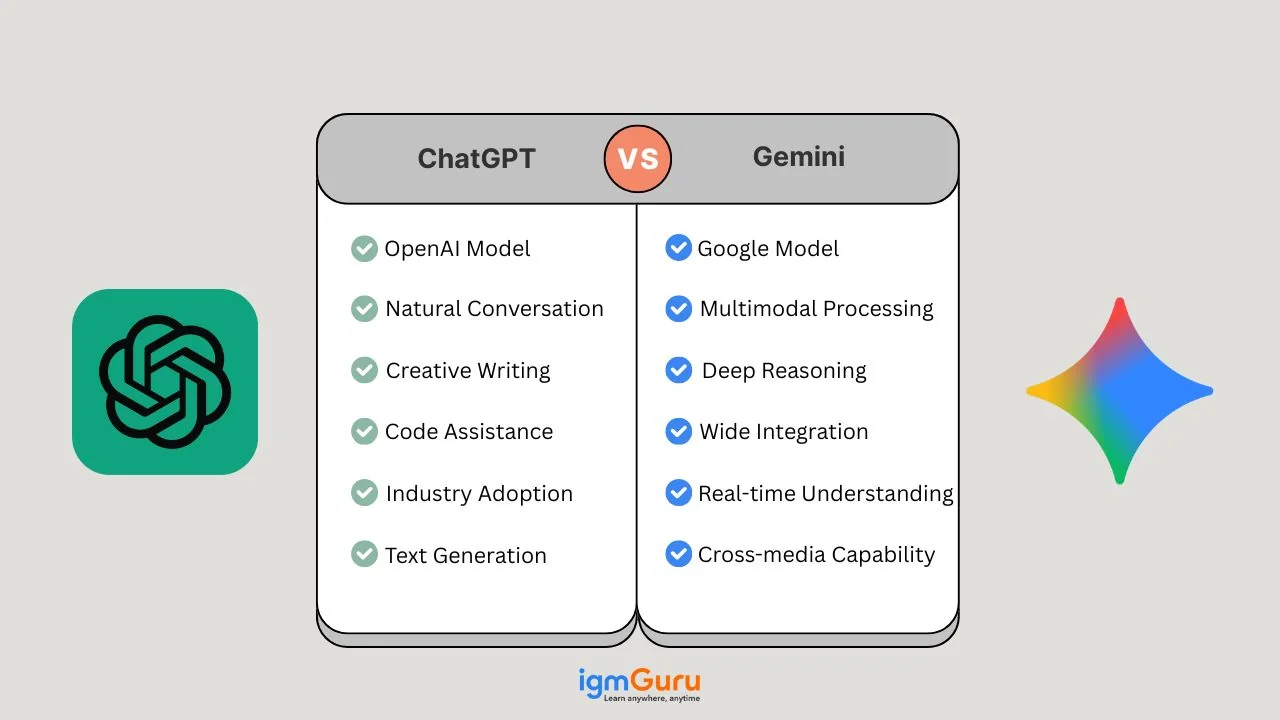
This tool was created by Google DeepMind and is used in multimodal tasks, general-purpose generation of texts, and understanding and reasoning. Gemini is Google's most recent multimodal AI model. It was developed by DeepMind for mixing the capabilities of LLMs with advanced multimodal functionalities and strong reasoning. Gemini mixes the strengths of LLMs for natural language processing and creation with the ability to handle many data types (like images and text). This model focuses on surpassing previous models regarding complicated reasoning, solving problems and doing a wide range of AI tasks with both text and visual input. This makes Gemini a competitor to other multimodal systems such as GPT-4 and PaLM.
This LLM was created by Anthropic and is applied in conversational agents, ethical AI research, and creating texts for general purposes. Claude was created for natural language understanding and creation. This model focuses on ethical AI principles for making safe and organized outputs while lessening the risks of harmful content production.
Read Also- Generative AI Interview Questions
Both of these innovative AI technologies sound completely different and incomparable. As one focuses on content creation whereas the other one is a class of models. If these sounded like they were comparable, it might sound more like Generative AI vs LLMs. So, let us take a look at their differences.
Topic | Generative AI | Large Language Models (LLMs) |
Introduction | It is a wide category of AI technologies that develops new content, text, images, music, video, code and more. It also involves models like GANs, VAEs and LLMs. | It is a particular kind of Generative AI focused on understanding and generating human language like text based content. These models are mainly designed for understanding and creating humanoid text. |
Main Function | This creates a vast range of creative outputs that depend on the data and model type. | Its specialty is processing, understanding and creating text in a humanoid way. |
Content Type | This can create images, sounds, 3D models, videos, music, codes and more. | It mainly focuses on creating texts like essays, responses, summaries and conversations. |
Output Types | It differs by model - images, audio, text or even videos | It has text-based outputs like sentences, paragraphs or even longer forms of coherent text. |
Training Data | It differs by modality like text for LLMs, images for GANs, audio for music generation and more. | Has primarily text data from multiple sources. |
Technologies | Makes use of a variety of techniques, including transformers (for text), GANs (images), VAEs for images and other data and more. | It makes use of deep learning architectures like transformers. |
Complexity | Its complexity differs as LLMs are complicated, whereas GANs and VAEs also have tangled architectures but are customised to different kinds of data. | It has high complexity in terms of model size and computational requirements. |
Computational Needs | It differs largely as LLMs are computationally very intense, whereas some image/audio models may have different needs. | It has high computational needs as it requires a strong hardware and extensive training time. |
Contextual Understanding | It differs by modality and model, as LLMs excel in text. Whereas image models concentrate on visual context and audio models manage temporal patterns. | It is amazing in maintaining and creating contextually relevant text. |
Generation Quality | Its quality differs by modality. As text models are high-quality, image models can create photorealistic images and audio models can make realistic sounds. | It has high quality in making humanoid text, contextually coherent and is often creative as well. |
Deployment Challenges | Its challenges vary depending on the modality. As text models need strong processing, image and audio models need high-resolution data and processing power. | Similar infrastructure is required for deployment and operation. |
Ethical and Bias concerns | In this, the concerns differ as image models may perpetuate biases in visual representation, audio models may raise problems of authenticity and manipulation. | This has a risk of creating biased or inappropriate text. Ethical considerations are around content generation. |
Future Directions | It has an expansion of new modalities, enhanced integration of multimodal generative abilities and developments in model efficiency. | Improvements in efficiency, contextual understanding and lessened biases. |
Examples | Tools like DALL·E are for creating images, Jukebox is for music and Codex is used for code, are a part of this. | Tools like ChatGPT, BERT, T5, Gemini and Claude are some of the examples of LLMs. |
The landscape of LLMs and Generative AI tools has evolved rapidly. Here are the most used and influential models as of 2025-2026:
| Model | Company | Modalities | Main Strength | Common Uses |
|---|---|---|---|---|
| GPT-5 / GPT-4o | OpenAI | Text, image, audio, video | Highest capability, multimodal reasoning | ChatGPT, APIs, enterprise apps |
| Claude Opus 4.6 / Sonnet 4.6 | Anthropic | Text, images, code | Long context, safety, coding & analysis | Claude.ai, enterprise AI, APIs |
| Gemini 2.5 Pro | Google DeepMind | Text, image, audio, video | Native multimodal AI, massive context window | Google Workspace, Gemini apps, APIs |
| Llama 4 | Meta | Text, code, images | Open-weight, deployable on private servers | Self-hosting, fine-tuning, research |
| DeepSeek R1 / V3 | DeepSeek | Text, code, reasoning | Frontier-level performance at low cost | Research, coding, local deployment |
| Mistral Large 2 | Mistral AI | Text, code | Efficient enterprise-grade European AI | APIs, enterprise, self-hosted systems |
| Qwen 3 | Alibaba Group | Text, code, multilingual | Strong multilingual and open AI ecosystem | Enterprise AI, local models, research |
| Grok 3 | xAI | Text, image | Real-time internet-connected AI | X platform integration, research |
| Command R+ | Cohere | Text, retrieval | Enterprise retrieval and RAG optimization | Business search, enterprise copilots |
| Gemini Flash | Text, image, audio | Fast and low-cost multimodal inference | Real-time assistants, mobile AI |
Although both generative and large language models (LLMs) use similar technologies, they perform different functions within artificial intelligence. Generative AI is capable of producing original works of writing, images, films, music and code, whereas LLMs are primarily focused on understanding the human language. Evaluating the advantages and disadvantages of each technology will assist you in selecting the best option for your particular requirements.
Read Also: How to Learn Generative AI
Now that you know the difference, the practical question is: which should you reach for? The answer depends on what you need to create.
Use Large Language Models when your primary need revolves around language, reasoning and text-based tasks. LLMs are currently the most mature, controllable and cost-effective choice for these scenarios.
Opt for broader Generative AI tools when you need creative outputs in non-text formats or multimodal results.
Popular examples: DALL·E, Midjourney, Stable Diffusion, Runway ML, Sora, Suno, Udio and multimodal models like GPT-4o, Claude 3.5, Claude Fabel 5, or Grok.
When to go beyond pure LLMs: Whenever the end deliverable is visual, auditory, or requires creative synthesis that text alone cannot produce.
Today's cutting-edge applications typically use a combination of the two types of processing. Common hybrid workflows include:
The rapid emergence of LLMs and Generative AI is reshaping industries globally. LLMs are mostly employed for language understanding, reasoning and responding while more widely utilized generative AI applications create images, video, audio and multimodal outputs. Businesses are increasingly utilizing both technologies in tandem to drive improved productivity, customer experiences and creativity through their use case developments.
| Industry | Best Tool | How It Helps | Example |
|---|---|---|---|
| Customer Service | LLM | Generates fast and accurate responses to customer queries, emails and live chat conversations. | OpenAI ChatGPT-powered customer support chatbots handling support tickets automatically. |
| Content Creation | Generative AI | Creates blog posts, marketing visuals, music, voiceovers and promotional videos within a single workflow. | Marketing teams using GPT-4o with OpenAI DALL·E and Sora for multimedia campaign creation. |
| Software Development | LLM | Autocompletes code, debugs errors, generates unit tests and explains code in natural language. | GitHub Copilot assisting developers with AI-powered coding suggestions. |
| Healthcare | Both | LLMs summarize medical records and generate reports, while Generative AI creates synthetic medical images for training and research. | Google's Med-PaLM for clinical question answering and AI-generated MRI datasets for medical training. |
| Education | LLM | Generates personalized quizzes, explains complex topics and provides real-time tutoring support. | Khan Academy Khanmigo AI tutor powered by GPT-4. |
| Marketing | Generative AI | Produces ad copy, product images, social media posts, short videos and branded audio content at scale. | Jasper AI combined with Midjourney and Sora for AI-powered advertising campaigns. |
| Legal & Finance | LLM | Summarizes contracts, extracts clauses, flags compliance risks and generates financial reports. | Harvey AI for legal analysis and BloombergGPT for financial research workflows. |
| E-commerce | Both | LLMs create personalized product descriptions, while Generative AI generates product photography and virtual try-on experiences. | Amazon AI-generated product descriptions and AI-powered virtual try-on systems. |
| Your Goal | Recommended Choice | Reason |
|---|---|---|
| Writing, analysis, chat | LLM | Best reasoning & language quality |
| Images, video, or audio needed | Specialized Generative AI | Purpose-built for that modality |
| Complex creative project | Hybrid / Multimodal model | Combines strengths |
| High control & accuracy | Fine-tuned LLM | Easier to manage hallucinations |
| Maximum creativity & novelty | Diffusion/GAN-based models | Stronger in visual innovation |
The table below compares Generative AI and LLMs from a career perspective to help you understand which path might suit you better:
| Point | Generative AI | LLMs |
|---|---|---|
| Career Opportunities | Generative AI is widely used in image generation, video creation, audio synthesis, gaming, design and multimedia production. It opens careers like AI Artist, Generative AI Engineer, AI Designer and Multimedia AI Specialist. | LLMs are mainly used in conversational AI, automation, coding assistants and enterprise AI systems. They offer roles like LLM Engineer, Prompt Engineer, AI Researcher and AI Application Developer. |
| Industry Demand | Generative AI has growing demand in marketing, entertainment, media, gaming, advertising and content creation industries. | LLMs have massive demand in software companies, healthcare, finance, education and customer support because businesses increasingly rely on AI-powered language systems. |
| Salary Potential | Professionals working with advanced Generative AI tools and multimodal systems often earn high salaries due to the rapid growth of AI content creation industries. | LLM specialists generally earn very competitive salaries, especially in AI engineering, enterprise automation and large-scale AI deployment roles. |
| Work Flexibility | Generative AI allows opportunities in creative industries, freelancing, digital media, animation studios and AI startups. | LLMs provide flexibility in software development, remote AI jobs, enterprise applications, SaaS products and research-based roles. |
| Technical Skills Required | Requires knowledge of diffusion models, multimedia AI, prompt engineering, design workflows and creative AI tools. | Requires knowledge of NLP, transformers, Python, fine-tuning, RAG systems, APIs and machine learning frameworks. |
| Best For | Best for people interested in creativity, design, media production and multimedia AI experiences. | Best for people interested in coding, reasoning systems, automation and conversational AI technologies. |
To effectively compare Generative AI and LLMs, it's important to first consider where they fit within the larger category of artificial intelligence. Though both terms refer to the same overarching topic of AI, they are not synonymous; instead, each term builds on top of the other as a component that belongs within an AI structure made up of many "levels." To illustrate this concept, think about Russian dolls. This is how they relate to one another.
1. At the first level - the outermost Russian doll - is Artificial Intelligence, which encompasses everything that has been created to do what human beings do (i.e., to replicate human intelligence).
2. Inside of AI is Machine Learning, which is an approach that enables systems to learn from the patterns it sees in input data rather than having all tasks programmed explicitly for it.
3. Inside of Machine Learning is Deep Learning, which uses neural networks with layers of processing that allow for more complex pattern recognition than was possible with older versions of machine learning algorithms.
4. Inside Deep Learning are Large Language Models. These are deep learning models that were trained to learn how to read words, interpret words, create sentences, write phrases based on the input (text), etc.
5. Generative AI fits within multiple areas of AI; in other words, generative AI can refer generically to any type of production of new (generative) content produced by an artificial intelligence system, including LLMs, images produced by non-LLMs or images produced by conventional image generation systems.
Key insight: All LLMs are a form of Generative AI, but not all Generative AI is an LLM. An LLM generates text. Generative AI also generates images, audio, video and code — using models that may or may not involve LLMs at all.
Recently, large language models (LLMs) have moved beyond simply producing text to functioning as AI agents that are capable of planning, reasoning, using tools, browsing the internet, writing and executing code, managing files and completing complex multi-step tasks without requiring continuous support from a human.
OpenAI has released its framework for LLMs to act as operators and ChatGPT Taskers for performing tasks ranging from online appointment booking to data entry and workflow management. Anthropic has also released its automation tools that will distinguish the lines between agentic and generative artificial intelligence (AI).
Google has developed a native integration between its assistant application, Gemini and the Google Workspace applications (Gmail, Docs and Sheets). Thus, the most significant trend for agentic AI in 2025 and 2026 will be moving from an LLM acting solely as a conversational agent to acting as an autonomous agent. In addition, the boundaries between LLMs as generative AI and agentic AI will continue to blend into a single entity.
The way companies operate across various sectors is being changed by Generative AI and Large Language Models(LLMs). Although LLMs are concerned only with comprehending and producing human text, whereas Generative AI performs many different tasks such as producing pictures, videos, music, programming code and combining functionalities across several modalities(Tayi, Sahu, Sreniev, 2023).
The use of Generative AI/LLM technology in various sectors leads to improvements in productivity, creativity and automation in respective areas, such as customer service, software design, marketing and healthcare.
Understanding the distinction between the two technologies, their respective capabilities and how they would be employed will allow companies and their employees to adopt the most suitable form of Artificial Intelligence, which in turn will promote new ideas and lead to success for all concerned.
The three types of GenAI are generative adversarial networks (GANs), variational autoencoders (VAEs) and transformer models.
In the area of AI, LLMs are mainly developed as a subset of machine learning also known as deep learning. It makes use of algorithms trained on large data sets to identify complicated patterns. These learn through getting trained on huge amounts of text.
The major pillars of generative AI are business alignment, maturity assessment, data governance, technical infrastructure and talent optimization.
Yes. Generative AI includes models for image and video generation that do not rely on LLMs. LLMs are only used for language-related tasks.
Course Schedule
| Course Name | Batch Type | Details |
| AI and ML Certification Courses | Every Weekday | View Details |
| AI and ML Certification Courses | Every Weekend | View Details |