


Are you also tired of continuously clicking through search results, navigating ads and piecing together information from multiple websites?
Then you must definitely try Perplexity AI. It is an AI-powered answer engine that combines conversational AI with real-time web search to provide accurate answers backed by citations. Its entire purpose is to deliver instant, AI-powered answers directly to you and complete with citations. For many of the users, today, it is becoming the go-to Google alternative for efficient and factual research. This blog, What is Perplexity AI, will break down everything you need to know, from its core features and real-world use cases to how perplexity AI works.
Let's begin.
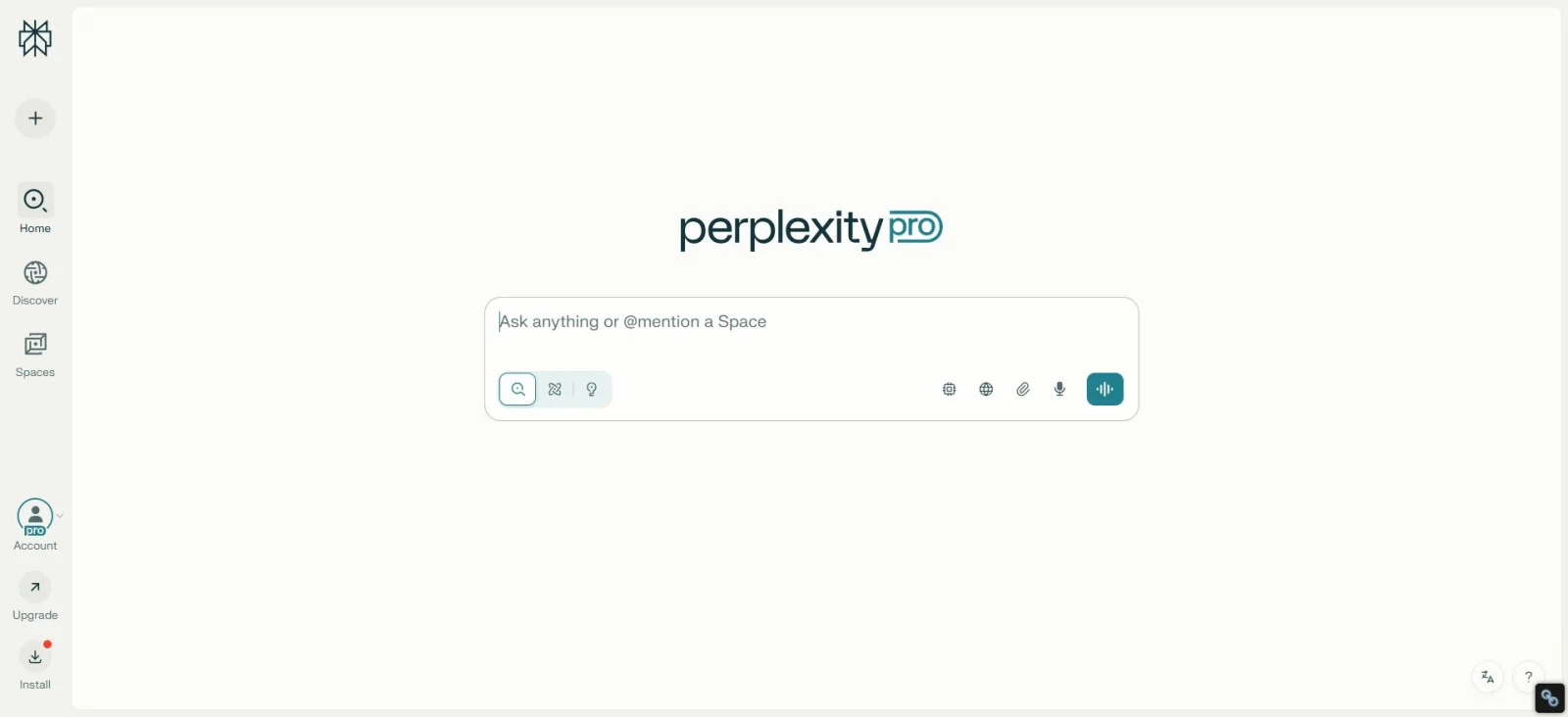
Perplexity AI is not just another search engine. Think of it as an answer engine rather than a traditional search engine, like Google. It is AI-powered, built to give you straight answers with a fast speed. Instead of making you scroll through a dozen links, ads and outdated forum posts, Perplexity AI gives you clean and accurate responses backed by real sources. It combines the power of a search engine with the conversational AI chatbot.
For instance, you can just type in any question like What caused the 2008 financial crisis or Best cafes in Bangalore with Wi-Fi. Perplexity AI responds instantly with a clear answer and clickable citations. It feels like chatting with a really smart research assistant who already knows where to look and gives you only what matters.
As you now understand 'what is perplexity AI', you must be curious to know about its features. Below is a given section that covers all the key features of Perplexity AI:
Perplexity AI has introduced and evolved its own models over time to improve real-time search, factual answers, and web-grounded responses. The model family started with PPLX Online models and later evolved into the Sonar family.
| Model | Description | Best Features |
|---|---|---|
| pplx-7b-online | One of Perplexity's first online LLMs, introduced in 2023 and fine-tuned from Mistral 7B. | Real-time information, factual answers, and fast web-grounded responses. |
| pplx-70b-online | A larger Perplexity online model introduced alongside pplx-7b-online and fine-tuned from Llama 2 70B. | Better reasoning, factuality, freshness, and web-based answers. |
| Llama 3 Sonar Models | Perplexity's next generation of search-focused models based on the Llama 3 family. | Improved search, longer context, better citations, and more accurate web-grounded responses. |
| Llama 3.1 Sonar Models | An improved generation of Perplexity's Sonar models introduced in 2024. | 128K context, improved search quality, better reasoning, and stronger online responses. |
| Sonar | A lightweight Perplexity search model optimized for fast, cost-effective, real-time answers. | Fast web search, factual Q&A, summarization, and citations. |
| Sonar Pro | An advanced version of Sonar designed for more complex search queries and deeper information retrieval. | Complex queries, deeper search, follow-up questions, and detailed answers. |
| Sonar Reasoning Pro | A reasoning-focused Sonar model designed for complex, multi-step tasks. | Advanced reasoning, logical problem-solving, and multi-step analysis. |
| Sonar Deep Research | A research-focused model designed to perform extensive web research and generate detailed reports. | Deep research, extensive web searches, source synthesis, and comprehensive reports. |
Note: Perplexity continues to update its model lineup as new models and search technologies are introduced. Therefore, the exact models available in Perplexity can change over time and may also depend on the user's plan. Its current documentation groups the Sonar range into Search, Reasoning, and Research models.
Perplexity AI is designed to make the entire information-finding experience smoother, smarter, and more efficient. Here are key features that set it apart from any other tool:
Forget running dozens of individual searches. Perplexity introduced a Deep Research mode that transforms the platform into an AI-powered research agent. It performs multiple searches, analyzes numerous sources, and creates detailed reports with citations, helping users conduct comprehensive research in a fraction of the usual time.
When you ask a complex question, this mode spends 2-4 minutes conducting multi-step, agentic analysis. It conducts successive searches, reviews hundreds of sources, and employs sophisticated reasoning to synthesize the material into a single, comprehensive, expert-level report.
This is Perplexity's biggest move yet: launching its own browser. Comet is a strategic leap intended to replace the traditional, tab-filled browsing experience. Comet, now free for Mac and Windows users, shifts the focus from navigating websites to finding answers.
It features a dedicated workspace and integrates the Perplexity Assistant on every new tab, allowing you to summarize a webpage, ask follow-up questions about a document, or even use the Shopping Hub to get AI-generated, cited product comparisons right in the browser.
This feature elevates Perplexity from a web tool to an enterprise-grade research partner. Pro and Enterprise Pro users can now simultaneously search the live web and their internal files (PDFs, Word docs, Excel sheets). This allows for truly unified, "all-in-one" Q&A.
The breadth of top-tier Large Language Models (LLMs) available to subscribers has never been richer. Perplexity Pro provides access to advanced AI models such as GPT-5, Claude Sonnet 4.5, Gemini 2.5 Pro, Gemini Omni, and other frontier models.
Users can select different models depending on their requirements for research, coding, reasoning, or content generation.
It does not require the use of perfect keywords. Just ask a question like you would ask a person. Perplexity AI understands natural language, replies in a clear and chat-style format. It is like talking to a knowledgeable friend who is fast at Googling things.
This AI tool pulls in the latest data from the web, so your answers are not based on any outdated information. If something just happened today or last week, it can find and summarize that instantly.
Every answer comes with clickable references. You can easily fact-check the response, dive deeper into the source or use it for your own research. This type of transparency makes it helpful for students, writers and professionals.
You can ask one question and then another. This AI tool remembers the context of your previous questions and lets you build on the conversation. Therefore, it feels more like a natural flow than starting over each time.
If you want more information from a specific field like academic research, YouTube videos or news articles? Perplexity helps you with this too. It lets you narrow down the source type to get the most relevant answers depending on what you are looking for.
The Pro version of this AI-bot can handle image inputs too. For instance, you can upload a chart or a screenshot and ask it to analyze or explain it. This adds a whole new dimension to how we interact with search engines.
It is not like some traditional search engines, which are filled with ads and distractions. This AI-bot keeps the interface clean and clutter-free. It is all about getting you the info you need at a fast pace.
Perplexity just rolled out a new video generation feature that lets Pro and Max users turn their ideas into short 8-second videos with audio. It works on web, iOS, and Android, giving you a quick and creative way to brainstorm and bring concepts to life.
Perplexity Finance now gives all users access to Indian market data across all devices such as desktop, mobile web, and mobile apps.
It now allows users to create reports, spreadsheets, dashboards, presentations, and simple applications using natural language prompts. This feature helps professionals, researchers, and businesses quickly transform ideas into useful outputs without requiring extensive technical knowledge.
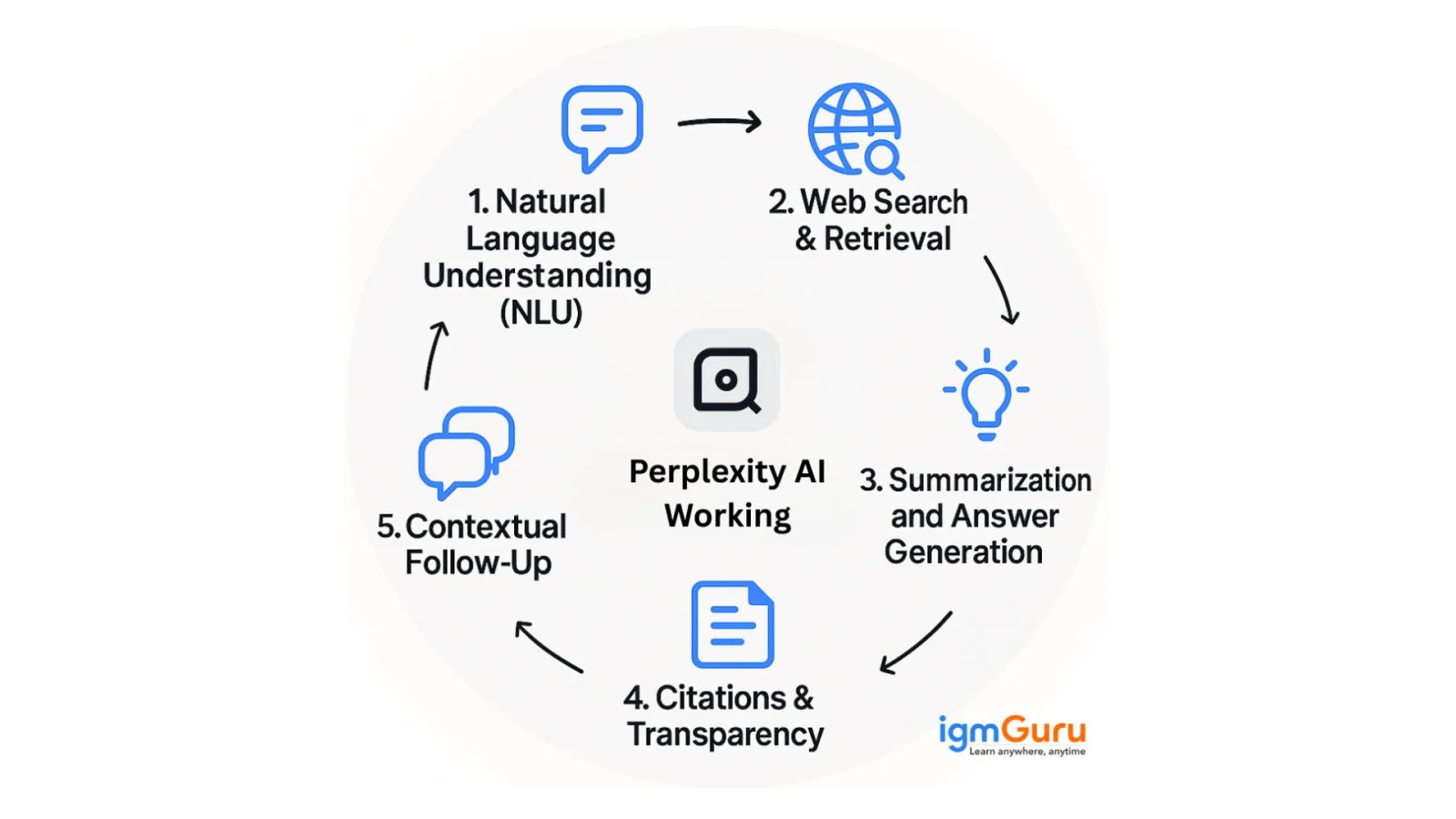
Perplexity AI works like a combination of a search engine, chatbot and research assistant. Yet, instead of giving you a list of links like Google does, it actually understands your question, finds the most relevant answers from the web and responds with a well-written explanation. Let's understand how it works.
When you type a question, Perplexity AI first uses powerful language models (like OpenAI's GPT) to understand what you are really asking, not just the keywords but the intent and context. Whether you have just asked something casual like the best books on productivity or how quantum computing works? It first processes the meaning behind your words.
After that, it scans the internet in real time to find relevant and trustworthy sources like news articles, academic papers, blog posts, videos or research databases. This is what sets it apart from many other AI tools that rely on outdated or static training data.
Once it pulls the data, it filters the noise and generates human-like answers. It does not just paraphrase what it finds, but actually summarizes and explains the core points in a way that is easy to understand.
The final answer includes clickable citations for every major fact or claim it makes. These sources are usually shown as footnotes or links beside the response. Therefore, you can quickly check where the information came from or explore further if needed.
One of the smartest things about this AI-bot is that it can remember the context of your questions during a session. So if you ask a question like- What is climate change? and then ask a follow-up question- How does it affect agriculture? It connects the dots and continues the conversation naturally.
Perplexity AI can intelligently select and utilize different AI models depending on the complexity of the query. This helps improve response quality, reasoning capabilities, coding assistance, and research accuracy while ensuring users receive the most relevant answer possible.
Read Also- The 5 Best AI Browsers You Need to Know in 2026
Using Perplexity AI is simple, even if you have never tried an AI search tool before. Here is a step-by-step section on how it works with a look at some of its most useful screens.
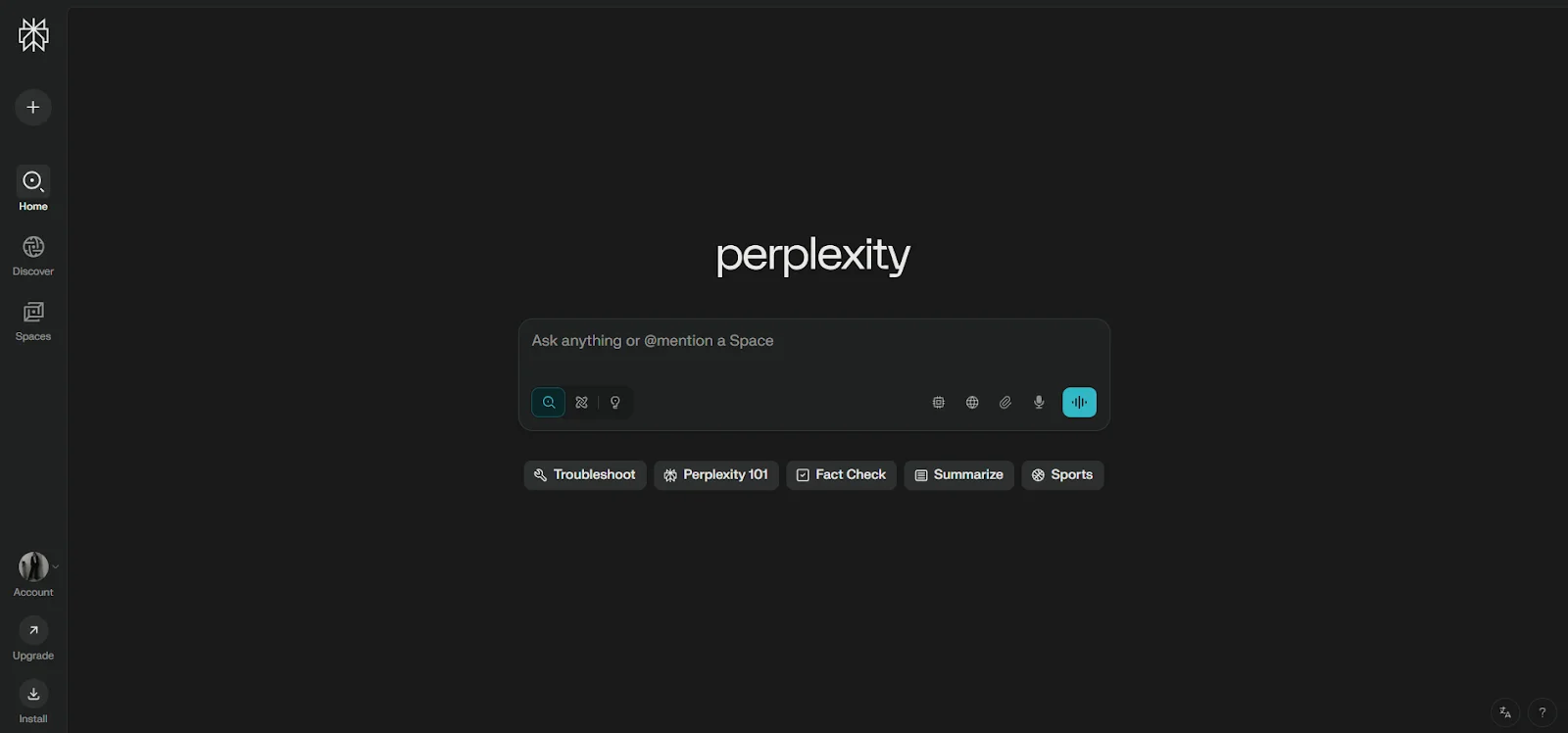
When you land on Perplexity.ai, you will be greeted with a clean and minimal interface. You will see a search bar right in the center, similar to Google.
You can just type in your query in natural language anything from- What is the difference between AI and ML? to Best books for beginner investors. Then, hit enter and Perplexity will instantly give you a well-written answer with clickable sources right below.
Below your search, you can even toggle between regular results or Focus mode to get more specific types of sources like YouTube, News, Academic, and more.
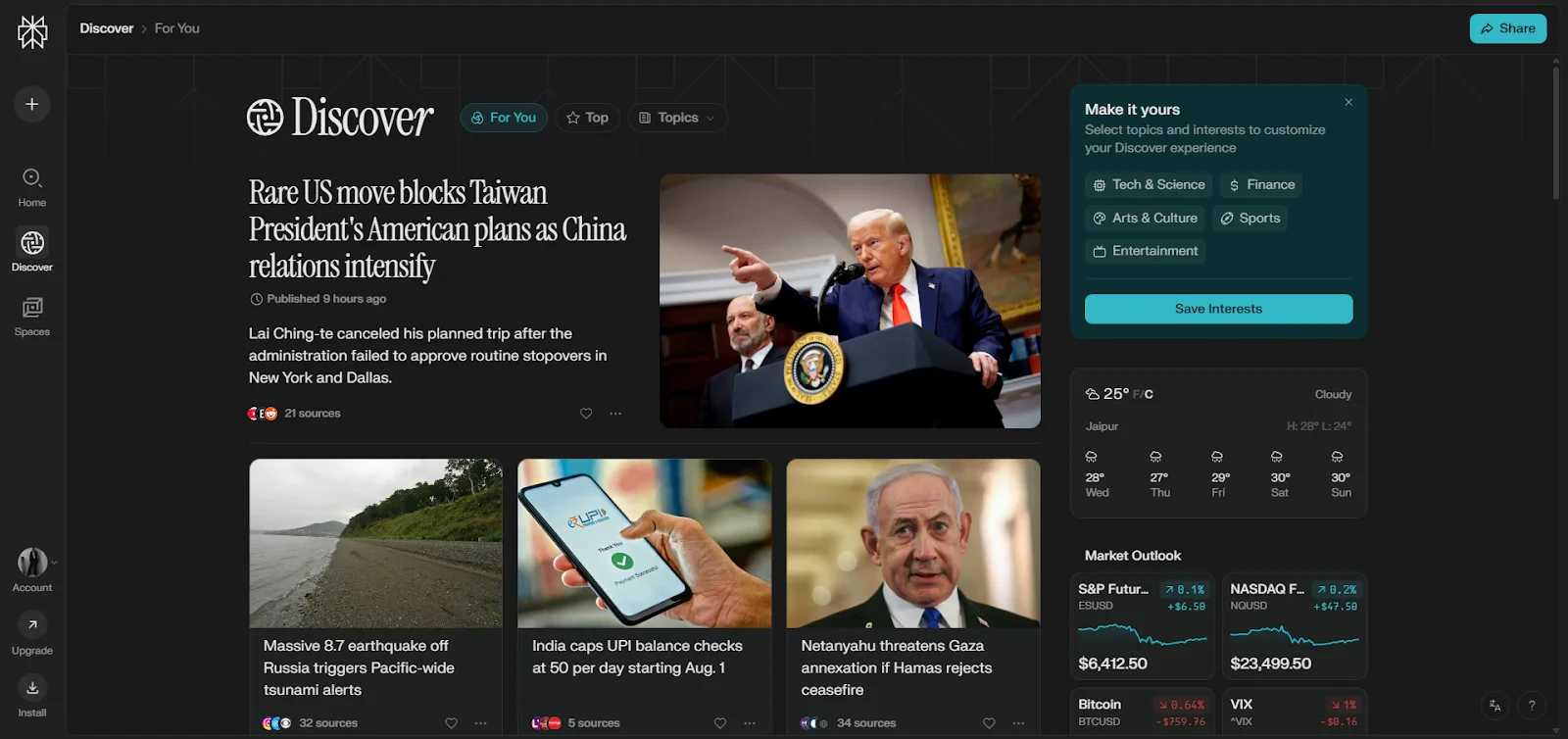
Perplexity’s Discover page is where your curiosity meets convenience. You will find a constantly updating feed of trending questions, user-generated spaces and popular topics from across the internet. It is like a personalized front page for deep learning, tech, culture, science and current affairs.
You can click on any topic to instantly view a short summary, related questions and direct answers. It is perfect when you are not sure what to ask but want to explore something interesting. Think of it as a smarter version of scrolling news, yet without the noise.
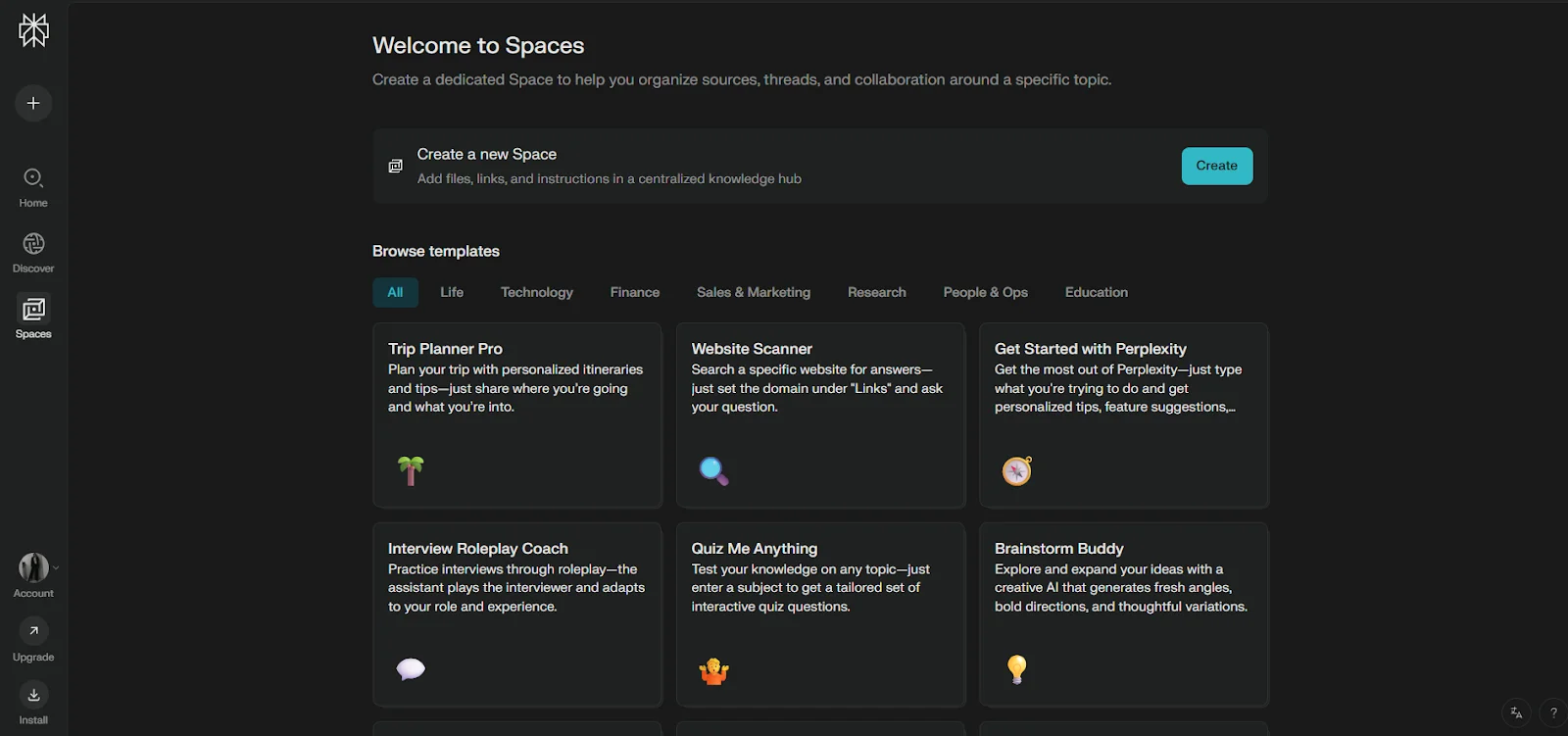
One of the most powerful and underrated features of Perplexity AI is Spaces. This lets you collect, organize and share your searches in one place like a research board. Every time you search or create a follow-up thread, you can always save it into a space. You can keep it private for yourself or publish it for others to explore.
It is especially useful for students, writers or anyone working on a project. For instance- you can create a space on 'Climate Policy in India', save all your related queries and sources there and come back to them later without starting from scratch.
Related Article- ChatGPT Tutorial
Here's a quick comparison to show how Perplexity AI stacks up against Google and ChatGPT in terms of purpose, data source, usability, etc.
| Feature/Aspect | Perplexity AI | ChatGPT | |
| Purpose | AI-powered search engine with real-time answers and citations | A traditional search engine shows a list of websites | AI chatbot for general conversation and information |
| Data Source | Real-time web browsing and language model knowledge | Index of websites (not always up to date) | Trained on large datasets (knowledge is static after cutoff) |
| Answer Format | Direct answer with citations and summary | List of links, snippets, ads | Long-form responses without direct citations |
| Citation Support | Yes, clickable sources are included with answers | Not directly in answer; users must check each link | No real-time web sources or citations (except in Pro and web mode) |
| Follow-up Questions | Maintains context in threads | Each search is treated as new | Maintains context within a conversation |
| Interface Style | Chat-style with research focus | Search bar with results page | Chat-based, creative and conversational |
| Use Case Focus | Research, fact-checking, quick accurate info | General-purpose searching, shopping, news, etc. | Brainstorming, writing help, code generation, and learning |
| Real-Time Info Access | Yes | Yes | ChatGPT's web browsing is now available more broadly |
| Ads and Clutter | Minimal to none | Yes, lots of ads and SEO-heavy content | No ads |
| Multimodal (Images/Files) | Yes (Pro), can interpret files and images | No | Yes (Pro), accepts images and documents |
| Best For | Quick, reliable and cited research answers | Broad discovery and browsing | Conversations, ideas, creative tasks |
Today, perplexity AI is being used widely. From academic research to coding help and technical queries, let's understand the use cases of it.
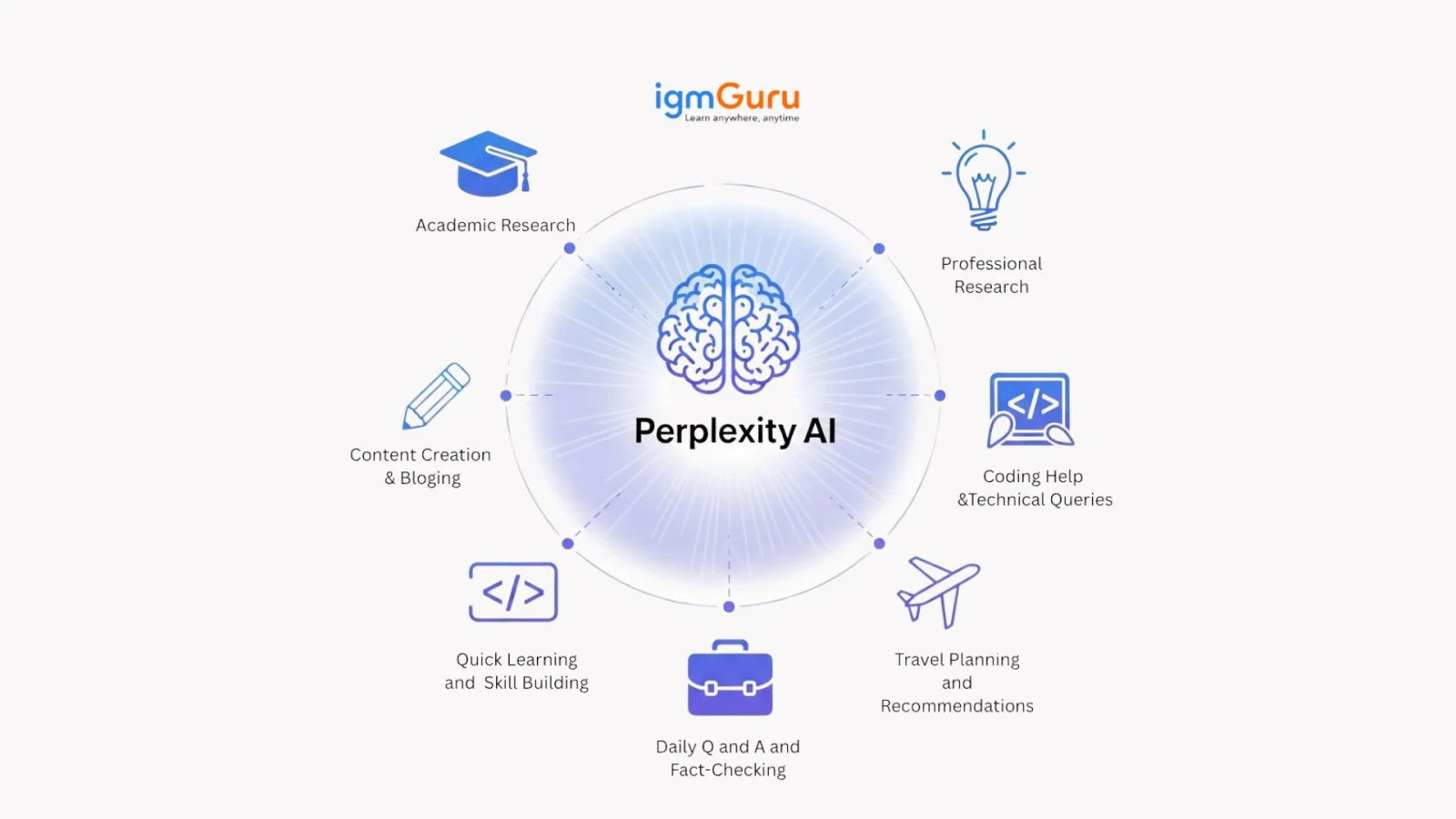
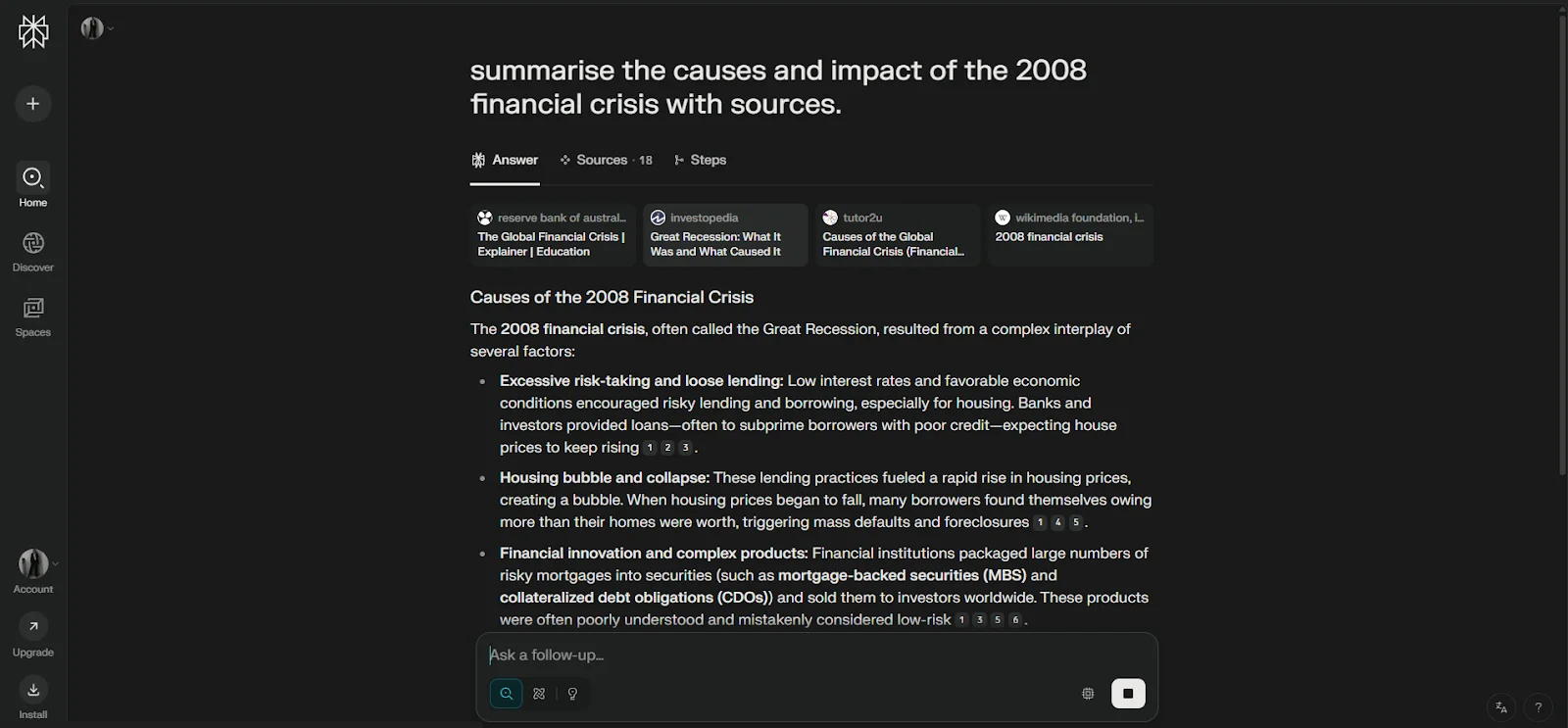
Students and researchers use this AI tool to get quick, reliable summaries of complex topics with sources included. It is great for writing papers, understanding concepts or finding credible references without getting lost in endless PDFs. For instance, you can say it to summarise the causes and impact of the 2008 financial crisis with sources.
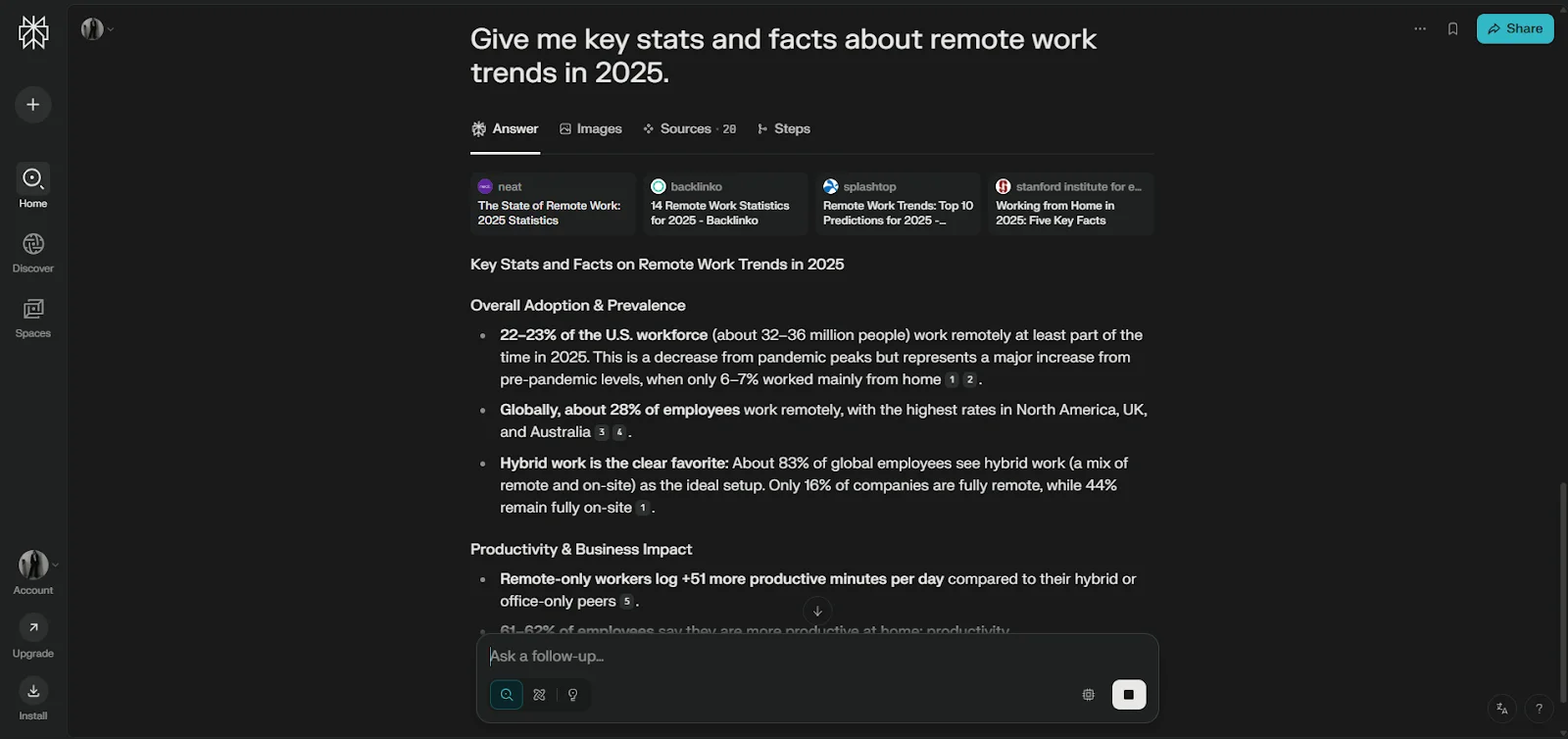
Writers and marketers use it to gather facts, spark ideas or quickly get up to speed on a topic they are writing about. No more juggling between 10 tabs- Perplexity gives you the core information in one place. For instance, you can say it- Give me key stats and facts about remote work trends in 2025.
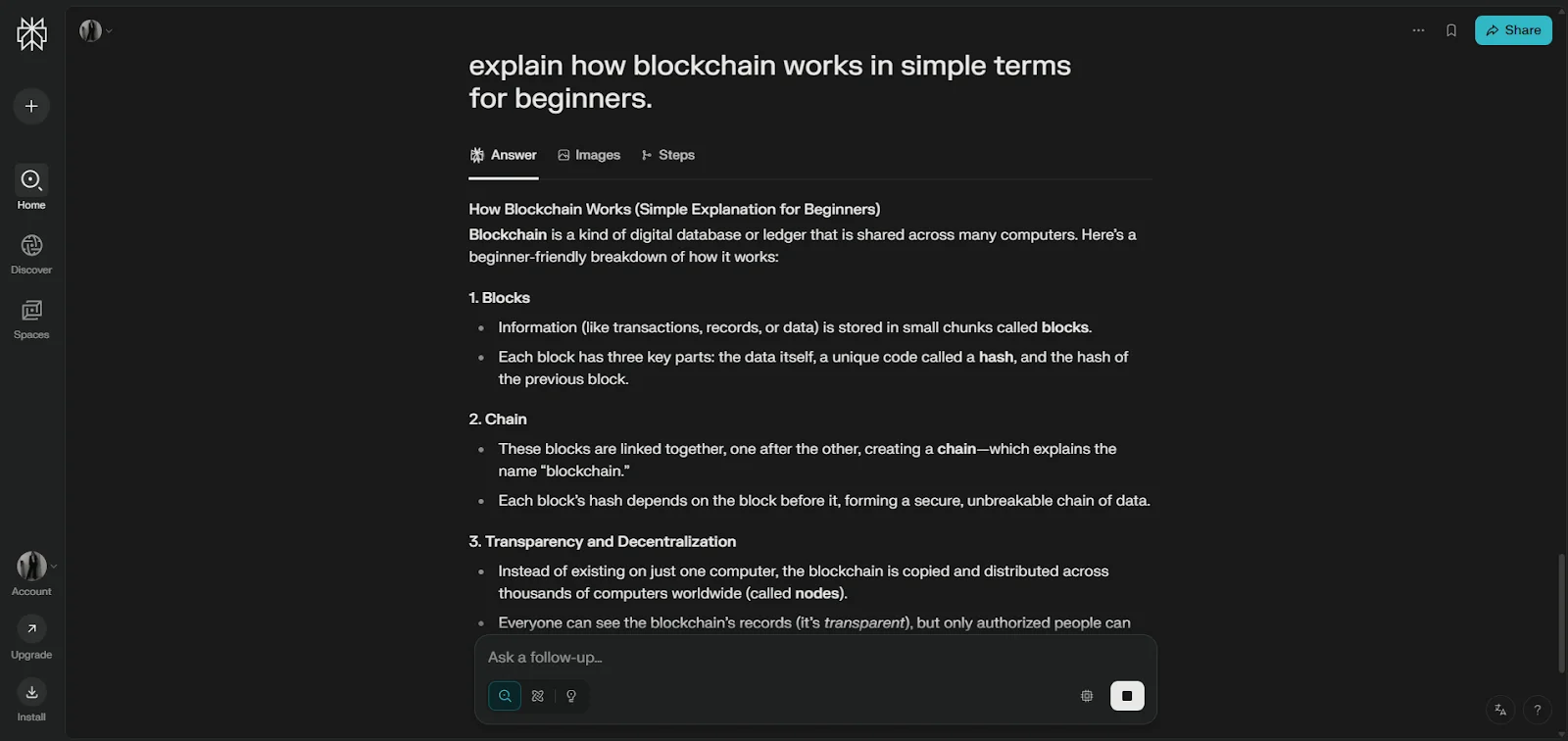
If you are curious about something new like how blockchain works or what is happening in geopolitics? This AI-bot breaks it down in simple language and makes it perfect for self-learners. For instance, you can say it to explain how blockchain works in simple terms for beginners.
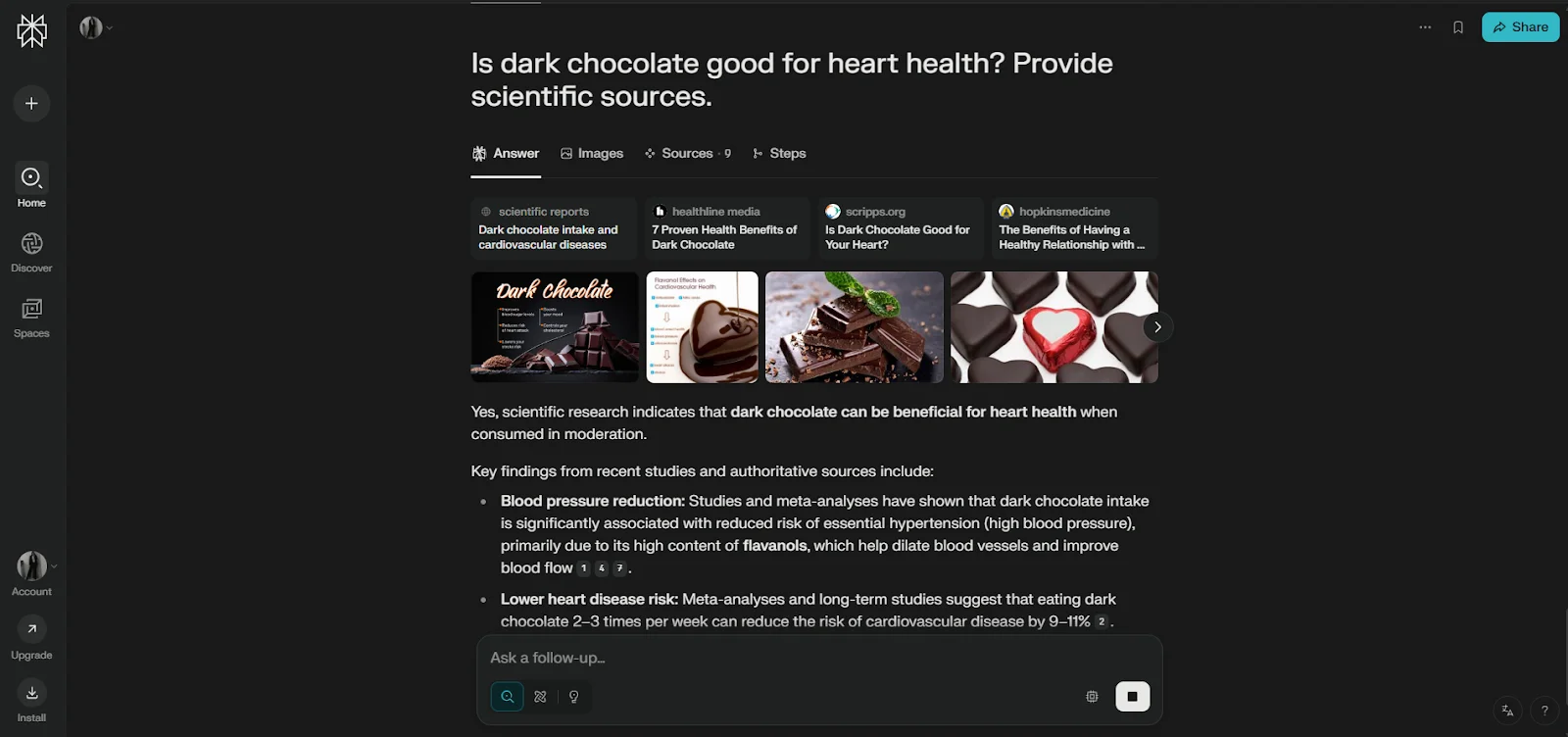
Whether you are settling a debate, looking up health facts or checking something you read online, it gives you straight answers backed by sources. Therefore, you can trust what you are reading. For instance, you can say- Is dark chocolate good for heart health? Provide scientific sources.
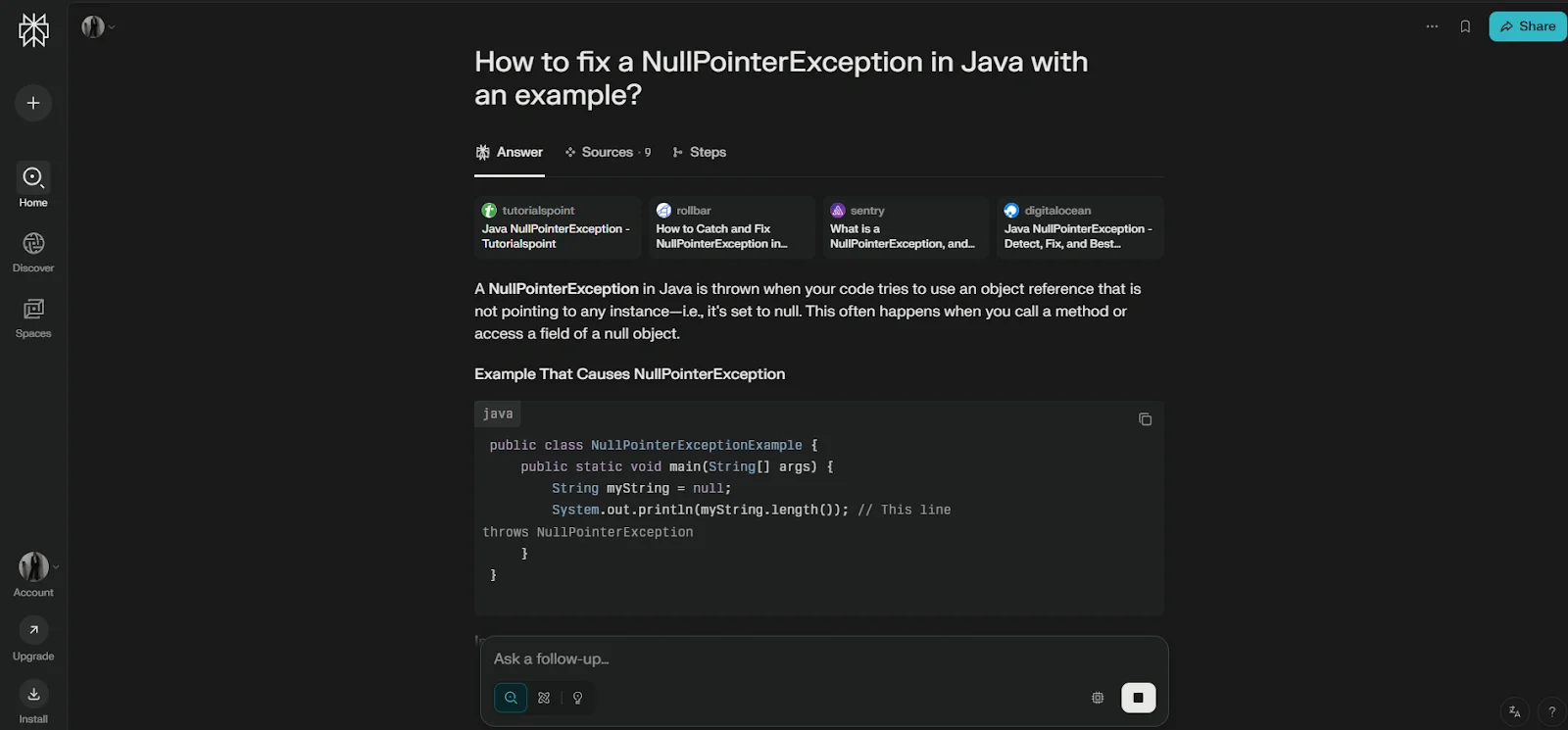
You can ask questions related to programming languages, debug errors or explore technical documentation. It pulls relevant info from the latest forums, docs, and tutorials. It often has more context than Google. For instance, you can say- How to fix a NullPointerException in Java with an example?
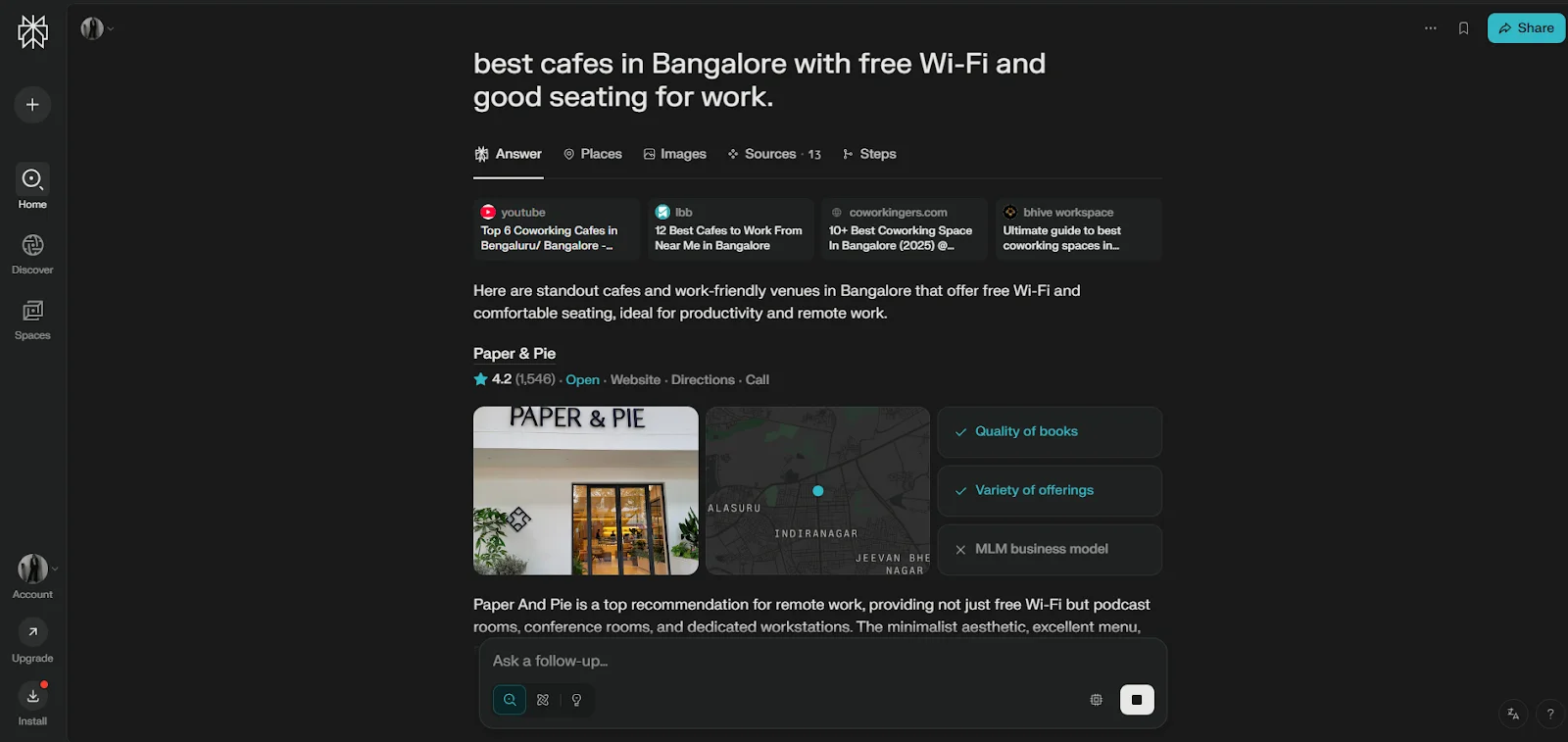
If you are looking for the best restaurants in a city, travel safety tips or offbeat destinations? It can combine live web data with quick summaries to help you plan smarter. For instance, you can say it to find the best cafes in Bangalore with free Wi-Fi and good seating for work.
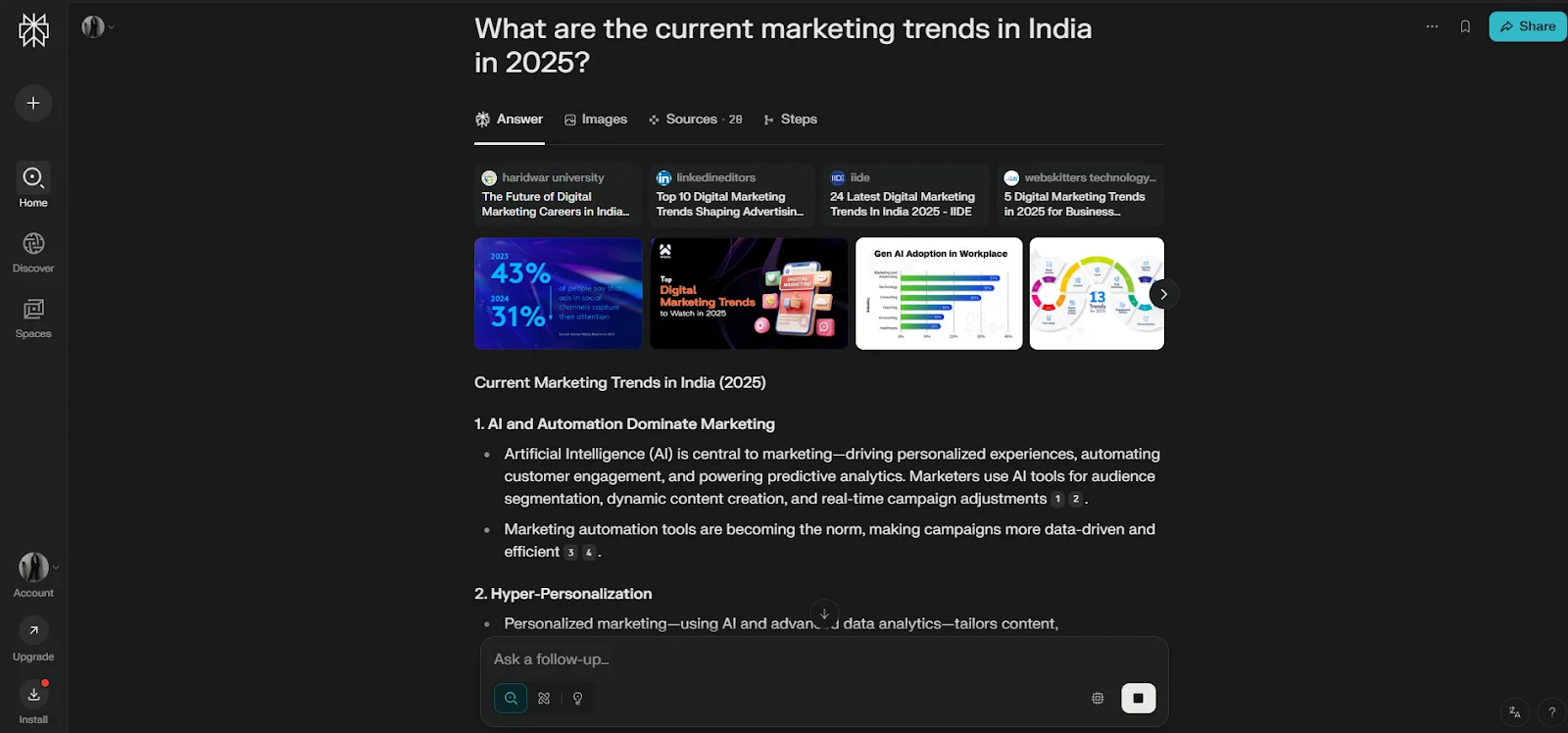
Professionals use this AI-bot to gather well-sourced intel without wasting time sifting through noise from finance and healthcare to marketing trends and startup insights. For instance, you can say it: What are the current marketing trends in India in 2025?
Related Article- Agentic AI Interview Questions and Answers
While Perplexity AI is super helpful and fast, yet it is not completely perfect. Like every other tool, it has its own set of limitations you must know, especially if you are relying on it for serious research or decision-making.
Perplexity AI pulls answers from online sources in real time. This is good, yet it also means the quality of the answer depends on the quality of what is available on the web. If the internet is full of outdated or misleading info on a topic, it might surface that too.
Since Perplexity AI relies heavily on information available online, the quality of its answers depends on the credibility of the sources it finds. Users should always verify important information using authoritative sources, especially for medical, legal, financial, or academic topics.
Unlike ChatGPT, Grok AI or Claude AI, which are better at writing stories, generating content ideas or doing creative brainstorming, Perplexity sticks strictly to facts. It is not designed for creative writing, scripting or imaginative tasks.
Sometimes, if your question is too vague, multi-layered or unusually worded the answer might miss the point or oversimplify things. It works best with direct and specific prompts.
The free version is powerful, but if you want access to more advanced features like image inputs, longer context memory or higher quality answers, you will need to pay for the Pro plan.
Since it depends on live web browsing, you can not use it without an internet connection. It is not like a stored database or an offline knowledge tool.
Read Also- How To Build an AI Agent
Perplexity AI offers six pricing tiers across individual, education, and business use: Free, Pro, Max, Education Pro, Enterprise Pro and Enterprise Max, along with a separate pay-as-you-go API.
| Plan | Pricing | Best For | Key Features |
| Free Plan | $0 | Casual users, students, and beginners | Unlimited basic searches, around 5 Pro Searches per day, web citations, AI-powered answers |
| Perplexity Pro | $20/month or $200/year (~$16.67/month annually) | Researchers, professionals, and content creators | Unlimited Pro Searches, access to premium AI models, model switching, file uploads, image/video generation, Comet browser, Labs |
| Education Pro | $10/month for verified students and educators (via SheerID) | University students and educators | All Pro plan features at a discounted rate, extended access to academic features |
| Perplexity Max | $200/month or $2,000/year | Power users, AI enthusiasts, advanced workflows | Everything in Pro, plus Perplexity Computer (multi-model agent orchestration), Model Council (multi-model answer comparison), unlimited Labs, priority support, early access to new features |
| Enterprise Pro | $40/seat/month or $400/seat/year | Teams and businesses doing everyday collaborative research | All Pro features plus team collaboration, admin controls, SSO, enterprise-grade security, shared knowledge bases, data never used for training |
| Enterprise Max | Custom pricing (reported up to roughly $325/seat/month) | Large, research-intensive enterprises | All Enterprise Pro features plus unrestricted access to top models, insight dashboard, audit logs, SCIM, advanced data retention controls |
| API (Sonar) | Usage-based, from about $1 per million tokens (Sonar) up to $15 per million output tokens (Sonar Pro) | Developers and SaaS companies | Token-based pricing for search-grounded AI model access and integration into custom applications |
For businesses and teams, Perplexity's Enterprise Pro plan unlocks all Pro features plus extras built for serious work environments, including enhanced data privacy and security, team and user management, single sign-on (SSO), and data retention controls. It is priced at $40/month per seat or $400/year per seat. Larger organizations with more demanding needs can move up to Enterprise Max, which adds features like audit logs and SCIM (available once an org has 50+ members or at least one Enterprise Max seat), with custom pricing available by contacting Perplexity's sales team.
Comet, Perplexity's AI browser, was previously gated behind paid plans but is now free for all users on Mac, Windows, iOS, and Android. Pro and Max subscribers get the premium add-on Comet Plus included at no extra cost, while standalone Comet Plus runs $5/month.
If you are a power user, researcher, analyst or someone who works with complex queries, large files and advanced models like GPT-4o or Claude. Then yes, the Pro version offers serious value.
Yet for casual users who just need basic search and reasoning, the free version still packs a punch with unlimited auto searches and Sonar model access. Ultimately, it is about how deep you go and how often you work.
Related Article- Generative AI Interview Questions And Answers
After using Perplexity AI for research, content planning and quick fact-checking, one thing became very clear. It saves a huge amount of time. Instead of opening multiple tabs and manually comparing information, I could simply ask a question and get a clean summary with sources attached.
What I personally liked the most was its citation feature. Unlike many AI chatbots that give answers without references, Perplexity AI shows where the information comes from. This makes it much more reliable for writing blogs, checking statistics or exploring technical topics.
I also found it especially useful while researching trending AI tools, coding concepts and industry updates. The follow-up question feature feels natural and helps continue the conversation without repeating the entire query.
However, it is not perfect for everything. For creative writing, brainstorming or detailed storytelling, tools like ChatGPT still feel more flexible. Perplexity AI works best when you need fast, research-focused and fact-based answers.
Overall, my experience with Perplexity AI has been positive. It feels less like a traditional search engine and more like a smart research assistant that helps you find information faster and with less clutter.
In short, Perplexity AI is more than just another AI tool. It is changing the way people search, research, and consume information online. With its mix of AI-powered answers, real-time web data and user-friendly features, it offers a faster and smarter way to explore topics. While it still has some limitations, its growing popularity clearly shows that AI-driven search platforms are shaping the future of digital information.
Not exactly. Perplexity actually uses GPT-4 (and other LLMs). It is better for search tasks while ChatGPT is better for creative or long-form responses.
It can provide quick and direct answers with sources. Yet for deep research, shopping or browsing, Google still has the edge.
Yes, it has a free version. But for accessing advanced features like Pro search and file uploads, you need a paid plan.
Perplexity AI is known for a variety of features and is used in various applications. It excels as a research tool, as it provides accurate and up-to-date information with citations. It is designed to give direct answers to user queries by synthesizing information from multiple online sources.


