Generative AI is a hot topic of discussion in today's tech world. People all around the globe are using its capabilities to create images, videos and text-based data. It has shown rapid development in recent years. Therefore, most individuals think it is a new technology. However, it is not the truth. Do you know the history of generative AI?
This article provides the complete timeline of when this technology was introduced, risen and developed. Let's begin with a basic introduction to Gen AI. It will help beginners understand this technology.
Explore igmGuru's Generative AI course program to learn Gen AI from scratch.
Gen AI is a branch of AI that creates different types of new content. This includes text, music and images. It does so by learning patterns and movements from existing data. It mimics human creativity via models like Variational Autoencoders (VAEs) and Generative Adversarial Networks (GANs).
Generative AI has heavily transformed various industries such as entertainment, design, and art. This has happened by automating various creative processes. It also improved natural language processing, which has led to sophisticated virtual assistants and chatbots.
For the coming years, gen AI showcases promise in revolutionizing industries via innovative product designs, advanced problem-solving capabilities and personalized content. Thus, significant benefits will be offered, expanding the potential of machine creativity.
Also Read - How To Start A Career in Artificial Intelligence
Generative AI has become one of the most influential technologies of the modern era. From creating text and images to generating videos and software code, its applications are expanding rapidly. Understanding the history of generative AI helps us see how decades of research, experimentation and technological advancements contributed to the powerful AI systems we use today.
The journey of generative AI did not begin with ChatGPT or image generators. It started with early artificial intelligence concepts, machine learning experiments and neural network research. Learning about this evolution helps beginners understand the technology's foundations while providing insight into where it may be heading in the future.
Artificial Intelligence was first introduced by the mathematician Alan Turing as intelligent machinery in 1947. He was the first one to think about whether a machine could be intelligent enough to do human tasks without their interference. He published a paper in 1950 with the question "Can machines think?". He has come up with a test called the Turing Test. This involves using different questions and their answers.
On the basis of these questions, the individual has to make a choice whether they are talking to a human or a computer. The idea of this test is to trick a person that they are talking to humans while they are not. This test has led to curiosity among various researchers and experts.
In 1956, a workshop called "The Dartmouth Summer Research Project on Artificial Intelligence" was built by several researchers from philosophy, linguistics and computer science. They came together to debate the potential of intelligent machines. The idea was to discover whether a computer can simulate intelligence, reasoning and creative processes. This is when it gained the name Artificial Intelligence by an American computer scientist John McCarthy.
The actual considerable progress was made in the next decade. In this decade, machines have become cheaper, faster, affordable and capable of storing data. Meanwhile, in 1959, Arthur Samuel introduced Machine Learning for the first time. He created a self-learning program to play checkers. This program had the capability to learn different moves on its own.
It was just the beginning that gave direction to many researchers to work on this idea. This is when perceptrons were first introduced by Frank Rosenblatt during this time only. It was the first operational neural network created to train computers from data.
Since then, there have been many developments in AI. John McCarthy introduced the LISP programming language in 1960 to help AI perform tasks. Joseph Weizenbaum created the first ever chatbot "ELIZA" in 1961. However, development of AI declined in the late 1970s due to low funding.
One of the biggest milestones in the history of generative AI was the rise of deep learning. Although neural network concepts existed since the 1940s and 1950s, limited computing power prevented researchers from fully utilizing them. As computer hardware became faster and data became more accessible, deep learning started gaining attention.
Deep learning models use multiple layers of artificial neurons to identify patterns within large datasets. This capability significantly improved image recognition, speech processing and natural language understanding. The success of deep learning created the foundation upon which modern generative AI systems were later built.
Today, technologies such as deep learning, neural networks and machine learning continue to drive innovations in generative AI.
Generative AI's history goes back to the 1990s. It all began with the growth and grooming of early AI concepts, along with neural networks. In the decade of 1990-2000, computer processing ability showed a sustainable growth. In 1997, DeepBlue, a chess computer system, defeated a world chess champion for the first time. This is also when Dragon Systems built NaturallySpeaking, a voice recognition system.
This all has become possible with the rise of the Internet. The early 2000s came with a major revolution in industry, where they all started to collect data for processing. In this period, artificial intelligence, machine learning, deep learning and neural networks have become more accessible. Many industries have started research to unlock the true capabilities of this technology.
Deep learning technology is one of the main reasons behind the advancement of Gen AI. DL was introduced between the 1940s and 1950s. But due to the lack of computational power, it did not get the recognition at that time. With the advancement of technologies, it has shown a rapid growth in the early 2010s, so does Gen AI.
As mentioned earlier, ELIZA is one of the first primitive generative AI. This chatbot was developed in the 1960s by Joseph Weizenbaum. It is the first Natural Language Processing (NLP) model with the capability of mimicking the work of a psychotherapist. ELIZA was built on a simple pattern that involves recognizing keywords in text to then create generic responses.
This chatbot also had the capability to communicate which showed how capable a machine can be. However, it was very different from the modern chatbots. It was built to communicate and create an impression to make machines understand human speech. ELIZA was referred to as a parody of a psychotherapist with no intelligence of its own.
The term 'Generative Adversarial Networks' was given by Ian Goodfellow in 2014. This was a major milestone in this journey. GANs are behind the revolutionization of the field as it enables machines to create and generate highly realistic data. Variational Autoencoders (VAEs) were introduced before GANs in the early 2010s.
These, too, played an important role in the advancement of generative models. The last decade has witnessed rapid evolution in these technologies. All this has led to impressive applications in various places like music, art, natural language processing, and more.
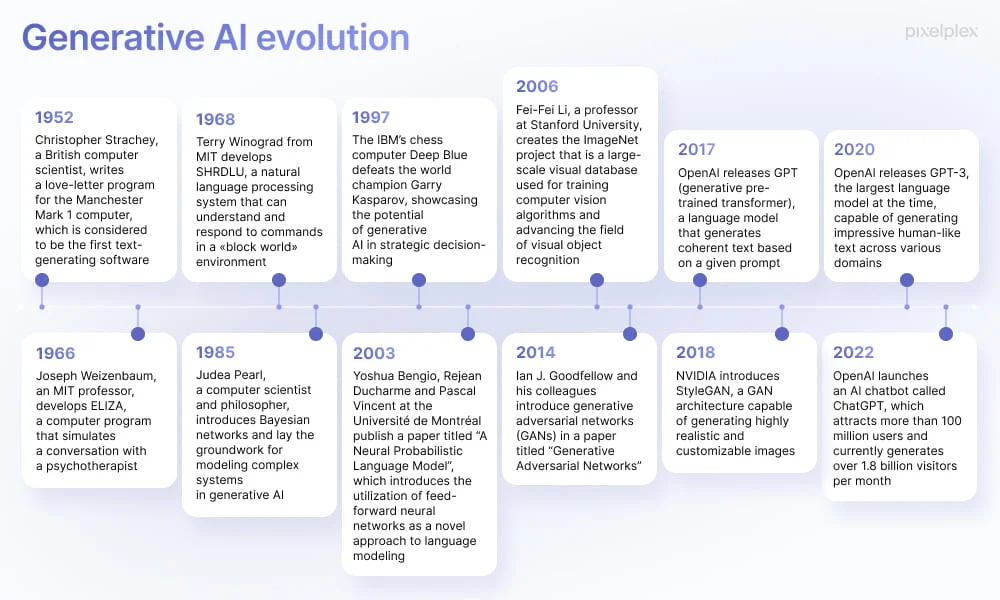
The continued enhancement of algorithms and computational power is driving generative AI's progress. All this has rendered it a transformative force across different industries. In fact, it is setting up the stage for future innovations. The image given below shows the evolution chart of Gen AI.
The year 2017 marked one of the most important moments in the history of generative AI. Researchers at Google introduced the Transformer architecture through the paper "Attention Is All You Need." Unlike previous neural network models, transformers could process large amounts of information more efficiently and understand context much better.
This breakthrough transformed natural language processing and became the foundation for modern large language models. Technologies such as GPT, Gemini, Claude and many other advanced AI systems are built upon transformer architecture.
The introduction of transformers significantly accelerated the growth of generative AI models and paved the way for the AI boom that followed.
The next major chapter in the evolution of generative AI was the development of Large Language Models (LLMs). These models are trained on massive amounts of text data and can understand, summarize, generate and translate human language with impressive accuracy.
OpenAI's GPT series played a major role in popularizing LLMs. The release of GPT-2 demonstrated the potential of large-scale text generation, while GPT-3 and subsequent models showcased unprecedented capabilities in content creation, coding assistance and reasoning tasks.
The success of LLMs led to the widespread adoption of AI-powered chatbots, virtual assistants and business automation tools across industries.
We have seen a rapid evolution in generative AI over time. The advancements in conversational AI, multimodal models and personalized experiences are furthermore driving its growth. Here are some of the most recent Breakthroughs of Generative AI:
| Breakthrough (Year) | Description | Organization |
| AI Code Agents (2025) | It can write, debug, and deploy code autonomously with minimal supervision. | OpenAI, GitHub |
| Video-to-Video Generation (2025) | It facilitates the transformation of existing video clips using prompts and generative video models. | Runway, Meta, Pika Labs |
| Personalized On-Device AI (2025) | On-device generative models enable private and fast AI on smartphones and wearables. | Apple, Google |
| Multimodal AI Agents (2025) | These agents are capable of combining vision, language, audio and actions in interactive environments. | OpenAI, DeepMind, Meta |
| GPT-4.5 / GPT-4.1 (2025) | It provides an improved LLM with better coding skills, instruction following and reasoning. | OpenAI |
| Pika 1.0 (2024) | It comes with the capability of video generation from text/image with strong cinematic features. | Pika Labs |
| Stable Diffusion XL (2024) | It is an advanced text-to-image model with improved photorealism, inpainting and creative control. | Stability AI |
| Grok (2024) | Grok is a conversational AI integrated with X, designed for real-time awareness and wit. | xAI (Elon Musk) |
| Claude 2 & 3 (2024) | This AI model comes with strong reasoning, long context and safe interaction design. | Anthropic |
| Gemini 1 & 1.5 (2024) | It is Google's powerful multimodal LLMs with vision, audio, coding and planning abilities. | Google DeepMind |
| Sora (2024) | It has made it easy to generate high-quality, realistic videos from text prompts. Major leap in video synthesis. | OpenAI |
Here is a glance view on the evolution of generative AI:
| Year | Milestone | Description |
| 1956 | Birth of AI | Artificial Intelligence was introduced as a scientific discipline at the Dartmouth Conference. |
| 1958 | Perceptron | Frank Rosenblatt proposed the Perceptron as the first model to simulate brain-like neural processing. |
| 1961 | ELIZA | One of the earliest examples of generative AI that simulates human-like conversations. |
| 1982 | Recurrent Neural Network (RNN) | RNNs enable models to handle sequences and generate sentences based on prior inputs. |
| 1997 | LSTM | Long Short-Term Memory networks improve learning of long-term dependencies in sequences. |
| 2013 | Varionalyional Encodders (VAE) | These generative models are capable of learning latent representations for structured data generation. |
| 2014 | GANs | Generative Adversarial Networks have revolutionized image generation with adversarial training. |
| 2015 | Diffusion Models | It is a new class of generative models that uses noise and reverse denoising processes, later essential in high-quality image generation. |
| 2017 | Transformer Architecture | The Transformer model architecture enables highly parallel processing and better scalability. |
| 2018 | GPT | OpenAI releases GPT, which is a breakthrough in natural language generation using transformers. |
| 2021 | DALL-E | OpenAI launches DALL·E with the capability of generating images from textual descriptions. |
| 2022 | Stable Diffusion & Midjourney | Rise of high-quality, text-to-image tools including open-source Stable Diffusion and artistic Midjourney. |
| 2023 | GPT-4 | It is a multimodal model with improved reasoning, memory and 25,000-word generation capability. |
| 2024 | Sora, Claude 3, Gemini 1.5 | Emergence of text-to-video models, safer LLMs and highly capable multimodal agents. |
| 2025 | AI Code Agents & On-Device AI | Rise of autonomous coding agents, personalized on-device models and video-to-video generation tools. |
Despite its remarkable progress, generative AI faces several challenges. One of the most discussed concerns is the creation of deepfakes, which can generate highly realistic but misleading content. There are also concerns related to misinformation, copyright ownership and data privacy.
Another challenge involves AI hallucinations, where models generate inaccurate or fabricated information. Researchers and organizations continue to work on improving transparency, safety and reliability to ensure responsible AI development.
As generative AI becomes increasingly integrated into everyday life, addressing these challenges will be essential for its sustainable growth.
Generative AI's rapid evolution began in the middle of the last decade and has become the most significant advancement. It is currently growing at an extraordinary rate. It is essential for organizations and societies to stay updated with its latest developments. At this rate, this technology has much more to offer in the near future.
Generative AI concepts came in the 1950s, but modern generative models like GANs and transformers were introduced in the 2010s.
Generative AI evolved from rule-based systems to neural networks, with major breakthroughs like GANs in 2014 and transformers in 2017, enabling more advanced content generation.
Jürgen Schmidhuber is generally known as the father of generative AI. However, many individuals do not agree with it. Schmidhuber himself gave the title of father of deep learning to Alexey Grigorevich Ivakhnenko.
Course Schedule
| Course Name | Batch Type | Details |
| AI and ML Certification Courses | Every Weekday | View Details |
| AI and ML Certification Courses | Every Weekend | View Details |