The Pyramid Framework was developed in Python as a way for developers to rapidly create web applications. I have worked with it while developing web pages and APIs and other types of projects. Pyramid follows a “start small, grow big” philosophy, making it easy for beginning developers and experienced developers to use as well.
This framework is built to handle incoming requests, route those requests to the appropriate code, and return the responses to the client. Moreover, Pyramid is a very fast and flexible framework, making it a good solution for developing all sizes of projects.
In this blog, I will explain to you about what is Pyramid framework, its core components, working and many more. Let’s start!
The Pyramid Framework is an open-source, Python-based web framework that uses the "start small, finish big, stay finished" philosophy. It is a general-purpose web development framework created as part of the Pylons Project putting minimalism, speed and maximum flexibility at its core.
|
Read Also: Tornado Framework
Pyramid is a very flexible and minimalistic framework. The major components of Pyramid (i.e. Configurator, Routes, Views, Requests and Responses) work in tandem to provide an efficient method to manage incoming web requests. However, features such as Traversal, Tweens and Security can enhance the functionality and power of the Pyramid framework when developing larger complex web applications.
For example:
|
For example:
|
For example:
|
All data about the HTTP request is stored in the Request object – including form submissions, headers and any query parameters that appear in the request URL.
For example:
|
For example:
|
For example:
|
Manage static content like CSS, JS, images
For example:
|
Read Also: Introduction to CherryPy
Pyramid works by handling user requests through a simple and flexible process. When a request is received, it matches a URL to a specific route, processes it using a view and returns a response. This structure allows developers to control how data flows in the application.
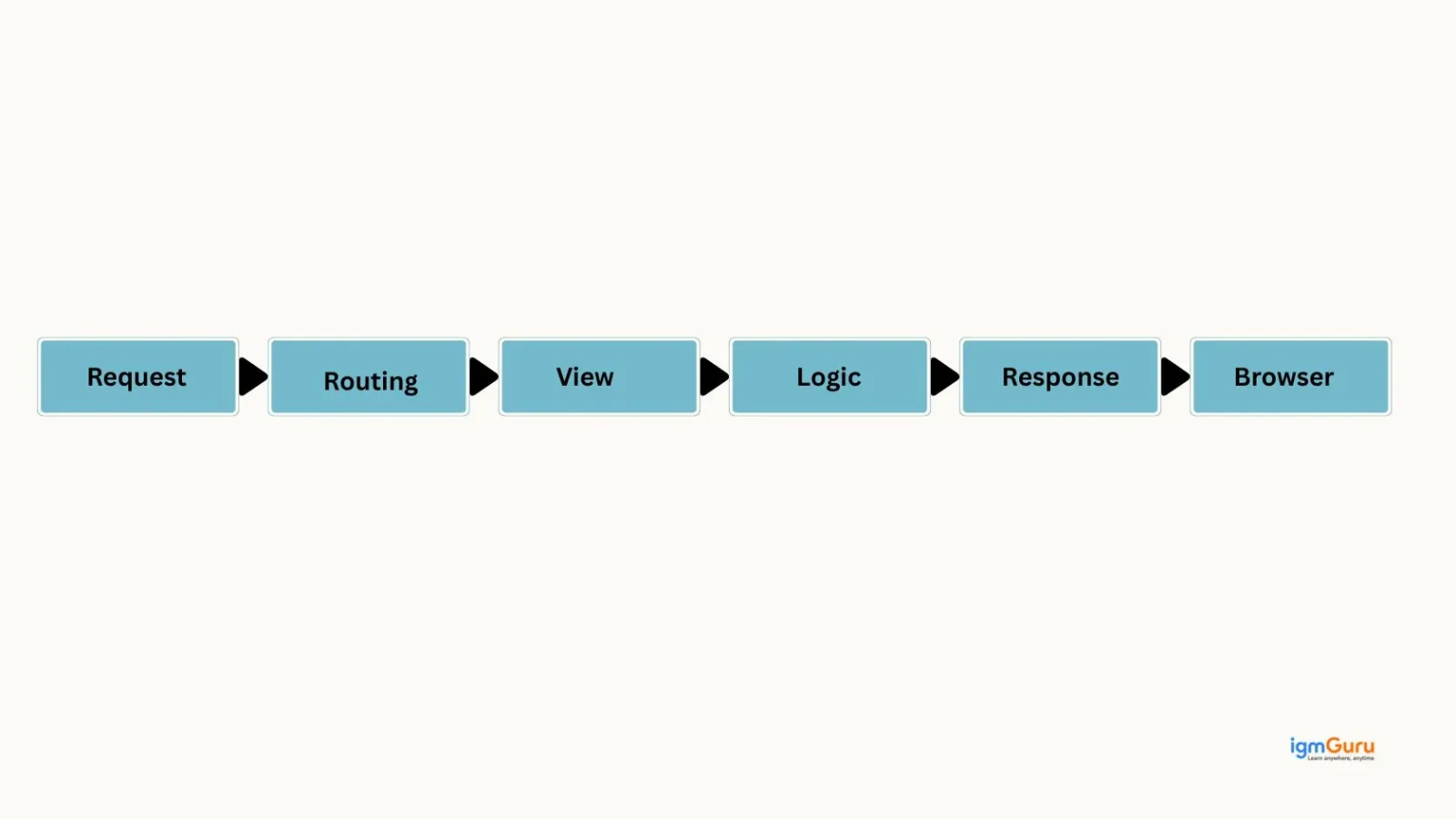
The user loads a page of a website or clicks on a link in their browser where an HTTP request ( GET or POST type ) is sent to the application Pyramid.
In this view, the business logic of your application is executed.
This is the core logic of the application.
The view builds a response by creating an HTTP response of one of the following types:
Pyramid converts the response built in the view to an HTTP response.
If the response is HTML:
The HTML response uses a template (e.g., .html file) as the basis for building a dynamic web page.
The dynamic data is merged with the template to produce the final web page.
Finally, the HTTP response is returned to the user using the browser.
Read Also: Bottle Web Framework
Pyramid Web Framework is flexible and powerful as it is used in many real-world applications. From small projects to large systems, developers use it to build scalable and customizable web solutions. Here are some of its common applications:
Users of the Pyramid content management platform are able to create a full online directory of their websites that includes text, images and pages. An example of this would be Plone, which uses the Pyramid framework to build a content management system.
For example: Simple Blog Page
|
The Pyramid framework allows developers to create highly customizable e-commerce sites that enable the management of products, user accounts and payment processing.
For example:
|
The Pyramid framework is the basis for a wide range of modern RESTful APIs. It provides front-end (web/mobile) applications with a secure connection to a backend data store, allowing for easy data exchange between the two.
For example:
|
Many enterprise size companies rely on the Pyramid framework to create and maintain their internal business applications, such as employee dashboards, CRM solutions and overall business management tools.
For example:
|
In addition to being able to build enterprise or consumer-based applications, Pyramid is a great option for building social networking-based applications where users can engage with each other, share content and communicate.
For example:
|
Pyramid can be utilized for developing dashboards, reporting tools and other applications that display data visually or provide fundamental analysis type insights to users regarding their data.
For example:
|
Read Also: Python Interview Questions and Answers
Choosing between Pyramid, Flask and Django depends on your project needs. Let’s compare them simply so you can understand which one fits best based on flexibility, complexity and use case.
| Feature | Pyramid | Flask | Django |
| Type | Flexible framework (can be small or large) | Microframework (lightweight) | Full-stack framework |
| Learning Curve | Moderate (some setup needed) | Easy (beginner-friendly) | Steep (many built-in features) |
| Flexibility | Very flexible (choose your tools) | Highly flexible | Less flexible (comes with fixed structure) |
| Built-in Features | Minimal (add what you need) | Very minimal | Many built-in (admin, ORM, auth) |
| Project Size Suitability | Medium to large apps | Small to medium apps | Large, complex apps |
| Performance | Good (scales well) | Good (fast for small apps) | Moderate (heavier framework) |
| Use Case | Custom web apps, APIs | Simple apps, prototypes | Enterprise apps, large websites |
Pyramid is a flexible and lightweight Python web framework that lets developers start small and grow applications as needed. It offers simplicity, scalability and powerful customization options, making it suitable for both beginners and advanced users.
Pyramid lets you build small and large applications. You can start simple and add features as your project grows without changing the framework.
As compared to other frameworks, Pyramid does not have any strict rules. Developers can choose tools, libraries and structures based on their needs.
It works well for both beginners and large-scale applications. You can easily expand your app without rewriting everything.
You can start with a simple setup and gradually learn advanced concepts. Beginners can build basic apps quickly.
Pyramid provides flexible and powerful routing, which makes it easy to manage URLs and connect them to views.
It has clear and detailed documentation, which helps developers understand and implement features easily.
Also Explore: Factorial Program in Python
While Pyramid is flexible, it can be harder to learn for beginners due to fewer built-in features compared to other frameworks. Developers may need to spend extra time configuring tools and components for building complete applications.
While setting up a basic Pyramid is fairly simple, using more advanced features, such as configuring a Pyramid, defining an application's routing and managing security, could be difficult for an inexperienced user to learn.
Other frameworks (i.e. Django and Flask) have larger user communities than pyramids do, which translates to fewer available resources for an inexperienced user to learn about the framework and its use.
A pyramid will need many manual configurations in addition to its basic setup. In fact, in many cases it will require more manual configurations than one or more of the previously mentioned frameworks may require to be set up and/or used.
The Pyramid web framework for Python allows you to create applications ranging from basic to very complex in a flexible manner. By utilizing organized core elements (routes and views) it is able to provide a mechanism for processing requests in a timely fashion. Although it takes time to set up, its ease of scalability, flexibility and true productivity make it an excellent choice.
Explore Our Trending Article:-
Pyramid is considered beginner-friendly, but there can be an initial learning curve. Beginners can use some of the more straightforward applications but will take a while to get accustomed to the flexibility of Pyramid.
Pyramid is a framework written in Python; therefore, having basic knowledge of Python is necessary to develop applications with Pyramid.
Pyramid has a scalable architecture and is used to build very large, complex applications.
Pyramid does not adhere strictly to the MVC architecture; however it does use the basic concepts of MVC by utilizing routes, views and models.