Are you preparing for OOP interview questions? Object-oriented programming is one of the most important concepts in software development. This is why companies frequently test candidates on OOP principles, design concepts, scalability, and real-world problem-solving during technical interviews.
This blog on OOPs Interview Questions and Answers will help you prepare with the most commonly asked questions covering beginners, intermediate learners, and experienced professionals. Whether you are preparing for Java, Python, C++, backend development or system design interviews, these questions will strengthen your skills for the interview and boost your confidence for upcoming technical interviews. Let’s begin!
Let’s begin with the most asked OOPs interview questions and answers for beginners. These are based on basic concepts and are mostly asked to freshers only.
Object-Oriented Programming is a unique programming paradigm that organizes software design around objects instead of functions or logic. An object represents a real-world entity and combines data (attributes) and behavior (methods) into a single unit. This approach helps developers model complicated systems in a more natural, structured and reusable way.
This concept uses classes to build programs, where classes are blueprints for creating objects. Each object created from a class can have its own data values while sharing common behavior. This makes code easier to manage, extend and debug, especially in large applications.
There are a variety of programming paradigms apart from OOP, including:
Object-oriented programming is preferred because it models real-world entities more naturally using objects and classes. OOP improves code reusability through inheritance, data security through encapsulation, and flexibility through polymorphism. It also makes large applications easier to maintain, test, and scale, especially when multiple developers are working on the same project.
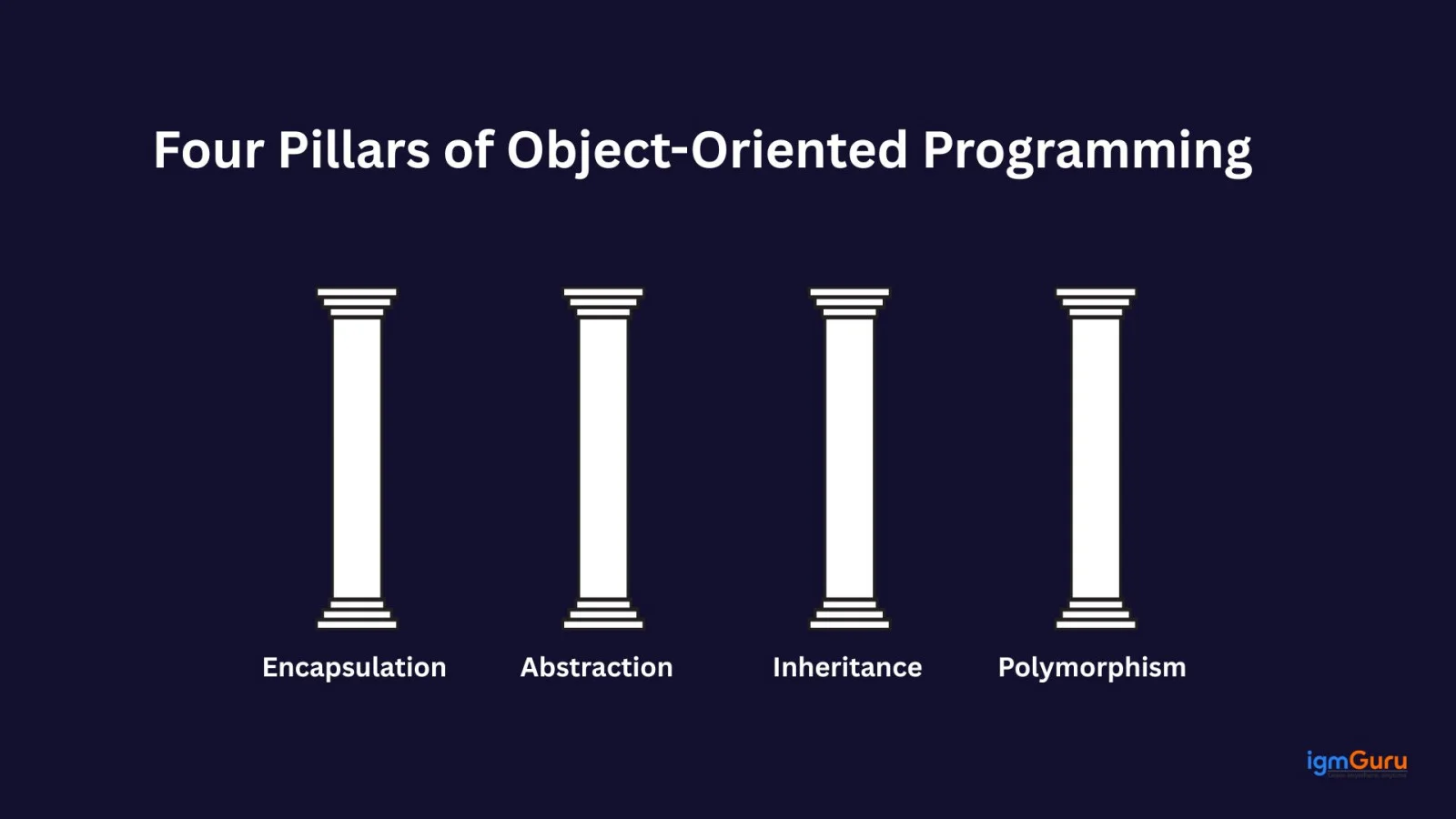
OOPs has four core pillars, including:
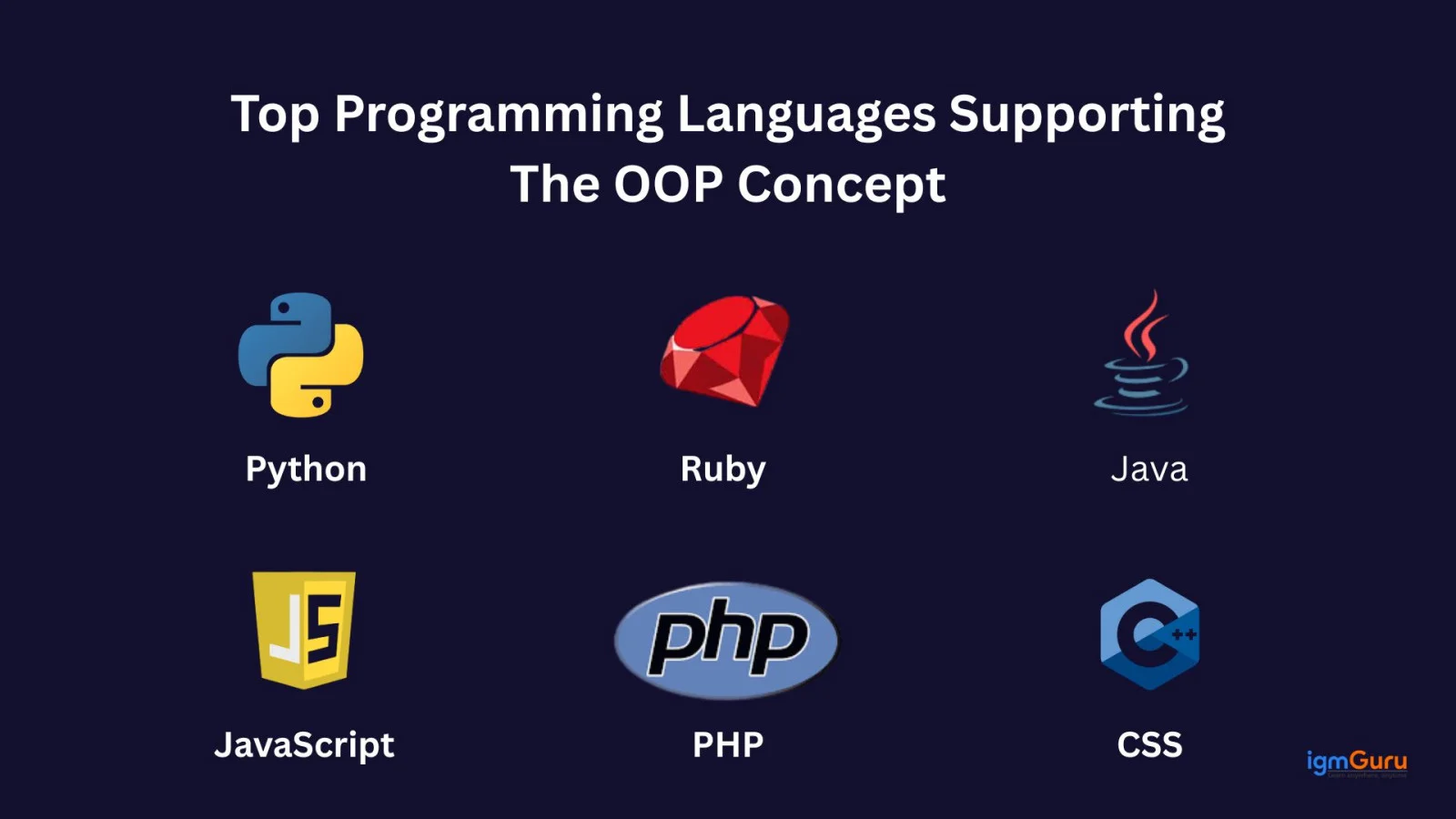
Many modern programming languages support the Object-Oriented Programming concept. Here are the common ones:
A class is basically a blueprint or template used to create objects. It defines the properties and behaviors that the objects created from it will have. A class itself does not represent a real object; instead, it describes what an object will look like and how it will behave.
Think of a class as a design plan. For example, a Car class can define attributes such as color, model and speed, along with methods like start(), stop() and accelerate(). When an object is created from this class, it becomes a real instance with actual values for those properties.
An object is a real-world instance of a class. It represents a tangible entity that has a state (data or attributes) and behavior (methods or functions). While a class is only a blueprint, an object is the actual implementation of that blueprint in memory.
For example, if a car is a class, then a specific car like myCar with a particular color, model and speed is an object. Each object created from the same class can have different values for its attributes, but they all share the same behavior and structure defined by the class.
Encapsulation is the concept of binding data and the methods that operate on that data into a single unit, known as a class. It also involves restricting direct access to some parts of an object’s data using access modifiers. This improves data security and prevents unintended modification of internal states.
Abstraction focuses on hiding complex implementation details and showing only the essential features of an object. It helps reduce complexity and allows developers to work with high-level concepts without worrying about internal logic. Interfaces and abstract classes are commonly used to achieve abstraction.
Polymorphism, “many forms” allows the same method or operation to behave differently based on the object that is calling it. It enables flexibility and dynamic behavior in programs, making code easier to extend and adapt to new requirements.
Inheritance allows a class to acquire the properties and behaviors of another class. This promotes code reusability and reduces duplication. A child class can reuse, extend, or modify the functionality of a parent class, making the system easier to enhance and maintain.
A class is a blueprint or template that defines the properties and behaviors an object will have. An object is an actual instance of that class created in memory with real values. For example, "Car" is a class, while "myCar with red color and 120km/h speed" is an object created from that class.
A method is a function defined inside a class that represents the behavior or action an object can perform. Methods operate on the data stored within an object and help organize program logic into reusable units. For example, a Car class may contain methods such as start(), stop() and accelerate() that define the actions a Car object can perform.
Read Also: Java Tutorial for Beginners
Here are some of the most asked OOPs interview questions and answers for intermediates. These are useful for both freshers and individuals with 2 or 3 years of experience.
Access specifiers (access modifiers) are keywords in Object-Oriented Programming. They are used to define the visibility and accessibility of classes, variables, methods and constructors. They control who can access what in a program, which helps protect data from unauthorized or accidental use. Access specifiers are mainly used to enforce encapsulation, one of the core pillars of OOP. Some of the common access specifiers are:
Superclasses and subclasses are used in OOPs to define a relationship based on inheritance.
A superclass (parent or base class) is the class whose properties and methods are inherited by another class. It contains common features that can be shared across multiple classes.
A subclass (child or derived class) is the class that inherits from the superclass. It automatically gets access to the superclass’s non-private members and can add new features or override existing methods to provide more specific behavior.
Example: If Vehicle is a superclass, then Car and Bike can be subclasses. Both subclasses inherit common properties like speed and fuel type from Vehicle, while also having their own specific features.
Static and dynamic are two forms of polymorphism in Object-Oriented Programming, and they differ mainly in how and when method calls are resolved.
| Feature | Static Polymorphism | Dynamic Polymorphism |
| Also known as | Compile-time polymorphism | Run-time polymorphism |
| Binding time | Method call is resolved at compile time | Method call is resolved at runtime |
| Achieved using | Method overloading | Method overriding |
| Inheritance required | No | Yes |
| Method selection based on | Method signature (parameters) | Actual object type |
| Flexibility | Less flexible | More flexible |
| Performance | Faster execution | Slightly slower due to runtime binding |
| Example languages | Java, C++, C# | Java, C++, C# |
| Use case | When behavior is known at compile time | When behavior may change at runtime |
Method overloading and overriding are two important concepts in OOPs that help achieve polymorphism. Although both use the same method name, they differ in purpose, behavior and implementation.
| Feature | Method Overloading | Method Overriding |
| Type of polymorphism | Compile-time (static) polymorphism | Runtime (dynamic) polymorphism |
| Definition | Multiple methods with the same name but different parameters | Subclass provides its own implementation of a superclass method |
| Inheritance required | No | Yes |
| Method signature | Must be different (parameters change) | Must be the same as the superclass |
| Binding time | Compile time | Runtime |
| Return type | Can be different (language dependent) | Must be the same or covariant |
| Access modifier | No restriction | Cannot reduce visibility |
| Performance | Faster | Slightly slower |
| Example use case | Same action with different inputs | Different behavior for the same action |
An abstract class and an interface are both used to achieve abstraction, but they differ in design, capability and usage.
| Feature | Abstract Class | Interface |
| Purpose | Represents an “is-a” relationship with shared base behavior | Represents a “can-do” capability |
| Methods | Can have abstract and non-abstract (concrete) methods | Methods are abstract by default (Java 8+ allows default & static methods) |
| Variables | Can have instance variables | Only constants (public static final) |
| Inheritance | A class can extend only one abstract class | A class can implement multiple interfaces |
| Access modifiers | Can use all access modifiers | Methods are public by default |
| Constructors | Can have constructors | Cannot have constructors |
| State | Can maintain state | Cannot maintain state |
| Use case | When classes share common behavior and state | When multiple classes need to follow the same contract |
An exception is an unexpected event or error that occurs during the execution of a program and disrupts its normal flow. Exceptions usually happen due to reasons such as invalid input, divide-by-zero errors, file not found issues or network failures. Not handling exceptions properly can cause the program to terminate abruptly. These are managed using exception handling mechanisms, which allow a program to respond gracefully to errors instead of crashing.
Garbage Collection is an automatic memory management process used to free up memory that is no longer in use by a program. It works by identifying objects that are no longer referenced or needed and reclaiming their occupied memory. This helps prevent memory leaks and improves application performance.
It is mostly used in languages like Java, Python, and C#, where it helps developers automatically deallocate memory. The garbage collector runs in the background and removes unused objects automatically. An object becomes eligible for garbage collection when there are no active references pointing to it.
Compile-time and run-time are two ways OOPs achieves polymorphic behavior. They mainly differ in when the method call is resolved.
| Feature | Compile-Time Polymorphism | Run-Time Polymorphism |
| Also known as | Static polymorphism | Dynamic polymorphism |
| Binding time | Method call resolved at compile time | Method call resolved at runtime |
| Achieved using | Method overloading | Method overriding |
| Inheritance required | No | Yes |
| Method selection based on | Method signature | Actual object type |
| Flexibility | Less flexible | More flexible |
| Performance | Faster | Slightly slower due to runtime binding |
| Decision made by | Compiler | JVM / runtime environment |
| Example scenario | Same method name, different parameters | Same method, different behavior |
A constructor is a special member of a class that is automatically called when an object is created. Its primary purpose is to initialize the object’s data members and set the object into a valid initial state. It has the same name as the class and does not have a return type.
It can be parameterized or non-parameterized, which allows objects to be created with default values or user-defined values. They can also be overloaded to support different ways of initializing an object. It improves code reliability and readability by ensuring that an object is properly initialized before it is used.
A class and a structure are both used to create user-defined data types, but they differ in design purpose, default behavior and usage, especially in languages like C++, C#, and others.
| Feature | Class | Structure (Struct) |
| Primary purpose | Used to model complex objects with behavior | Used to group related data |
| Default access specifier | Private | Public |
| Supports OOP concepts | Fully supports OOP (inheritance, polymorphism, encapsulation) | Limited OOP support (language-dependent) |
| Inheritance | Supported | Supported in some languages (e.g., C#), not in C |
| Use case | Large applications and business logic | Small, simple data structures |
| Memory management | Usually allocated on heap | Often allocated on stack (language-dependent) |
| Performance | Slightly slower due to overhead | Faster for small data due to lightweight nature |
| Example usage | Classes like Employee, Account, Vehicle | Structs like Point, Date, Coordinate |
An abstract class can have both abstract and concrete methods, can maintain state through instance variables, and supports all access modifiers. A class can only extend one abstract class. An interface, on the other hand, only has abstract methods by default (Java 8+ allows default/static methods), cannot maintain state, and a class can implement multiple interfaces. Use an abstract class for shared base behavior and an interface when multiple unrelated classes need to follow the same contract.
Constructor overloading is the process of defining multiple constructors within the same class with different parameter lists. It allows objects of the same class to be initialized in different ways depending on the data available. For example, one constructor may initialize an object with default values, while another may accept parameters to provide specific values during object creation.
Read Also: Python Tutorial for Beginners
Now, we will discuss the most asked OOPs interview questions and answers for experienced professionals. These are based on the most important and advanced concepts.
This programming paradigm helps in building scalable applications by providing a structured way to design, develop and extend software as requirements grow. It breaks complicated systems into independent, reusable objects, which makes large applications easier to manage and expand over time.
One of the biggest advantages of this paradigm is modularity. Each class handles a specific responsibility. This means new features can be added by creating new classes instead of modifying existing code. This reduces the risk of breaking the system and supports continuous growth.
It also improves scalability through inheritance and polymorphism, which allow developers to extend existing functionality without rewriting code. Combined with encapsulation and abstraction, it makes applications easier to maintain, test and scale across teams and evolving business needs.
Design principles in this programming concept are a set of best practices that guide developers in structuring classes and objects in a clean, efficient and maintainable way. These principles are not language-specific rules but guidelines that help build software that is easy to understand, extend, and scale. These design principles are critical in large systems as multiple developers work on the same codebase over long periods.
One of the most well-known sets of design principles is SOLID: (Single Responsibility, Open/Closed, Liskov Substitution, Interface Segregation, and Dependency Inversion). Together, these principles encourage low coupling and high cohesion, which means classes do one job well and depend less on each other.
Coupling refers to the level of dependency between classes or modules. It describes how closely one class is connected to another. It actually plays a major role in code flexibility, maintainability and scalability.
Composition and inheritance are two fundamental ways to create relationships between classes in OOPs. They differ in purpose, flexibility and impact on system design. Inheritance is best for stable hierarchies, while composition is preferred for flexible, scalable and maintainable designs.
Inheritance represents an “is-a” relationship, where a subclass extends a superclass and automatically inherits its properties and methods. It promotes code reuse but creates a tight coupling between parent and child classes. Changes in the superclass can affect all subclasses, which may lead to rigid and hard-to-maintain systems if overused.
Composition represents a “has-a” relationship, where a class contains one or more objects of other classes and uses them to perform tasks. Instead of inheriting behavior, the class delegates responsibilities to its composed objects. This approach results in loose coupling, making the system more flexible and easier to modify or extend.
You should prefer inheritance when there is a clear, stable hierarchy and shared behavior that naturally fits an “is-a” relationship. The use composition will be best when you need flexibility, frequent changes or want to avoid strong dependencies between classes.
SOLID principles help prevent rigid and fragile code, which makes object-oriented systems scalable and maintainable over time. It provides a set of design guidelines that help developers create clean, flexible, and maintainable software. These principles are especially important when building large and long-term applications.
SOLID is an acronym that stands for Single Responsibility, Open/Closed, Liskov Substitution, Interface Segregation, and Dependency Inversion. Together, they encourage writing classes that are focused on a single task, open to extension but closed to modification, and dependent on abstractions rather than concrete implementations.
OOP supports code reusability and maintainability by organizing software into modular components that reflect real-world entities. This structured approach is especially effective in enterprise applications, where systems are large, complicated and continuously evolving.
It enables code reusability through mechanisms like inheritance, composition and polymorphism. Common functionality can be written once in base classes or shared components and reused across multiple modules. This reduces duplication and development time. This leads to consistent behavior across the application.
It enables maintainability by encapsulation and abstraction, which hide internal implementation details and expose only what is necessary. This makes it easier to update or replace parts of the system without affecting others. This helps enterprise applications become easier to debug, test, scale and adapt to changing business requirements.
Excessive inheritance in a project can lead to rigid, fragile and hard-to-maintain code. It often occurs in large Object-Oriented Programming systems. It can also occur several design problems.
One major issue is tight coupling. When many classes depend on deep inheritance hierarchies, a small change in a base class can unintentionally affect multiple subclasses. This makes the system risky to modify and difficult to debug.
Another problem is complexity and reduced readability. Deep inheritance chains make it hard to understand where behavior is coming from, increasing the learning curve for new developers. Excessive inheritance also reduces flexibility, as classes are locked into rigid hierarchies and cannot easily change behavior.
Poor OOP code is identified by tight coupling and oversized classes.
It is refactored by applying SOLID principles, which increase modularity and favor composition over inheritance.
Identifying and refactoring poorly designed code is essential for improving maintainability, readability and scalability. It is identified by the following signs:
Refactoring should be done incrementally and safely using the following steps:
Object cloning is the process of creating an exact copy of an existing object instead of creating a new object from scratch. The cloned object has the same state as the original object at the time of cloning, but it exists as a separate instance in memory. Object cloning can be implemented in different ways depending on the language.
This programming paradigm provides the foundation required to implement design patterns effectively by offering structured concepts such as classes, objects, abstraction, inheritance and polymorphism. Design patterns are proven solutions to common design problems and it makes these solutions practical and reusable.
It supports design patterns through abstraction and interfaces, which allow patterns to define contracts without depending on concrete implementations. This is essential in patterns like Factory, Strategy and Observer, where behavior needs to change dynamically without modifying existing code. Concepts like polymorphism and composition enable objects to interact flexibly, which makes it easier to replace, extend or combine behaviors.
SOLID principles are a set of five design guidelines, Single Responsibility, Open/Closed, Liskov Substitution, Interface Segregation, and Dependency Inversion. These help developers write clean, maintainable and scalable code. They encourage low coupling and high cohesion, meaning classes do one job well and depend minimally on each other. This is especially critical in large systems where multiple developers work on the same codebase over long periods.
The Dependency Inversion Principle states that high-level modules should not depend directly on low-level modules; instead, both should depend on abstractions. It also states that abstractions should not depend on implementation details. This principle reduces tight coupling between classes and makes applications easier to test, maintain and extend. It is commonly implemented using interfaces and dependency injection.
Read Also: Java Object-Oriented Programming Concepts Explained with Examples
Here are some of the most frequently asked advanced OOPs interview questions and answers. These are mostly asked to candidates applying for manager-level job positions.
Object-Oriented Programming and Object-Based Programming (OBP) may sound similar, but they differ in capabilities, design philosophy and use cases. Let’s understand how:
| Aspect | Object-Oriented Programming (OOP) | Object-Based Programming (OBP) |
| Core Concept | Based on objects and classes | Based only on objects |
| Inheritance | Supported | Not supported |
| Polymorphism | Supported | Not supported |
| Encapsulation | Supported | Supported |
| Abstraction | Supported | Limited or not supported |
| Reusability | High (through inheritance & polymorphism) | Limited (object reuse only) |
| Complexity | More structured and scalable | Simpler and lightweight |
| Use Case | Large, complex, enterprise systems | Small to medium applications |
Anti-patterns in OOP are design approaches that look like a good idea initially but end up creating more problems as the software grows. They usually happen due to rushed decisions, lack of design understanding or overusing familiar solutions without thinking through the long-term impact. Common anti-patterns include:
These patterns make the code harder to understand, test and modify. The impact on software quality is significant. It reduces maintainability because even small changes can require updates across multiple classes. They also increase the risk of bugs, slow down development and add technical debt over time.
This programming paradigm supports Domain-Driven Design (DDD) by providing a natural way to model real-world business concepts directly in code. It represents domain concepts as objects and classes that encapsulate both data and behavior, which aligns well with how DDD focuses on the core business domain.
Using OOP, entities, value objects, and aggregates can be clearly defined with well-encapsulated responsibilities. This helps ensure that business rules live inside the domain model rather than being scattered across services or controllers. Concepts like encapsulation and abstraction also make it easier to protect domain invariants and expose only meaningful operations.
Association and aggregation both describe relationships between classes, but they differ in strength and meaning.
| Aspect | Association | Aggregation |
| Relationship Type | General relationship between objects | Special form of association |
| Meaning | One object uses or interacts with another | Represents a “has-a” relationship |
| Dependency | Objects are independent | Part is independent of the whole |
| Lifecycle | Objects have separate lifecycles | Part can exist even if the whole is destroyed |
| Ownership | No ownership implied | Weak ownership |
| Strength | Weaker relationship | Stronger than association |
| Example | Teacher and Student | Department and Employee |
Immutability and OOP work together in modern applications by making object behavior safer, more predictable and easier to reason about. It is mostly used in large or concurrent systems.
Immutability means creating objects whose state cannot change after they are created. This fits naturally with concepts like value objects, where identity is less important than the data they represent. By making such objects immutable, we avoid unintended side effects and ensure that business rules remain consistent throughout the application.
Modern OOP-based systems use immutability to improve thread safety and reliability. Since immutable objects cannot be modified, they can be safely shared across threads without synchronization. This reduces bugs related to concurrency and makes the code easier to test and maintain.
Applying this concept in a microservices architecture comes with a few practical challenges. It is because microservices focus more on service boundaries and communication than on object hierarchies.
Object-Oriented Programming handles concurrency and multithreading by providing structured ways to manage shared state, synchronization and task coordination. It is all done while keeping code readable and maintainable.
Concurrency issues in this paradigm are mainly addressed through encapsulation. By keeping data private inside objects and exposing controlled methods, we reduce the risk of multiple threads modifying shared state directly. Languages like Java and C# also offer built-in synchronization mechanisms, such as synchronized methods, locks and monitors, which can be applied at the object level.
Another important approach is using immutable objects. Since immutable objects cannot be modified after creation, they are naturally thread-safe and can be shared across threads without synchronization. This greatly reduces race conditions and unexpected behavior.
This means it can handle multithreading by combining encapsulation, synchronization and immutability, allowing developers to build concurrent systems that are safer, more predictable and easier to maintain.
Dependency Injection plays an important role in Object-Oriented design. It reduces tight coupling between classes and makes systems easier to test, extend, and maintain.
A class often creates its own dependencies, which makes it strongly dependent on specific implementations. With dependency injection, those dependencies are provided from the outside, usually through constructors, setters or frameworks. This allows a class to focus on its own responsibility instead of managing object creation.
From a design perspective, dependency injection supports core OOP principles like abstraction and encapsulation. Classes depend on interfaces rather than concrete implementations, which improves flexibility and enables easy swapping of components, such as using mock objects during testing.
Thread safety is ensured by controlling access to shared data and designing objects so that concurrent behavior is predictable and safe.
The first step is encapsulation. By keeping fields private and exposing only well-defined methods, we limit how and where shared state can be modified. This makes it easier to apply synchronization at the right points rather than across the entire system.
Another important approach is using synchronization mechanisms such as locks, synchronized methods or mutexes to ensure that only one thread can modify a shared resource at a time. Along with this, immutability plays a major role. Immutable objects are inherently thread-safe and can be freely shared across threads without any coordination.
Combining encapsulation, synchronization and immutability allows object-oriented systems to handle concurrency reliably while keeping the design clean and maintainable.
Object-Oriented Programming has several strengths, but it also comes with practical limitations, especially in large or modern systems.
Three key challenges arise. First, overusing inheritance across services creates tight coupling, making independent deployment difficult. Second, mapping object models to service boundaries is tricky since each microservice owns its own data, and sharing domain objects across services can break encapsulation and cause data inconsistency. Third, OOP often assumes in-memory object state, while microservices rely on stateless services and external persistence, requiring careful design to avoid unnecessary state inside objects.
A shallow copy creates a new object but copies references to nested objects, meaning the original and copied objects may share the same referenced data. A deep copy creates a completely independent copy, including copies of nested objects. As a result, modifying nested data in a deep copy does not affect the original object. The appropriate approach depends on object structure, performance requirements and whether shared references are acceptable.
Read Also- How To Learn Python? A Complete Roadmap
This section discusses the most asked scenario-based interview questions and answers. These are asked to check the expertise and proficiency of candidates to solve real-world problems.
It is a kind of complicated setup that requires applying proper logic. Here are the steps I would follow in this setup.
I would follow the given steps to refactor a large monolithic class that violates multiple OOP principles:
When business rules change frequently, I use OOP to separate rules from core logic. Each rule is implemented as a separate class following a common abstraction. The main system depends only on that abstraction and uses polymorphism to apply the correct rule at runtime. This allows new rules to be added or modified without changing existing code, which makes the system flexible and easy to maintain.
I would follow the given steps to build such a notification system:
This design allows new notification types to be added easily without changing existing code, keeping the system flexible and maintainable.
I would follow the given steps to handle code duplication when multiple classes share similar functionality:
This approach reduces redundancy, improves maintainability and makes future changes easier to manage.
I would follow the given steps to redesign an inheritance-heavy system using composition:
This redesign reduces tight coupling, improves flexibility, and makes the system easier to extend and maintain.
I would follow the given steps to apply polymorphism and avoid large conditional statements:
This results in cleaner code, better readability, and easier extensibility.
I would follow the given steps to design a logging framework using OOP principles:
This design keeps the logging system extensible, loosely coupled, and easy to maintain.
I would follow the given steps to optimize the design when performance degrades due to excessive object creation:
This reduces memory overhead, improves performance, and keeps the design efficient.
I would follow the given steps to ensure changes in one class do not break other parts of the application:
This approach isolates changes, reduces side effects, and keeps the system stable.
I would first identify common behavior across all payment methods, such as accepting an amount, validating input and processing a transaction. Then I would create a common abstraction like a PaymentMethod interface with a pay() method. Each payment type, credit card, UPI, wallet, would be implemented as a separate class with its own unique validation and processing logic. The checkout system would depend only on the abstraction and use polymorphism to execute the correct payment logic at runtime. Adding a new payment method would only require creating a new class without touching existing code.
I would define a common abstraction, such as a DiscountStrategy interface, with a method for calculating the discount. Each discount rule, such as percentage discount, seasonal discount or loyalty discount, would be implemented as a separate class. The application would depend on the common abstraction and use polymorphism to apply the required discount strategy. This approach follows the Open/Closed Principle because new discount rules can be introduced by adding new classes without modifying the existing discount calculation logic.
Read Also: Concurrency in Python
This section focuses on Object-Oriented Design interview questions that are commonly asked in modern technical interviews. These questions test a candidate’s ability to apply OOP concepts in real-world system design scenarios rather than just explaining definitions. They are especially important for backend, full-stack and senior-level roles.
Object-oriented design is the process of planning and structuring a software system by identifying objects, their responsibilities, relationships and interactions before writing actual code. It focuses on how a system should be organized to solve a problem efficiently using object-oriented principles.
Object-oriented programming is the implementation phase where those design decisions are translated into code using classes, objects, methods, and relationships. In simple terms, OOD is about how to design the system, while OOP is about how to implement that design.
Good object-oriented design is based on principles that make systems easy to understand, maintain, and extend as requirements evolve. These principles guide developers in distributing responsibilities across classes in a balanced way.
Following these principles results in systems that are easier to test, scale, and refactor over time.
Identifying classes and objects starts with understanding the problem domain and the business requirements. The goal is to model real-world concepts that naturally exist in the system.
A common approach is to analyze requirements and look for nouns and entities, such as User, Order, Product, or Payment. These often become candidate classes. Next, you identify what data they hold and what actions they perform. Responsibilities are then distributed so that no single class becomes too complex.
Good design also involves eliminating unnecessary classes, merging closely related responsibilities, and ensuring each class represents a meaningful concept in the domain.
UML (Unified Modeling Language) diagrams are used in object-oriented design to visually represent the structure and behavior of a system. They help developers and stakeholders understand how classes interact without diving into code.
Class diagrams show relationships such as inheritance, association, and composition. Sequence diagrams illustrate how objects communicate during a specific flow. These diagrams improve communication within teams, reduce misunderstandings, and serve as a blueprint during implementation.
While UML diagrams are not mandatory for every project, they are highly valuable for complex systems and collaborative environments.
To design an extensible system, object-oriented design relies heavily on abstraction and polymorphism. Instead of coding against concrete implementations, the system is built around interfaces or abstract classes that define expected behavior.
When new requirements arise, new classes can be introduced that implement the same abstraction, without changing existing logic. This approach follows the Open/Closed Principle and reduces the risk of introducing bugs into stable code.
Using patterns like Strategy, Factory, and Observer further supports extensibility by allowing behavior to change dynamically at runtime while keeping the core system intact.
I would identify core entities such as Book, Member, Library, Loan/Transaction, and Reservation. Each class would have single responsibility — Book handles book details, Member manages user information, and Loan manages borrowing logic. I would use composition (Library has Books and Members) and apply polymorphism for different types of members (Student, Faculty) or books (PhysicalBook, EBook). This design ensures loose coupling and easy extensibility.
I would create classes like Product, CartItem, ShoppingCart, User, and Payment. ShoppingCart would compose multiple CartItem objects. I would use the Strategy pattern for different payment methods and apply the Open/Closed Principle so new discount types or payment gateways can be added without modifying existing code. This keeps the system flexible and maintainable.
The Liskov Substitution Principle states that objects of a subclass should be substitutable for objects of the superclass without affecting the correctness of the program. A classic violation is the Rectangle-Square problem — if Square inherits from Rectangle and overrides setters, changing width can unexpectedly change height, breaking the expected behavior of the parent class.
I prefer Composition over Inheritance in most modern projects because it provides better flexibility and loose coupling. Use Inheritance only when there is a clear “is-a” relationship and the hierarchy is stable (e.g., Animal → Dog). For most other cases, especially when behavior needs to change frequently, Composition (has-a relationship) is better as it allows changing behavior at runtime and avoids fragile base class problems.
Start by analyzing the business requirements and looking for nouns and real-world entities within the problem domain. These naturally become candidate classes. For example, User, Order, Product, or Payment in an e-commerce system. Next, identify what data each entity holds and what actions it performs. Distribute responsibilities so no single class becomes too complex, eliminate unnecessary classes, and merge closely related responsibilities. The goal is for each class to represent one meaningful concept in the domain.
I would identify core classes such as ParkingLot, ParkingFloor, ParkingSpot, Vehicle, Ticket and Payment. Vehicle could serve as an abstraction for different vehicle types such as Car, Bike and Truck, while ParkingSpot could have specialized types for different vehicles. The ParkingLot would manage floors and available spaces, while separate classes would handle ticket generation and payment processing. Using encapsulation, composition and abstractions would keep responsibilities separated and make the system easier to extend with new vehicle types, parking rules or payment methods.
This blog has listed various most asked OOPs interview questions and answers for each level of individuals. Whether you are a beginner, intermediate or experienced professional, it is your go-to guide to prepare for your next interview. You can also check our top-ranking interview guides on different programming languages for additional knowledge.
Explore Our Trending Articles
OOPs interview questions are useful for anyone involved in software development or planning a career in the tech industry. The following professionals can benefit from these questions:
The Diamond Problem occurs when a class inherits from two classes that share a common parent class. If the parent class contains a method that is overridden by both child classes, the compiler faces ambiguity in deciding which version of the method to use.
Yes, OOPs concepts are extremely important in technical interviews because they test a candidate’s ability to design scalable, maintainable and real-world applications.
Yes, it can indirectly boost salary prospects due to the high significance of OOP concepts for developer roles. They can get up to 20–30% higher salary offers compared to candidates with weak conceptual understanding.
Course Schedule
| Course Name | Batch Type | Details |
| OOP Training | Every Weekday | View Details |
| OOP Training | Every Weekend | View Details |