LangChain is a powerful framework that helps developers build applications powered by large language models (LLMs). It provides tools and build blocks that make it easier to connect an AI model like GPT-4 to other sources of data. This is important because it allows developers to create more powerful and useful AI applications. LangChain simplifies complex tasks and enables AI models to work with information that is not in their original training data.
This blog will explain everything you need to know about LangChain. We will cover the topics from What is LangChain to the integration of LangChain with other LLMs. Let's begin.
LangChain is an open-source framework for building applications with large language models (LLMs). It works with models like GPT-4, Anthropic Claude, or Google Gemini. LangChain gives developers ready-to-use tools and components. This means they do not have to build everything from the start.
Think of it as a developer's toolkit or a set of LEGO blocks for building with Artificial Intelligence. If an LLM is the engine, LangChain is the vehicle around it. It helps developers connect the model to data, memory and other systems.
LLMs are very smart but have limitations. On their own, they are like a brain in a jar. They have a lot of general knowledge but do not know about your private data or recent events. LangChain provides the body for that brain. It connects the model to different data sources and lets it interact with the outside world. This helps developers create truly useful applications like chatbots, document assistants and question-answer systems.
LangChain is a game-changer because it solves two major problems with standalone LLMs:
By bridging this gap, LangChain empowers developers to move beyond simple prompts and build sophisticated, end-to-end AI solutions.
Related Article: What is AI Project Cycle?
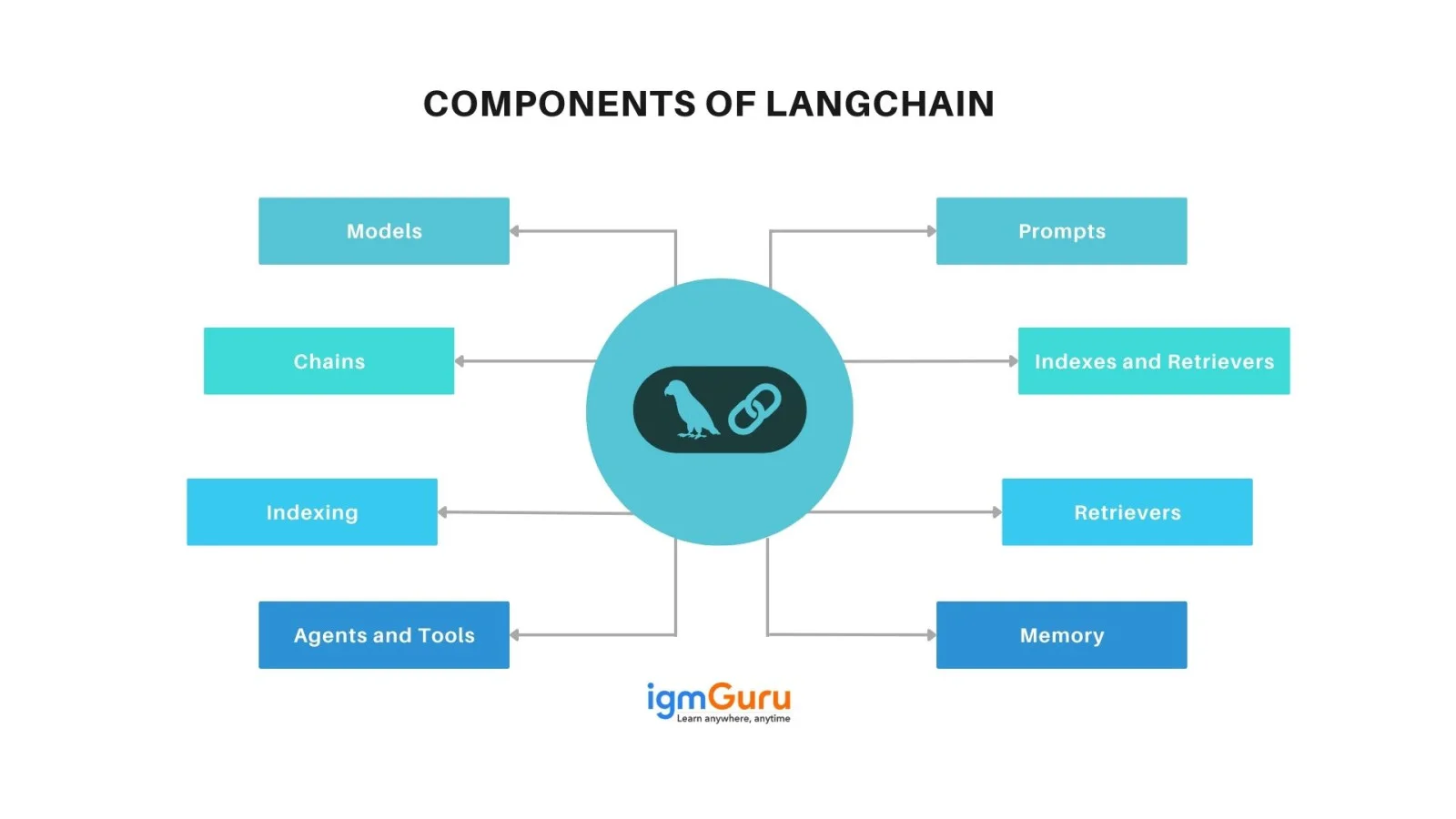
LangChain's magic comes from its modular components, which developers can mix and match. Let's look at the most important ones using an analogy of a high-tech kitchen.
For example, a chain could be:
1. Take the customer's order (user input).
2. Use a recipe (prompt) to prepare the instructions.
3. Give it to the chef (LLM).
4. Plate the dish beautifully (format the output).
Also Read: What are Generative Adversarial Networks?
Let's revisit our 'chat with HR documents' example and see the components in action, step-by-step.
This entire complex process is managed by LangChain, making it simple for a developer to implement.
Also Read: What are Variational Autoencoders?
LangChain has become popular because it makes building AI apps not only faster but also smarter and more practical. Here are the main benefits explained in plain language:
Without LangChain, developers would need to write a lot of code just to connect an AI model with data, memory or workflows. LangChain provides ready-made building blocks so you can put everything together quickly.
Example: Instead of coding your own document search + summarization tool, you can use LangChain's prebuilt chains and connect it to a vector database in a few lines.
LangChain doesn't lock you into one provider. You can easily switch between different language models (like OpenAI GPT-4, Anthropic Claude, Hugging Face models or Google Gemini) depending on your project's needs.
Why it matters: If one model is cheaper, faster or more accurate for your use case, you can switch without rebuilding everything from scratch.
Normally, AI models forget the previous conversation once the session ends. LangChain adds memory so apps can 'remember' past interactions. This makes conversations feel more natural and human-like.
Example: A chatbot built with LangChain can remember your name, preferences or the last question you asked.
Building a small demo is easy, but running a real-world AI app for thousands of users is harder. LangChain includes tools for monitoring, debugging and deploying applications, so your project can grow without breaking.
Example: If your customer support chatbot suddenly gets 10,000 queries in a day, LangChain's tools help you track performance and scale up smoothly.
Every business has unique needs. LangChain lets you add your own tools, APIs and data sources. You can shape it to match exactly what your application requires.
Example: A finance company could connect LangChain to its private SQL database, while a healthcare app might link it with medical research papers.
Related Article: GPT-3.5 vs GPT-4 vs GPT-5
The use cases are exploding across every industry:
Related Article: Types of Artificial Intelligence
LangChain connects easily with many other tools and platforms. These connections are called integrations. Integrations let LangChain get data from different places. They also help it use outside tools and work well with existing business systems. Here are the main types of integrations.
LangChain works with many different large language models. It is not limited to just one.
Examples: OpenAI (GPT-4), Anthropic (Claude), Google Gemini and others.
Why it matters: This lets you choose the best model for your needs. You can select a model based on its cost, speed or accuracy. It is also easy to switch to a different model later.
These tools store and organize information. This helps the AI find and use data quickly.
Examples: Pinecone, Weaviate, FAISS and Chroma.
How they help: A user can ask a question. LangChain then searches these databases to find the best information. This helps it give accurate answers based on that specific data.
Real use case: A company can upload its documents. Employees can then ask questions about the documents in simple language.
LangChain can use outside APIs and tools for more capabilities.
Examples: It can use Google Search for new information or Wolfram Alpha for math problems. It can also connect to any special API a business has.
Why it matters: The model does not have to depend only on its own knowledge. LangChain can get live data or perform certain tasks using these tools.
Real use case: A travel application can check current flight prices or the latest weather report before giving an answer.
LangChain works with major cloud providers. This helps make applications that can grow and are ready for real users.
Examples: AWS (Amazon Web Services), GCP (Google Cloud Platform) and Microsoft Azure.
How they help: You can run LangChain apps securely on the cloud. These platforms can manage many users at once. They also connect to a company's current cloud services.
These integrations allow LangChain to connect to two types of data.
This flexibility helps developers build powerful AI systems. These systems are smart and are also well-connected to a business's real data and tools.
LangChain helps developers build AI applications. LangSmith is a separate tool made to help developers test, monitor and improve those applications.
| Feature | LangChain | LangSmith |
| Purpose | Framework for building AI apps | Platform for testing, debugging and monitoring AI apps |
| Role | Helps you create workflows, chains, agents and memory | Ensures those workflows are reliable and production-ready |
| Focus | Development and integration | Observability, evaluation and performance tracking |
| Best For | Developers building new LLM-powered apps | Teams that want to analyze, monitor and improve existing apps |
LangChain provides the main tools for building AI workflows. LangGraph is a library built on top of LangChain that is used for creating more complex and flexible agent systems.
| Feature | LangChain | LangGraph |
| Purpose | Provides modular components like chains, prompts, memory and agents | Built on top of LangChain for designing workflows as graphs |
| Role | Foundation for AI app development | Adds structure for complex, multi-step, stateful agents |
| Workflow Style | Linear or simple multi-step chains | Graph-based (supports loops, branching and persistence) |
| Best For | Basic to medium-complexity AI apps | Advanced AI agents that need memory across long sessions |
LangChain is a key framework for anyone building applications with AI. This guide explained what LangChain is, how it works, and its main benefits. It also covered the key components, real-world applications and important integrations. The differences between LangChain, LangSmith and LangGraph were also clarified.
This knowledge provides a strong foundation. The best way to learn more is to start building. Try creating a simple project to see how the different parts work together. As AI continues to grow, tools like LangChain will become even more essential for creating smart and useful applications.
Yes, LangChain is an open-source framework which means it is completely free to use. You only have to pay for the API costs of the language models you connect to it like GPT-4.
No, LangChain is not a programming language. It is a framework that works with Python and JavaScript to help you build applications on top of large language models.
No, you can use models like ChatGPT directly. LangChain is a tool you use when you want to connect a model to your own data, documents or other tools to build a more powerful and custom application.
The main difference is their purpose. You use LangChain to build your AI application. You use LangSmith to test, monitor and debug your application after you have built it.
LangChain helps developers build apps using large language models. It connects AI models with data and tools to create chatbots and smart applications.