Data does not wait. Every second, your business is generating it, collecting it, and trying to make sense of it. Sales figures, customer behavior, website events, product logs, and so much more. All of this data is valuable. But only if you can move it, organize it, and analyze it fast enough to act on it. That is exactly where ELT comes in.
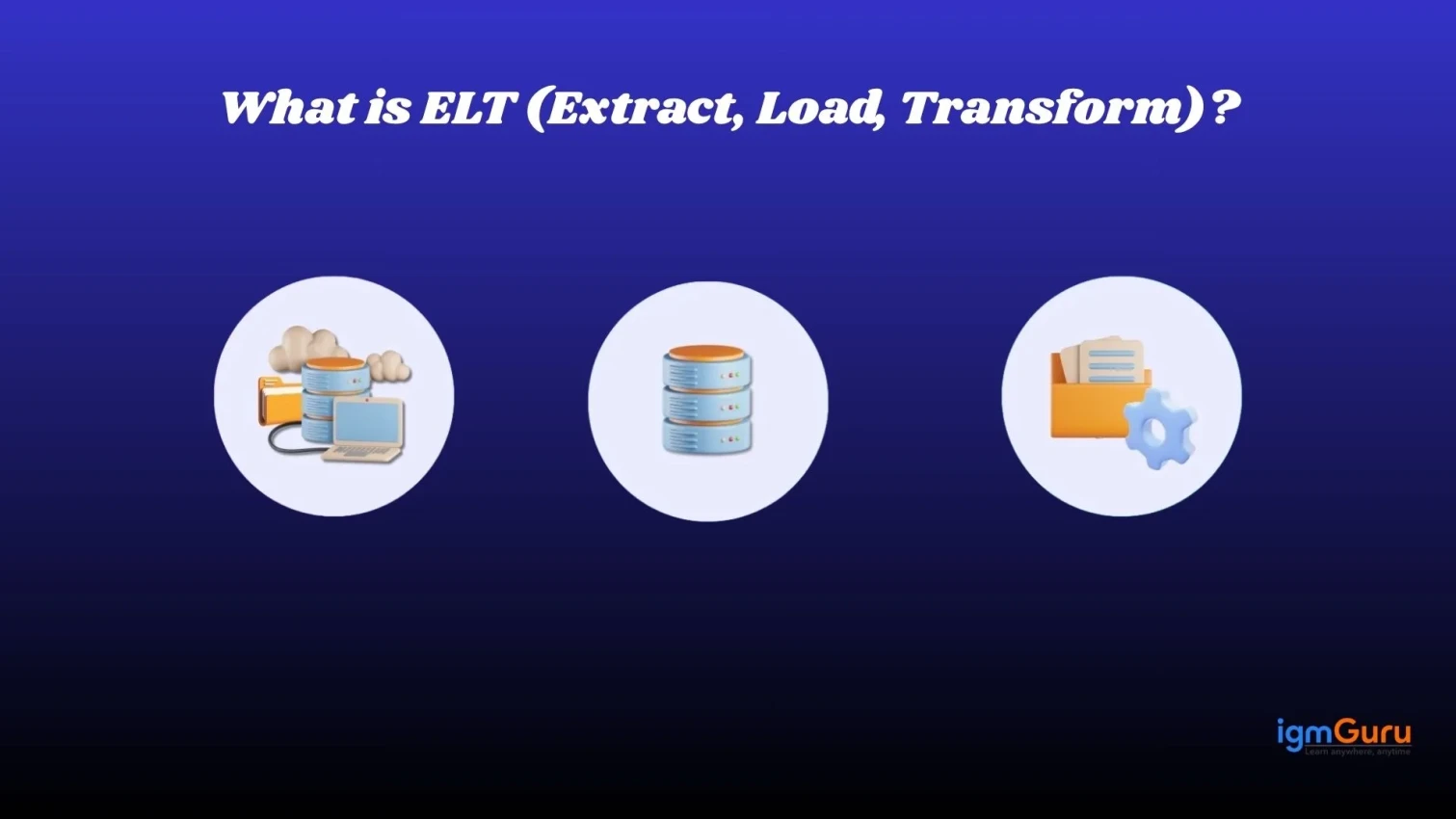
ELT stands for Extract, Load, Transform. It is a modern data integration approach that has become the standard for teams working with cloud-based big data systems. ELT lets you pull raw data from multiple sources, load it directly into a cloud data warehouse or data lake, and then transform it inside that destination system.
It is a shift in when you clean and shape your data. And that shift makes a big difference.
In this guide, you will learn what ELT is, how the ELT process works step by step, how it compares to the older ETL method, what benefits and challenges it brings, and which tools teams are using today. By the end, you will have a clear picture of whether ELT is the right approach for your data needs.
Read Also: What is Hadoop and What is it Used For?
ELT is a data pipeline model. A data pipeline is a system that moves data from point A to point B while making it usable for analysis, reporting, or machine learning.
In an ELT pipeline, data moves in this order:
Extract data from source systems
Load that raw data into a target system (such as a cloud data warehouse)
Transform the data inside that target system
The key idea here is simple. ELT loads data first and transforms it later. This separates it from the older ETL model, where data is cleaned and shaped before it is loaded.
ELT has grown popular because cloud data warehouses like Google BigQuery, Snowflake, Amazon Redshift, and Azure Synapse have changed the game. These platforms offer massive computing power at a low cost. They can handle large-scale transformations on their own. So there is no longer a need to do all the heavy lifting before loading.
The ELT process has three distinct stages. Each one plays a specific role in getting your data from source to insight.
The first stage is extraction. This is where you pull raw data from your source systems. Source systems can include:
Relational databases like MySQL or PostgreSQL
NoSQL databases like MongoDB
SaaS platforms like Salesforce, HubSpot, or Shopify
APIs from web services
Log files and event streams
IoT sensors and devices
Cloud storage buckets
During extraction, the data is collected in its raw, unmodified form. The goal is completeness and reliability, not perfection. Modern ELT pipelines often use a technique called Change Data Capture (CDC) to extract only new or updated records. This reduces the load on source systems and keeps things efficient.
In the load stage, the raw data is moved directly into a destination system. This destination is most often a cloud data warehouse or a data lake. Common destination platforms include:
Google BigQuery (serverless and highly scalable)
Snowflake (flexible and multi-cloud)
Amazon Redshift (deep AWS integration)
Azure Synapse Analytics (Microsoft ecosystem)
Databricks (great for machine learning workloads)
The data arrives in its raw form. It is not cleaned or structured yet. This is intentional. Loading raw data is fast. It also preserves the original state of the data, which is useful for audit trails, compliance, and re-processing.
Transformation is the final stage. This is where the raw data becomes analysis-ready. Inside the cloud data warehouse, data teams apply:
Cleaning: Removing duplicates, fixing null values, standardizing formats
Filtering: Selecting only the relevant records
Aggregation: Summing, averaging, grouping data for reports
Joining: Combining data from multiple tables or sources
Business logic: Applying rules specific to your organization
Most transformations happen using SQL. Many teams also use tools like dbt (data build tool) to manage transformation logic in a structured, testable, and version-controlled way.
ELT and ETL are both data pipeline approaches. They use the same three steps. But the order matters, and so does where the transformation happens.
| Feature | ETL (Extract, Transform, Load) | ELT (Extract, Load, Transform) |
| Transformation timing | Before loading | After loading |
| Transformation location | External processing engine | Inside the target system |
| Best for | Structured, small-to-medium datasets | Large-scale, cloud-native environments |
| Speed of loading | Slower (transforms first) | Faster (raw load) |
| Flexibility | Lower (schema defined upfront) | Higher (transform on demand) |
| Storage cost | Lower raw storage | Higher raw storage |
| Typical tools | Informatica, IBM DataStage | dbt, Fivetran, Airbyte |
ETL works well when data quality is critical before ingestion, when the destination system has limited computing power, or when regulatory rules require data to be masked or cleaned before it enters storage.
ELT works well when you are dealing with large data volumes, when your destination is a cloud platform with powerful compute, and when data teams want flexibility to build multiple transformation views from the same raw data.
In many modern organizations, both approaches coexist. ETL handles certain sensitive or legacy pipelines. ELT handles the rest.
Also Read: Grafana vs Splunk: Which One Should You Choose?
ELT has not always been the dominant approach. ETL was the standard for decades. Three major changes pushed ELT into the spotlight.
Cloud platforms changed the economics of data. Storage became cheap. Compute became elastic. Platforms like Snowflake and BigQuery can spin up massive processing power in seconds and scale back down just as fast. This made it practical to store large amounts of raw data and transform it inside the warehouse rather than before loading.
Data volumes have grown at an extraordinary pace. Traditional ETL pipelines were not designed to handle petabytes of data from dozens of sources at once. ELT pipelines, built on cloud infrastructure, are designed for exactly this scale.
Business needs change. A report that was useful last quarter may not be relevant this quarter. With ETL, changing the transformation logic often requires re-extracting and re-processing data from scratch. With ELT, the raw data is always available in the warehouse. You can apply a new transformation without touching the ingestion pipeline.
Related Article: What is Splunk in Big Data?
ELT loads data quickly because there is no transformation step before ingestion. Data is available in the warehouse almost immediately after extraction. Analysts and business intelligence tools can start exploring it sooner.
Cloud-based ELT pipelines scale horizontally. As data volumes grow, the compute resources scale with them. There are no hardware bottlenecks to plan around.
Because raw data is preserved in the target system, you can build new transformation views at any time. You do not need to go back to the source. You can experiment, iterate, and change business logic without rebuilding the entire pipeline.
ELT handles structured data, semi-structured data (like JSON), and unstructured data (like logs or text). Traditional ETL systems often struggled with anything outside of structured tables.
ELT pipelines tend to be simpler to maintain. The transformation logic lives inside the warehouse, where it is visible and centralized. Changes are easier to track and implement.
Data scientists need access to raw, unfiltered data for model training. ELT preserves this raw data in the warehouse, making it easy to build machine learning pipelines on top of it.
Read Also: What is Data Collection? Types and Methods
ELT is not a perfect solution for every situation. Here are the most common challenges and practical ways to deal with them.
Because data is loaded before it is cleaned, errors and inconsistencies can enter the warehouse. These issues can then affect downstream reports and dashboards.
How to address it: Add data validation checks during or immediately after the load step. Use tools like Great Expectations or dbt tests to flag anomalies early. Set up alerts so your team knows when data quality drops.
Raw data often includes sensitive information like personally identifiable information (PII). Loading it into the warehouse before transformation means it sits in its raw form, which can create compliance risks under regulations like GDPR or HIPAA.
How to address it: Apply role-based access controls (RBAC) to restrict who can see raw data. Use encryption at rest and in transit. Mask or tokenize sensitive fields as part of the transformation step and enforce strict data governance policies.
Storing large amounts of raw, unprocessed data can increase cloud storage costs, especially if old or duplicate data is not managed properly.
How to address it: Implement data retention policies. Use incremental loading instead of full reloads. Archive or delete data that is no longer needed.
Some business transformations are highly complex. Running them entirely inside a cloud data warehouse using SQL can be challenging, especially when your team lacks strong SQL skills or when the logic is difficult to express in SQL alone.
How to address it: Use tools like dbt to organize transformation logic into reusable, testable models. For complex processing, consider using Python inside the warehouse (supported by Snowpark and BigQuery DataFrames).
In an ELT pipeline, extraction, loading, and transformation are separate steps. Coordinating them and handling failures between stages can get complicated.
How to address it: Use an orchestration tool like Apache Airflow, Prefect, or Dagster. These tools handle scheduling, dependency management, retries, and monitoring for your pipeline stages.
Also Read: How to Start a Career in Big Data?
The ELT ecosystem has grown rapidly. Here are the tools that data teams are using most today.
Fivetran: Managed connectors that automatically sync data from hundreds of sources into your warehouse. Very low maintenance.
Airbyte: Open-source data integration platform with a large connector library. Good for teams that want control and customization.
Stitch: Simple, reliable EL tool ideal for smaller teams that want to get data moving quickly.
Integrate.io: Low-code platform with 200+ connectors and built-in monitoring.
dbt (data build tool): The most widely adopted transformation tool. It lets you write SQL models, test them, document them, and run them in a structured workflow.
Apache Spark: For teams that need distributed processing on very large datasets.
SQLMesh: An open-source alternative to dbt with strong semantic layer features.
Apache Airflow: The most widely used open-source orchestration platform. Highly flexible.
Prefect: A modern alternative to Airflow with a cleaner interface and better cloud support.
Dagster: Asset-focused orchestration, great for complex data pipelines with many dependencies.
Snowflake: Extremely popular for its flexibility, multi-cloud support, and ease of use.
Google BigQuery: Serverless, no infrastructure to manage, and deeply integrated with the Google Cloud ecosystem.
Amazon Redshift: Best for teams already using AWS.
Azure Synapse Analytics: Best for teams in the Microsoft ecosystem.
Databricks: Excellent for ML-heavy workloads and lakehouse architectures.
Related Article: Best ETL Tools in 2026
ELT is not just a technical concept. It solves real business problems across many industries. Here are some of the most common use cases.
Marketing teams pull data from Google Ads, Facebook Ads, HubSpot, Salesforce, and website analytics tools. An ELT pipeline loads all of this raw data into a central warehouse. Analysts then transform it to build unified dashboards showing cost per lead, conversion rates, and campaign ROI across all channels.
Finance teams work with transactional data from ERP systems, payment processors, and billing platforms. ELT helps them ingest this data quickly and then apply calculations, reconciliations, and aggregations inside the warehouse for accurate financial reporting.
Product teams track user events, feature usage, and session data. ELT pipelines stream this event data into the warehouse continuously. Analysts transform it to understand how users are engaging with the product and where they are dropping off.
Data science teams need large volumes of historical, raw data to train machine learning models. ELT pipelines preserve raw data in the warehouse, making it easy to build feature engineering pipelines and training datasets without going back to source systems.
Organizations combine data from CRMs, support systems, billing platforms, and product usage logs to create a complete view of each customer. ELT makes it practical to ingest all of these data sources and join them together in the warehouse.
To get the most out of your ELT pipeline, follow these best practices.
Use incremental loading where possible. Full data reloads are expensive and slow. Load only new or changed records using techniques like Change Data Capture or timestamp-based filtering.
Separate raw and transformed layers. Keep raw data in a dedicated schema or layer. Build your transformation models on top of it. This makes it easy to re-transform data if business logic changes.
Test your transformations. Use dbt tests or custom validation scripts to check that your transformation output is correct. Catch problems before they reach dashboards or reports.
Monitor your pipelines. Set up alerts for failures, slow runs, and unexpected data volumes. Do not rely on users to discover when the pipeline breaks.
Document your data. Use a data catalog or dbt documentation to describe what each table and field means. This saves time for everyone on your team and reduces errors.
Control access to raw data. Apply column-level and row-level security to protect sensitive fields. Do not give everyone access to everything.
Review storage costs regularly. Raw data accumulates fast. Set retention policies and audit your storage usage to avoid runaway cloud bills.
Also Read: What is Grafana?
ELT is a great choice if your organization matches most of these criteria:
You are working with large data volumes from multiple sources
Your destination system is a cloud data warehouse (BigQuery, Snowflake, Redshift, etc.)
Your team has SQL skills and uses tools like dbt
You need flexibility to create multiple views of the same data
You want fast data availability without waiting for transformations
ELT may not be the best fit if:
You are working with sensitive data that must be masked before it enters any storage system
Your destination is an older, on-premises data warehouse with limited compute
Your team does not have the skills or tools to manage in-warehouse transformations
In those cases, ETL or a hybrid approach may serve you better.
Read Also: How to Learn Snowflake? A Complete Roadmap
ELT has become the foundation of modern data engineering. It is built for the cloud era, where storage is inexpensive, compute is elastic, and data volumes are large and growing fast.
By extracting raw data, loading it directly into a cloud data warehouse, and transforming it there, ELT gives your team speed, flexibility, and scalability. It lets analysts and engineers work from a single source of truth without rebuilding pipelines every time business needs change.
The ELT approach is not magic. It comes with real challenges around data quality, security, and cost. But with the right tools, governance policies, and best practices, those challenges are very manageable.
If your organization is working with cloud infrastructure and growing data volumes, ELT is likely the most practical and efficient way to move and prepare your data for analysis.
The main difference is the order of steps. In ETL (Extract, Transform, Load), data is transformed before it is loaded into the destination. In ELT, data is loaded first and transformed afterward, inside the target system. ELT is generally better suited for cloud environments and large data volumes.
An ELT pipeline is the automated system that carries out the Extract, Load, and Transform steps. It pulls data from source systems, moves it to a cloud warehouse, and applies transformation logic to make the data ready for analysis.
Popular ELT tools include Fivetran, Airbyte, and Stitch for data extraction and loading. dbt is the most widely used tool for transformation. Apache Airflow, Prefect, and Dagster are commonly used for pipeline orchestration.
Use ELT when you are working with large volumes of data, when your destination is a cloud data warehouse, and when you need flexibility to transform data in multiple ways without re-extracting it. Use ETL when data must be cleaned or masked before entering any storage system, or when your destination system has limited computing power.
ELT can be secure when implemented correctly. You should apply role-based access controls, encrypt data at rest and in transit, and mask sensitive fields during the transformation stage. Without proper governance, loading raw data into a warehouse does create potential security and compliance risks.