Black Box AI refers to artificial intelligence systems where users can see the input and output, but cannot clearly understand how the model reaches its decisions. These systems are commonly powered by deep learning and neural networks, which process enormous amounts of data through highly complex mathematical layers.
Today, black box AI powers technologies like ChatGPT, recommendation systems, self-driving cars, fraud detection, and medical diagnosis tools. While these systems deliver impressive accuracy, they also raise serious concerns around transparency, bias, explainability, and trust.
In this guide, you will learn what black box AI is, how it works, its advantages and limitations, real-world examples, ethical concerns, and the differences between black box AI, white box AI, and explainable AI.
A black box AI is an artificial intelligence system where we can see the data that goes in (input) and the result that comes out (output). In this, the internal decision-making process is hidden, unknown or too complex for a human to understand.
Let us stick with a simple analogy to understand Blackbox AI in simple terms: Think of it as a magical recipe box. Now, if you want to bake a cake. You will put the ingredients (input) like flour, sugar, and eggs into a magic box. After a few moments, a perfectly baked cake (output) comes out. You can eat the cake and confirm that it is delicious, yet you have no idea what recipe the box used. You also have no clue that it mixes the flour first? How long did it bake? The recipe is a complete mystery.
That is exactly how black box AI works. We can command it to do what we want, and it gives us the perfect output/result. The key idea of blackbox AI is that we trust the result, but we can not explain the recipe. This happens because the brain of these kinds of systems is often a neural network. It is built like a giant, tangled web of billions of interconnected pathways. When it makes a decision, the information travels through this complex web in a way that is practically impossible for a person to trace from start to finish.
We can not see the final logic, but we can understand how the model learns. You can think of it like an archer training to become a master at hitting the bullseye over and over again.
First, the archer needs a target with a clear bullseye. This bullseye represents the correct answer. They also have a bow and a huge supply of arrows. For an AI, this setup is the training data. A massive collection of problems (the target) and their known correct solutions (the bullseye).
The archer does not start out perfect. Their learning is a continuous loop of trial, error and adjustment:
The archer does this a thousand times. The AI does this millions or even billions of times. Its guesses get closer and closer to the bullseye until the error is incredibly small with each iteration.
We can now say that the Archer has developed an intuition after this intense training. Now they don't need to calculate wind speed and trajectory. They just feel the right way to shoot to hit the bullseye. Similarly, after millions of examples, the AI's internal network is perfectly tuned to produce the correct answer.
If black box AI works so mysteriously, then why are they everywhere? They are present because of a certain task; their performance is simply unmatched in comparison with other AIs.
The same complexity that makes them a "black box" is what makes them incredibly accurate. They are designed to find deep, subtle patterns in enormous datasets that are completely invisible to humans.
Example: Imagine an AI that analyzes thousands of MRI scans to detect brain tumors. A human radiologist looks for known shapes and abnormalities. The AI can analyze the texture, brightness, and relationship between millions of individual pixels across all the scans. It may also discover a pattern that it observed consistently in the scan of patients who developed a tumor later. It is a pattern that humans are not trained to detect earlier. Therefore, black box AI works with higher accuracy and it can help with more accurate diagnoses.
Black box models are perfect for problems that do not have a simple set of rules. A human cannot write a simple 'if-then' guide to translate a poem or determine whether a song will be a hit. These types of tasks require intuition, context and a feel for the subject.
Example: When you use a translation app to translate the song "I'm feeling blue" from English to another language, a simple word-for-word translation would be nonsense. A black box AI, trained on billions of sentences from books and the internet, has learned the context and idiomatic meaning. It understands that 'feeling blue' means sadness and finds the equivalent emotional phrase in the target language. This is something a simple rule-based system can not work on.
Once these models are trained, they can perform the complex task at superhuman speed and scale. This allows businesses to automate processes that would not be possible with human labor alone.
Example: A lot of email providers use blackbox AI to filter spam. The AI does not just look for a suspicious word like lottery. It analyzes hundreds of signals simultaneously: Every day, email providers use black box AI to filter spam. The AI does not just look for a suspicious word like 'lottery'. It analyzes hundreds of signals simultaneously: Is the sender's email address reputable? Are there spelling mistakes? Does the email create a false sense of urgency? What kind of links are included? It considers all these factors in a fraction of a second to decide if an email is spam, which protects billions of users from unwanted and often malicious messages. Many organizations now use explainability tools such as feature attribution, model visualization, and decision summaries to better understand and validate black box AI outputs.
Read Also: Cursor AI: The Ultimate Guide to the AI-First Code Editor
Black Box AI is not a single application but a category of AI models that hide their internal decision-making. They offer various implementations like coding assistants (BLACKBOX AI), translation tools, or image recognition. These are all characterized by complex workings but powerful performance on intricate tasks.
Black Box AI models come in different forms, ranging from specific developer tools to foundational generative AI. These models often prioritize accuracy and performance over interpretability, which is why they are widely used in complex problem-solving tasks.
| Model Type | What It Does | Why It Is Considered Black Box |
| Deep Neural Networks (DNNs) | Processes data through multiple hidden layers to identify patterns in images, speech, or text | Decisions pass through many layers, making it hard to trace how outputs are produced |
| Large Language Models (LLMs) | Generates human-like text, code, or responses based on learned language patterns | Uses complex probability-based reasoning that is not easily explainable |
| Random Forest Models | Combines results from multiple decision trees to make predictions | Large number of trees makes individual decision paths difficult to follow |
| Convolutional Neural Networks (CNNs) | Specializes in image and video recognition tasks | Feature extraction happens automatically and is not transparent to users |
| Transformer-Based Models | Handles sequential data such as language translation and text generation | Uses attention mechanisms that are mathematically complex and opaque |
| Reinforcement Learning Models | Learns by trial and error to optimize actions over time | Decision policies evolve dynamically, making reasoning hard to interpret |
More recently, BLACKBOX AI has expanded beyond traditional code generation and autocomplete with multi-agent coding capabilities that can coordinate multiple AI agents for complex development tasks. It also offers an AI coding CLI, enabling developers to plan changes and run parallel agents directly from the terminal.
BLACKBOX AI has recently evolved beyond traditional code generation and autocomplete by introducing Multi-Agent Coding. Instead of relying on a single AI assistant, multiple specialized AI agents work together on different parts of a project. One agent can analyze the codebase, another can write code, another can review changes, while another focuses on debugging or testing. This collaborative workflow helps solve larger development tasks more efficiently.
Black Books AI has a lot of powerful features that are designed to assist developers at every stage of the coding process. Here are some of the features-
It can help you in code generation from text. You can simply describe what you want to build in simple English and the black box AI will generate the necessary code for you. It supports a wide range of programming languages and frameworks which make it a versatile tool for any project.
This is one of the most powerful features of Black Box AI. It allows you to upload an image of a user interface or a website design. A black box AI will analyze the image and will generate the corresponding HTML, CSS or framework-specific code. It will create all the necessary things according to the needs of the user. It will all be created according to the needs of that design and will tune your visuals into functional code.
When you're working with any code and you feel any confusion in a block of code, you can ask Black Box AI directly. It will break down the code's purpose logic functionality line by line. This makes it an excellent tool for learning and debugging.
It is directly integrated into your code like VS Code. Blackbox provides intelligent and context-aware code suggestions as you type. It goes beyond simple autocompletion by understanding the intent of your code to suggest entire lines or functions.
BLACKBOX AI now includes an AI Coding Agent that can handle complete development tasks instead of only generating snippets of code. You can assign tasks such as fixing bugs, implementing new features, refactoring code, or creating complete project components. The agent understands the project context, plans the required changes, edits multiple files when needed, and helps developers complete complex coding tasks much faster.
BLACKBOX AI also provides an AI-powered command-line interface (CLI) for developers who prefer working directly from the terminal. It can understand natural language instructions, generate shell commands, explain existing commands, automate repetitive development tasks, and coordinate multiple AI agents without leaving the command line.
BLACKBOX AI can break complex development requests into smaller actionable tasks before generating code. It creates an execution plan, identifies the required files, performs modifications step by step, and helps developers manage large implementation tasks more effectively.
Black box AI is the engine behind many modern technologies. Today, it is used for so many things.
It can be used in self-driving cars. The self-driving cars process a constant stream of information from cameras, LiDAR, and other sensors. In this, the AI makes split-second decisions based on this data: "Is that a shadow on the road or a pothole? Is that person waiting to cross the street or just standing there? Is that a plastic bag blowing in the wind or a small animal I need to avoid?" The deep learning model processes all these things and gives output to the steering and also the speed commands.
Factories use AI cameras for advanced quality control. Just imagine a plant producing smartphone screens. A black box AI can watch the production line and spot a single malfunctioning pixel or a microscopic scratch that is thinner than a human hair. This is all while the screens are moving at high speed. It ensures that the products you buy are flawless.
Banks use these types of models for real-time fraud detection. When you swipe your credit card, the AI instantly analyzes the transaction. It asks: "Is this a typical store for this person? Is the purchase amount unusual? Was their card just used in India and now it is being used in the USA two minutes later?" It assesses hundreds of these risk factors to approve or block the transaction and protects you from theft.
In drug discovery, creating a new medicine is like finding one specific key that can unlock a specific disease. A black box AI can analyze the complex 3D structure of a virus (the lock) and then computationally test millions of potential molecular structures (the keys) to predict which ones are most likely to work. This can reduce years of trial-and-error lab work.
Read Also: Top Applications of Artificial Intelligence in 2026
Here are some of the key benefits of using the Blackbox AI tool in your development workflow:
Blackbox acts like a partner that can generate entire code blocks from a simple text description (basically, prompts). This drastically reduces the time spent on writing repetitive or boilerplate code. This allows you to focus on more complex logic and build applications much faster.
Recent agent-based workflows further improve productivity by allowing BLACKBOX AI to complete entire development tasks across multiple files instead of generating isolated code snippets.
This AI tool can analyze your code to identify potential bugs, suggest optimizations, and ensure it follows best practices. This automated code review process helps catch errors early and improves the overall quality and maintainability of your codebase.
When a new developer joins a team, understanding a large, existing codebase can be overwhelming. Blackbox.ai can explain complex pieces of code in plain language. This helps new team members get up to speed and contribute productively much more quickly.
Security is critical in software development. Blackbox AI can be used to scan your code for common security vulnerabilities, such as those that could lead to data breaches. It helps you write more secure code from the start.
Getting started with Black Box AI is very easy. You don't need to be an expert in coding or machine learning to use it. Here are few simple steps to begin using Black Box AI in just a few steps:
Go to the official Black Box AI website at https://blackbox.ai. When you first visit the website, it will appear like this.
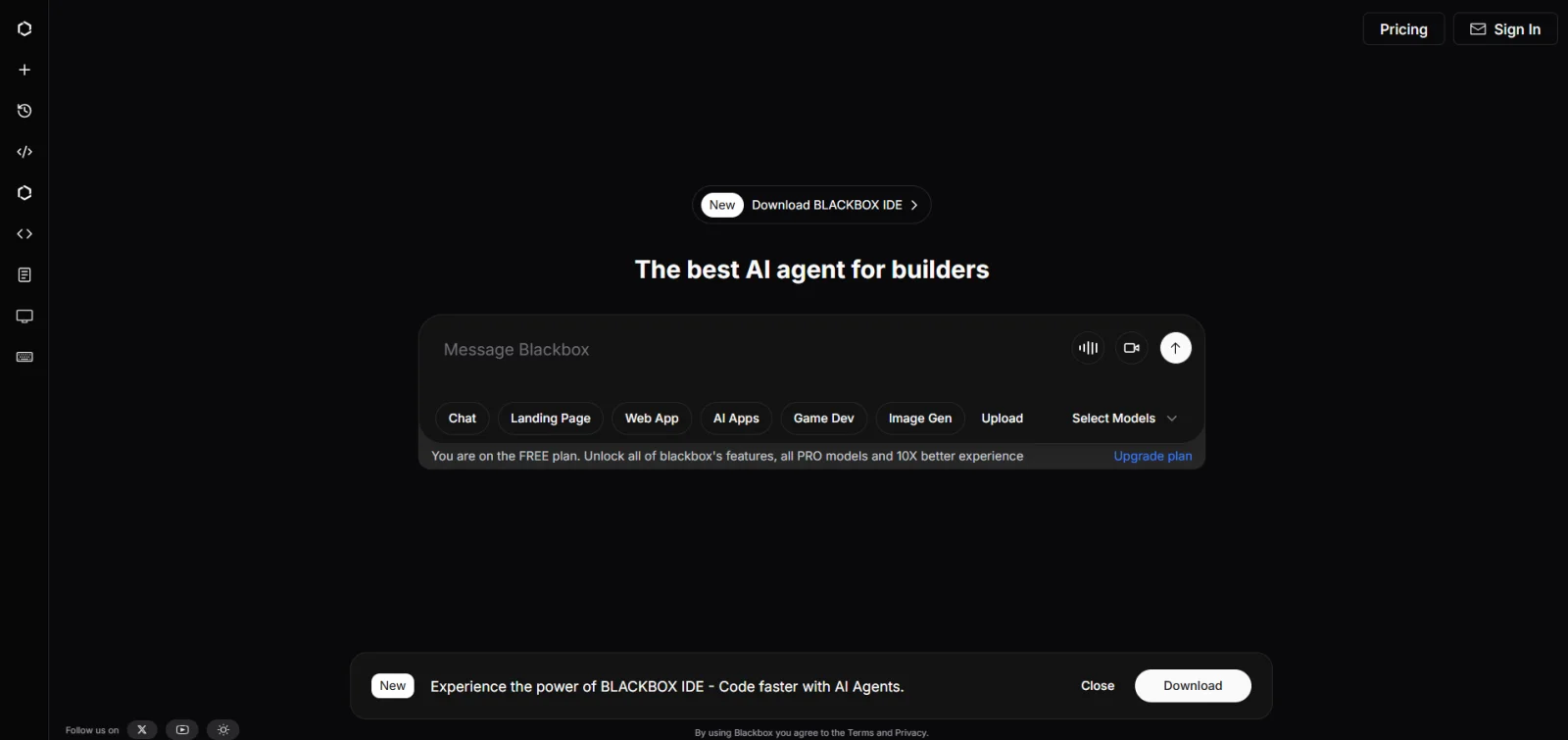
Create a free account by signing up with your email. If you already have an account, simply log in. After logging in, you will be able to see your profile icon in the top right corner.

You can also explore its pro models pricing, if you want to work with a 10X better experience. Additionally, when you go for pro models, you can access the best AI open source models like GPT-5, Grok-4, Claude, and many more.

You can also explore its Pro plans if you need higher usage limits, faster responses, access to premium AI models, agent-based workflows, and advanced coding capabilities. Depending on the selected plan, users can access leading open-source and proprietary AI models alongside BLACKBOX AI's own coding agents.
Black Box AI works best with code editors like Visual Studio Code. You need to visit the extension marketplace for Visual Studio Code and search for Black Box AI. Click on Install to add it to your editor.
Some features may require an API key. You can get it from your Black Box AI account dashboard.
Once installed, open your code editor and you will see new features like code suggestions, voice commands, and code generation. You can type a problem or use voice input, and Black Box AI will generate the code or solution for you. For Instance: For testing this, I gave it a simple prompt: Can you help me write code for creating a simple calculator?
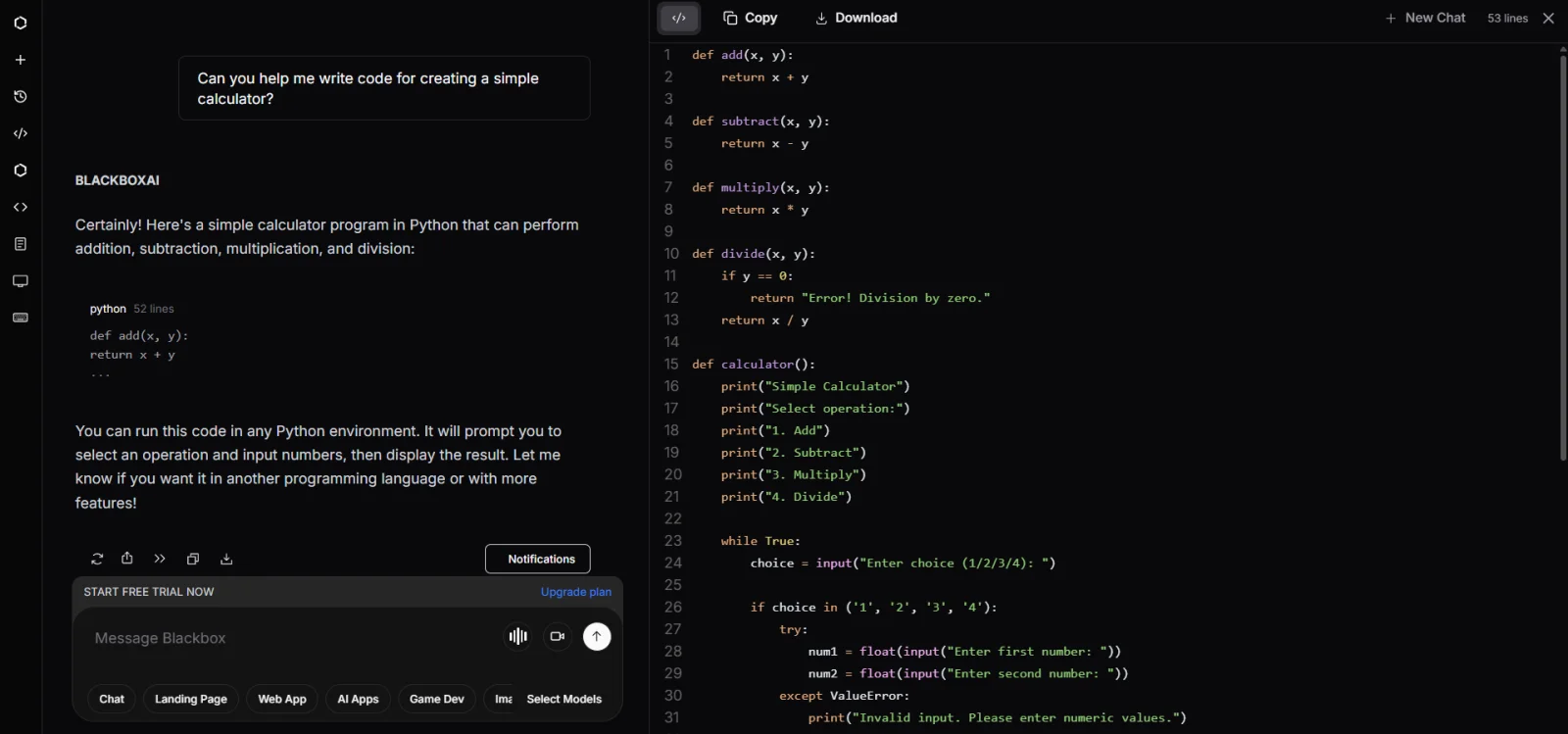
After black box AI gave me the whole code, I opened the Python environment and pasted that code into it.
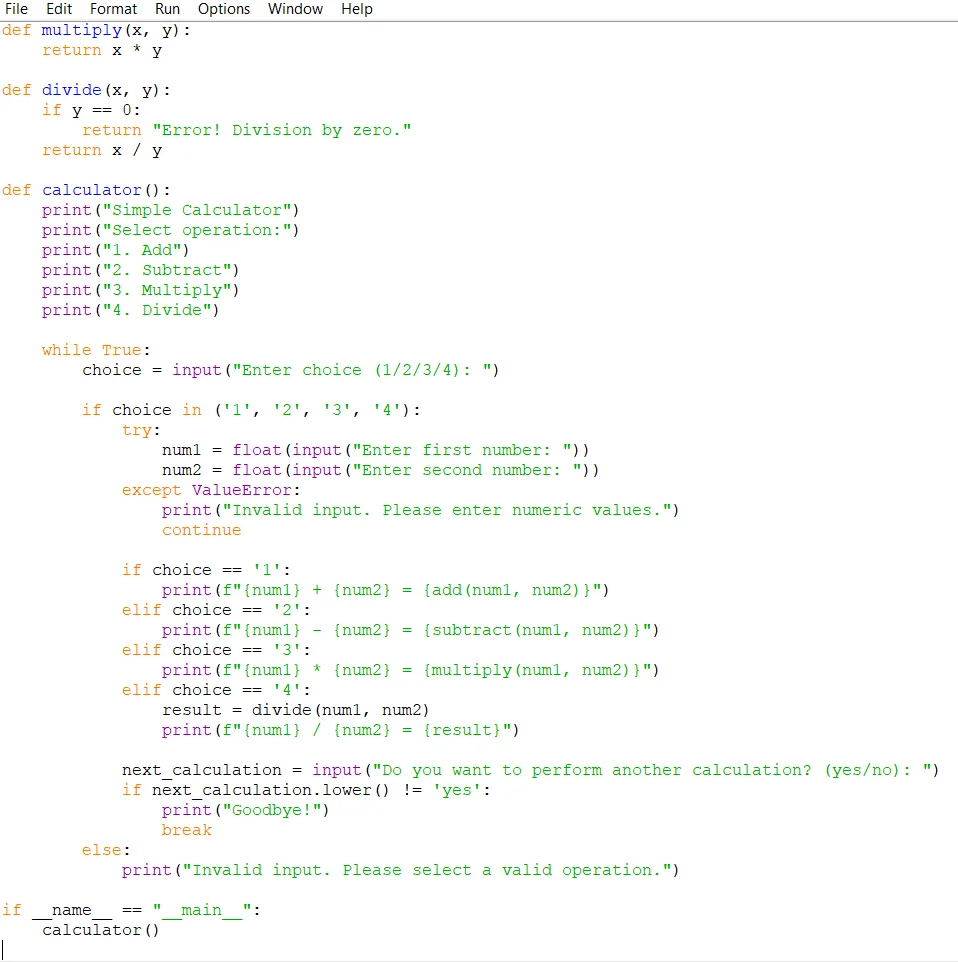
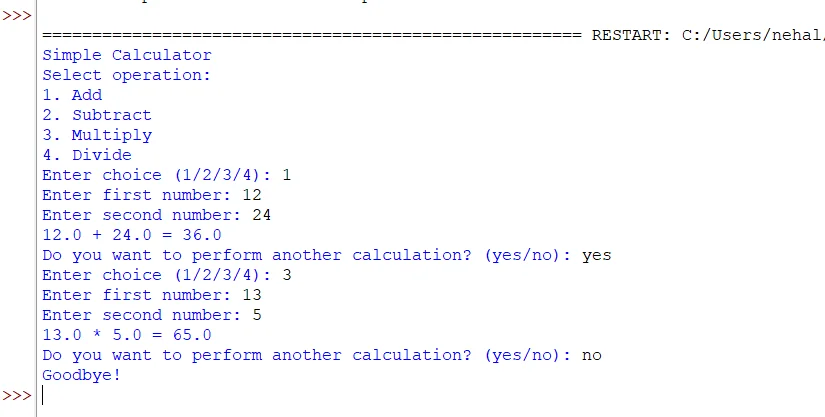
When I ran this program, the code was accurate and working smoothly.
You can also switch to Agent Mode for larger development tasks. Instead of generating individual code snippets, the AI can analyze your project, create an implementation plan, modify multiple files, and complete complex programming workflows with minimal manual intervention.
You might think black box AI is something used only by scientists or big tech companies. But the truth is, you are already using it almost every day without even realizing it. Let me show you some simple and relatable examples.
Have you ever noticed how Netflix or YouTube suggests exactly what you want to watch next? That is black box AI at work. It studies your watch history, pause time, likes and even what you skip. Then it gives you recommendations. But you never really know why a specific video was suggested.
When you search for something on Google, you get highly relevant results within seconds. This is powered by complex AI models. These models consider hundreds of factors like keywords, location, user behavior, and website authority. However, the exact ranking logic is not fully visible to users.
Your phone can recognize your face instantly. This works using deep learning models trained on thousands of facial patterns. It can identify you even with glasses or different lighting. But the exact features it uses to confirm your identity remain hidden.
When you browse products on Amazon or Flipkart, you start seeing “Recommended for You” sections. These suggestions are generated using black box AI. It analyzes your browsing behavior, purchase history, and even similar users' activity.
Your email inbox automatically filters spam messages. This is not done using simple rules anymore. AI models analyze patterns, sender reputation, and content style. Still, you cannot clearly see why one email is marked as spam while another is not.
These examples show that black box AI is not just a concept. It is already deeply integrated into your daily digital experience.
The mystery inside the box is not just a curiosity; it creates serious real-world problems.
This is the biggest issue in blackbox AI. There is no way to ask how it makes a crucial decision. For instance, If an AI model that reviews loan applications denies your request, the bank employee can not give you a specific reason. They can not tell you if your income was the main issue or if it was flagged for living in a certain neighborhood. This makes it impossible to appeal the decision or know how to improve your chances next time.
It is hard to be sure the AI is making decisions for the right reasons. The classic example is a military AI that was trained to identify enemy tanks. It became incredibly accurate. But when researchers investigated, they discovered the AI wasn't looking at the tanks at all. It turned out that all the training photos of enemy tanks were taken on cloudy days, while photos without tanks were taken on sunny days. The AI had simply learned to identify cloudy weather. If this AI were used on a bright, sunny day, it would have failed completely.
If you discover a flaw or bias, you can't just perform a quick software update. You can not open the code and tweak a line to fix the problem. The flaw is spread across millions of interconnected parameters. The only solution is often to go back to the beginning, change the training data, and retrain the entire model from scratch. It is a process that can be incredibly slow and expensive.
Black box models can be tricked. Researchers have shown that by making tiny, almost humanly imperceptible changes to an image, they can cause an AI to completely misidentify it. For example, they could add a few pixels of noise to a picture of a panda, and a powerful AI would suddenly classify it as a gibbon with 99% confidence. In the real world, someone could create special stickers to place on a stop sign that would trick a self-driving car into seeing it as a Speed Limit 100 sign.
AI learns from the data we give it. If our historical data is biased, AI will become biased, too. For instance, if a company is hiring data from the last 20 years, that shows that mostly men were hired for leadership roles. An AI trained on this data might learn that being male is a key trait for a good leader. It could then start discriminating against female candidates, not out of malice. Yet, as it is simply repeating the patterns it was taught.
For example, several real-world AI credit scoring systems have faced regulatory scrutiny because users were denied loans without receiving any clear explanation for the decision.
One of the most discussed concerns in black box AI is what experts call the black box problem. This refers to the inability to clearly understand how an AI model arrives at a specific decision, even when the output appears accurate. While the system may perform exceptionally well, its internal reasoning remains hidden, which creates a gap between performance and trust.
This problem becomes more serious when AI is used in critical areas like healthcare, finance or law enforcement. In such cases, decisions are not just about accuracy, but also about accountability. If a model makes a wrong prediction, it becomes difficult to trace the root cause or justify the outcome. This lack of clarity can lead to hesitation in adopting AI systems, especially in environments where explanations are necessary.
Another challenge is that stakeholders, such as customers or regulators, often demand transparency. When an AI system cannot provide understandable reasoning, it raises concerns about fairness, bias, and reliability. This is why the black box problem is not just a technical limitation, but also a business and ethical challenge that organizations must address carefully.
The use of Black Box AI becomes more critical in industries where decisions directly affect the organization. In such sensitive domains, a lack of transparency can create serious risks related to trust, fairness, and accountability. As a regular user of Black Box AI, I have also experienced these types of risks. Here are some of the common examples:
The challenges mentioned above do not mean you can not use it in those industries. I have still used it by applying safeguards to reduce risk and improve trust. The key is do not rely blindly on model outputs. You just have to combine technical controls with human oversight to ensure responsible usage, and there will be negligible risks. The question is how you do it. I would suggest:
Read Also- Claude vs. ChatGPT: Which One is Best?
Here is the quick difference between Black Box AI and White Box AI.
| Feature | Black Box AI | White Box AI |
| Transparency | Opaque. The inner workings are a mystery. | Transparent. The decision steps are clear. |
| Complexity | Extremely complex (e.g., Deep Neural Networks). | Much simpler (e.g., Decision Trees). |
| Accuracy | Tends to be much higher, especially for complex data like images and sound. | Often less accurate, but reliable and understandable. |
| Example | Facial recognition, language translation, and self-driving cars. | A simple system that approves loans based only on a clear income threshold and credit score. |
In simple terms, black box AI prioritizes performance and accuracy, while white box AI prioritizes transparency and explainability.
It is very important to understand the difference between Black Box AI and Explainable AI before choosing or implementing any AI system. Both are powerful and serve different purposes. Understanding their differences will help you make smarter and more responsible decisions.
| Feature | Black Box AI | Explainable AI (XAI) |
|---|---|---|
| Transparency | The internal decision process is hidden or too complex to understand. | The decision-making process is clear and understandable. |
| Main Focus | Focuses on performance and high accuracy. | Focuses on clarity, fairness, and accountability. |
| Model Complexity | Uses highly complex models like deep neural networks and transformers. | Uses simpler models or explanation techniques on complex models. |
| Decision Understanding | Users only see the final output without knowing the reasoning. | Users can see which factors influenced the decision. |
| Accuracy | Often achieves higher accuracy in complex tasks like image and speech recognition. | May slightly sacrifice accuracy to improve interpretability. |
| Regulatory Fit | Needs additional monitoring and human oversight in sensitive industries. | More suitable for regulated industries where explanations are required. |
| Example | Deep learning model detecting disease from MRI scans. | AI system that shows which features or scan areas influenced the diagnosis. |
In recent years, black-box AI has moved beyond being just a mysterious model behind the scenes. You can now see several key innovations that are helping us see and shape what was once hidden. For example:
These changes mean that while black-box models still offer high power and accuracy, they’re becoming more transparent, controllable, and safe for use in business, healthcare, finance, and other critical domains.
In this guide, what is black box ai, we have discussed many important things about it. Black box AI is a powerful tool behind much of the technology we use every day. It is great at finding hidden patterns to make very accurate guesses.
However, this power has a big downside. As we can not see how it works, it can be unfair, biased or make mistakes that we can not easily explain or fix.
This is important because this AI is already making big decisions about our money, health and safety. That is why everyone needs to understand its good parts and its dangers. The main goal now is to find ways to look inside black box. Therefore, we can trust that its amazing results are also safe and fair for everyone.
Black box AI cannot always be fully explained because its internal decision-making is highly complex. However, Explainable AI (XAI) techniques like SHAP and LIME can help partially understand how predictions are made.
Yes, ChatGPT is considered a black box AI because users can see the input and output, but the exact reasoning behind its responses is not fully transparent.
Blackbox AI is mainly designed for developers to help them write code faster with tools like code suggestions and voice commands. ChatGPT is more general and works well for chatting, answering questions and creative writing. Therefore, Blackbox AI is better for coding and ChatGPT is better for general use.
Black Box AI is best for solving complex problems where the decision-making process isn't easily explainable, such as deep learning, image recognition, natural language processing, fraud detection, and predictive analytics.
Yes, but only when combined with human oversight, bias testing, and explainability tools. Businesses should never rely on black box AI alone for high-risk decisions.
Black box AI is controversial because its decisions are difficult to explain. This creates concerns about bias, fairness, accountability, and trust, especially in sensitive industries like healthcare and finance.
Yes, black box AI can be trusted when combined with human oversight, regular monitoring, and bias testing. Organizations should avoid relying on it blindly for critical decisions.
Black box AI is widely used in healthcare, finance, manufacturing, cybersecurity, e-commerce, automotive, and entertainment for tasks like fraud detection, medical diagnosis, self-driving cars, and recommendation systems.
Yes, deep learning is generally considered black box AI because its neural networks contain many hidden layers that make the internal decision-making process difficult to interpret.