In the world of technology, Artificial Intelligence (AI) is something we have all heard of or encountered regularly. With more new terms emerging, such as Generative AI and Agentic AI, it has become important to keep up with them in order to grow along with the technical world. Earlier, we utilized traditional AI to make the best use of our data. Now, Gen AI is here to generate everything from images to code. On the other hand, Agentic AI has emerged as an autonomous system that pursues outcomes with minimal human intervention.
I have used Generative AI tools for writing, research, and coding assistance, and they are incredibly helpful for me in most of cases. But at some point, a thought naturally comes up: what if AI could do more than just respond? What if it could actually take action, make decisions, and complete tasks on its own? That is where Agentic AI enters the picture. Unlike Generative AI, which acts like a conversational assistant, Agentic AI behaves more like a digital co-worker, pursuing outcomes with minimal human intervention.
In this article, I will explain Agentic AI and Generative AI, their features, advantages, limitations, and more.
Let's get started.
Agentic AI refers to AI systems that can make decisions and take actions independently to achieve specific goals. These systems, often called AI agents, use techniques like reinforcement learning to analyze situations, plan steps, and adapt over time with minimal human input.
Most agentic AI today still operates within goals set by humans and works best in controlled environments. Fully autonomous AI that can define and pursue its own objectives across all situations does not yet exist, and its development raises important safety concerns.
Here are the benefits and limitations of Agentic AI you need to know:
| Aspect | Benefits | Limitations |
| Autonomy | Can plan and execute tasks independently with minimal human input | True autonomy is still limited to defined goals and environments |
| Decision-Making | Makes goal-driven decisions using feedback loops and real-time data | Poor inputs or rules can lead to incorrect or unsafe decisions |
| Task Orchestration | Handles multi-step workflows across tools, APIs, and systems | Complex workflows increase monitoring and debugging effort |
| Efficiency | Reduces manual effort and speeds up repetitive or operational tasks | High setup time and infrastructure cost |
| Adaptability | Learns from outcomes and adjusts actions over time | Struggles with unexpected or chaotic real-world scenarios |
| Scalability | Can operate across multiple tasks or users simultaneously | Scaling increases system complexity and resource usage |
| Tool Integration | Connects directly with databases, CRMs, APIs, and enterprise tools | Integration with legacy systems can be challenging |
| Human Oversight | Works with limited supervision once deployed | Still requires governance, guardrails, and human checkpoints |
| Reliability | Executes tasks consistently without fatigue | Errors can propagate across systems if not controlled |
| Safety & Control | Can follow predefined constraints and policies | Misaligned goals may cause unintended actions |
Read Also- Top 40+ Agentic AI Interview Questions and Answers
Generative AI, or Gen AI, is a type of artificial intelligence that creates new content such as text, images, code, audio, or videos based on user prompts. It uses deep learning models trained on large datasets to identify patterns and generate relevant outputs.
Generative AI gained massive attention after the launch of ChatGPT in 2022 and is now widely used to support writing, design, research, and software development. While powerful, it mainly responds to instructions rather than acting on its own.
Below are the limitations and benefits of Generative AI:
| Aspect | Benefits | Limitations |
| Content Creation | Generates text, images, code, audio, and video quickly | Output may contain inaccuracies or hallucinations |
| Creativity | Produces new and original ideas based on learned patterns | Creativity is limited to training data and lacks true understanding |
| Productivity | Speeds up writing, design, research, and coding tasks | Requires human review for quality and correctness |
| Ease of Use | Works through simple prompts and natural language | Performance depends heavily on prompt quality |
| Personalization | Can tailor content based on user input or context | Deep personalization requires access to user data |
| Scalability | Can generate large volumes of content on demand | High usage may increase operational costs |
| Adaptability | Can be fine-tuned for different domains or tasks | Fine-tuning requires expertise and quality data |
| Automation | Automates repetitive content-related tasks | Cannot act independently without instructions |
| Learning Support | Helps explain concepts and generate examples | May provide outdated or misleading information |
| Ethical & Legal Concerns | Enables rapid experimentation and innovation | Raises copyright, bias, and data privacy concerns |
Related Article: Top 30 Generative AI Interview Questions And Answers (2026)
Before explaining the Generative AI vs. Agentic AI, let's have a quick look at both of them.
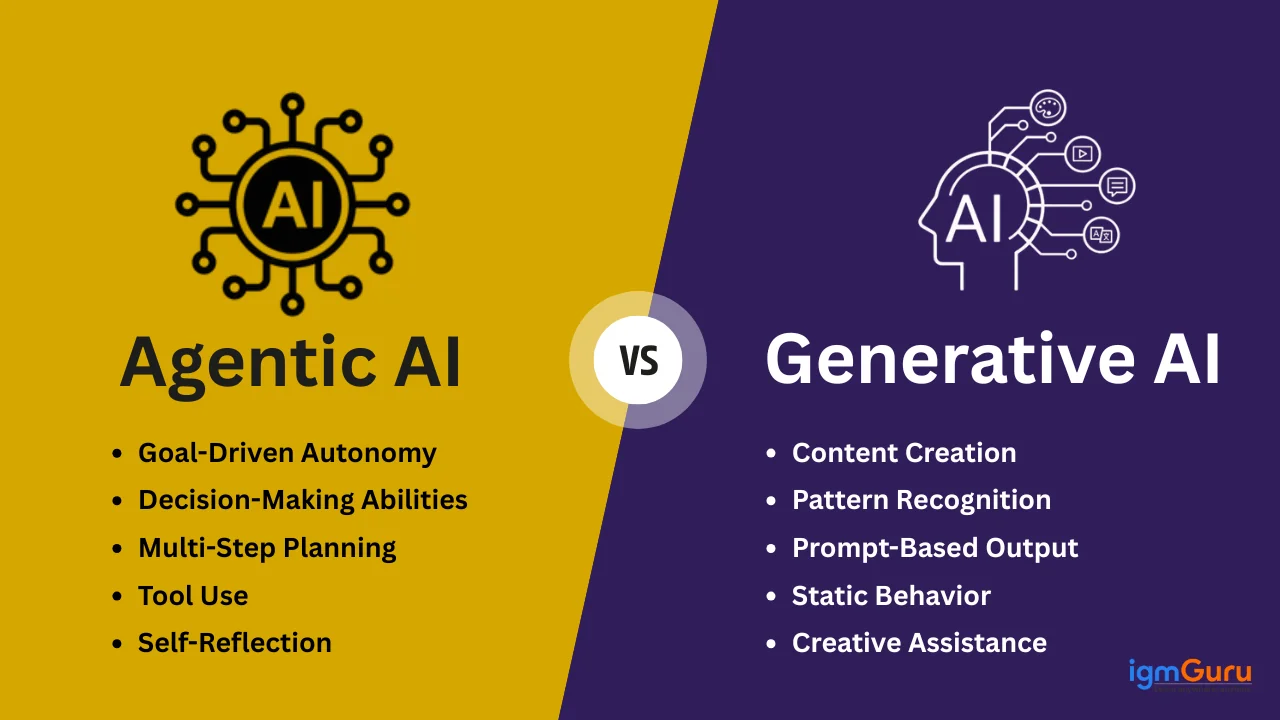
| Aspect | Agentic AI | Generative AI |
| Core Purpose | Acts autonomously to achieve goals | Generates content based on prompts |
| Primary Function | Decision-making and task execution | Content creation and assistance |
| Human Involvement | Minimal after setup | Required for every task |
| Autonomy | High - plans and acts independently | Low - responds only when prompted |
| Memory | Long-term and task-aware | Mostly short-term and session-based |
| Task Handling | Manages multi-step workflows | Handles one request at a time |
| Tool Usage | Directly interacts with APIs, tools, and systems | Suggests actions but does not execute |
| Learning Style | Learns from outcomes and feedback | Learns patterns from training data |
| Typical Role | Digital co-worker or autonomous agent | Conversational assistant |
| Common Use Cases | Workflow automation, operations, IT, customer service | Writing, design, coding assistance, research |
| Example LLM Usage | GPT-4 or Claude used inside agent frameworks | GPT-4, Claude, Gemini for content generation |
This section highlights the features of these two evolutionary technologies.
Let's begin with some impressive features of Agentic AI.
Agentic AI can handle tasks on its own without needing constant human input. They can keep track of long-term goals, manage complex problems, and monitor their progress.
It blends the flexibility of large language models with the structure of traditional programming. This means they can come up with responses or actions based on understanding the situation.
The agents in an agentic AI system can focus on specific tasks. Some might do simple, repetitive work, while others tackle more complicated issues using their memory and perception.
Agentic AI learn from its experiences, takes feedback, and adjusts how it acts. This ongoing improvement helps them work better over time.
Thanks to large language models, agentic AI can be interacted with using everyday language, making it easier for users and cutting down the need for complex software.
Generative AI has some really interesting features that make it stand out. Let's check out five of them and see what they're all about.
One of the coolest things about generative AI is how creative it can be. It can come up with fresh and unique ideas all on its own. For example, artists have sold paintings created by AI, and musicians have performed songs that were written by it. This creativity comes from the AI's ability to analyze tons of examples and mix them up in new ways.
For instance, if you ask an AI to tell a story about a pirate teaming up with a robot, it could create a fun adventure with surprises that nobody has thought of before. That knack for inventing new stuff is what sets generative AI apart from other types of AI.
Generative AI is also great at working with less data. Typically, AI works best with a lot of examples, like thousands of labeled photos or texts. But generative AI can create new stuff even when there's only a small amount of data available, which is super useful when it's hard to gather information.
Take medical research, for example. If scientists only have a few samples of a rare disease, generative AI can generate more data from those few samples. This helps researchers test out ideas without needing loads of additional real-world info.
This type of AI is really adaptable. After it's trained, it can handle different tasks. It learns general patterns from the data it sees, which means it can apply what it learned to new areas with just a few tweaks.
Another big feature of generative AI is its ability to automate tasks. This technology can take over manual work, saving time and money. It's like having a tireless worker ready to help out all the time.
For example, some organizations use generative AI to write short news articles about sports or financial updates. This lets journalists focus on bigger stories while the AI quickly produces descriptions and social media content, giving businesses an edge in speed and efficiency.
Finally, generative AI does an awesome job at personalization. It can create content just for you based on your preferences or behaviors, which is a big plus for marketing.
Imagine you're shopping online. Generative AI could whip up product recommendations or emails that feel like they were made just for you, making you more interested in what's being offered. In the past, this kind of customization was a lot of work, but now AI makes it quick and easy.
Related Article: How to Write Effective ChatGPT Prompts?
Now that we've covered the main features of generative and agentic AI, let's talk about how they actually work.
Traditional AI just reacts to what you ask or the problems you report. In contrast, agentic AI doesn't sit around waiting. It can predict, plan, and take action on its own, aiming for a specific goal rather than just responding to a prompt.
The best AI agents gather information, plan their next steps, make decisions, and adapt based on what happens. They don't need constant nudging from humans. Companies offering agentic AI can provide customer service that does a few key things:
Generative AI models utilize neural networks to identify patterns in existing data and generate new content.
One cool thing about these models is how they can use different learning methods, like unsupervised or semi-supervised learning, for training. This means companies can make the most of a ton of unlabeled data to build their base models. These foundation models serve as a starting point for AI that can handle various tasks.
Some examples are GPT-3, GPT-3.5 and Stable Diffusion. GPT-3 powers popular tools like ChatGPT, where you can generate an essay just by giving a short text prompt. Meanwhile, Stable Diffusion can create lifelike images from a text description.
Read Also- How To Become A Prompt Engineer: A Comprehensive Guide
Choosing between generative AI and agentic AI depends on what you want AI to do for you- assist or act.
You should choose generative AI when your primary goal is content creation or idea support. It works best when humans remain in control and the AI acts as an assistant.
Use Generative AI when:
Generative AI is ideal for marketing teams, writers, designers, students, and developers who want to speed up work without handing over control.
You should choose agentic AI when the goal is automation, execution, and decision-making, not just suggestions.
Use Agentic AI when:
Agentic AI is best suited for business operations, customer support automation, DevOps, IT monitoring, and enterprise workflows, where efficiency and autonomy matter more than creativity.
Read Also- Generative AI Tutorial
Seeing agentic AI and generative AI in action makes their differences much clearer. Although both rely on advanced AI models, the way they behave in real-world scenarios is fundamentally different.
Agentic AI systems are built to take initiative, make decisions, and complete tasks with minimal human involvement.
An agentic AI can detect a service issue such as a delayed order, investigate the cause by checking logistics systems, reschedule delivery, notify the customer, and update internal records automatically.
In development environments, agentic AI can identify bugs from system logs, modify code, run tests, and deploy fixes while monitoring performance- similar to how a junior software engineer works.
Agentic AI can manage operational workflows like approving requests, assigning tasks, coordinating meetings, and interacting with tools such as CRMs, calendars, and databases to ensure processes move forward smoothly.
It can monitor system health, detect anomalies, restart services, or trigger alerts without waiting for human instructions, helping prevent downtime.
Generative AI focuses on creating content in response to user prompts rather than acting independently.
Generative AI is widely used to write blog posts, marketing emails, social media captions, and product descriptions, helping teams produce content faster.
Developers use generative AI to generate code snippets, explain complex logic, or suggest improvements, while humans still review and apply the code.
It can create images, videos, music, or design concepts based on text prompts, supporting creative work in advertising, entertainment, and branding.
Generative AI helps summarize documents, explain technical topics, and generate examples, making it useful for education and research tasks.
Read Also- Top 6 Examples of Generative AI (2026)
Generative and agentic AI are going to blend more as they develop. With tech getting better, we could see systems that mix creative and action-driven abilities. Just think about an AI that not only comes up with new ideas but also puts them into action on its own. This could really change the game for fields like healthcare and manufacturing.
But with this potential, we have to take responsibility. It's important to make sure these technologies are created and used in a way that's ethical and clear. By knowing what sets generative and agentic AI apart, we can recognize their strengths and aim for a future where AI truly benefits people.
Generative AI really helps with creativity and making customized content, especially in marketing and design. On the flip side, agentic AI is great for automation and decision-making, which can boost productivity in fields like healthcare and logistics. By understanding what each AI type can do, businesses can reach their full potential. As technology keeps changing, having a good grip on both generative and agentic AI will put professionals in a strong spot.
Related Articles:
Agentic AI focuses on making decisions and executing tasks autonomously, while generative AI focuses on creating content like text, images, or code based on user prompts.
Agentic AI is more advanced in terms of autonomy and execution, but it often uses generative AI models internally for reasoning and language understanding.
In most modern systems, agentic AI relies on generative AI models for reasoning and planning, but the agentic layer adds decision-making, memory, and tool execution.
It depends on the goal. Generative AI is better for content and creativity, while agentic AI is better for automation, operations, and workflow execution.
No. Generative AI only responds to prompts and generates outputs. It cannot independently take actions unless it is part of an agentic AI system.
Course Schedule
| Course Name | Batch Type | Details |
| Generative AI Training | Every Weekday | View Details |
| Generative AI Training | Every Weekend | View Details |