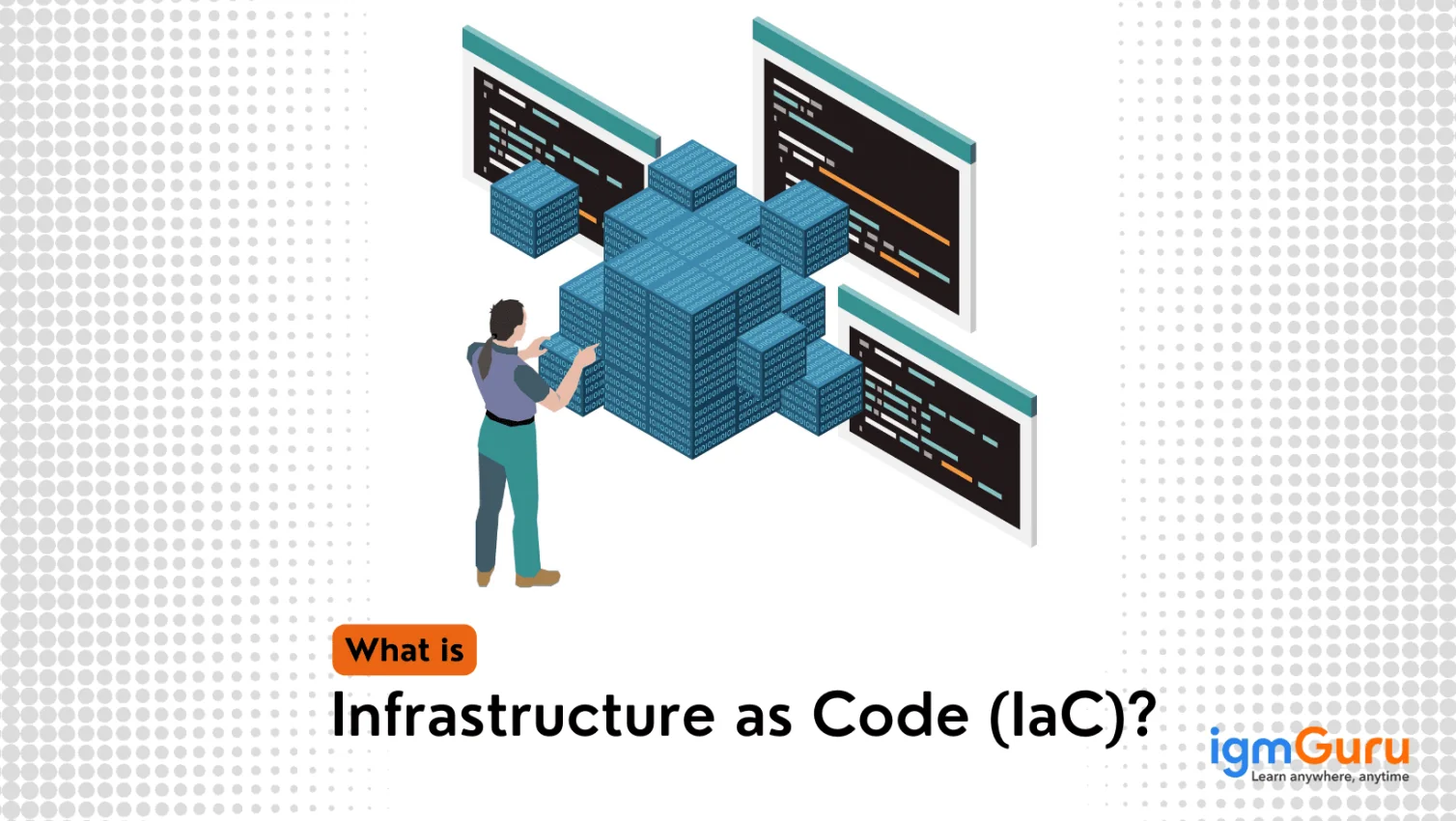
Infrastructure as Code (IaC) is about managing, provisioning, and supporting IT infrastructure through code or machine-readable script files rather than manual processes. Teams can automate the setup and management of their infrastructure for more efficiency and compatibility. In a DevOps environment where teams continuously update and deploy software, IaC proves to be extremely useful.
Manual infrastructure management is prone to errors and is also time-consuming. IaC helps manage applications at scale as it defines the desired state of the infrastructure without all the steps involved. Management gets automated to allow developers to focus on building and enhancing apps rather than managing environments.
Read on to know what is Infrastructure as Code (IaC), declarative vs imperative approaches, benefits, types and much more.
Explore igmGuru's DevOps Course program to accelerate your career growth.
TL;DR
Infrastructure as Code (IaC) is the practice of managing, provisioning, and maintaining IT infrastructure through code and machine-readable configuration files instead of manual processes. This blog, from the DevOps and Cloud Computing category, explains IaC concepts, declarative and imperative approaches, benefits, working methodology, its role in DevOps and CI/CD pipelines, key features, applications, challenges, limitations, and popular IaC tools such as Terraform, AWS CloudFormation, Ansible, and Kubernetes.
Infrastructure as Code (IaC) is the practice of managing and provisioning computer data center resources through machine-readable definition files instead of physical hardware configuration or manual processes.
IaC has two main approaches that it uses to get things done. These are declarative and imperative, wherein each of these have a specific purpose and use cases. Here is a peek into declarative vs imperative comparison.
| Aspect | Imperative Approach | Declarative Approach |
| Introduction | It details the precise steps or commands needed to achieve the desired infrastructure state. | It specifies the desired state of the infrastructure like the resources and their configurations. |
| Execution | The user must execute the commands in the correct order to configure the infrastructure. | Here, the IaC tool automatically locks and performs actions to attain the desired state. |
| State Management | It does not track state, the users are responsible for handling changes manually. | It keeps a track of the current state of the infrastructure and simplifies updates and resources. |
| Ease of Use | It demands detailed instructions, which makes the user in charge of defining how to attain results. | It makes the process easier as users only define what they want and omit how it is attained to the tool. |
| Change Management | The users must manually figure out and apply the changes. | It automatically makes changes upon modification of the wanted state. |
| Tool Preference | It is less common, but a few tools or situations might need it for greater control over actions. | It is preferred by most IaC tools, as it permits automation and efficiency. |
| Example Use Case | One can write scripts to develop or modify infrastructure in a particular order. | It defines infrastructure as a code template and lets the tool provision resources. |
IaC is essentially the procedure of handling infrastructure with automated methods. It includes handling and provisioning data centers through code modules rather than interactive configuration tools. Software development has its most common use as it automatically sets up the environment in mere minutes. This environment is also more efficiently manageable.
Here are some of the benefits of Infrastructure as Code.
Tasks like infra configuration are otherwise time-consuming. When automated by IaC, the attached cost reduces significantly. Engineers or IT experts can complete these tasks in no time and concentrate on other mission critical tasks. Organizations take maximum benefit of the consumption-based cost structure of cloud computing.
There are multiple processes in the CI/CD lifecycle of structures, but IaC makes almost every process two times faster. Automation stretches from significant processes like virtualization to user account management, databases and network management. This faster speed is not only for developers but for the rest of the team too.
There are two descriptions of human errors. The first is the face meaning, which implements mistakes made by engineers or IT personnel in the manual process of infrastructure building. The second side to human error is the adaptation of new employees to the infrastructure built by the prior IT expert.
This automation solves these two issues by reducing the risk of man-made mistakes by cutting down long processes. It develops detailed reports and documentation of how the infrastructure works, is handled, and is deployed. It also outlines how new employees can continue handling without setbacks.
IaC assists consistency as it avoids human errors and incompatibility. Human errors in activities like deployment and configuration are avoided, which are usually prone to inconsistent behavior. This makes it impossible to manually carry out activities like deployment and configuration without at least one inconsistency.
Its one-way deployment improves security strategies. Through IaC, computing, storage and networking services are all provisioned with code and deployed the same way, often through a private or public cloud. It can also be the case for security standards, which are easily created and deployed. This proves to be the most beneficial for infrastructure needing tight security, resulting in many security passes.
Related Article- DevOps Tutorial For Beginners
Infrastructure as Code is a procedure of defining and handling a system's infrastructure through machine-readable script files. It defines the architecture of the system, just the way software code determines the logic and functionality of an application. The system's architecture encompasses components like networks, servers, storage and operating systems.
Infrastructure resources can be handled in a consistent and organized way with this method. Configuration files are treated like source code, making it possible to use version control, easily make updates and track errors.
These configuration files are usually written in Python or Java programming language. These are often created in integrated development environments (IDEs) for identifying errors and improving the coding procedure. All changes are tracked through version control systems, while developers can also collaborate more effectively. Let's explore an answer to what is the role of Infrastructure as Code in DevOps, since both are quite closely aligned.
DevOps concentrates on making sure that development and operations teams deliver software faster and with higher quality. It shortens the app or software development lifecycle through continuous delivery of top-quality software by automating infrastructure tasks. IaC plays a major role in this as IaC is integrated into the continuous integration and deployment (CI/CD) pipelines
Adding Infrastructure as Code in DevOps would change infrastructure automatically depending on application changes. There are many reasons why DevOps teams are using this method. Some of them are -
Its features are what make this method such a globally picked one. Here are some of the features of Infrastructure as Code.
Related Article- How To Become A DevOps Engineer?
Infrastructure as Code has a vast variety of applications across different domains and industries. Here are some well-known applications of Infrastructure as Code.
The main challenges and limitations with Infrastructure as Code involve a steep learning curve for coding languages. Also includes potential security risks because of poorly handled templates and access controls. Here are a few others to know about -
Related Article- Top Certifications for DevOps Engineers for Career
IaC tools are useful for automating the creation, management, and deployment of infrastructure resources. Each of these has its unique features and specific use cases. Here are some of the best Infrastructure as Code tools -
Terraform is a widely used open source tool that automates the management of on-premises and cloud resources. It is a declarative approach with multi-cloud compatibility, extensibility and modular infrastructure state management.
AWS CloudFormation automates infrastructure deployment within the AWS environment. This tool is deeply integrated with AWS, has rollback abilities and templated infrastructure setup.
Ansible is a simple agentless automation tool for handling provisioning, deployments and configuration. It follows both imperative and declarative approaches. Ansible is easy to use with YAML playbooks and boasts a vast community.
Kubernetes automates the deployment, management and scaling of containerized applications. It handles container lifecycle, scaling and networking in a cluster environment.
Learning what is Infrastructure as Code is quite an expansive topic and there's always scope to learn more. It is an important method in modern IT operations, making sure of speed, efficiency and accuracy in infrastructure management. Its solutions have special features that cater to different requirements and environments. It has different uses in software development, infrastructure testing, cloud deployments, monitoring IT resources and cloud infra management.
Explore These Trending Articles:
It lets an individual build, change and handle their infrastructure in a safe, consistent, trackable and repeatable way by describing resource configurations.
It can be stored in a source code repository.
It is the procedure of analyzing these code configurations for detecting misconfigurations, security risks and compliance violations before deployment.
Course Schedule
| Course Name | Batch Type | Details |
| Cloud Computing Certification Courses | Every Weekday | View Details |
| Cloud Computing Certification Courses | Every Weekday | View Details |