Machine Learning Frameworks have revolutionized the way we build and deploy Artificial Intelligence (AI) systems. These can design and train robust AI and Machine Learning Models without writing complicated code from scratch. These systems can then identify patterns, make predictions and generate solutions. ML frameworks are basically the backbone of modern AI.
But with so many options available, which one should you choose? Making a choice among them can be complicated sometimes. But you don’t have to worry about that anymore. This blog will discuss the top 10 machine learning frameworks, what they are, their pros and cons, and more. It will provide all the insights one must have before choosing the right one.
Let's start with what machine learning frameworks are.
TL;DR
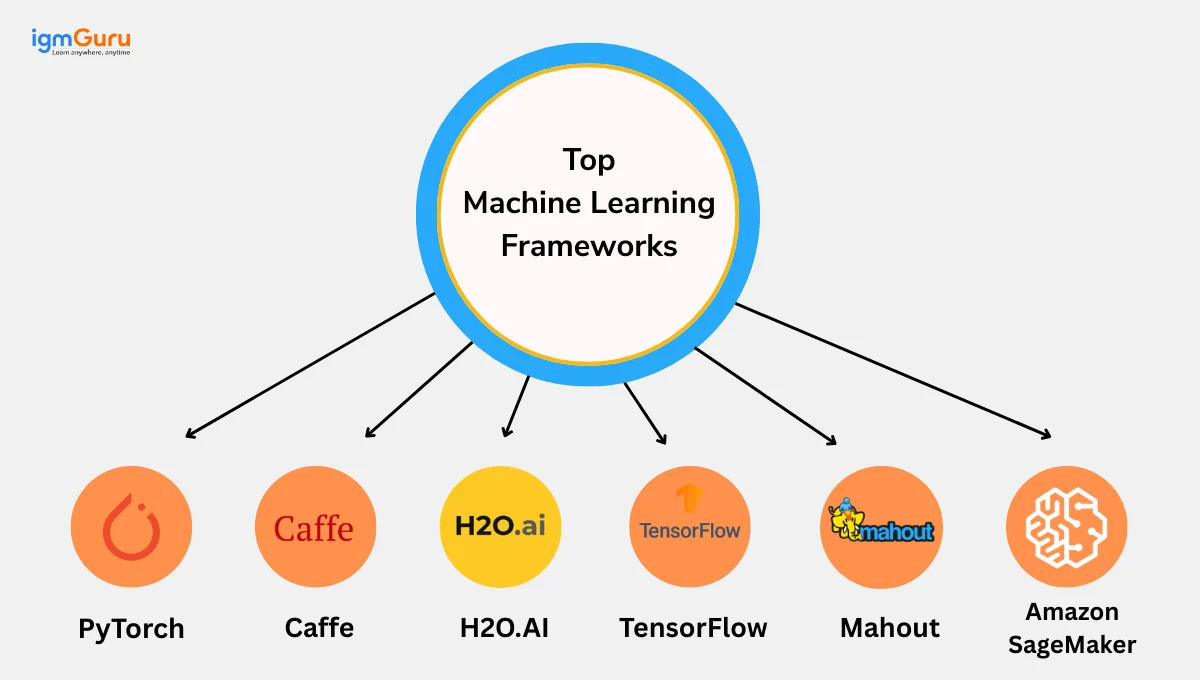
Machine Learning Frameworks are software platforms and libraries that provide pre-built components for designing, training, and deploying machine learning models efficiently without building algorithms from scratch. This blog, from the Machine Learning and Artificial Intelligence category, explores the top 10 machine learning frameworks—TensorFlow, PyTorch, Scikit-learn, Keras, Hugging Face Transformers, Amazon SageMaker, H2O.ai, Apache Mahout, Caffe, and Accord.NET—along with their features, drawbacks, ideal use cases, and framework selection guidance. The frameworks were evaluated based on use cases, programming language support, learning difficulty, scalability, deployment capabilities, and suitability for different users and projects.
A Machine Learning (ML) framework is a software platform or library that provides pre-built, optimized components to design, train, and deploy ML models. Developers use these tools to build intelligent systems, like neural networks, much faster and more efficiently, without writing complex mathematical equations and algorithms from scratch.
Explore igmGuru's Machine Learning Training program to build your career in ML.
If you are short on time, this quick overview compares the most popular machine learning frameworks based on their primary use cases, programming languages, learning difficulty, and ideal users. Use it to identify the framework that best matches your project before exploring each one in detail.
| Framework | Best For | Primary Language | Difficulty | Open Source |
| TensorFlow | Production Deep Learning | Python, C++ | Intermediate | Yes |
| PyTorch | Research & Generative AI | Python | Easy to Intermediate | Yes |
| Scikit-learn | Classical Machine Learning | Python | Beginner | Yes |
| Keras | Quick Neural Network Development | Python | Beginner | Yes |
| Hugging Face Transformers | LLMs & NLP Applications | Python | Intermediate | Yes |
| Amazon SageMaker | Cloud ML & MLOps | Python | Intermediate to Advanced | No (Managed Service) |
| H2O.ai | AutoML & Enterprise AI | Python, R, Java | Intermediate | Yes |
| Apache Mahout | Big Data Machine Learning | Java, Scala | Advanced | Yes |
| Caffe | Computer Vision | C++, Python | Intermediate | Yes |
| Accord.NET | .NET Machine Learning | C# | Intermediate | Yes |
This field is growing rapidly, and its intricacy grows, focusing on making procedures easier. Many successful technologies have been using frameworks for effective development. Obtaining proficiency in machine learning frameworks not only saves time but also improves the development process. Read on to explore the top 10 machine learning frameworks.
This machine learning framework was developed by Google and launched as a web-based project. TensorFlow is a versatile and strong machine learning tool with a complete library. Its libraries have large and flexible functions that are used to create classification models, neural networks, regression models, and other kinds of machine learning models. This also has the ability to personalize machine learning algorithms to one's requirements and needs. It operates on both GPUs and CPUs. The main obstacle of TensorFlow is that it's not easy to use for beginners.
PyTorch is an open-source and free machine learning framework that is based on Torch and Caffe2 and is perfect for neural network design. This also supports the Lua language for user interface development. It is combined with Python and is compatible with famous libraries like Cython and Numba. This framework is intuitive and faster for freshers to learn.
PyTorch gives an end-to-end workflow that allows permission to develop models in Python and deploy them on iOS and Android. The extensions of this framework API manage common pre-processing and combined tasks needed to implant machine learning models in mobiles.
This is a free and user-friendly machine learning framework. It comes with detailed documentation. Sci-Kit Learn lets the developers change the algorithm's preset parameters either in use or at runtime, which makes tuning and troubleshooting models easier. It supports machine learning development with a large Python library. SciKit Learn falls among the best tools available for data mining and analysis. This has vast pre-processing abilities and authorizes algorithm and model design for classification, clustering, dimensionality reduction, regression and model selection.
Related Article: Real-Life Machine Learning Examples
Keras is an advanced neural network API built on Python. It is capable of running on top of TensorFlow, JAX or PyTorch. Its design is focused on fast experimentation with deep neural networks. Keras prioritizes user-friendliness, modularity and extensibility. This makes it an excellent choice for beginners and for quickly building and prototyping deep learning models. It abstracts away much of the complexity, allowing users to focus on model architecture and data.
Hugging Face Transformers is technically a library built on top of PyTorch and TensorFlow. It has revolutionized Natural Language Processing, computer vision, and speech. It provides thousands of pre-trained models, tools for fine-tuning, and a consistent API. This makes state-of-the-art AI models accessible to everyone. Its impact on enabling new forms of generative AI and language-based applications is immense.
Amazon SageMaker is a completely integrated development environment (IDE) for machine learning. It was launched in 2017. Amazon Web Services offers this Machine Learning service for applications like Computer Vision, Image, Recommendations and Video Analysis, Forecasting, Text analytics, and more. One can choose this Machine Learning framework for building, training and deploying machine learning models on the cloud.
H2O is a fully open-source and free machine learning framework that was created to solve the organizational procedures of decision support systems. H2O combines with other frameworks for managing actual model development and training. This framework is largely used in risk and fraud trend analysis, patient analysis in healthcare, insurance customer analysis, customer intelligence, advertising costs and ROI.
This is a free machine learning framework that is primarily focused on Linear Algebra. This was developed by the Apache Software Foundation and launched in 2009. Apache Mahout permits data scientists to apply their mathematical algorithms in an interactive environment. The algorithms are for clustering, classification and batch-based collaborative filtering in Apache Mahout use Apache Hadoop. It works and distributes with interactive shells and a library to link the application.
Convolutional Architecture for Fast Feature Embedding (CAFFE) was created at the Berkeley Vision and Learning Center at the University of California and launched in 2017. This is a deep learning framework written in C++ that has an expression architecture. It easily permits switching between the CPU and GPU. It has a MATLAB and Python interface and Yahoo has also integrated Apache Spark with this machine learning framework for developing CaffeOnSpark. It is a perfect framework for image classification and segmentation. It supports many GPU- and CPU-based libraries like NVIDIA, cuDNN, Intel MKN and more.
This machine learning framework is completely written in C#. Accord.NET was made by Cesar Roberto de Souza and launched in 2010. It offers coverage on many topics like statistics, machine learning, and artificial neural networks with many machine learning algorithms. Algorithms like classification, regression, clustering and more, also with audio and image processing libraries. These libraries are available as source code, executable installers and NuGet packages.
Related Article: How To Learn Machine Learning?
Here's a table comparing the machine learning frameworks we discussed above, including their primary language, strengths, and ideal use cases:
| Rank | Framework | Language(s) | Strengths | Ideal For |
| 1 | TensorFlow | Python, C++ | Production-ready, rich ecosystem (TFX, TF Lite), strong distributed training, robust for large-scale deployments. Default Keras 3.0 support. | Deep learning in production, mobile & edge ML, large-scale distributed training, custom research models. |
| 2 | PyTorch | Python, C++ | Dynamic computation graphs, easy debugging, highly Pythonic, vibrant research community, growing production support. | Deep learning research, rapid prototyping, custom neural networks, NLP, computer vision. |
| 3 | Scikit-learn | Python | Simple syntax, comprehensive for classical ML models, excellent documentation, wide range of preprocessing tools. Stable release: 1.7.0. | Beginners, classical ML (regression, SVM, clustering, decision trees), tabular data analysis. |
| 4 | Keras | Python | High-level API, rapid prototyping, modular, runs on TensorFlow, PyTorch, and JAX (Keras 3.0). | Beginners in deep learning, standard neural networks (CNNs, RNNs), quick model experimentation. |
| 5 | Hugging Face Transformers | Python | Vast pre-trained transformer model hub, unified API, state-of-the-art NLP, expanding to vision and audio domains. | NLP tasks (classification, generation, translation), LLMs, transfer learning with transformers. |
| 6 | Amazon SageMaker | Python (platform) | Fully managed service, end-to-end ML pipeline, strong MLOps support, seamless AWS integration, unified Studio for AI. | Cloud-native ML, large-scale training/deployment on AWS, MLOps, GenAI on AWS. |
| 7 | H2O.ai | R, Python, Java | Scalable ML, strong AutoML, in-memory speed, big data support (Spark), focus on Agentic AI and LLM Studio. | Enterprise ML, AutoML pipelines, fraud detection, business intelligence. |
| 8 | Apache Mahout | Java, Scala | Distributed linear algebra, big data friendly, Spark backend support, custom algorithm development. Release: Qumat 0.4. | Scalable ML on Hadoop/Spark, collaborative filtering, clustering, distributed analysis. |
| 9 | Caffe | C++, Python | High performance for CNNs, optimized for vision tasks, supports deployment on edge/embedded systems. | Computer vision, convolutional neural networks, embedded vision deployment. |
| 10 | Accord.NET | C# (.NET) | Extensive ML algorithms in .NET, include signal/image processing, ideal for scientific computing. Last update: 2022-11-18. | ML in .NET apps, signal/image processing in desktop or web apps. |
Over the years, I have worked with multiple machine learning frameworks for different types of projects. One thing I learned very quickly is that there is no single framework that is perfect for every situation. The right choice depends on your project goals, technical requirements, team expertise, and deployment environment. Whenever I evaluate a new framework, I focus on a few important factors that help me make the best decision.
The first thing I always consider is the type of problem I am trying to solve. Some frameworks are designed primarily for deep learning, while others work better for traditional machine learning tasks such as classification, regression, or clustering. Understanding your project requirements early helps narrow down the available options and prevents unnecessary complexity later.
Before selecting a framework, I usually ask myself:
In my experience, developer productivity matters just as much as technical capability. A framework may offer powerful features, but if it takes too long to learn or maintain, it can slow down development. For beginners, I often recommend frameworks that provide clear documentation, active community support, and a simple API structure.
Frameworks such as Scikit-learn and Keras are excellent starting points because they allow developers to build working models quickly without dealing with unnecessary complexity.
Another factor I always evaluate is scalability. A framework that works well with small datasets may struggle when processing millions of records or training large neural networks. For enterprise projects, I pay close attention to distributed training support, GPU acceleration, cloud compatibility, and deployment capabilities.
As project requirements grow, the framework should be able to scale without requiring a complete redesign of the solution.
One lesson I learned early in my machine learning journey is that strong community support can save countless hours of troubleshooting. Popular frameworks often provide extensive documentation, tutorials, pre-built models, third-party integrations, and active discussion forums.
Frameworks such as TensorFlow, PyTorch, and Hugging Face benefit from large communities that continuously contribute new tools, examples, and improvements.
Building a model is only part of the process. Eventually, most machine learning solutions need to be deployed into production. When selecting a framework, I always examine how easily models can be exported, integrated into applications, monitored, and maintained after deployment.
A framework that supports production workflows, cloud deployment, APIs, and MLOps practices can significantly simplify long-term maintenance and operational efficiency.
Finally, I prefer frameworks that give me room to grow. Project requirements often change over time, and the framework should be flexible enough to support future enhancements. Whether it is integrating new models, handling larger datasets, or supporting emerging AI technologies, long-term adaptability is an important consideration that should never be overlooked.
From my experience, the best machine learning framework is not necessarily the most powerful one. It is the framework that aligns most closely with your goals, skills, infrastructure, and future requirements. Taking time to evaluate these factors carefully can save significant effort and lead to more successful machine learning projects.
Machine learning is growing pretty fast, which has seen a significant surge in adoption by organizations looking to revolutionize industries. With this technology's progress, the demand for frameworks is crucial for making procedures easier and making sure of efficient development. These machine learning frameworks offer the needed resources for creating advanced models personalized for special needs and requirements. Keeping oneself up to date with the latest developments in machine learning frameworks is the key to a successful future and an impactful domain.
The most commonly used ML frameworks are TensorFlow, Pytorch, Caffe, Scikit-learn and Keras.
PyTorch framework is used by OpenAI.
LangChain, a GenAI framework, is for combining large language models with applications.
Course Schedule
| Course Name | Batch Type | Details |
| AI and ML Certification Courses | Every Weekday | View Details |
| AI and ML Certification Courses | Every Weekend | View Details |