Java 8 changed the way developers write Java code. It brought functional programming into the Java ecosystem with features like lambda expressions, streams, the Optional class, and the new Date and Time API. These additions made Java applications more expressive, concise, and easier to maintain.
Having both conducted technical interviews and appeared in Java interviews myself, I know the kinds of Java 8 questions recruiters and hiring managers frequently ask. From assessing core concepts to evaluating problem-solving skills with real-world scenarios, Java 8 remains one of the most important topics in Java interviews.
If you are preparing for a Java interview, you need to know Java 8 well. Most companies expect Java developers to be comfortable with Java 8 features, whether you are a fresher attending your first interview, a mid-level developer looking for career growth, or an experienced professional targeting senior or principal engineering roles.
This guide covers Java 8 interview questions for every experience level. The questions are organized into sections for freshers, intermediate developers, experienced professionals, and scenario-based interviews to help you prepare for both conceptual and practical discussions.
Let's get started.
These Java 8 interview questions for freshers focus on core concepts. Interviewers want to ensure that you understand the basics before moving on to more complex topics.
Java 8 introduced several important features. The key ones are:
java.time packageThese features together pushed Java toward a more modern programming style.
A lambda expression is an anonymous function. It does not have a name, but it has parameters and a body. You use it to write short, inline implementations of functional interfaces.
Syntax:
|
Example:
|
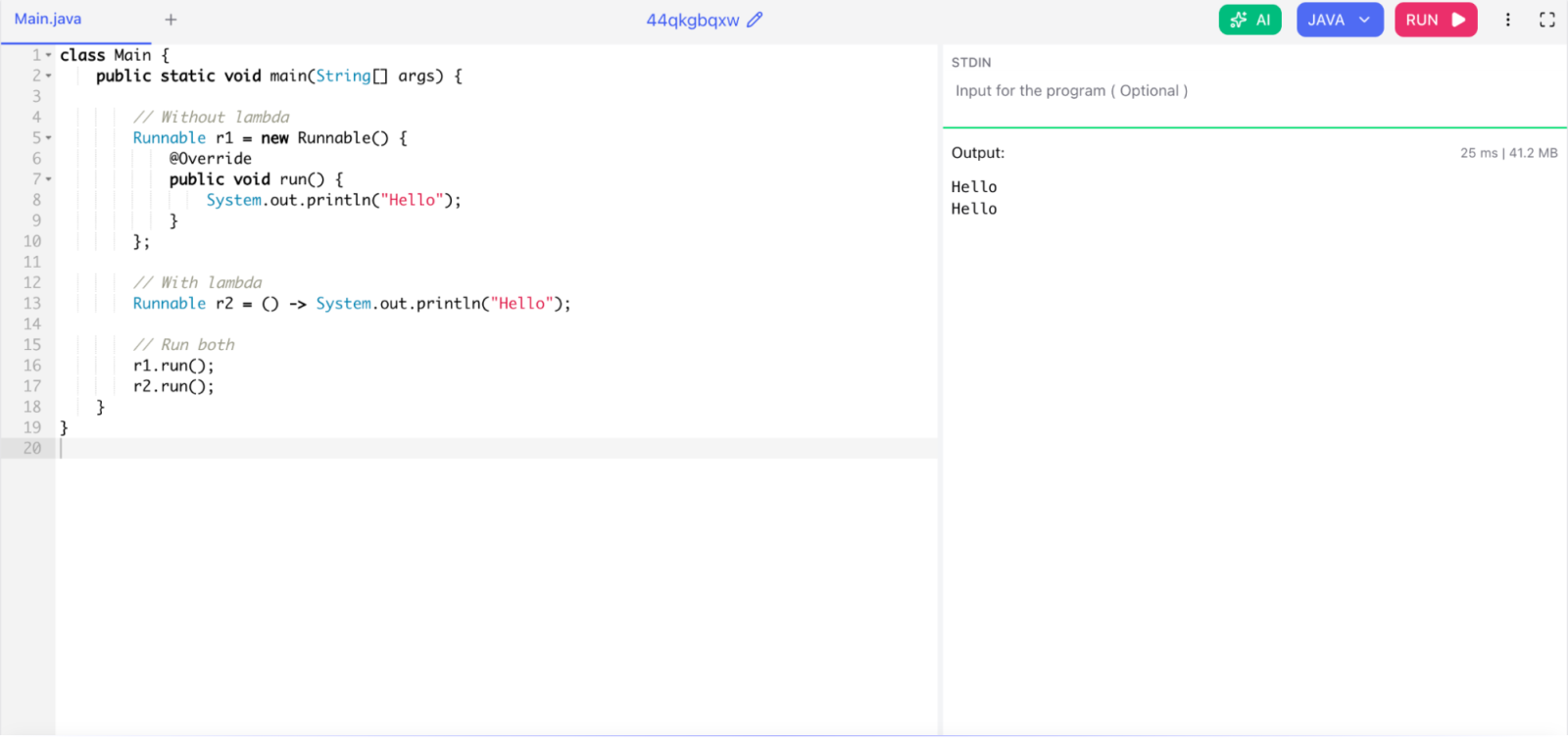
Lambda expressions reduce boilerplate code and make your code easier to read.
Read Also: Collections in Java: Learn to Implement Them
A functional interface is an interface that has exactly one abstract method. Java 8 uses the @FunctionalInterface annotation to mark these interfaces, though the annotation is optional.
Example:
|
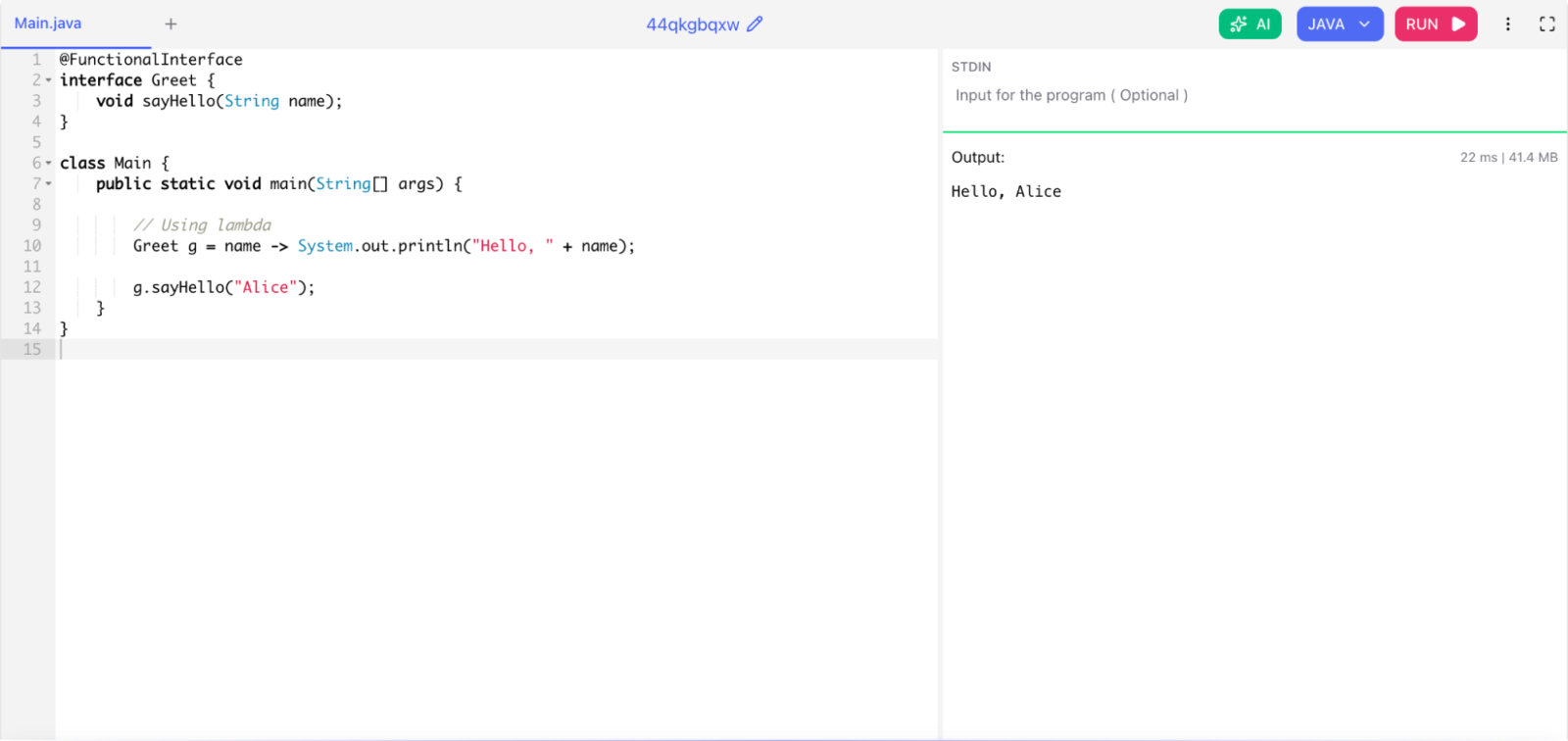
Common built-in functional interfaces include Runnable, Callable, Comparator, Predicate, Function, Consumer, and Supplier.
The Stream API lets you process sequences of elements in a functional style. A stream is not a data structure. It does not store data. Instead, it carries values from a source like a collection or an array through a pipeline of operations.
Streams support two types of operations:
filter(), map(), sorted(), distinct() — they return a new stream.collect(), forEach(), count(), reduce() — they produce a result.Example:
|
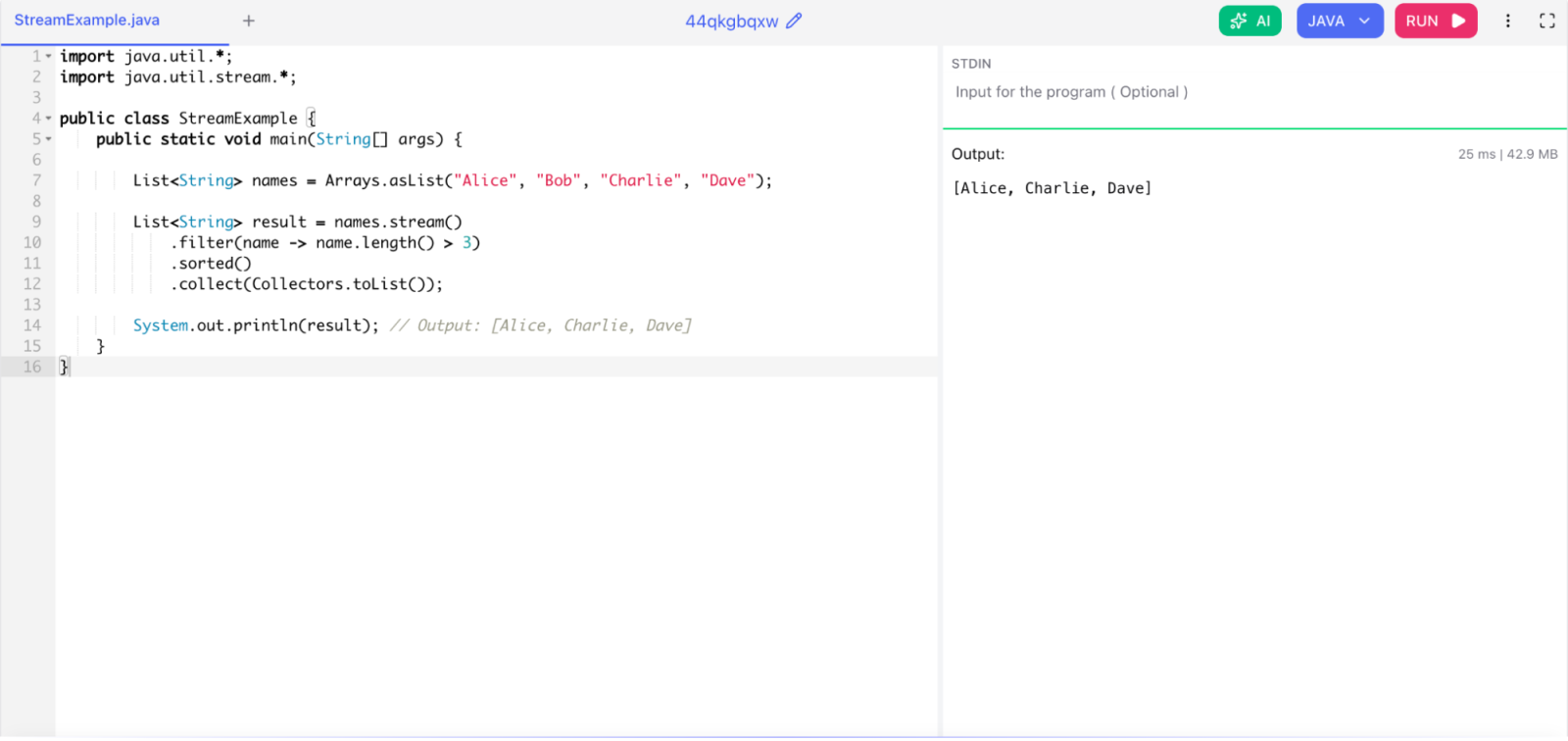
Optional<T> is a container object that may or may not contain a non-null value. It helps you avoid NullPointerException by forcing you to handle the case where a value might be absent.
Example:
|
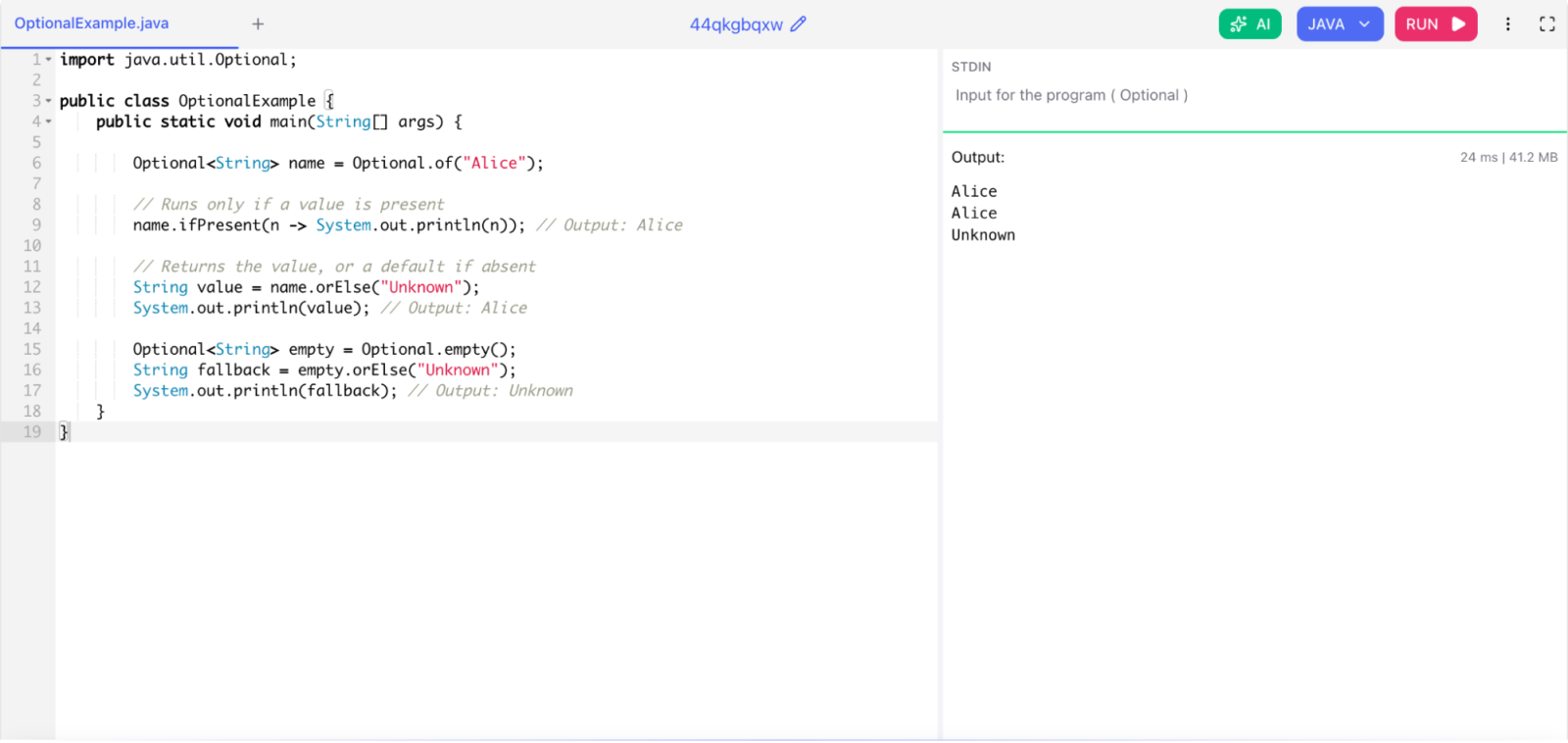
Optional makes your code more expressive and reduces the need for null checks scattered throughout your code.
Read Also: What are Packages in Java?
Default methods allow you to add method implementations directly inside an interface. Before Java 8, interfaces could only have abstract methods. Default methods let you add new functionality to an interface without breaking existing implementations.
Example:
|
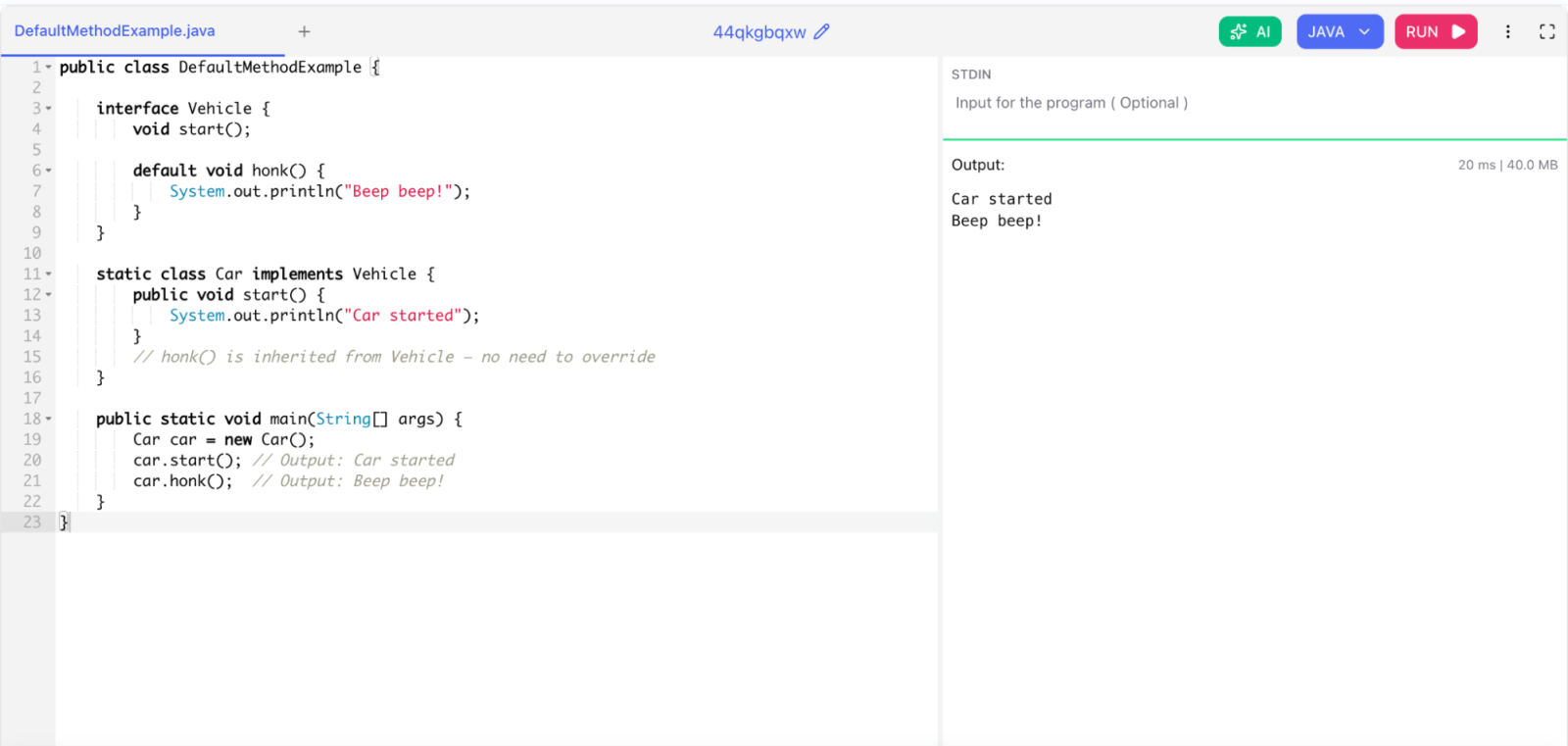
A method reference is a shorthand for a lambda expression that calls a specific method. You use the :: operator.
Four types of method references:
| Type | Syntax | Example |
|---|---|---|
| Static method | ClassName::methodName |
Math::abs |
| Instance method of a specific object | instance::methodName |
str::toUpperCase |
| Instance method of an arbitrary object | ClassName::methodName |
String::toLowerCase |
| Constructor reference | ClassName::new |
ArrayList::new |
Java 8 introduced the java.time package to replace the old java.util.Date and java.util.Calendar classes. The old API was mutable, not thread-safe, and hard to use correctly. The new API is immutable and thread-safe.
Key classes:
Both lambda expressions and anonymous inner classes allow developers to provide implementations of interfaces without creating separate classes. However, lambda expressions were introduced in Java 8 to simplify code and support functional programming concepts.
A lambda expression is more concise and readable because it focuses only on the logic that needs to be executed. In contrast, an anonymous inner class requires additional syntax, making the code longer and harder to maintain. Another important difference is that lambda expressions can only be used with functional interfaces, which contain a single abstract method. Anonymous inner classes can implement interfaces with multiple methods or extend classes.
The forEach() method is a feature introduced in Java 8 that allows developers to iterate through elements of a collection or stream and perform a specific action on each element. It provides a cleaner and more modern approach compared to traditional loops. The method works particularly well with lambda expressions, making code easier to read and maintain.
The forEach() method is considered a terminal operation in the Stream API because it processes all elements and produces a final result rather than returning another stream.
Related Article: List of Java Keywords
These Java 8 interview questions for intermediate developers go deeper. Interviewers want to see that you can not only explain features but also apply them correctly and understand the trade-offs.
Both map() and flatMap() are intermediate stream operations, but they behave differently.
map() applies a function to each element and produces one output per input. The structure is preserved.
flatMap() applies a function that returns a stream for each element, then flattens all those streams into one single stream.
Example:
|
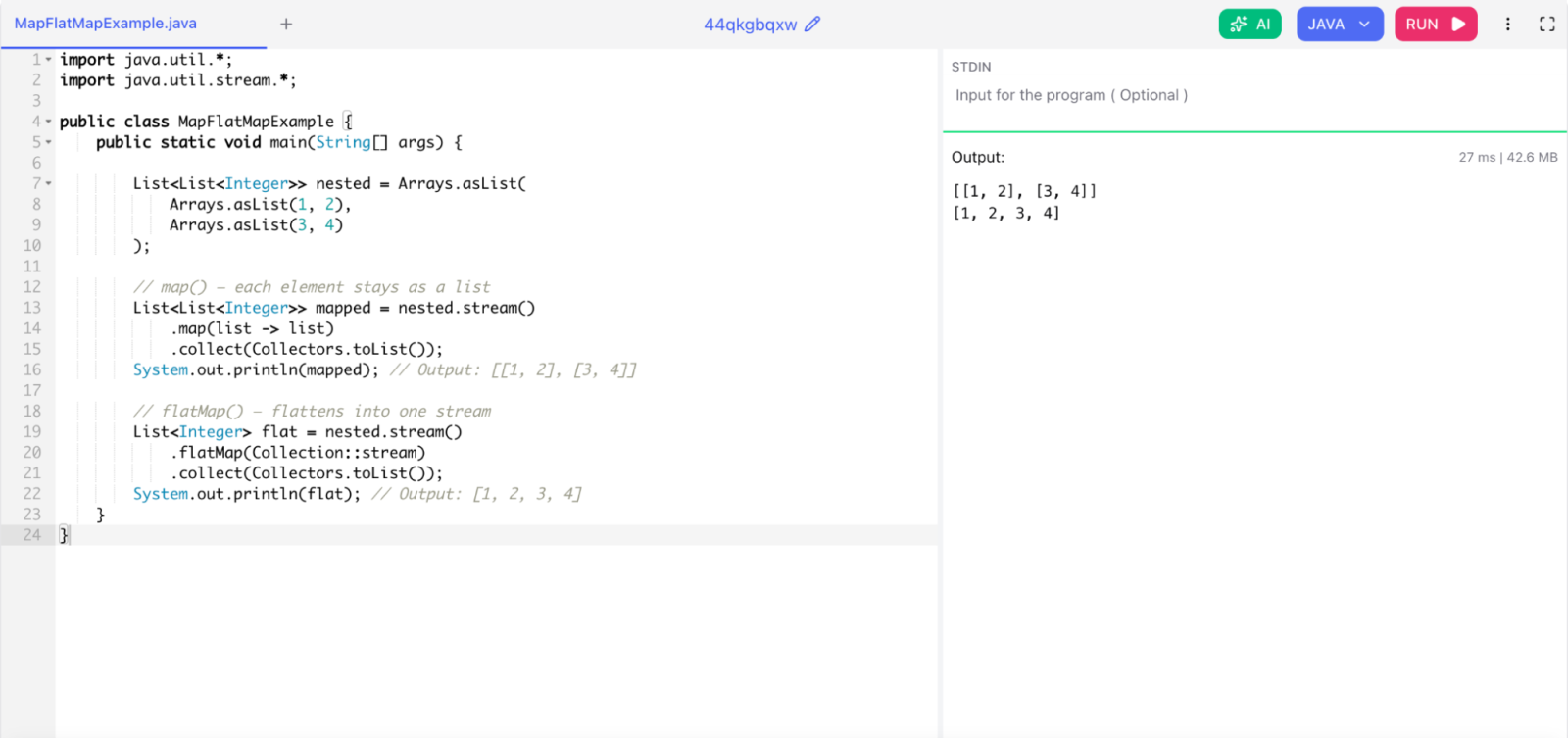
Use flatMap() when your mapping function returns a stream and you want one flat stream instead of a stream of streams.
These are all built-in functional interfaces in java.util.function.
| Interface | Input | Output | Use Case |
|---|---|---|---|
Predicate<T> |
T | boolean | Test a condition |
Function<T, R> |
T | R | Transform a value |
Consumer<T> |
T | void | Consume a value, no return |
Supplier<T> |
none | T | Produce a value |
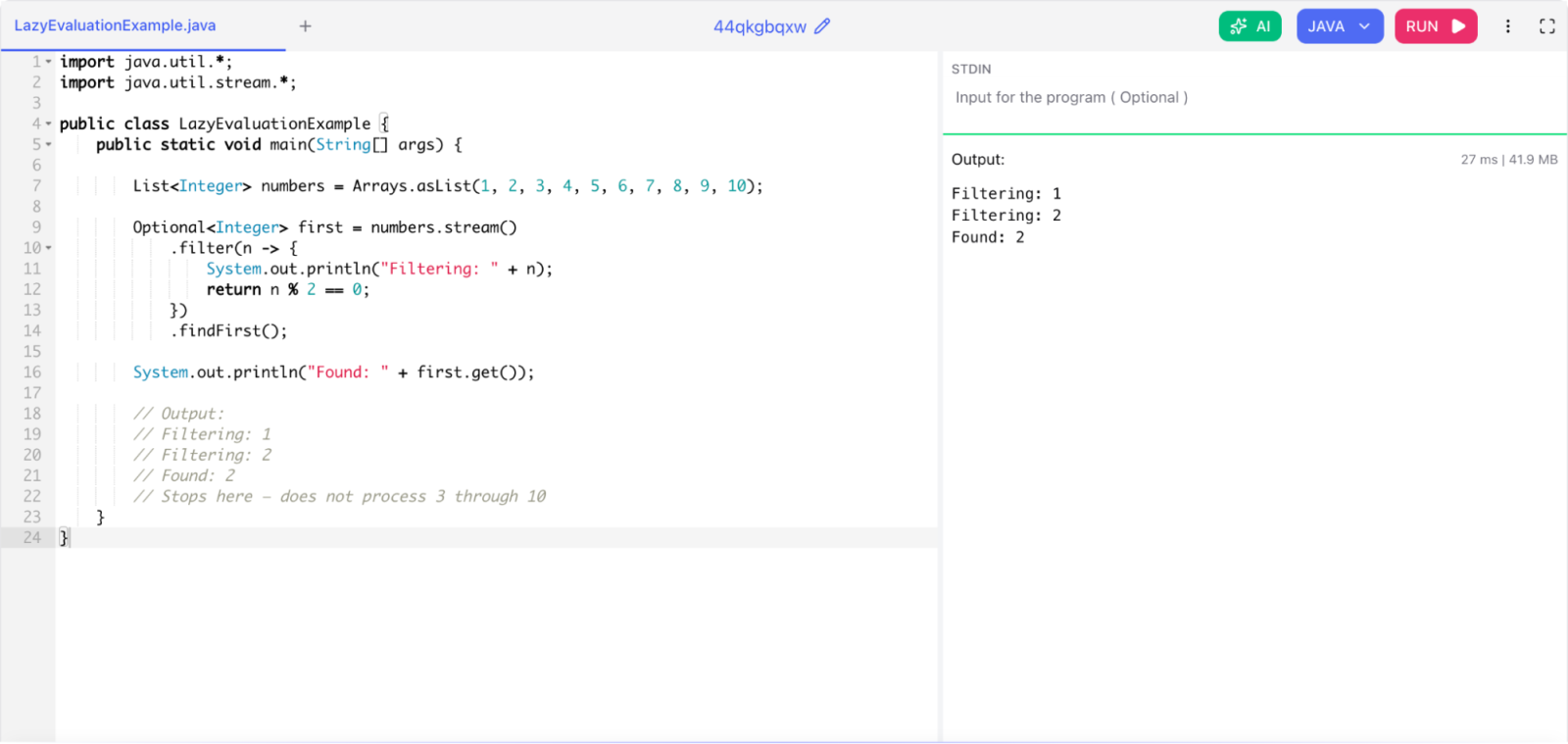
Stream operations are lazy by default. Intermediate operations like filter() and map() do not execute immediately. They wait until a terminal operation is called.
This design improves performance because Java can optimize the pipeline. If you chain filter().map().findFirst(), Java does not process the entire collection. It stops as soon as it finds the first matching element.
Example:
|
Both return an Optional element from the stream, but they differ in behavior with parallel streams.
findFirst() always returns the first element in encounter order. It is deterministic.
findAny() returns any element. In parallel streams it may return a different element each run for better performance.
|
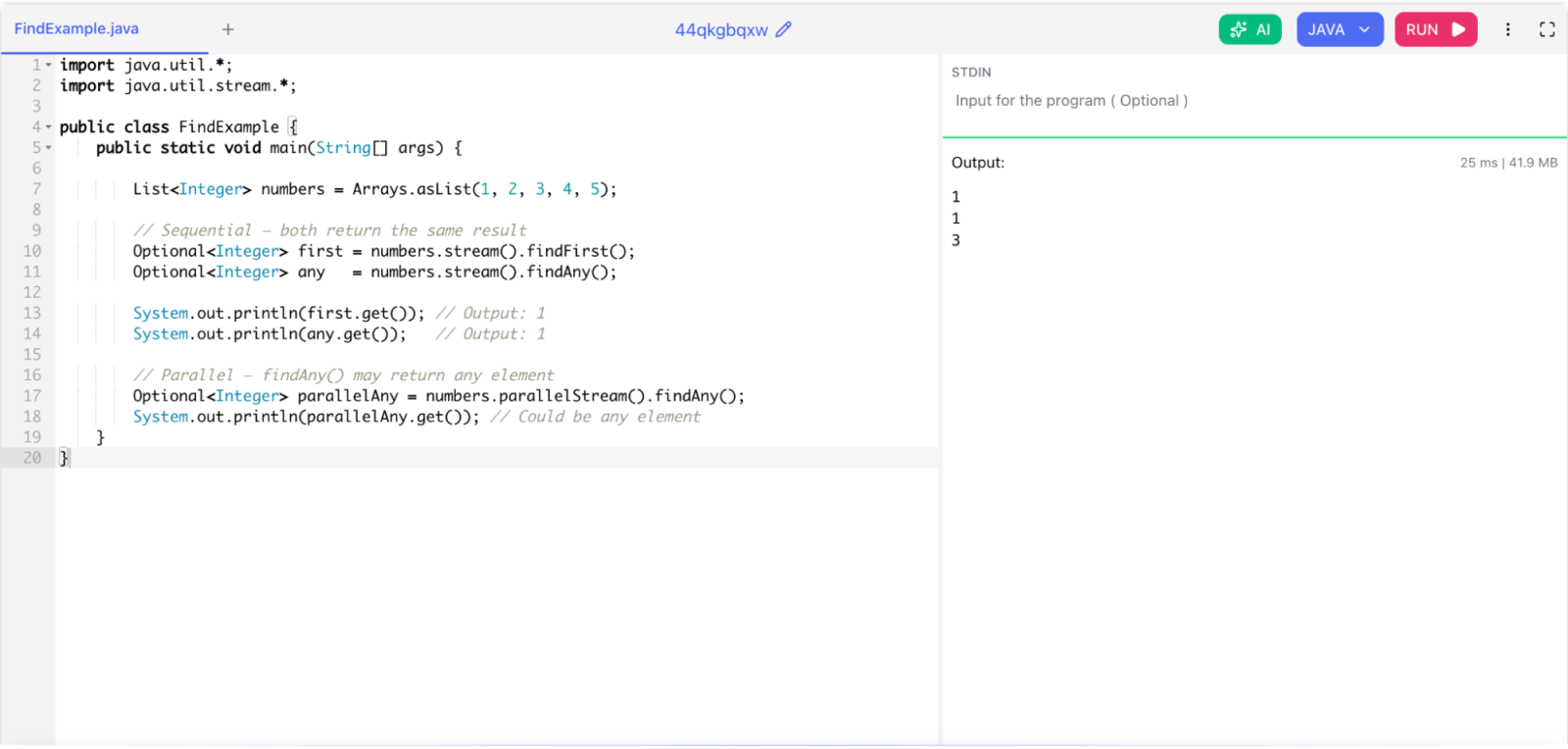
In sequential streams, both return the same result. Use findAny() in parallel streams when you do not care which element you get and want maximum speed.
Also Read: What is JDBC (Java Database Connectivity)
Lambda expressions do not allow checked exceptions directly unless the functional interface declares them. You have two practical options.
Option 1: Wrap in try-catch inside the lambda
|
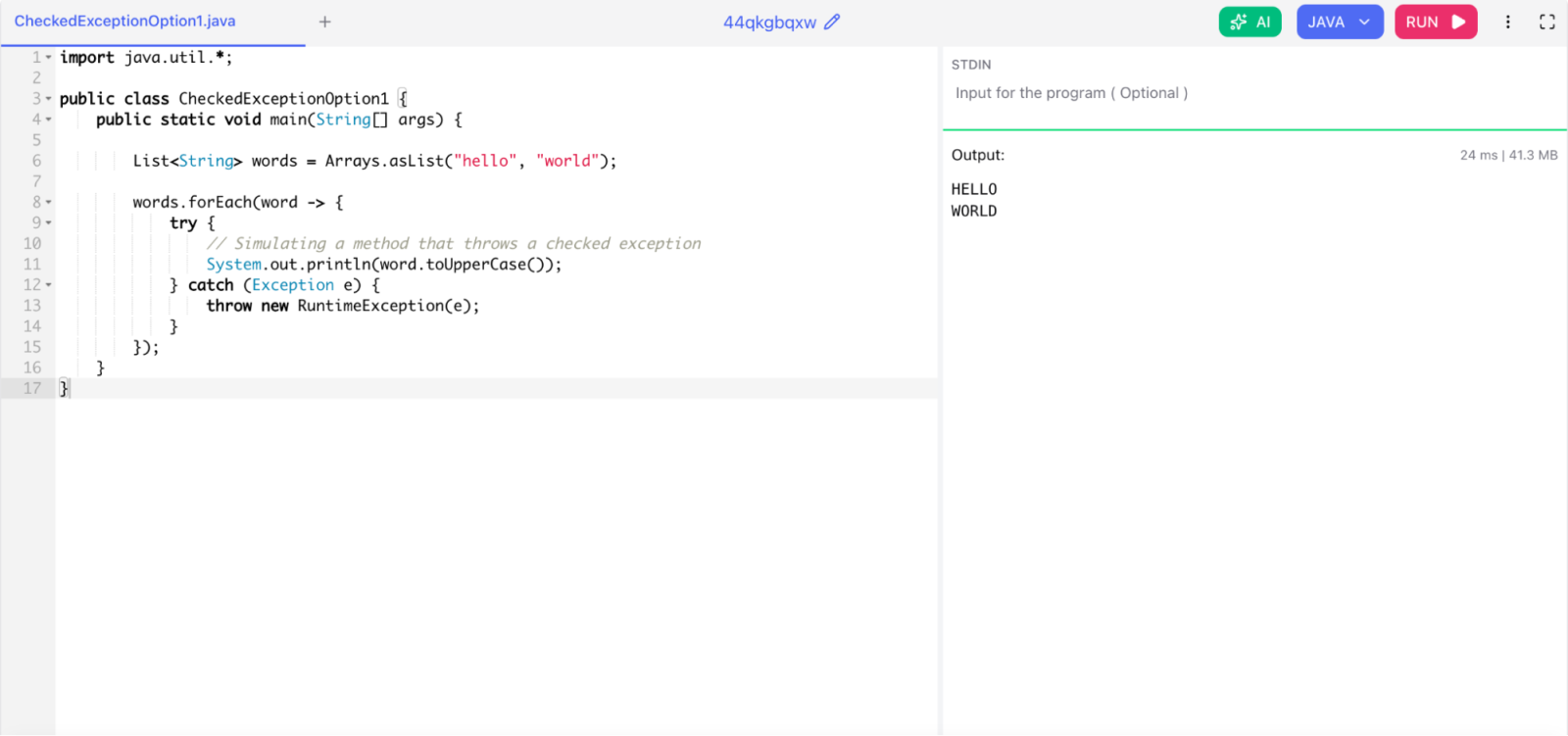
Option 2: Create a reusable wrapper utility
|
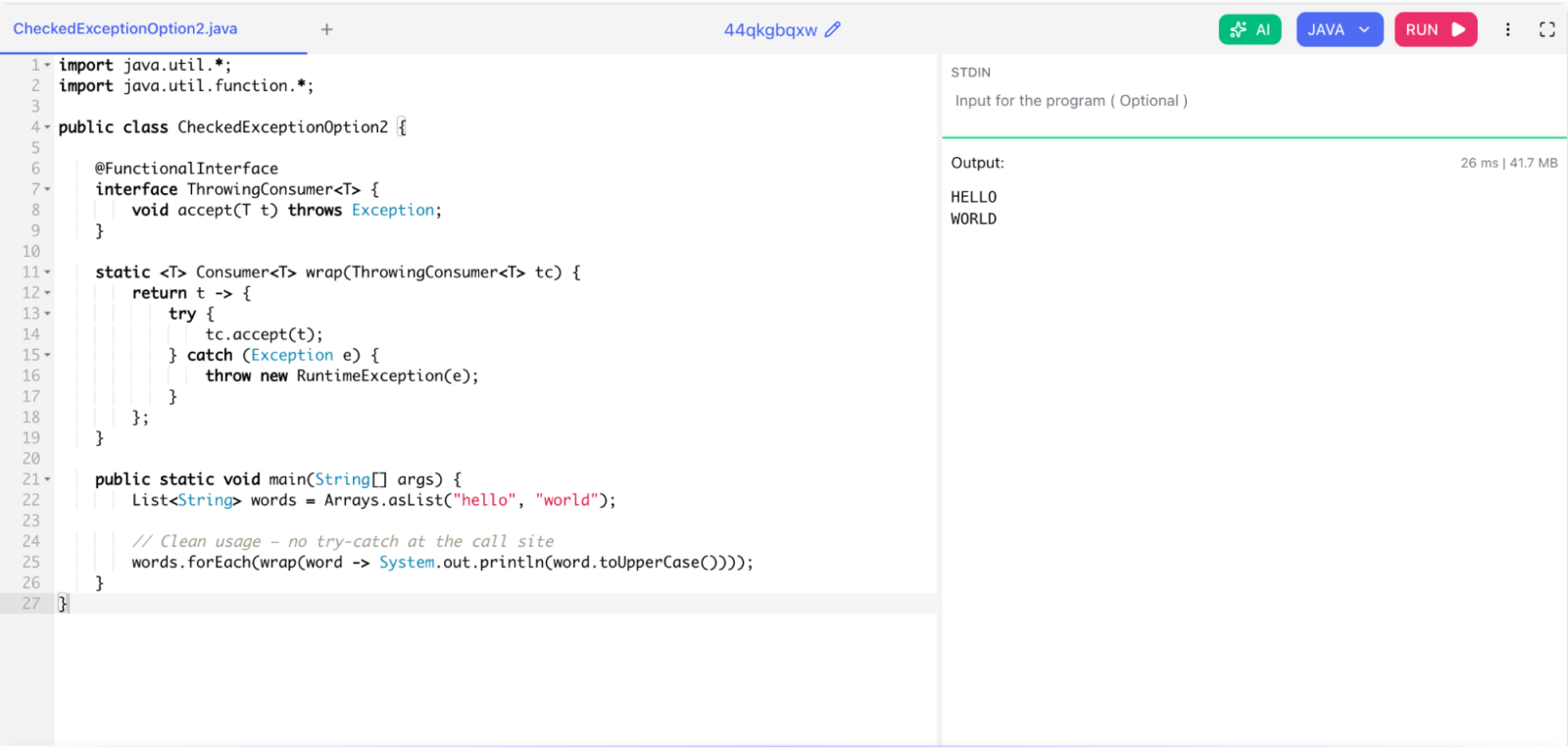
Option 2 is cleaner when you reuse the same pattern in multiple places.
A sequential stream processes elements one at a time in a single thread. A parallel stream splits the data into chunks and processes them concurrently using threads from the common ForkJoinPool.
|
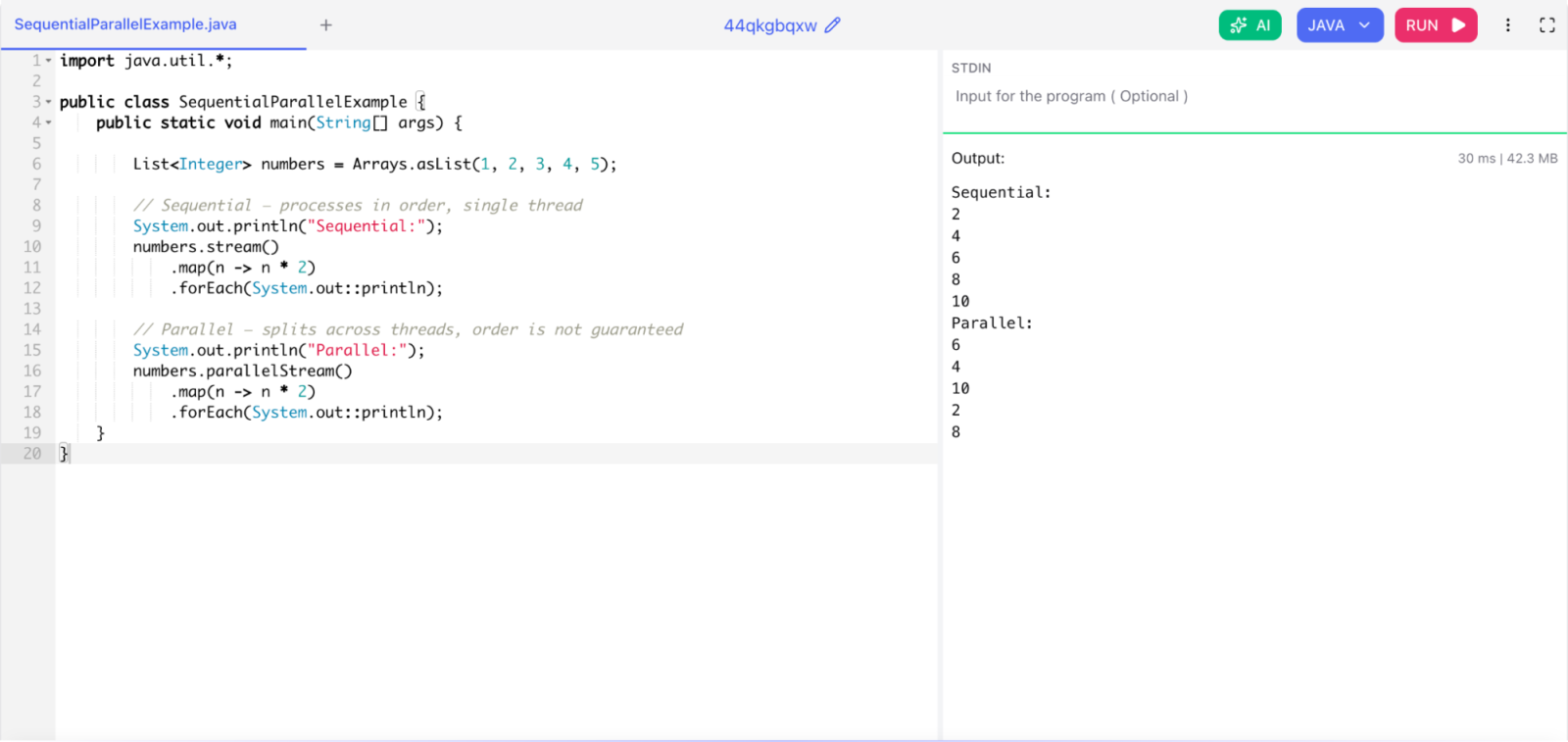
Always benchmark before switching to parallel streams. Thread management overhead can make parallel streams slower on small inputs.
Read Also: Write Your First Java Program - Hello World
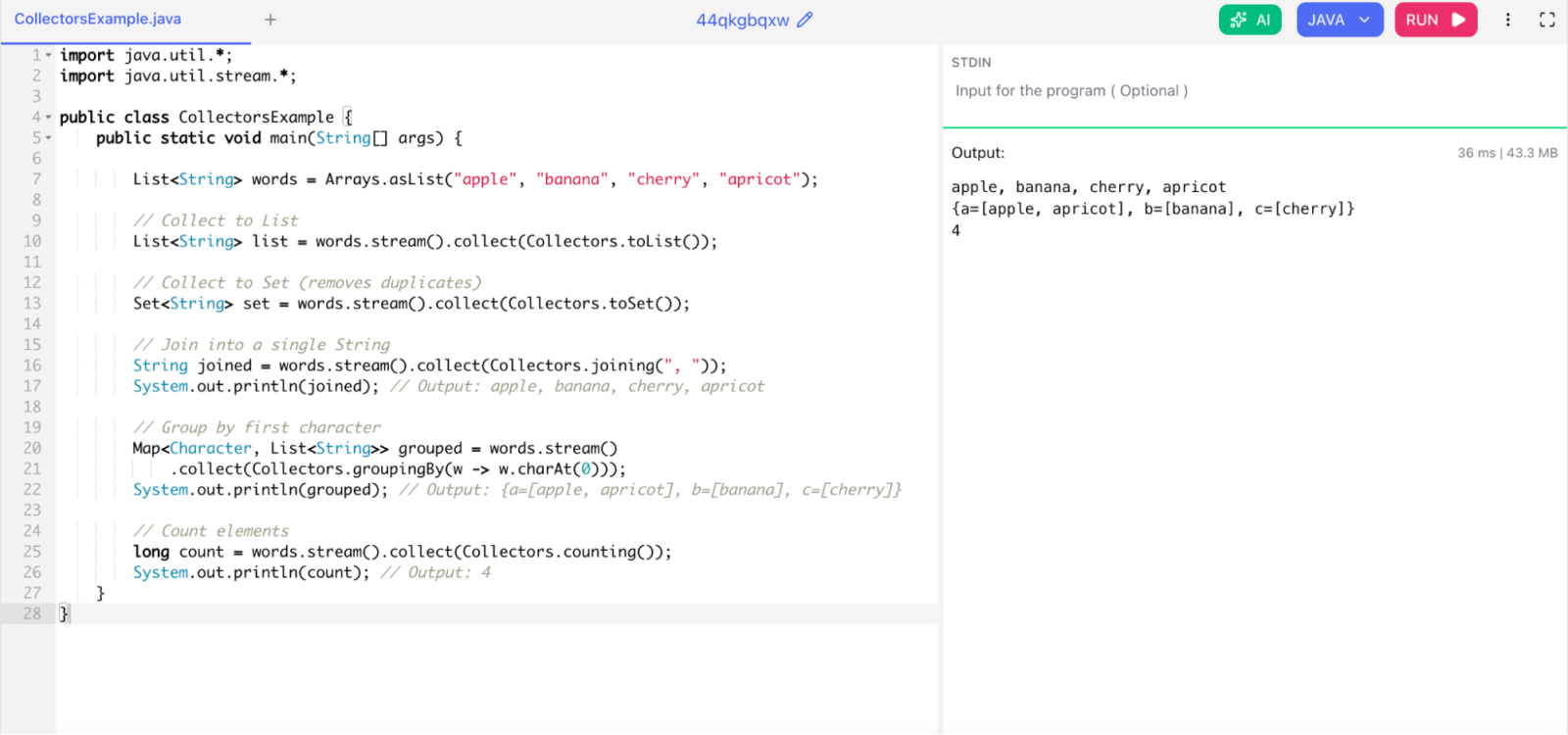
Collectors is a utility class that provides ready-made implementations of the Collector interface. You use them with the collect() terminal operation to accumulate stream elements into a result container.
Example:
|
Both are terminal operations that aggregate stream elements, but they serve different purposes.
reduce() combines elements into a single immutable result like a number or a string.collect() accumulates elements into a mutable container like a List, Set, or Map.Example:
|
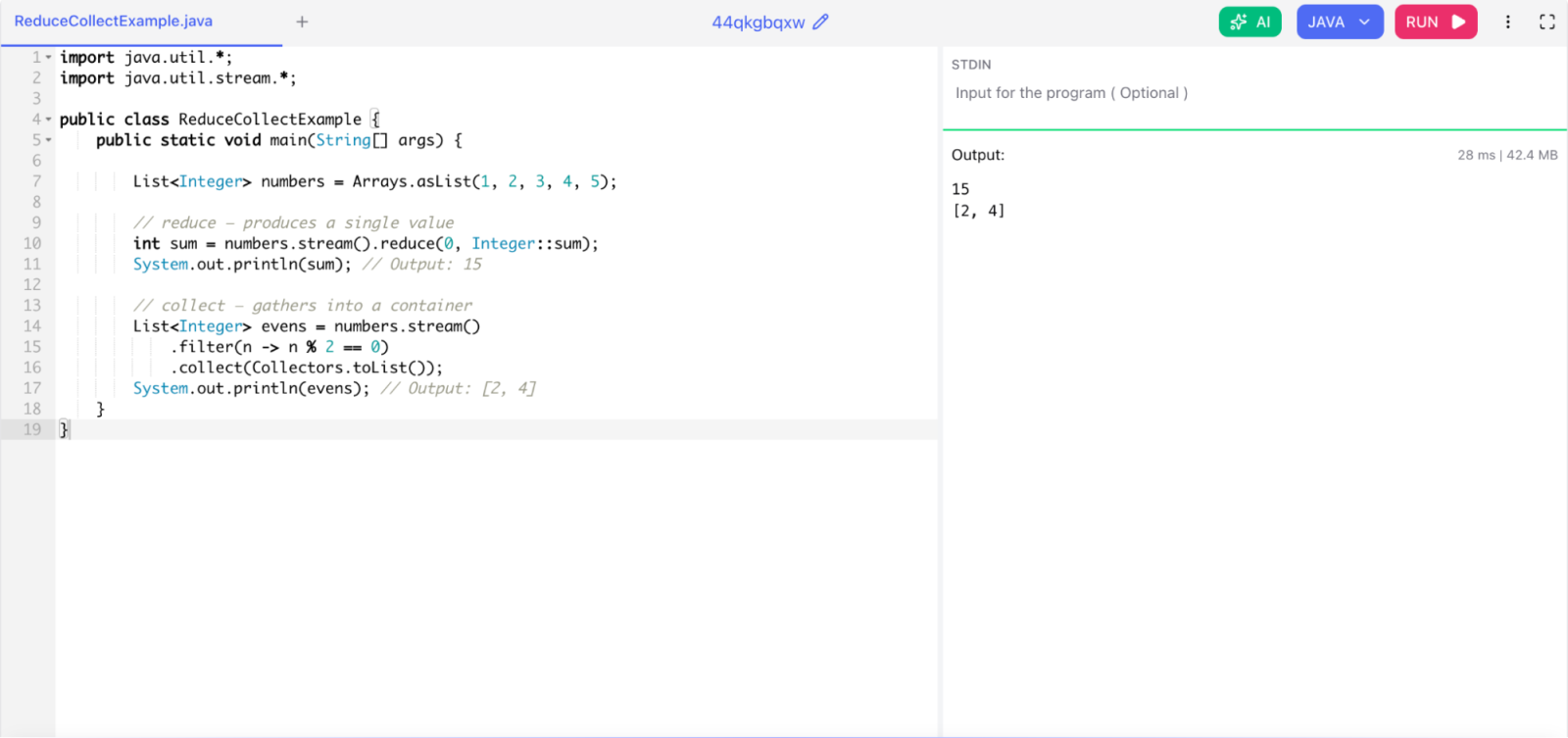
Do not use reduce() to build a collection. It creates a new collection object on every step, which is very inefficient. Use collect() for that instead.
Related Article: How to Learn Java from Scratch?
Both were introduced in Java 8, but they have different rules.
|
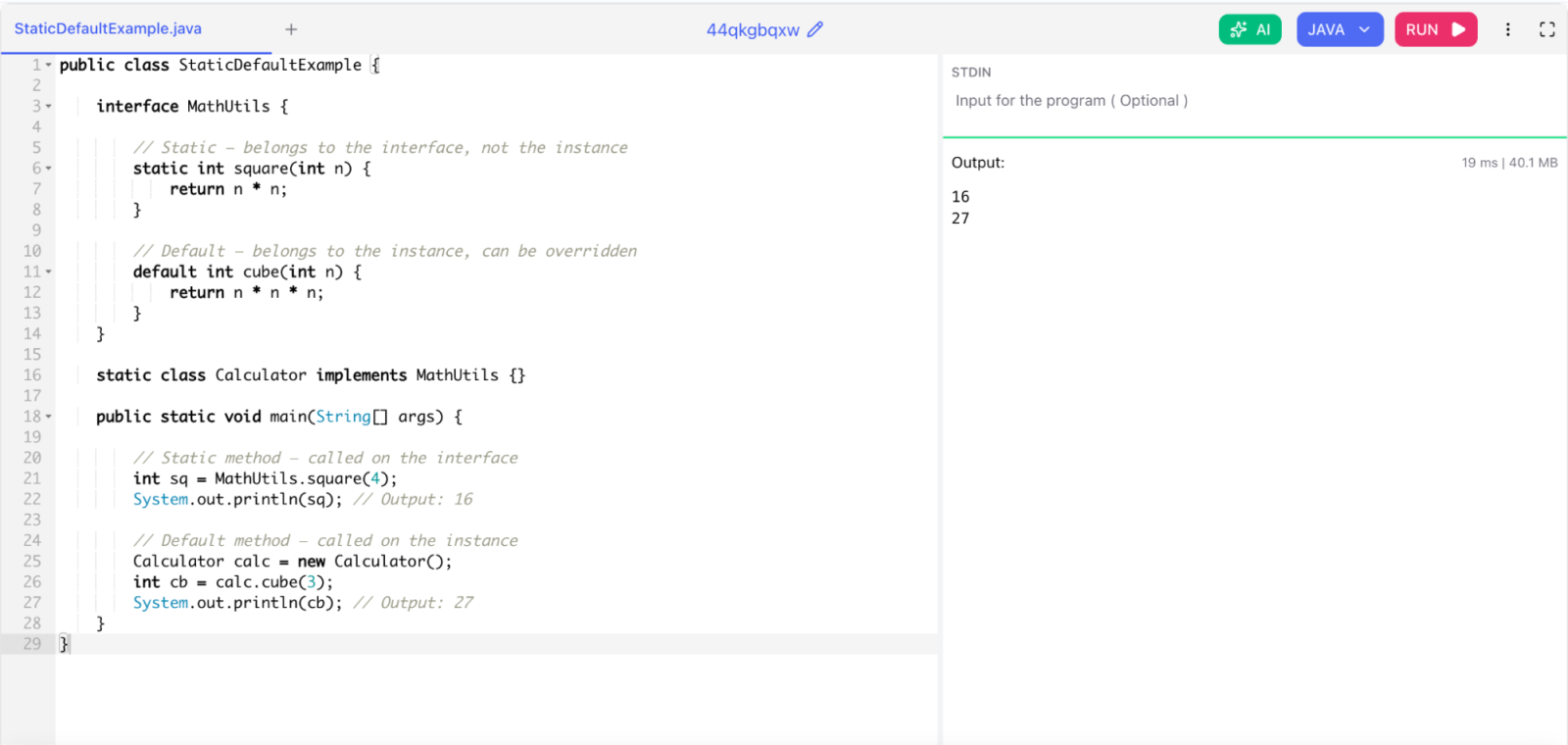
Both peek() and map() are intermediate operations in the Java Stream API, but they serve different purposes. The map() method is used to transform or modify data. It takes each element from the stream, applies a transformation, and returns a new stream containing the modified values.
The peek() method, on the other hand, is mainly used for inspecting or debugging stream operations. It allows developers to view elements as they pass through the stream pipeline without modifying them.
Java 8 Interview Questions for Experienced Professionals
These Java 8 interview questions for experienced professionals test your in-depth knowledge. Senior engineers are expected to understand internals, performance trade-offs, and design decisions.
Streams in Java 8 use a pipeline model. A stream pipeline consists of a source, zero or more intermediate operations, and one terminal operation.
Internally, each intermediate operation creates a new Reference Pipeline stage. These stages are linked together. When the terminal operation is triggered, Java traverses the entire pipeline using a Spliterator from the source in a single pass.
This single-pass design is what makes streams efficient. Java does not create intermediate collections between operations. All operations fire together on each element as it moves through the pipeline.
Also Read: Classes and Objects in Java
Spliterator stands for Splittable Iterator. Java 8 introduced it as a replacement for Iterator inside the Stream API. It supports both traversal and splitting for parallel execution.
| Feature | Iterator | Spliterator |
|---|---|---|
| Splitting for parallel use | Not supported | Supported via trySplit() |
| Characteristics reporting | None | Reports SORTED, DISTINCT, SIZED, ORDERED, etc. |
| Size estimation | Not supported | Supported via estimateSize() |
| Traversal style | External (hasNext + next) | Internal (forEachRemaining) |
The Stream API uses Spliterator internally so it can divide work across threads for parallel streams.
CompletableFuture is Java 8's solution for non-blocking asynchronous programming. It implements both Future and CompletionStage, which means you can chain tasks together without blocking.
Problems with the old Future:
CompletableFuture solves all of this:
|
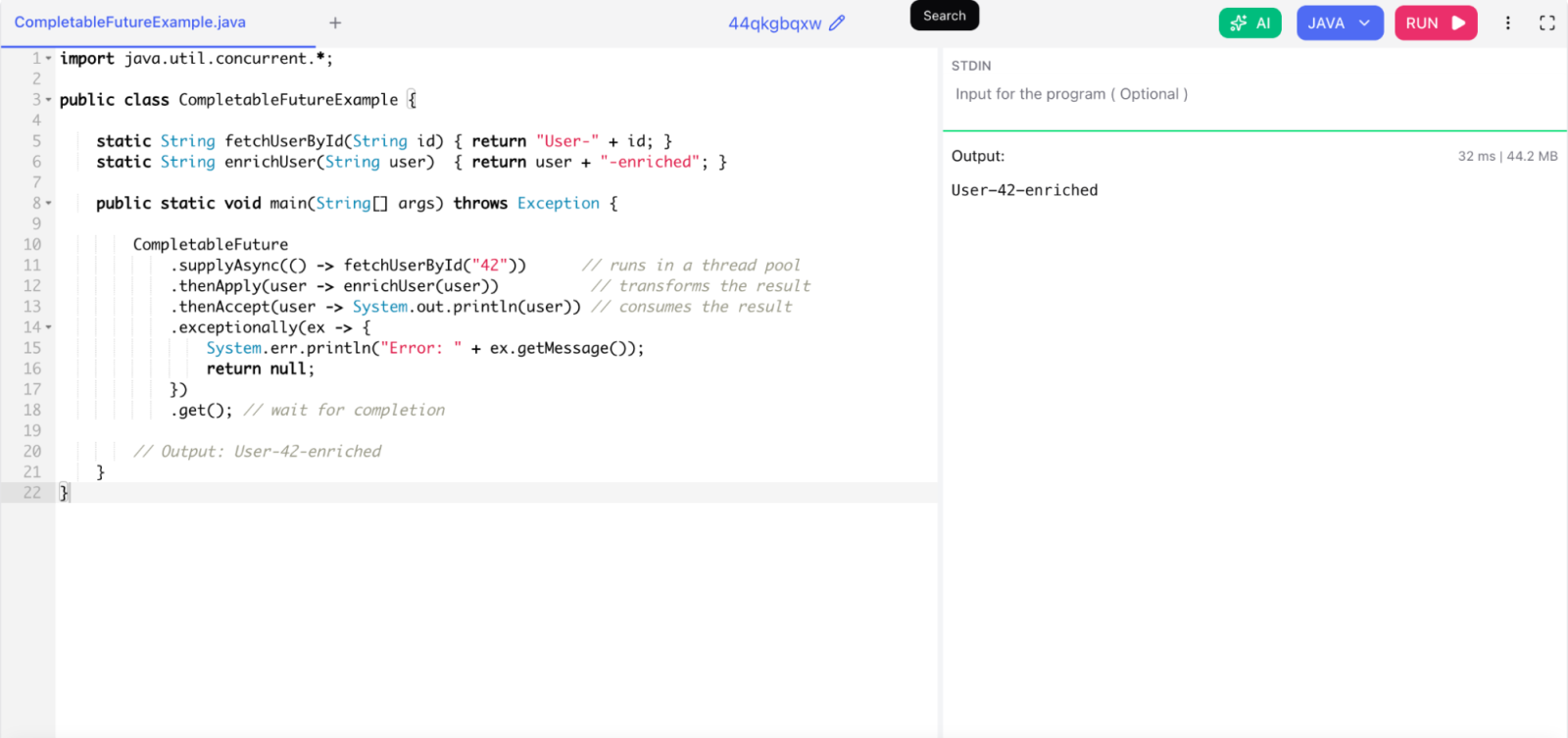
The chain runs without blocking the calling thread until you explicitly call get() or join().
Parallel streams are not always faster. You need to weigh the benefits against the costs.
When parallel streams help:
When parallel streams hurt:
Always benchmark with realistic data before switching to parallel. Assuming parallel always means faster is one of the most common mistakes with streams.
Read Also: What is Java Used For?
A Collector has four components: a supplier (creates the mutable container), an accumulator (adds an element to the container), a combiner (merges two containers in parallel), and a finisher (transforms the container into the final result).
|
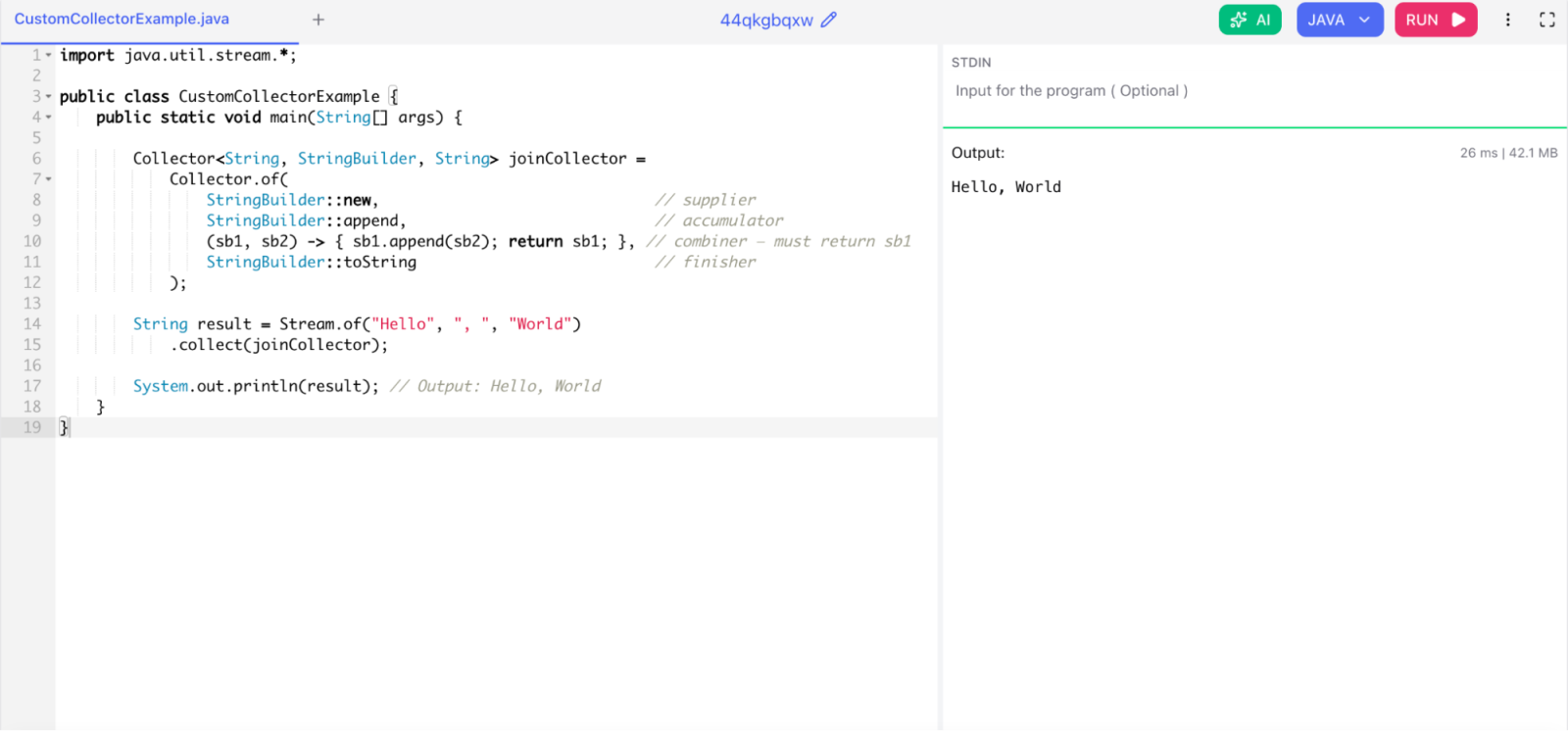
Important: The combiner must return the merged StringBuilder. A common mistake is writing (sb1, sb2) -> sb1.append(sb2) in a block lambda without a return statement, which causes a compile error.
The old java.util.Date stores UTC milliseconds since the Unix epoch. All time zone logic lived in Calendar and TimeZone, which were mutable and error-prone.
The new java.time API separates concerns clearly:
|
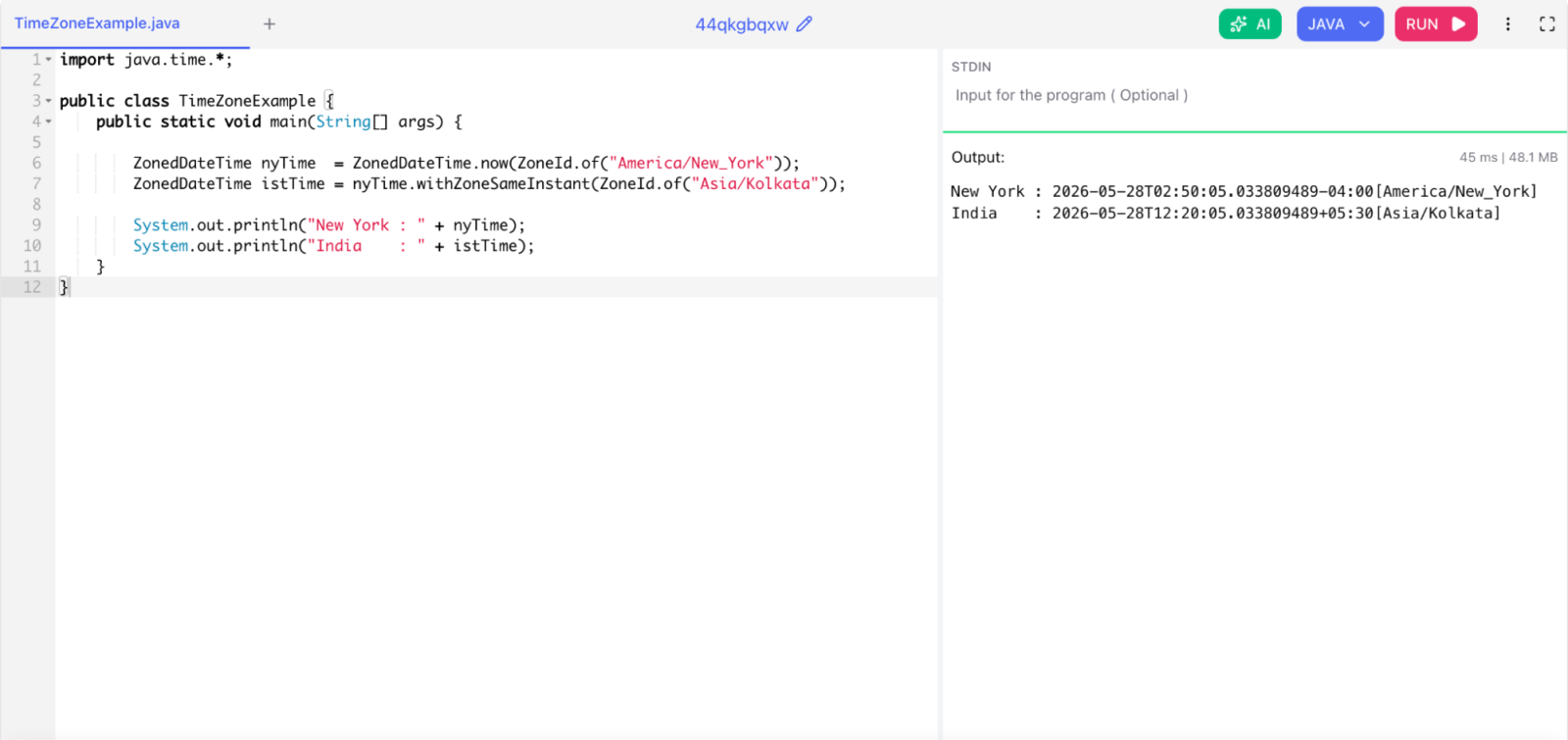
The new API uses the IANA time zone database through ZoneRules, which handles daylight saving time transitions accurately. The old API depended on JVM-bundled time zone data that was often outdated.
When a class implements two interfaces that both declare a default method with the same signature, the compiler cannot decide which one to use. It forces the implementing class to override the method and resolve the conflict explicitly.
|
Java 8 resolves conflicts with three rules:
ForkJoinPool is a framework in Java designed to improve performance by dividing large tasks into smaller subtasks and processing them concurrently using multiple threads. When developers use parallel streams, Java automatically utilizes a common ForkJoinPool to distribute work across available processor cores. This enables applications to process large datasets more efficiently and take advantage of modern multi-core systems.
The framework follows a divide-and-conquer strategy, where tasks are repeatedly split into smaller units until they become manageable. The results are then combined to produce the final output.
Related Article: Pattern Program in Java (Different Patterns to Practice)
Scenario-based Java 8 interview questions test how you apply your knowledge to real-world problems. These questions reveal how you think, not just what you know.
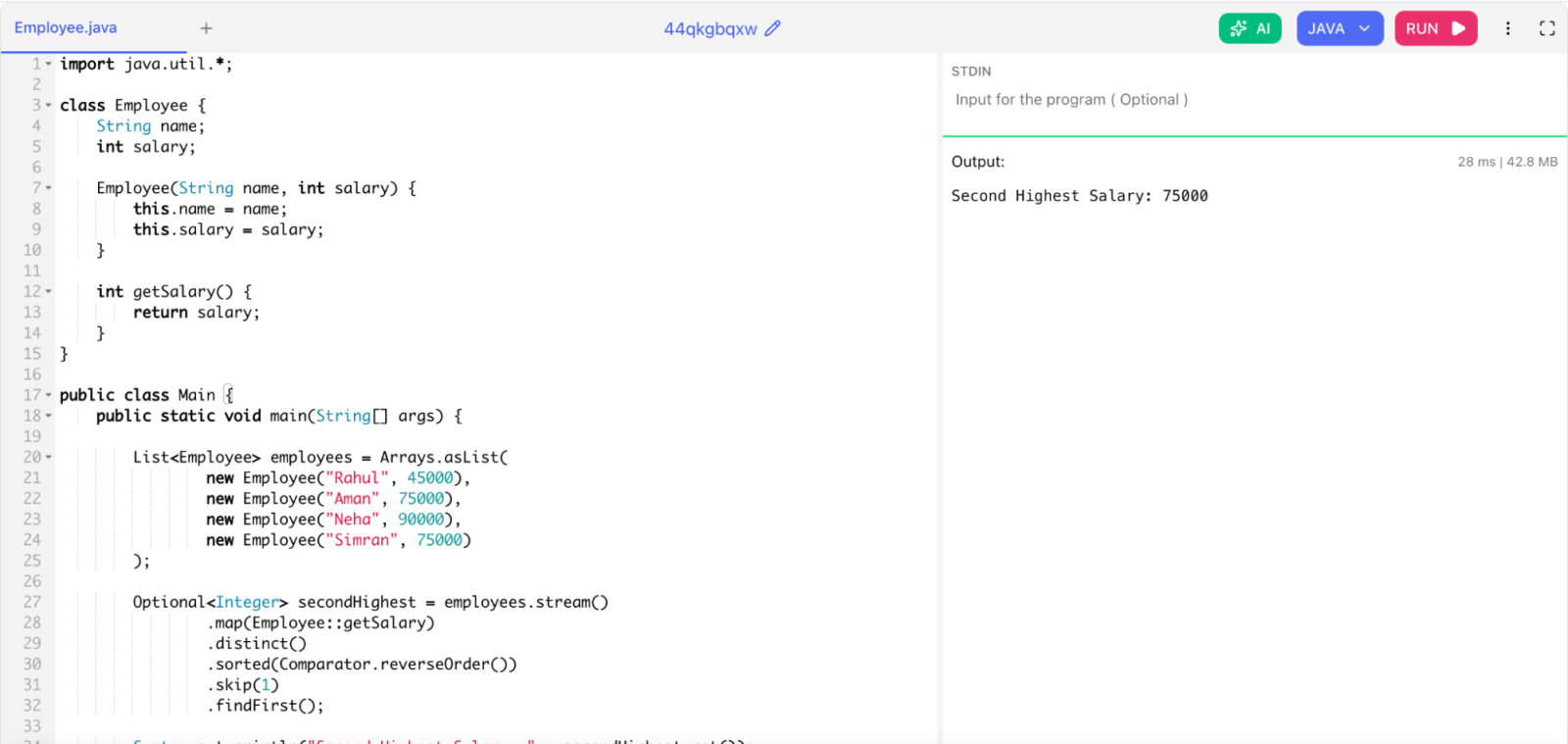
Scenario: A company wants to identify the employee with the second highest salary for bonus distribution. The salary list may contain duplicate values.
In Java 8, we can solve this problem using the Stream API.
First, we convert the employee list into a salary stream using map(). Then we remove duplicate salaries using distinct(). After that, we sort salaries in descending order using sorted(Comparator.reverseOrder()). Finally, we skip the highest salary using skip(1) and fetch the next value using findFirst().
This approach is clean, readable, and efficient compared to traditional loops.
|
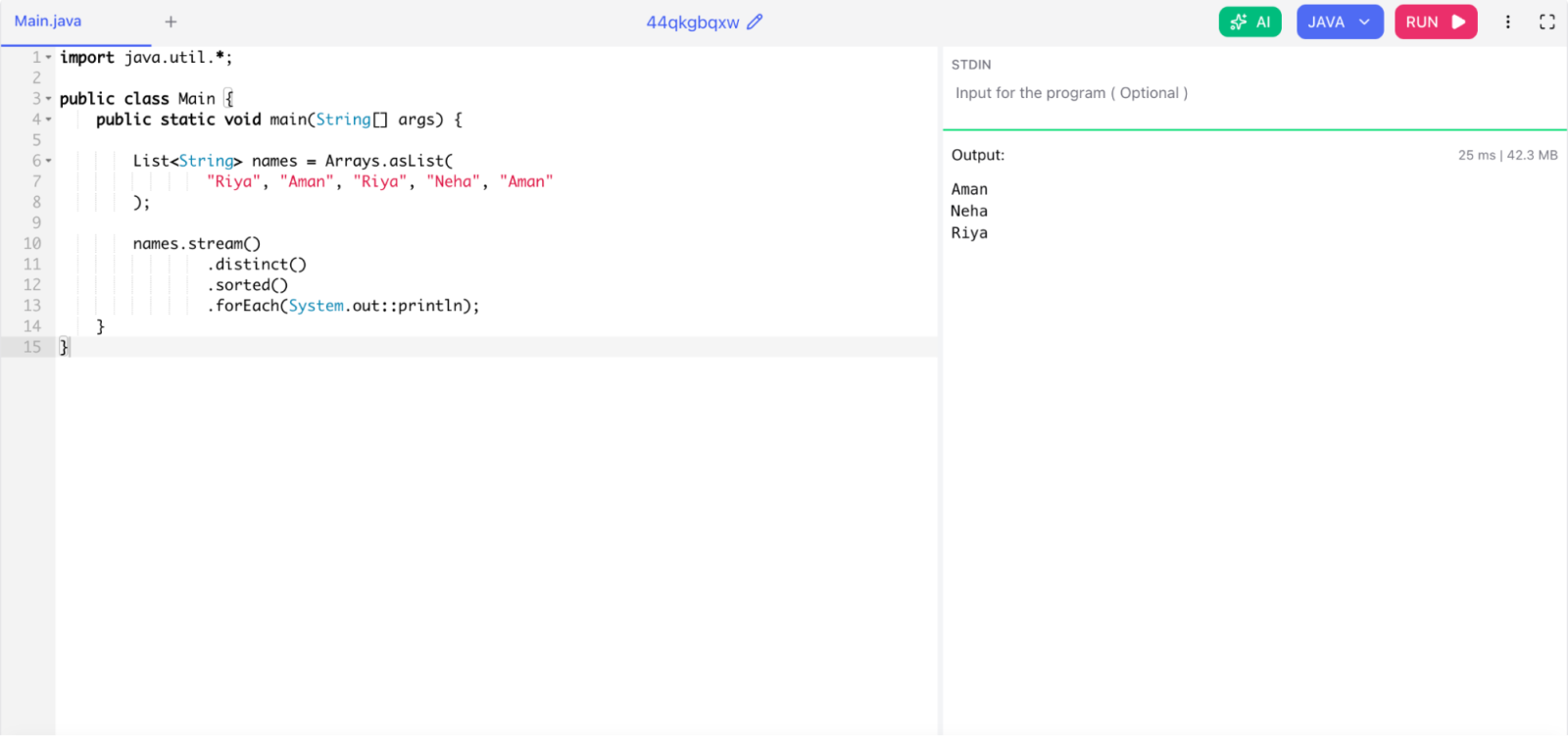
Scenario: An e-commerce platform stores duplicate customer names due to multiple registrations. The company wants a unique sorted customer list.
Java 8 Stream API provides the distinct() method to remove duplicate values from a collection. After removing duplicates, we can use sorted() to arrange names alphabetically.
This approach reduces manual coding and improves readability.
|
Read Also: What is Interface in Java?
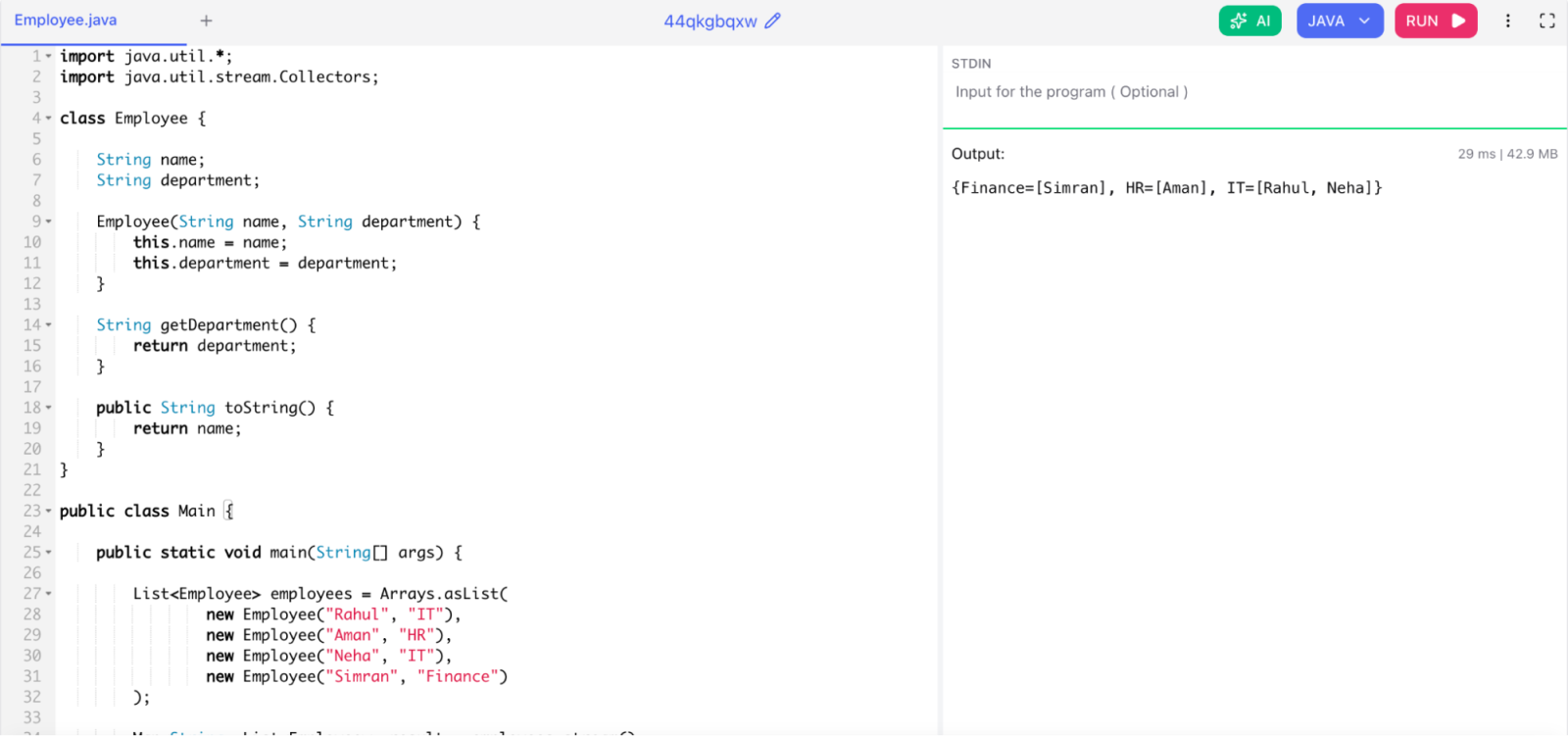
Scenario: A company wants to generate department-wise employee reports for management.
Java 8 provides Collectors.groupingBy() to group objects based on a field or condition. Here, employees are grouped according to their department names.
The result is stored inside a Map, where:
This method is widely used in real-world reporting applications.
|
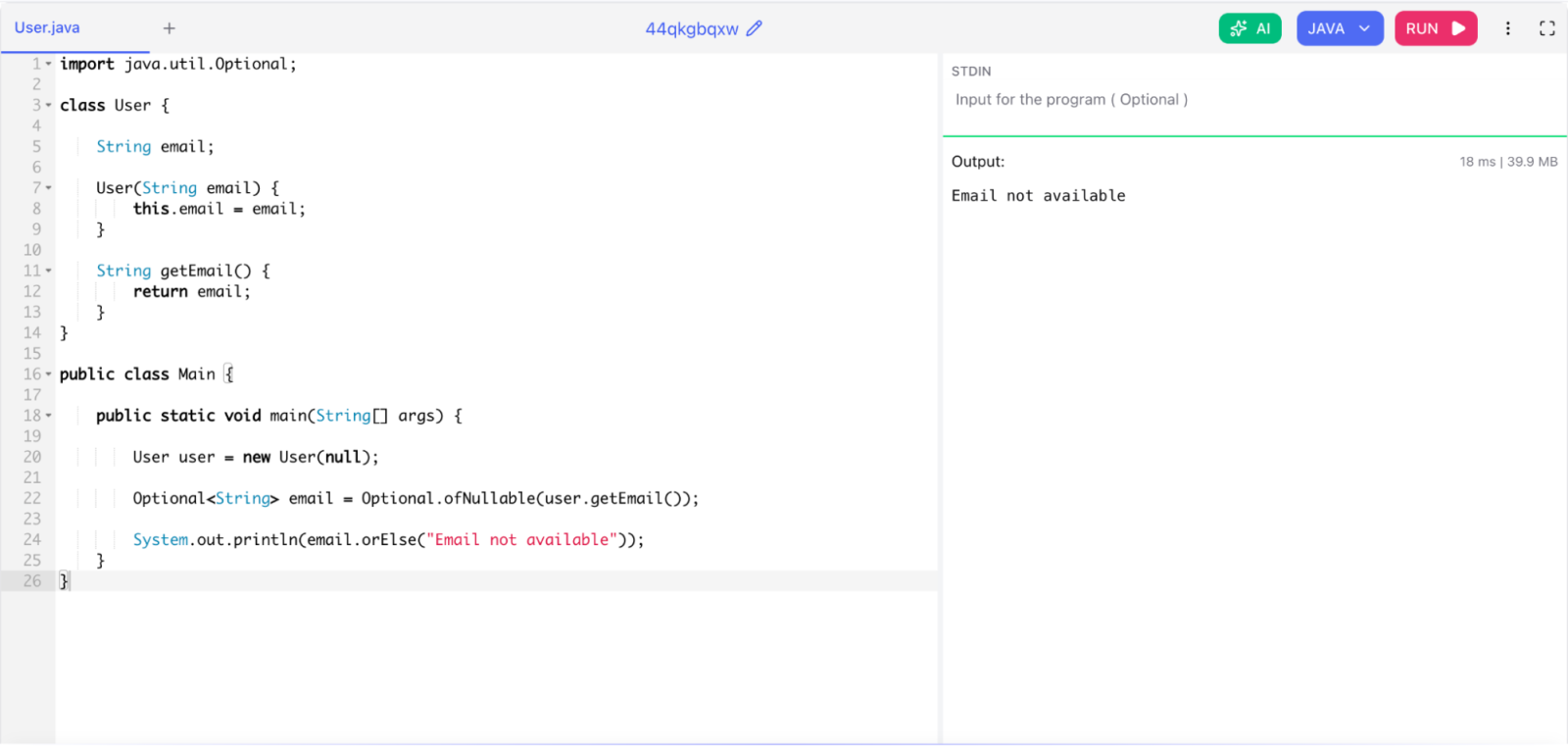
Scenario: A user profile may not always contain an email address. The application should avoid NullPointerException.
Before Java 8, developers manually checked null values using if conditions. Java 8 introduced the Optional class to handle null values safely.
Optional.ofNullable() creates an Optional object that can contain either a value or null.
orElse() provides a default value if the object is null.
This improves code safety and readability.
|
Scenario: An online shopping application wants to process orders asynchronously to improve system performance and reduce waiting time.
Java 8 introduced CompletableFuture for asynchronous programming.
This helps applications perform multiple operations simultaneously without blocking the main thread.
It is commonly used in:
|
Related Article: StringBuilder Class in Java
Java 8 is not just an older version. It is the foundation of modern Java development. The features it introduced — lambdas, streams, Optional, CompletableFuture, and the new Date-Time API — are still central to how Java developers write code today.
If you are preparing for a Java interview, make sure you can do more than define these features. You should be able to write code with them, explain their trade-offs, and apply them to real-world scenarios. That is what separates candidates who pass from those who do not.
Keep practicing. Build small programs that use these features. Read the JDK source code for the stream pipeline classes. The more you use Java 8, the more natural it feels.
Yes. Java 8 remains one of the most widely used Java versions in production systems. Even companies running Java 11, 17, or 21 still ask Java 8 questions because lambdas and streams are fundamental to modern Java. You should know Java 8 thoroughly regardless of what version the company runs.
The Stream API comes up most often. Interviewers ask you to write stream pipelines, explain lazy evaluation, and discuss the difference between operations like map, flatMap, reduce, and collect. Lambda expressions and functional interfaces are close behind.
Java 8 introduced functional programming support that Java 7 did not have. The major additions are lambda expressions, the Stream API, functional interfaces, Optional, default and static interface methods, method references, and the new Date-Time API. These changes made Java code much more concise and expressive.
No. You can only use lambda expressions with functional interfaces, interfaces that have exactly one abstract method. If an interface has more than one abstract method, the compiler will not accept a lambda in its place.