Have you ever wondered who builds the AI (artificial intelligence) that powers your Netflix recommendations or enables a car to drive itself? That's the work of a Machine Learning Engineer, one of the most exciting and in-demand roles in the tech industry today. ML Engineers are the crucial bridge between data science and software engineering, taking groundbreaking AI models and transforming them into robust, real-world products. They are the architects and builders of the intelligent systems that are shaping our future.
If you are fascinated by the power of data and have a passion for building innovative solutions, this career path might be perfect for you. In this comprehensive guide, I will provide a clear, step-by-step roadmap on how to become a Machine Learning Engineer, following the essential skills, educational paths, and practical experience you'll need to succeed in this growing field. Let's begin your journey.
Machine Learning (ML) is a field of artificial intelligence where computers learn from data without being explicitly programmed for every task. Think of it as teaching a computer to recognize patterns. Instead of writing step-by-step rules, developers feed the system vast amounts of data and let algorithms figure out the connections on their own. As the system processes more data, it gets better and more accurate at making predictions or decisions.
You see ML in action all the time:
In short, machine learning allows a system to learn from experience and improve its performance automatically.
A Machine Learning Engineer (ML Engineer) is a specialized software engineer who designs, builds, and deploys artificial intelligence (AI) systems that can learn and make predictions from data. They are the crucial link between the experimental models created by data scientists and the scalable, real-world applications that businesses use.
In simple terms, if a data scientist builds a prototype of a smart system, the machine learning engineer is the one who turns it into a robust, efficient, and reliable product.
The primary goal of an ML Engineer is to put machine learning models into production. This involves a blend of software engineering, data science, and DevOps practices.
Key Responsibilities:
Prepare for the most asked Machine Learning Interview Questions to ace interview rounds.
Becoming a machine learning engineer takes more than just coding skills. You need a mix of math, programming, and problem-solving abilities to build and deploy intelligent systems. Here are some important skill sets required to become an ML engineer successfully.
Here are some essential technical skills a professional should have.
This is the most obvious requirement for having the ability to write code. R and Python are the most famous languages for machine learning practitioners. Even though some companies might need you to have knowledge of other languages like C++ and Java too.
Machine learning engineers must have a knowledge of the formal characterization of probability. This includes Bayes' rule, independence, conditional probability, and likelihood, along with the techniques derived from it. Engineers should also have a good grasp of distributions, analysis methods, and statistical measures.
You should have a good grasp of the machine learning algorithms and frameworks that are usually used, along with their best practices and implementations. Many knowledgeable people have made many ML frameworks like SciKit learn, TensorFlow, Pytorch, Hugging Face and more, making ML accessible. These are supervised, semi-supervised, unsupervised, and reinforcement learning algorithms. There are many subdivisions to these, which you will learn better by online learning resources.
You must have a good understanding of how all of the elements work mutually and communicate with one another. They should have knowledge of developing interfaces that can be used by others. Having knowledge of system design and software engineering best practices is a must.
MLOps is among the core functions of ML engineering. It concentrates on smoothening the procedure of deploying ML models to production and the required resources to manage and monitor them once they're in production. This is still a reasonably recent function, but is starting to gain attraction as a practical approach for making high-quality learning applications.
When we say computer science fundamentals and programming, we mean an understanding and knowledge of:
It's essential to have skills for analyzing unstructured data models, meaning having skills around data modeling and evaluation. There are many data modeling concepts that you must be aware of. Learning to analyze data structures and identify patterns. This helps in evaluating data through suitable algorithms such as clustering algorithms, classification algorithms, and so much more.
Soft skills like communication, teamwork and critical thinking help bridge the gap between complex technical work and real-world applications. Here are some of the soft skills one must have-
ML engineers should work with many stakeholders. A few of these stakeholders will be pretty technical like data scientists, whereas others might not be, like product teams. So, effectively adapting your communication style for your stakeholders is important.
As ML is a fast-growing field, you can see that a researcher is working somewhere on improving some model or procedure. To stay at the cutting edge, you need to have a knack for rapidly learning new tools, how they work, where they work well and where they don't. In short, your decision to become an ML engineer is an implicit commitment to continuous learning.
Despite all the fancy tools at the forefront of ML, the main goal of a machine learning project is to solve a problem. Meaning, thinking creatively and critically about problems is a highly desirable trait for ML engineers.
Also Read- Machine Learning Tutorial
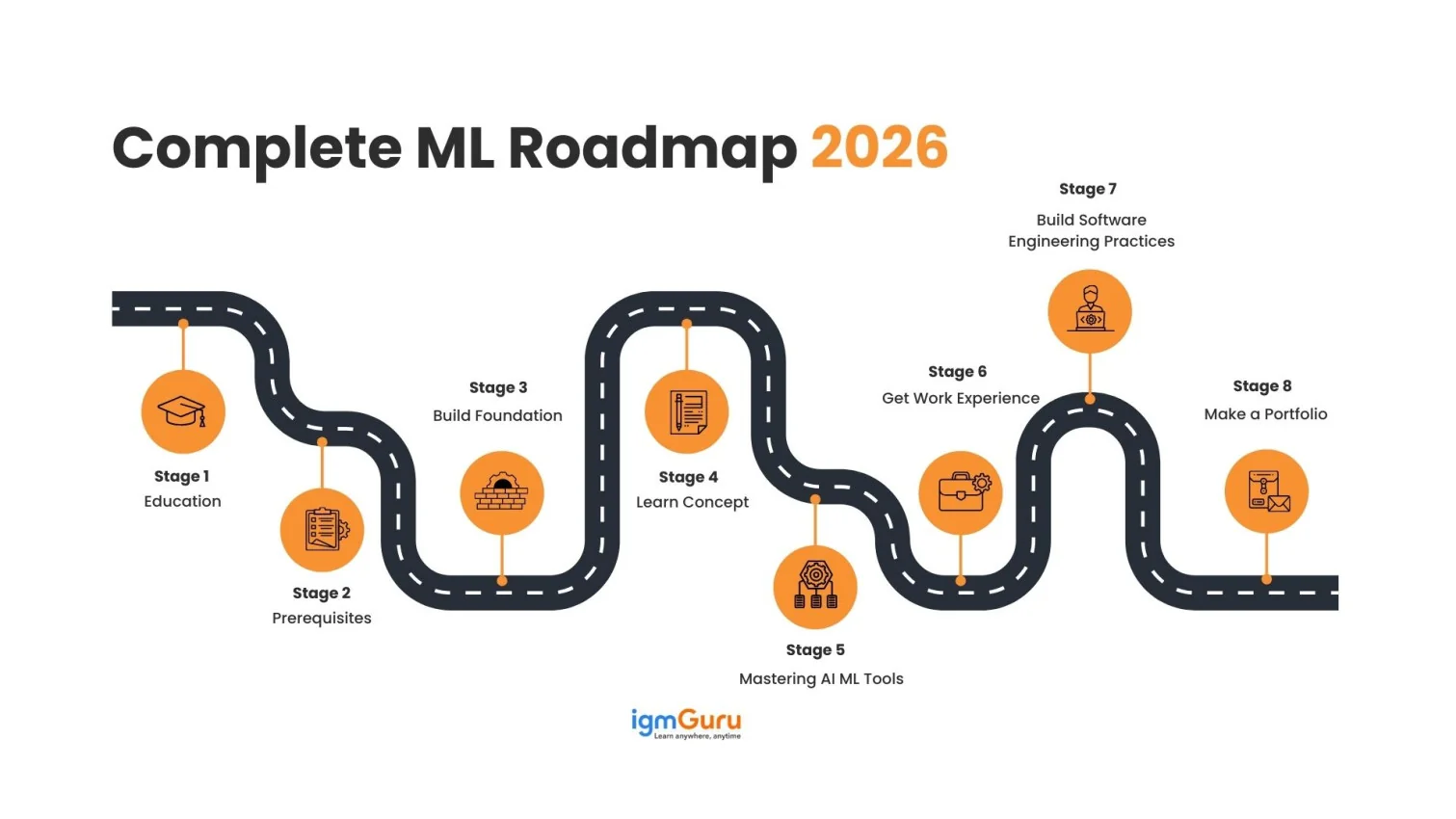
Below is a complete step-by-step roadmap with timelines to help you understand exactly what to learn and how long each phase typically takes.
| Phase | Timeline | Learning Goals (what to master) | Key Skills & Tools | Suggested Projects/Deliverables | Milestone (Portfolio/Resume) |
| Phase 1- Foundations | 1-2 months | Gain strong Python basics, programming fundamentals, and core math (linear algebra, calculus basics, probability & statistics). Learn git and basic Linux. | Python (functions, OOP), Git/GitHub, Jupyter, NumPy, Pandas, basic SQL, Khan Academy/3Blue1Brown math refresh | Small notebooks: Python utilities, data cleaning scripts, simple SQL queries on public dataset | "Python + Data Cleaning" notebook link; GitHub with README |
| Phase 2 - Core ML Concepts | 2-3 months | Learn supervised & unsupervised algorithms: linear/logistic regression, decision trees, SVMs, clustering, evaluation metrics, feature engineering. | Scikit-learn, Pandas, Matplotlib/Seaborn, train/test split, cross-validation | End-to-end classic ML project: Titanic or customer-churn model with feature engineering and evaluation report | Project repo with clear data pipeline + README and results |
| Phase 3 - Deep Learning Basics | 2-3 months | Understand neural networks, backprop, optimizers, regularization. Build simple CNNs/RNNs and work with image/text data. | TensorFlow/Keras or PyTorch, GPU basics, data augmentation | Image classification (small CNN) and basic text classifier (sentiment) with training logs | Two model demos + notebooks showing training curves and confusion matrices |
| Phase 4 - Production & MLOps Fundamentals | 1-2 months | Learn how to package models, serve APIs, containerization, CI/CD basics, and experiment tracking. | Flask/FastAPI, Docker, basic Kubernetes concepts, MLflow, CI (GitHub Actions) | Deploy a model as a REST API using FastAPI + Docker; simple CI pipeline to run tests | Live demo URL (or video) + Dockerfile and deployment README |
| Phase 5 - Scalable Data & Big Data Tools | 1-2 months | Work with large datasets, ETL pipelines, streaming/batch processing, and cloud basics. | SQL at scale, Spark (PySpark), Airflow (or Prefect), basic AWS/GCP/Azure services (S3, EC2, Vertex AI/SageMaker) | ETL pipeline: ingest, clean, transform, store; run a Spark job on bigger dataset | Pipeline repo + architecture diagram + infra-as-code snippet |
| Phase 6 - Advanced Topics & Specialization | 2-4 months | Pick specialization: NLP (transformers), Computer Vision (advanced CNN/ViT), Reinforcement Learning, or Recommendation Systems. Master relevant architectures and papers. | Hugging Face Transformers, advanced PyTorch/TensorFlow, domain-specific libs (Detectron2, Recsys libs) | One large capstone project in chosen specialization (end-to-end) | Capstone repo, blog post explaining design and results, hosted demo if possible |
| Phase 7 - Real-World Experience & Soft Skills | Ongoing (3+ months concurrently) | Apply for internships, contribute to open-source, participate in Kaggle, improve communication and system design for ML. | System design for ML, clear documentation, stakeholder communication, code reviews | Internship/freelance work, Kaggle competition or open-source PR, talk or blog post | Work experience entry / published articles/contribution links |
| Phase 8 - Job Prep & Interview Readiness | 1-2 months (intensive) | Prepare ML system design, coding interviews, ML fundamentals, and behavioral questions. Build STAR stories for projects. | LeetCode (algorithms), ML interview Qs, system design templates, mock interviews | Mock interviews, detailed case-study docs for 3 projects, tailored resume + LinkedIn | Ready-to-apply resume, interview-ready portfolio, and recorded mock interview feedback |
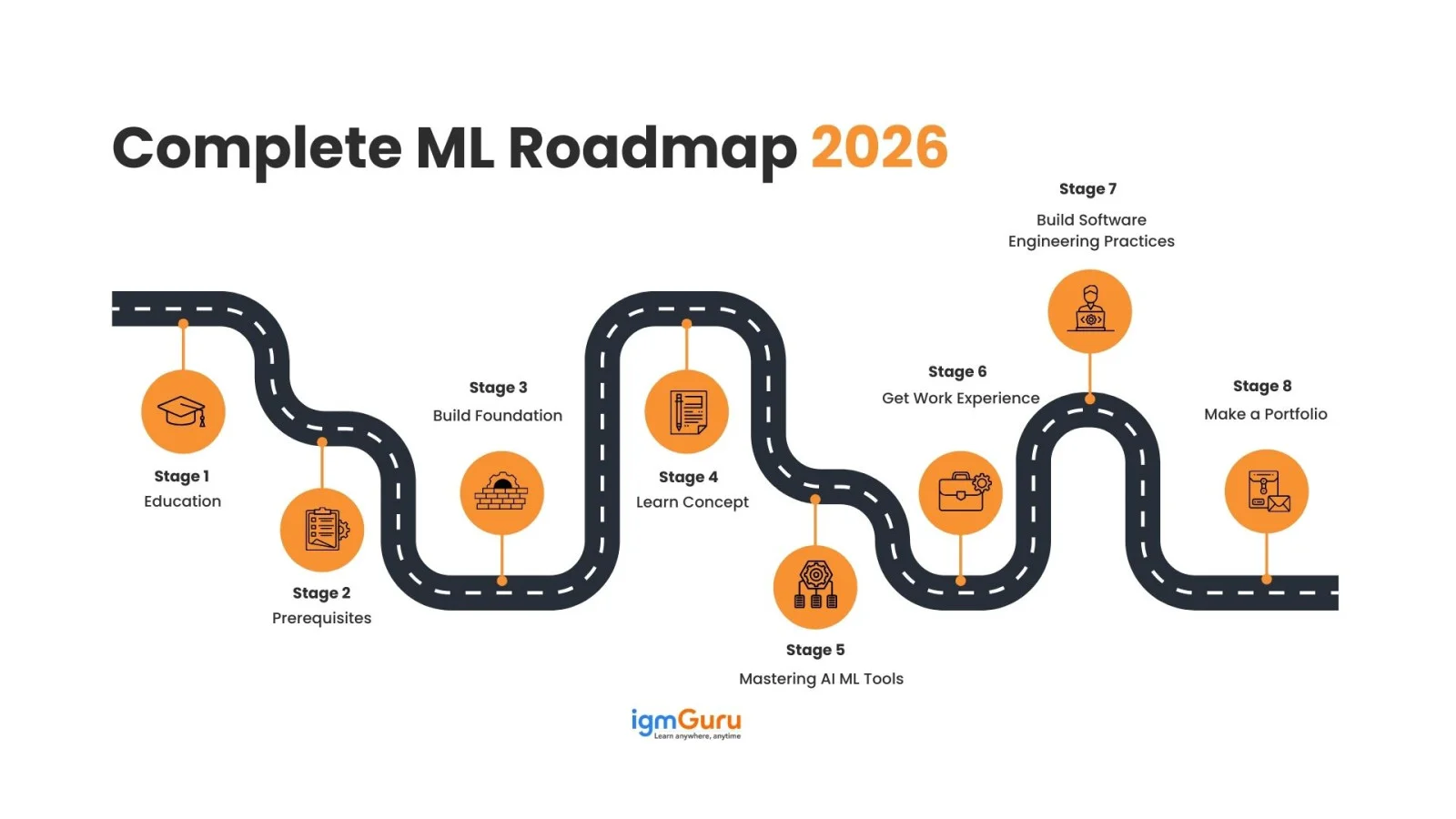
The major question still here is how to become a machine learning engineer after all. Climbing the ladder up to become an ML engineer takes time and effort. Let us understand how to become a machine learning engineer through the important steps to help make it possible.
As machine learning is a part of the computer science sector, a powerful background in programming, data science and mathematics is important for getting successful. ML jobs basically need a bachelor's degree at a minimum, so starting a course of study in computer science or a closely associated field like statistics is an amazing first step.
You must understand what an ML engineer does. They design, develop and deploy machine learning models for solving real problems. They work with data scientists, software engineers and stakeholders for integrating ML solutions into production systems. They also make use of models for performance, scalability and efficiency. Must also understand the skills needed to become one. These skills include both technical and soft skills.
You can learn programming languages, including Python and libraries like NumPy, Pandas, Matplotlib and Scikit-learn. Must be familiar with R or Julia for particular use cases and practice coding on platforms like HackerRank, LeetCode, etc. You should also master mathematics and statistics to understand data structures and algorithms.
You should understand the core ML topics like regression, clustering, dimensionality reduction, neural networks and deep learning, including CNNs, RNNs, transformers and reinforcement learning. Master the main algorithms like Gradient Descent, K-Nearest Neighbors, Naive Bayes and Ensemble methods like XGBoost and LightGBM.
You can master its libraries and frameworks like Scikit-learn, TensorFlow or Python and more. You must understand data handling by learning SQL for querying databases and working with big data tools such as Apache Spark or Dask. Learn about visualization like Matplotlib, Seaborn or Plotly for data exploration and model evaluation.
You can master MLOps tools by learning model deployment tools like Docker, Kubernetes, Flask and FastAPI. You must be familiar with cloud platforms like AWS, Google Cloud and Azure, and version control including Git and GitHub.
After getting your computer science degree, the next step is to begin working in the data science field to get experience working with ML or AI. A few entry-level jobs as an intern, leading to a machine learning career, involve:
You should learn code quality through writing clean, modular and well-documented code and understand the software development lifecycle (SDLC) and agile methods. Must also learn model deployment by learning how to deploy models through REST APIs like Flask or FastAPI or cloud services like AWS SageMaker, Google Vertex AI. You should study model monitoring, retraining pipelines and A/B testing, and tools like MLflow, Kubeflow or Airflow for workflow automation.
Working with data science and AI with a bachelor's degree is very much possible. Even though pursuing level seven or eight qualifications in computer science, data science or software engineering can assist in learning tougher tasks needed by machine learning engineers. This will be a leverage as you apply for jobs, especially if you have strengthened your studies with a bunch of internships, traineeships or studentships.
As we read the three major steps to becoming an ML engineer, but this is not enough, as there are many skills that you need to become one. So, go through the skills discussed above to become a machine learning engineer.
You must create a GitHub repository representing your ML projects, write blogs or make a personal website explaining your projects like Medium or GitHub Pages. Should involve diverse projects like traditional ML, deep learning and deployment examples.
You can increase your networking by attending ML meetups, conferences like NeurIPS or ICML, or local tech events. You can also engage with the ML community on X (prev. Twitter), LinkedIn or Discord.
Then you can customize your resume to show your ML projects, tools and skills. After this, you must prepare yourself for interviews. Also, follow companies such as Google, MetaAI or startups on X for job postings.
Read Also- How to Build A Machine Learning Model?
Here is the table explaining the salary of a machine learning engineer-
| Category | India (INR) | USA (USD) |
| Average Salary (All Levels) | ₹13,10,000 per year | $162,509 per year |
| Entry-Level (0-2 years) | ₹6,00,000 - ₹8,00,000 per year | $110,000 - $140,000 per year |
| Mid-Level (3-6 years) | ₹12,00,000 - ₹20,00,000 per year | $140,000 - $180,000 per year |
| Senior-Level (7+ years) | ₹20,00,000 - ₹35,00,000+ per year | $180,000 - $250,000+ per year |
| Top Tech Companies (FAANG / Product-Based) | ₹30,00,000 - ₹50,00,000+ per year | $200,000 - $300,000+ per year |
| Highest Reported Salaries | Up to ₹60,00,000+ | $300,000 - $450,000 |
Becoming a machine learning engineer isn't just a career, it's your gateway to shaping the future of AI. By mastering Python and TensorFlow to build real-world models, you've got the roadmap. Get in, experiment relentlessly and network with industry pros. The demand for ML engineers is pretty high, and salaries usually exceed $175K. You can start today, change data into intelligence and join the elite innovators driving tomorrow's tech revolutions. So, are you ready to launch your ML journey? I bet you must be now.
Explore Our Trending Articles:
ML is a tough, multidisciplinary field and different roles need different levels of knowledge and skills. But it usually takes up to 6 months to master the basics.
Make a portfolio of projects showcasing your ability to solve real-world problems through machine learning. You can participate in platforms like Kaggle for competitions, contribute to open-source ML projects on GitHub, or even collaborate on research papers. Internships, freelance work, or part-time roles in data-related fields can also give real-world experience and networking opportunities.
Absolutely Yes! Everything in machine learning is coding.
Course Schedule
| Course Name | Batch Type | Details |
| Machine Learning Training | Every Weekday | View Details |
| Machine Learning Training | Every Weekend | View Details |