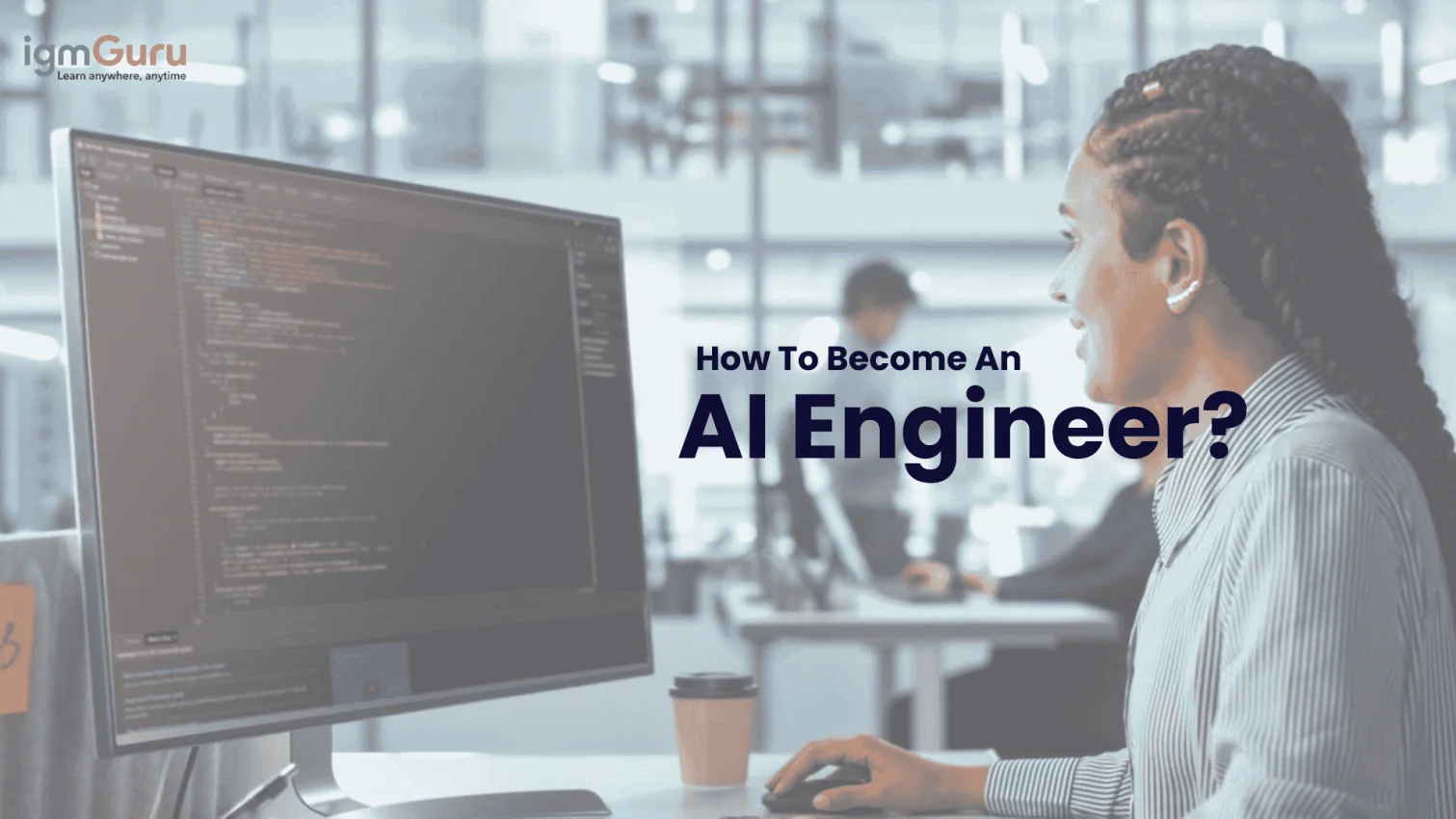
Artificial Intelligence (AI) is not just the future, it is already transforming how the world works today. From self-driving cars to chatbots and virtual assistants, AI is at the centre of modern innovation. And behind these technologies are skilled professionals called AI Engineers.
If you are wondering how to become an AI Engineer? Then you are definitely at the right place. As a working professional in this field, I will guide you step by step from what AI engineers do, to the AI skills and tools you need, tools you should learn and how to land your first AI job. This guide will give you all the answers you need to start your journey in Artificial Intelligence.
So let's begin your journey of becoming an AI Engineer.
According to the World Economic Forum's Future of Jobs Report , AI and Machine Learning Specialists are among the fastest-growing job roles and 86% of employers expect AI to transform their businesses by 2030.
An AI Engineer is a professional who builds intelligent systems that can simulate human behavior like learning from data, making decisions and solving problems. These systems are used in many areas, such as chatbots, recommendation engines, self-driving cars, fraud detection and even medical diagnosis.
In simple terms, AI Engineers create smart machines that think and learn. They work with large amounts of data, train machine learning models and design algorithms that power applications. AI Engineers combine software engineering, data science and machine learning to build tools that make machines smarter over time.
To understand it better, let's look at a real-world example you have probably come across every day.
Explore igmGuru's Artificial Intelligence Courses and choose the best as per your skills set.
When you open Netflix, the shows and movies you see on your home screen are not random. The AI Engineers build algorithms that analyze your watch history, preferences and behavior to suggest content you are most likely to enjoy.
This is made possible using machine learning models, which continuously improve as you keep watching more content.
An AI Engineer at Netflix works on these below mentioned things:
AI Engineers are in high demand because almost every industry is now using Artificial Intelligence to grow faster and work smarter. From healthcare to finance and e-commerce, companies need AI to automate tasks, improve customer experience and make better decisions. Since AI is the future of innovation and there is a shortage of skilled professionals, AI Engineers are not only popular but also among the highest-paid tech experts today.
Now that you know what an AI Engineer is and why they are so popular, you might be wondering what are the actual responsibilities of an AI Engineer? What does their day-to-day work look like? What is the role of AI Engineers in a company?
For that, in this section, I will explain about some key responsibilities and roles that define an AI Engineer's job. This will help you in understanding what companies expect from AI professionals and you get an idea what skills you will need to succeed in this field.
Here are some of the crucial responsibilities that an AI engineer holds:
The AI Engineers build and train machine learning and deep learning models to solve specific problems like image recognition, language translation or fraud detection.
They collect, clean and organize big data from various sources to train models accurately.
They write algorithms that help machines learn from data and make predictions or decisions.
AI Engineers constantly test model performance using metrics like accuracy and precision to make improvements.
They work closely with data scientists, software developers and product managers to build AI-powered solutions.
Once a model is ready, then AI Engineers help in integrating it into real-world applications using APIs, cloud platforms or edge devices.
The following are some job roles of an AI Engineer-
1. Machine Learning Engineer: Focuses on building ML models that learn and improve over time.
2. Data Scientist (AI-Focused): Uses data analysis and modeling to solve complex problems using AI.
3. Computer Vision Engineer: Works on image and video processing tasks like facial recognition, object detection, etc.
4. Natural Language Processing (NLP) Engineer: Builds systems that understand and generate human language.
5. AI Research Engineer: Works on cutting-edge AI research and builds new techniques or models.
6. AI Product Engineer: Bridges AI development and business needs, often involved in product design and delivery.
Before you dive into building AI models and algorithms, there are a few basic skills and foundations you need to build. For starting a career as an AI Engineer, you don't need a specific degree to become an AI Engineer, yet it varies from company to company. What matters most is having the right knowledge and technical skills.
Here are the key prerequisites to get started:
While many AI Engineers come from Computer Science, Engineering or Data Science backgrounds, it is not mandatory to have this background. Many self-taught professionals and profession switchers have built successful careers in AI with the help of online courses and hands-on projects.
You must know the basics of at least one programming language, preferably Python, as it is used in AI and ML. Understanding how to write clean, logical code is essential for building and training models.
AI and machine learning rely heavily on concepts like linear algebra, probability and statistics. You do not need to be a math expert, yet a clear understanding of how models learn, make predictions and evaluate results is important.
In this section, I have explained a step-by-step roadmap that you can follow to answer your question- What is the right path to become an AI Engineer?
Whether you are a student, a fresher or a working professional who wants to switch careers, this roadmap will guide you with clear direction, trusted certifications and hands-on strategies to build a successful career in Artificial Intelligence.
Every strong career starts with a solid foundation. To become an AI Engineer, you first need to understand the basics of Artificial Intelligence, Machine Learning and how data works. You are required to get familiar with key concepts like:
Along with these concepts, learn Python. It is simple to learn and has tons of useful libraries like NumPy, Pandas and scikit-learn that will help you in processing data and training models.
Once your basics are strong, then you can move into core AI and ML topics. This is where your actual learning journey starts. The concepts you must study with core AI/ML are:
You need to focus on understanding how algorithms learn patterns from data, how to evaluate model performance and how to choose the right algorithm for the right task. This knowledge will form the core of your work as an AI Engineer.
AI Engineers need to be hands-on with various tools and frameworks. Knowing these tools will not only make your work more efficient but will also help you tackle real-world AI problems. Therefore, you are required to learn:
It is also important to get comfortable with Git and GitHub for version control and collaboration.
To become job-ready, theory is not enough. You need to practice with real data. For that, use open-source datasets from platforms like:
You can try solving actual problems like:
These exercises will help you understand the challenges of real-world data like missing values, data cleaning, feature selection and more.
Your project portfolio is your proof of skills. It is what recruiters and hiring managers will look at before calling you for interviews. You can start by creating some projects like:
Tip: Upload your projects to GitHub, write a clear README and even create a blog explaining your work. This will build your personal brand and make your resume stand out.
Certifications validate that you have the right skills. Choose a certification based on the tools or platform you want to work with. They not only boost your resume but also prepare you for real-world roles. Here are some official and globally trusted AI certifications that you can pursue:
It is ideal for learning how to design, build and productionize ML models on Google Cloud. Additionally, it is also recognized by top employers worldwide.
It is great for engineers who want to work on ML solutions in cloud environments, especially by using AWS tools and infrastructure.
It is best for those working with Microsoft cloud services and building enterprise-grade AI solutions.
Once your skills are sharp and your projects are ready, start applying for internships and entry-level jobs. The roles you can target include:
You can find opportunities on platforms like LinkedIn, Internshala or by contributing to open-source AI projects. Also, keep exploring freelance platforms like Upwork or Fiverr to get project-based experience early on.
Tip: Never stop learning, stay updated. AI is an evolving field. You can keep learning by some places like:
| Step | What You Do | Why It Matters |
| 1. Learn Fundamentals | Understand basics of AI and Python | Build strong base |
| 2. Master ML Concepts | Learn how machines learn from data | Core of AI role |
| 3. Use Tools & Libraries | Get hands-on with Python, TensorFlow, etc. | Work-ready skills |
| 4. Practice on Datasets | Work with real-world data | Build experience |
| 5. Build Projects | Create a visible portfolio | Show your capability |
| 6. Get Certified | Earn official, job-ready credentials | Boost your credibility |
| 7. Apply & Contribute | Gain real-world experience | Start your career |
Becoming an AI Engineer is not just about learning one programming language or one model. It is about mastering a combination of technical, analytical and problem-solving skills that allow you to build intelligent systems that learn, adapt and deliver real-world value.
Here are the essential skills every aspiring AI Engineer must focus on:
Programming is the foundation of AI engineering. Most AI models are built using Python, because of its simplicity and vast collection of AI/ML libraries. You should know how to:
Knowing other languages like R, Java or C++ can be a bonus in specific domains, but Python remains the standard in AI.
Behind every AI algorithm is a lot of math. This helps in tuning models, understanding how they learn and improving their accuracy. You are not required to learn it heavily, yet you must understand:
This is one of the most important parts of an AI Engineer's job. Since, a strong grasp of ML/DL helps you build smarter, more accurate models. You need to deeply understand:
AI Engineers deal with huge amounts of data. Skills in data handling turn raw information into valuable training input for AI models. You must know how to:
AI development is powered by robust libraries. Using the right tools accelerates development and improves model efficiency. You must get hands-on with:
Building models is not enough. AI Engineers must also know how to deploy them into real-world applications. This ensures your models can be integrated into products and used at scale. You can do it with the use of:
To help you plan your learning journey, here is an estimated time you might need to build each core skill. This may vary based on your background and consistency, yet this roadmap can help you stay on track.
| Skill | Learning Duration (Approx.) | Learning Focus |
| Python Programming | 2 to 3 weeks (basics), 5 to 6 weeks (intermediate) | Syntax, loops, functions, OOP, libraries like NumPy, Pandas |
| Machine Learning (ML) | 4 to 6 weeks | Supervised & unsupervised learning, regression, classification |
| Deep Learning (DL) | 3 to 5 weeks | Neural networks, RNNs, CNNs, activation functions, backpropagation |
| Mathematics & Statistics | 3 to 4 weeks | Linear algebra, probability, statistics, calculus (basic), gradient descent |
| Data Handling & Preprocessing | 2 to 3 weeks | Cleaning, missing data, feature engineering, data transformation |
| Frameworks (TF, PyTorch, etc.) | 3 to 4 weeks | Building models, training, evaluation, tuning using libraries like Keras/PyTorch |
| NLP | 2 to 3 weeks | Text cleaning, tokenization, sentiment analysis, using libraries like NLTK/spaCy |
| Computer Vision | 2 to 3 weeks | Image classification, object detection, OpenCV basics |
| Model Deployment | 2 weeks | Flask/FastAPI, Docker basics, deploying on cloud or local |
| Git & GitHub (Version Control) | 1 week | Repositories, commits, branches, pull requests |
| Cloud & MLOps Tools | 3 to 4 weeks | Basics of AWS/GCP, Docker, CI/CD, MLflow |
A career in AI opens the door to many exciting and high-paying roles across different industries. As you grow your skills and gain experience, you can move into various specialized roles depending on your interests from building smart machines to solving real-world business problems. Here are some of the most in-demand career paths you can pursue as an AI Engineer:
As AI is continuously shaping the future of technology, some of the world's biggest and most innovative companies are actively hiring AI Engineers to lead their transformation. These companies offer exciting opportunities, competitive salaries and work on cutting-edge AI projects that impact millions of users globally.
Here are some of the top companies hiring AI talent:
Artificial Intelligence offers one of the highest-paying tech careers today. Salaries vary depending on experience, role and company. Yet, whether you are in India or abroad, the earning potential is excellent.
According to Glassdoor, here is a comparative table of average salary ranges:
| Experience Level | India (Annual) | USA (Annual) |
| Entry-Level | INR 6 to INR 12 LPA | $90,000 to $120,000 |
| Mid-Level (3 to 5 yrs) | INR 12 to INR 20 LPA | $130,000 to $160,000 |
| Senior / Specialist | INR 25 to INR 40+ LPA | $170,000 to $250,000+ |
As someone who has walked this journey, I can confidently say that becoming an AI Engineer is one of the most exciting and future proof career paths in tech today. You do not need to be a genius or have a PhD to enter this field. What you need to be consistent in learning and hands-on practice to solve problems using data and algorithms.
From building small projects to working on real-world systems that impact millions, I have seen how this field rewards skill, passion and effort. If you have read this far, you already have the right mindset to get started. Now it is time to take action.
Explore Our Trending Articles:
How To Become A Cyber Security Engineer? Complete Guide
How to Become a Software Engineer?
How to Become a Prompt Engineer?
How To Become A Generative AI Engineer in 2026?
How to Become a Robotic Process Automation (RPA) Developer
No, you do not need a specific degree. Many AI Engineers are self-taught or come from different fields. What matters most is your skills, projects and hands-on experience.
It is not too hard if you stay consistent. With the right learning plan, practice and real projects, anyone can break into this field even without a tech background.
It usually takes 6 to 12 months of focused learning and practice to become job-ready. The exact time depends on your background and how much time you can dedicate daily.
Basic coding is important to build and train models. You do not need to be an expert, yet you must know how to code in Python to work with AI tools and algorithms.
Course Schedule
| Course Name | Batch Type | Details |
| Generative AI Training | Every Weekday | View Details |
| Generative AI Training | Every Weekend | View Details |